Office Supplies & Stationery
index card box fit: choose cards and dividers
Match real card and divider sizes to a box before comparing card counts or bundle contents.
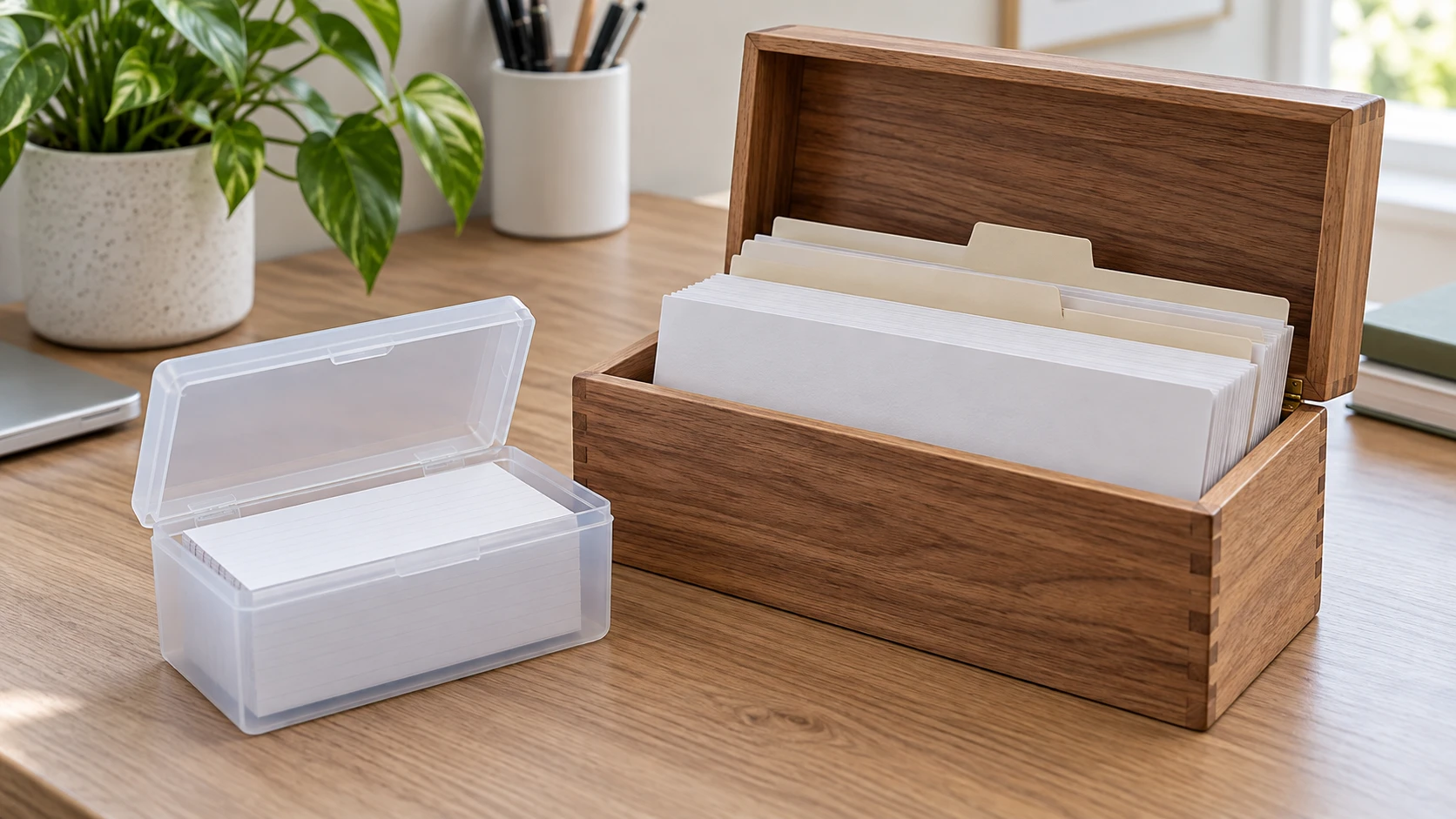
An index card box should be chosen for the cards and dividers you will actually file, not just for the number printed in its title. A small box labeled for three-by-five-inch cards and a larger organizer labeled for five-by-eight-inch cards solve different storage jobs. The outside dimensions of a container, its stated card size, its internal compartments, and the height of divider tabs are separate measurements. Before ordering, identify the largest card and the tallest tab in your working set. That simple inventory prevents a box that technically holds a card from becoming one whose lid presses on the labels.
Start with the card that must fit
Lay out a representative card, including any sleeve or added label that will remain on it. Check the actual width and height rather than relying on a category name such as “recipe cards” or “flashcards.” Some home collections mix sizes, and a familiar nominal size may describe only the paper insert, not a protective sleeve. If the collection contains several sizes, choose the largest item that must remain upright and accessible. A smaller card may sit in a larger box, but that alone does not mean the dividers or compartments will organize it well.
Decide how the cards will stand. A box may present their short edge to the front, their long edge to the front, or separate them into multiple compartments. Keep one sample in the intended orientation and add a divider with its tab showing. Measure the height of that combined setup before comparing it with a lid. A lid that closes on loose cards may catch an elevated tab. Likewise, an organizer with ample outside length may have internal walls that divide the usable space. The dimension that matters is the unobstructed card path inside the intended compartment.
The native BAZIC index card box listing states that it holds three-by-five-inch cards and up to 250 cards. It gives outside measurements of 5.5 by 3.5 by 2.9 inches and describes a lidded plastic box. Its gallery shows several color variants and a latch-style closure. The capacity is a seller statement for the specified card format, not evidence that 250 sleeved cards or tall third-party dividers will fit under the lid. Confirm the current pack quantity on the offer, because the title describes a multi-pack while the gallery shows individual boxes.
Keep outside size separate from usable space
Outside dimensions help you decide whether a box fits on a shelf or in a drawer. They do not provide the exact internal clearance. Wall thickness, hinges, handles, and compartment dividers can all occupy some of the space within that footprint. If the listing does not give an internal measurement needed for a specific tab or sleeve, do not subtract a guessed wall thickness and call the result confirmed. Ask for that measurement or test a sample with the actual product. The relevant result is whether the lid closes without bending the tallest card or divider.
A stated card capacity is also different from a usable working capacity. A tightly packed box may meet a seller's count yet leave too little space to lift a card or move a divider. Count the cards you have today, allow for the number you expect to add, and leave enough room to thumb through them without tearing corners. That practical allowance is an organizing choice, not a new product specification. Avoid promising that a given number of laminated or sleeved cards will fit where the listing counted ordinary index cards.
The native Highcool five-by-eight-inch index card organizer lists a wooden box with a lid and four compartments. Its description says the set includes 150 lined five-by-eight-inch cards and paper dividers measuring 5.4 by 8 inches; it also states a capacity of up to 1,200 cards. The gallery depicts cards and tabbed dividers in the larger box. These details make it a useful example of a box whose card size, divider size, compartment layout, and total claimed capacity must be read separately. The listing does not establish how many outside sleeves or oversized homemade dividers can be added.
Do not read the larger Highcool number as a recommendation to store three-by-five cards in its compartments, and do not assume the BAZIC box accepts five-by-eight cards. The products address different nominal card formats. The hanging-file-folder fit guide makes a related distinction between an item’s paper size and the support system around it. This guide applies that measurement discipline to card boxes; it does not use the folder guide to prove any card-box dimension. Check the selected box against its own cards and dividers.
Check dividers and tab clearance
A divider is useful only if it stands where you need it and its label remains visible. Compare the divider's body with the intended card size, then check the tab's extra height and lateral position. A tab can hit the lid even when the card beneath it fits. Several tabs aligned at one side can also hide each other. Arrange a small sample of dividers as you will actually use them before estimating capacity. The aim is an accessible file, not merely a stack that can be squeezed inside a container.
For a box with multiple compartments, consider whether each divider belongs to a particular compartment. The Highcool set describes four compartments and included dividers, but the description does not provide every internal compartment measurement. Do not assume an unrelated divider can cross a compartment wall or stand in any orientation. The BAZIC listing establishes its target card size and outer measurements, but does not establish a precise third-party tab clearance. Treat those gaps as questions for the product page or a physical trial, not as facts to fill with an estimate.
Stored paper can also have different functional capacities. The clipboard capacity guide separates the writing face, active clip stack, and storage space. An index card box needs a similar separation: the nominal card format, the number of cards claimed, and the usable room around dividers are not one measurement. The linked clipboard article supplies the comparison in reasoning, not card-box performance data. Your decision still comes from the actual card set and the selected box’s own listing.
Plan the collection before filling the box
Sort the cards into the groups you will look up later. A recipe collection may need categories different from a study deck or address file. Estimate how many dividers each group needs and where the labels will appear when the lid is open. Put one representative card behind each proposed divider and test whether you can read the label without removing a pile. If the box will travel between rooms, check that the lid closes over the organized set, not merely over an empty container.
Reserve space for growth in a way that reflects actual use. A box that starts close to its stated maximum leaves little room for new cards or comfortable browsing. On the other hand, a very large box can let a small stack fall flat unless it has suitable compartments or supports. Neither issue can be decided from card count alone. The best trial uses a realistic portion of your collection with the dividers you plan to keep. Record what you observe rather than converting one seller's count to another product’s capacity.
Keep any protective sleeves in the test. A sleeve can add width, height, or thickness around the paper. Even a modest change matters when the lid and tabs have little clearance. Do not claim that a three-by-five sleeve is automatically compatible with a three-by-five card box; the phrase may describe the insert and omit the sleeve's outer edge. If sleeves are essential, obtain their outside dimensions and compare them with verified internal clearance. If that information is absent, a physical sample is the honest way to settle the fit.
Use the images for form, not unseen measurements
The BAZIC gallery shows a compact plastic box with a hinged, latching lid. That helps you recognize the kind of container and where a card stack would go. It does not show a measured internal height or prove how a third-party tab will behave as the lid closes. The Highcool gallery shows a wooden lidded box with larger cards and tabbed dividers. It helps explain the stated organizer format, but a staged image cannot establish a maximum mixed-card load. Use images to identify physical roles, then use verified measurements or a sample for close-fit decisions.
Pay attention to offer quantity as a separate purchasing question. A product image often shows one assembled unit even when the title describes a bundle; another image can show several colors or accessories as examples. Confirm the current listing’s unit count and included contents before checkout. The BAZIC title calls out a 36-pack, while the Highcool description lists cards and dividers with its box. Neither fact changes card compatibility, but confusing included supplies with the box’s usable capacity can leave you short of the storage arrangement you planned.
Do not infer that the larger outer box is automatically better. If the collection is uniformly three-by-five cards and must sit in a shallow drawer, the smaller format may be the relevant one. If it is made from five-by-eight cards and needs the listed divider system, a larger compartmented organizer may make sense. These are distinct jobs rather than a ranking of brands. The choice should follow the actual card format, divider arrangement, lid clearance, shelf space, and expected access pattern.
A quick fit check before checkout
Write down four things: the largest card’s outside dimensions including any sleeve, the divider body and tallest tab, the number of cards you need to file with room to browse, and the space available where the box will live. Compare each item with the selected product's stated card size, components, and outside dimensions. Where internal clearance is missing, seek a product-specific measurement or plan a physical trial. Avoid turning a photo, a nominal card label, or an outside dimension into an invented guarantee about the lid.
When the box arrives, load a modest sample in the intended orientation before filling it. Place the tallest divider, close the lid gently, open it, and remove a card from the middle of the stack. If a tab bends or the cards cannot be browsed, change the arrangement or choose a better-matched box. This is a simple acceptance check for your actual collection, not a certification of the seller's maximum capacity. Keep the packing and current order details until you know the physical fit.
The practical choice is the box that accommodates the real cards and dividers while leaving a workable path to each entry. The BAZIC example is listed for three-by-five cards with a 250-card claim; the Highcool example is listed for five-by-eight cards with compartments and included dividers. Their numbers describe different products and different formats. Verify the card size first, then tab clearance and usable browsing space, and only then compare claimed capacity or bundle contents. That sequence is far more reliable than shopping by the biggest count alone.