Office Supplies & Stationery
Imaginary unit pair model: define the product
An explicit ordered-pair arithmetic model separates real scalars from a chosen imaginary unit, with a worked product and a universal sum-of-squares identity.
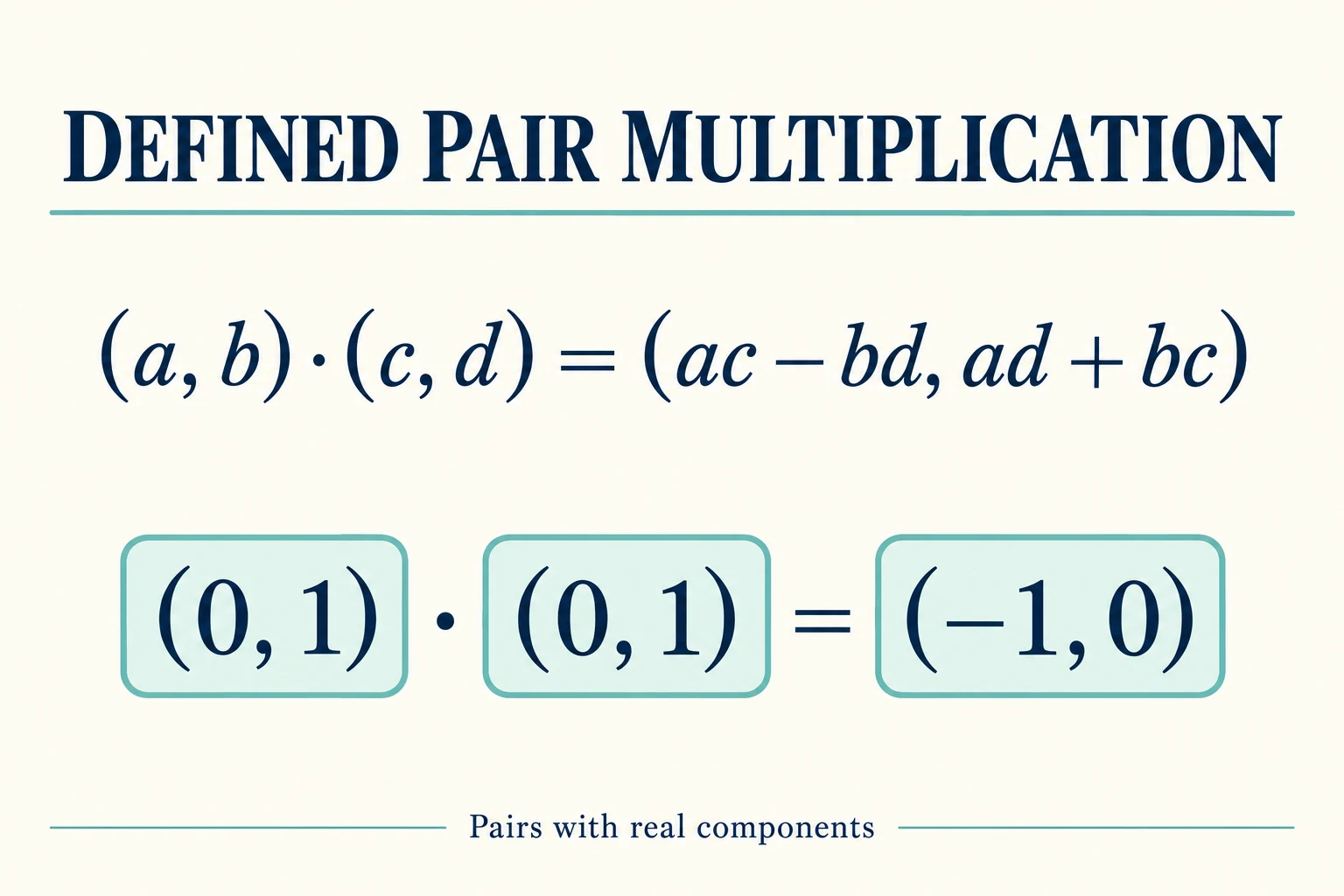
Define the objects and their multiplication
An imaginary unit pair model makes the arithmetic rule visible before asking how a square can represent minus one. Its objects are ordered pairs (a, b), with both components real numbers. Two pairs are equal when their first components agree and their second components agree. Define addition component by component. Define multiplication by (a, b) · (c, d) = (ac − bd, ad + bc). This cross-coordinate rule is the operation used throughout the worksheet. It is not ordinary multiplication of each component separately, and it describes no feature of a real device or book stand.
Keep the first and second components in their assigned positions. The pair (2, 1) differs from (1, 2), because the first components differ and the second components differ. A comma separates components rather than denoting a decimal point. Keep each pair's parentheses when copying a calculation. The multiplication formula tells you which component takes each role: a and c are the first components of the two inputs, while b and d are the second. Reading those roles before substituting numbers prevents a missing minus sign or exchanged component from quietly changing the product.
Place ordinary real values on one axis of the model
Represent a real number r by the pair (r, 0). Then componentwise addition gives (r, 0) + (s, 0) = (r+s, 0), and the defined multiplication gives (r, 0) · (s, 0) = (rs, 0). The second calculation follows because rs − 0 × 0 is rs and r × 0 + 0 × s is zero. Thus these real-axis pairs retain the original sum and product of the real values they represent. Different real values remain different pairs under componentwise equality, so the representation does not identify two unequal real numbers.
The pair e = (1, 0) is a multiplicative identity. Substituting it on the right of (a, b) gives (a × 1 − b × 0, a × 0 + b × 1) = (a, b). Substituting it on the left gives the same pair by the declared formula. The zero pair is (0, 0); multiplying it with any pair gives (0, 0). These are direct checks of particular properties of the operation. They do not rest on the visual similarity of the notation to ordinary number multiplication or on an unexplained claim that every rule must transfer automatically.
Choose a pair that squares to encoded minus one
Define j = (0, 1). Its square means its product with itself under the stated rule. Calculate j · j = (0 × 0 − 1 × 1, 0 × 1 + 1 × 0) = (−1, 0). The output is the pair representing the real number minus one. This is the precise sense in which the chosen imaginary unit squares to minus one in the model. The calculation uses the negative bd term in the first component; replacing the rule with componentwise multiplication would give a different output.
No real scalar has acquired a negative square in that argument. Every real r still has r² at least zero under ordinary real multiplication. The pair j is not any real-axis pair (r, 0), because its second component is one instead of zero. We changed the objects under discussion and supplied their product rule explicitly. Keep the encoded real value (−1, 0) distinct from a claim that j itself is an ordinary real number. The new calculation does not contradict the earlier real-number fact, whose domain and operation remain intact.
The opposite pair (0, −1) also squares to (−1, 0): its first output component is zero minus the product of two minus ones, and its second is zero. It is distinct from j by componentwise equality. Our choice j = (0, 1) was a definition, rather than a conclusion uniquely forced by the square alone. No convention for a principal complex square-root expression is being supplied here. Retain the chosen coordinates with the label j so that an argument about this particular unit does not silently turn into a different root-selection question.
Work a product with both components present
Take x = (2, 1) and y = (3, −1). The first component of their product is 2 × 3 − 1 × (−1). That equals six minus minus one, or seven. The second component is 2 × (−1) + 1 × 3, which equals minus two plus three, or one. Therefore x · y = (7, 1). Keep the parentheses around the negative input while working. The sign in the formula and the sign of d are separate parts of the calculation, and both are needed for the first component.
Multiplying the two first components and the two second components independently would instead produce (6, −1). That calculation describes another possible operation on pairs, but it is not the one defined for this model. Its disagreement with (7, 1) does not expose an arithmetic inconsistency. It exposes a changed rule. When checking a proposed result, write the two output formulas beside it and substitute a, b, c and d in the same roles each time. Correctly multiplying individual numbers cannot compensate for applying the wrong pair operation to those numbers.
Keep a sum-of-squares measure separate from a pair square
Define N(a, b) = a² + b² using ordinary real squares and addition. N is a single nonnegative real value, rather than an ordered pair. For x = (2, 1), N(x) = 4 + 1 = 5. For y = (3, −1), N(y) = 9 + 1 = 10. The product pair (7, 1) has N(x · y) = 49 + 1 = 50. Those values suggest a product relationship, because five times ten is fifty. One worked example cannot establish that relationship for every real pair, so the formula needs a general check.
Do not identify N(a, b) with the first component of (a, b) squared under the pair operation. A pair square is (a² − b², 2ab). The measure N(a, b) is the real sum a² + b². These expressions have different output types and different signs between the squared terms. For j, N(j) = 1, while j² = (−1, 0). Applying N to that output pair gives N(j²) = 1 as well. A nonnegative measure and an encoded negative real value can occur in the same calculation without being the same quantity.
Prove the product identity for every real pair
Let x = (a, b) and y = (c, d), with arbitrary real components. By the declared product rule, N(x · y) = (ac − bd)² + (ad + bc)². Expanding the ordinary real squares gives a²c² − 2abcd + b²d² + a²d² + 2abcd + b²c². The negative and positive 2abcd terms cancel. The remaining four terms group as a²(c²+d²) + b²(c²+d²), which factors to (a²+b²)(c²+d²). That is N(x)N(y). Every step is an ordinary real algebraic identity applied to the explicitly given output components.
Consequently N(x · y) = N(x)N(y) for all real pairs in this model. The earlier values five, ten and fifty check one case of a now-general result. The proof did not assume that a particular component was positive, nonzero or an integer. It therefore includes j and zero pairs as well. For j · j, the identity predicts one times one, matching the directly computed measure of (−1, 0). For a zero input pair, it predicts zero, also matching the direct product. Keep these controls alongside the algebra rather than treating them as replacements for the arbitrary-component proof.
Use only the properties actually checked
The identity pair, the chosen unit's square, the worked product and the sum-of-squares product law each have their own calculation above. A convincing example of one property does not by itself establish every other possible property of an algebraic system. If a later argument uses an additional law, its justification should be supplied there. This worksheet needs no inverse operation, permutation restoration or geometric rotation. Its central distinction is between real scalars and the explicitly defined pair model, with a product calculation that can be inspected component by component.
When revising an incorrect worksheet, preserve the input pairs and the declared operation before correcting the output. A result (6, −1) for the worked example needs the cross-coordinate rule restored; the original integers need not be changed. A statement that j is a real number needs the pair domain restored. A statement that N(j) is minus one needs the difference between a real measure and a pair square restored. Naming the exact mistaken substitution or output type gives the reader something to check, instead of treating all disagreements as mysterious behavior of imaginary numbers.
Keep the supporting references separate
The account for the GZHJMY fixed book support shows a complete clear-looking interlocking-panel stand in a collage with an open-book inset. Views do not establish extra supplied units; the book is an unconfirmed prop. Catalog Blue color, maker, material, dimensions, load and book-fit claims are not authenticated.
The account for the Hyjoy open book holder shows front and rear views of a complete dark interlocking-panel support with a book. Neither multiple views nor the book establish supplied quantity or contents. No material, dimensions, load, stability, assembly, collapse or reading-performance result is adopted. These are optional paper-reference supports.
The guide on real-root candidate checking keeps a principal real square root and its original equation conditions intact after squaring. This model instead declares different objects and a pair product. It does not alter that real equation or supply a principal complex-root convention to change its rejected candidates.
The guide on negative-base integer notation represents signed integers using alternating place weights and a defined encoding procedure. Our pair multiplication is a different construction. It changes the arithmetic objects under discussion, rather than changing the digits used to write an integer or prescribing any actual calculator mode.
Keep a transaction outside the algebra
If a reader considers a book stand order on republeq.com, the actual transaction requires its own current evidence. The pairs and sum-of-squares values above are stipulated mathematical objects, not product measurements, package counts, prices or cryptocurrency amounts. Before considering USDT, check whether the current checkout offers that method for the intended item and order. The reference here does not establish availability. Read the instructions for the requested asset, network, payable amount, receiving destination and order reference from the responsible checkout or service. Resolve missing or conflicting details before authorizing a transfer. Keep the selected product and quantity attached to the instructions so an answer for a different order is not silently reused. Review current delivery details, total charges and any disclosed payment or conversion conditions. A familiar token name does not settle those facts, and a correct mathematical product cannot authenticate a receiving address. Check applicable cancellation, return and refund arrangements before relying on them, including how a refund would be handled for the chosen method. This article supplies no wallet address, exchange rate, transfer timing or promise that a payment can be recovered. Retain the actual acknowledgment and payment record for any completed action, while keeping pending steps distinct from confirmed results. If order or payment status remains uncertain, clarify it before considering another payment. An unchanged screen is not proof of a failed transfer. The pair model can be checked on paper without ordering a support, and a purchase cannot establish a missing algebraic identity. Decide whether to proceed only when the relevant terms and instructions for that particular transaction are clear. Keep receipts and transaction communications separate from the invented pair worksheet.
Retain the definition with each conclusion
Save the pair product rule with j = (0, 1), its square (−1, 0), and the representation of real r as (r, 0). Keep the worked output (7, 1) beside its two coordinate calculations. Keep N's ordinary real definition beside its expansion proof and the values five, ten and fifty. These records show exactly which objects and operations support each result, without claiming a real scalar gained a negative square or a pictured support performed the arithmetic.