Crypto Commerce
IDEARACE fanless mini PC versus Cubi N office desktop
A workstation connected to serial equipment asks a different question of a computer than a desk used for routine office work. The IDEARACE fanless mini PC has four RS232 ports in its description, giving it a concrete reason to enter an industrial endpoint shortlist. The Cubi N ADL-021US description instead presents an entry desktop for light office and home tasks. That distinction supports an initial direction, but neither description establishes compatibility with your particular equipment or software. For IDEARACE fanless mini PC , verify each step.
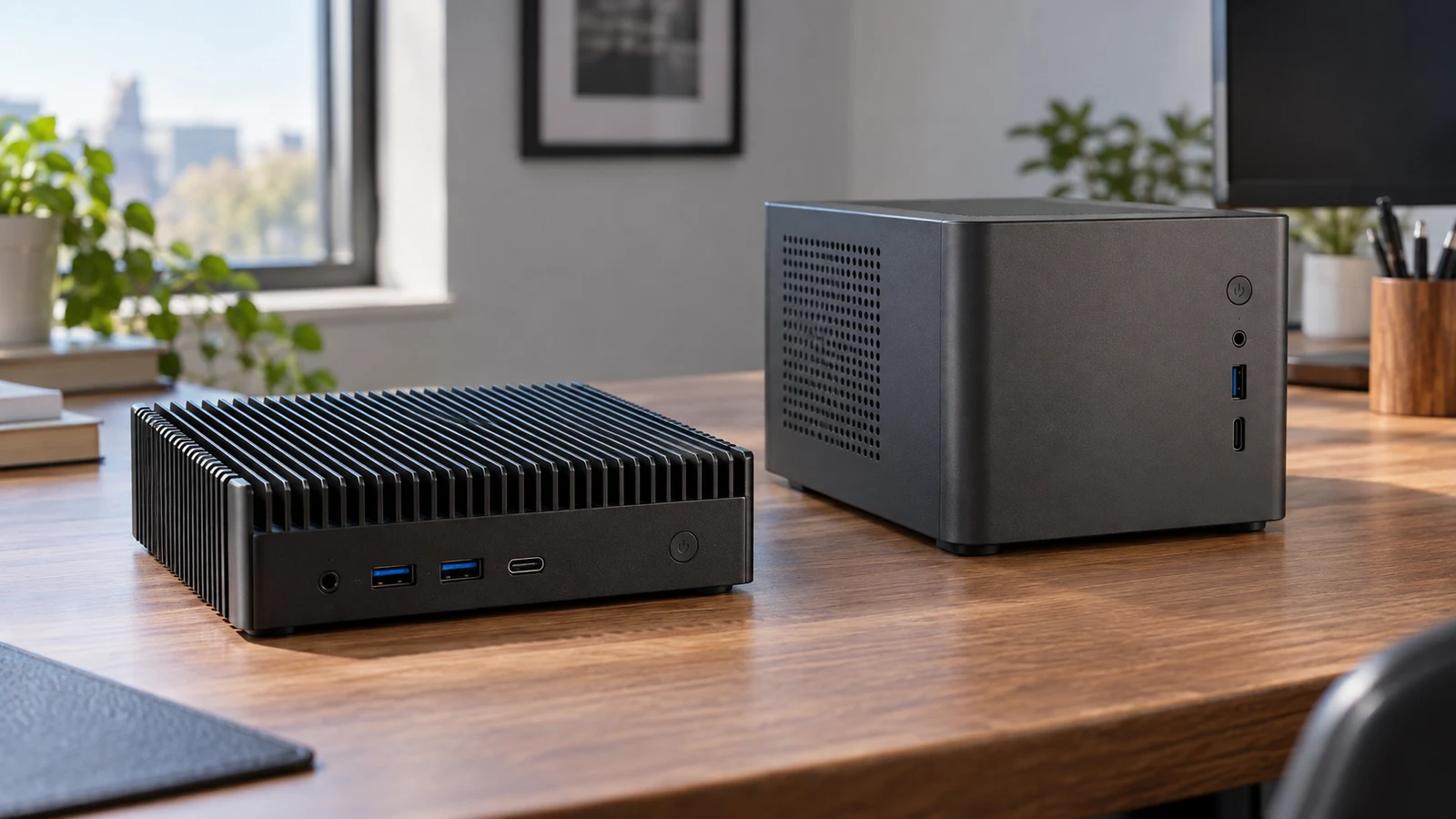
A workstation connected to serial equipment asks a different question of a computer than a desk used for routine office work. The IDEARACE fanless mini PC has four RS232 ports in its description, giving it a concrete reason to enter an industrial endpoint shortlist. The Cubi N ADL-021US description instead presents an entry desktop for light office and home tasks. That distinction supports an initial direction, but neither description establishes compatibility with your particular equipment or software. For IDEARACE fanless mini PC, verify each step.
For a serial-connected endpoint, investigate IDEARACE first if its listed connections match the installation you need to preserve. For an ordinary office desk, investigate the Cubi N against the applications and peripherals the user actually needs. The final choice depends on software support, physical installation and how you would restore service after a failure. Processor branding and memory figures alone cannot settle those questions.
Virtual Outlet Computer Alternative: Where The Two Descriptions Diverge
The IDEARACE description specifies a fanless desktop in a full metal case, powered by a Core i5-3317U dual-core processor. It lists a 1.7GHz base frequency and turbo up to 2.6GHz, alongside 8GB DDR3L RAM and a 256GB mSATA SSD. There is also provision to add a 2.5-inch SATA SSD or HDD. These are stated specifications, not results from an independent workload test.
Its connection list is unusually relevant to the endpoint question: four RS232 serial ports, four USB 3.0 ports and two RJ-45 network ports. The description also names an HD port, a VGA port and built-in WiFi. Intel HD Graphics 4000 is specified. Before planning around any display connection, ask for its exact specification and supported display configuration; the label “HD port” alone leaves details unresolved.
The Virtual Outlet computer alternative is the Cubi N ADL-021US. Its description identifies the processor as Pentium N100 and lists 4GB of RAM, 128GB of storage, UHD graphics and W11P. It describes the intended use as light computing for home and office. Confirm the precise processor identity and operating-system edition for the selected unit before using those labels in a purchasing specification.
The Cubi N description does not provide a port inventory, cooling arrangement or mounting details. Those omissions are unresolved specifications, not proof that the computer lacks particular features. They do mean that you cannot treat the Cubi N as an equivalent replacement for a serial-connected computer from this description alone. Request the information needed for your installation before comparing the two as interchangeable options.
Virtual Outlet Computer Alternative: Map The Serial Equipment First
Start with the devices that must remain connected when the computer changes. For each serial device, record its model, the connection standard specified in its documentation and the software that communicates with it. Include the existing cable arrangement. This creates a concrete endpoint requirement: a computer must communicate with these devices through this software, rather than merely offer a promising number of sockets.
For example, imagine a workstation that needs several RS232 connections at the same time. IDEARACE's four listed ports make that requirement worth investigating directly. Ask whether the equipment's connector wiring and communication settings match the computer's documented interfaces. A stated port count does not establish the electrical details, driver behavior or application compatibility needed to complete that installation.
If the Cubi N would need external serial adapters for the proposed setup, identify the adapters and their supported operating systems before treating that approach as workable. Consider where they would sit and how their cables would be secured. This is a conditional installation option, not a claim that adapters are necessary, included or compatible with the listed Cubi N.
Give the two IDEARACE network ports equally specific jobs in your planning. If your endpoint needs separate physical connections to equipment and an office network, document who will configure them and what the application requires. Two sockets do not, by themselves, establish network isolation or suitability for a particular system. The description leaves network controller details and supported configurations to be confirmed.
Compare Computer Memory And Storage Without Adding Them Together: Size The Intended Work
The listed capacities belong in separate fields when comparing these machines: IDEARACE has 8GB DDR3L RAM and a 256GB mSATA SSD; Cubi N has 4GB RAM and 128GB storage. For a separate explanation of those categories, read Compare computer memory and storage without adding them together. Here, the useful decision is whether each stated configuration meets the requirements of the endpoint or office workload you intend to run.
Write down the applications that must operate together. A serial endpoint might need its equipment application open alongside a monitoring screen, while an office user might need a browser and document software throughout the day. These are planning examples, not verified capabilities of either machine. Compare the actual software requirements with the selected configuration and allow for the files your own workflow produces.
The IDEARACE description expressly provides for an additional 2.5-inch SATA SSD or HDD. It does not specify included installation hardware, a supported maximum drive capacity or the procedure for fitting a drive. Ask about those details if expansion affects your decision. The Cubi N description gives no corresponding expansion information, so do not assume its storage is either fixed or upgradeable.
A larger listed RAM capacity does not establish that IDEARACE will finish every task sooner. Nor does a processor model's perceived age establish which computer will respond better in your application. Neither description includes comparable benchmark results. If responsiveness is important, seek a demonstration using the intended application and representative work, with the operating system and configuration identified so the result has a clear meaning.
Keep the test focused on the job. For an equipment endpoint, the useful result could be successful communication with the intended devices while the operator uses the normal interface. For an office desk, it could be acceptable response while the usual applications remain open together. Decide what acceptable operation means before evaluating a demonstration; a quick launch of an unrelated program would leave the purchasing question unanswered.
Virtual Outlet Computer Alternative: Resolve Software And Physical Installation
The Cubi N description says it comes with W11P. Confirm that abbreviation's exact edition, licensing and recovery arrangements for the unit being offered. The IDEARACE description does not state an included operating system. Ask what, if anything, ships installed and which operating systems have documented driver support. Do not budget or schedule deployment on the assumption that both computers arrive with the same software preparation.
For a serial endpoint, check the equipment application's supported operating systems before choosing the computer. Then check the drivers for the computer's relevant interfaces. If a supplier proposes a particular configuration, ask them to identify the application version and driver versions covered by that answer. This separates a specific compatibility statement from a broad assurance that a computer is suitable for industrial use.
The IDEARACE fanless mini PC is explicitly described as fanless and housed in a full metal case. Those construction details do not establish a permitted ambient temperature, dust protection rating or continuous-duty rating. If the proposed location is inside a cabinet or near process equipment, obtain the environmental limits and clearance instructions for that location before deciding that the enclosure is appropriate.
The description's low-noise language is a vendor characterization, not an acoustic measurement. The Cubi N description gives no cooling or noise details for a direct comparison. If the computer will sit near someone throughout a shift, ask how each unit is cooled and whether suitable noise information is available. Avoid turning the presence or absence of a fan specification into a promise of silence.
Neither supplied description establishes dimensions or a mounting method. Sketch the proposed position with space for connected plugs and access to the power control. If you want to secure the unit behind a display or attach it to an equipment panel, confirm the supported mounting arrangement and whether the necessary hardware is included. A compact product description does not establish that a particular bracket or opening will fit.
Plan maintenance access before choosing the location. Someone may need to identify a cable, disconnect power or remove the computer for service. Ask for the manufacturer's care instructions and keep the installation accessible enough to follow them. Where an endpoint forms part of a larger equipment system, have the person responsible for that system approve the proposed connection and placement arrangement.
Virtual Outlet Computer Alternative: Plan Replacement And Make The Purchase Decision
An endpoint purchase also needs a recovery plan. Ask what would be required to put another unit into service if the original became unavailable. For IDEARACE, that includes preserving the serial connection assignments and the software configuration that uses them. For an office deployment, identify how the user's applications and settings would be restored. Neither product description supplies recovery media details or a promised replacement lifecycle.
Ask the seller whether a later replacement would be the same configuration and what support is available if hardware components change. Do not assume that a matching product name guarantees identical internal components over time. If your application depends on particular drivers or interfaces, record those dependencies in the purchasing notes so a future substitution can be assessed against the original requirement.
The costs worth comparing extend to the parts of your proposed installation that remain unresolved. An operating-system license, mounting hardware or interface adapter may affect the choice if it is needed and not included. Confirm package contents before assigning those costs to either computer. Likewise, obtain current price and stock information for the exact selected variant; a catalog description does not hold an offer open.
Keep payment questions separate from equipment suitability. Before committing, read the displayed total and the terms that apply to the selected order, including delivery and any relevant return conditions. If paying with cryptocurrency, check the payment instructions presented for that transaction without assuming a particular network or refund outcome. None of those checkout details establishes that the computer will support your equipment.
Choose a direction by resolving the dependency that would prevent deployment. IDEARACE is the more directly documented candidate when four RS232 ports and a fanless metal enclosure answer real requirements, provided software and installation support check out. The Cubi N remains a candidate for light office use when its stated configuration meets the intended applications and its missing interface details are resolved. Either choice can remain unsuitable if a necessary dependency cannot be confirmed.
Before ordering, send the seller a short description of the intended installation: the connected equipment or office peripherals, the application and operating-system requirement, and the proposed mounting location. Request answers tied to the exact model being offered. Use those answers to complete the comparison, then choose the unit whose documented configuration fits the work and whose recovery arrangements you can support.