Heating, Cooling & Air Quality
Humidifier wet shelf: separate refill spill from mist placement
A source-bound way to trace water found near a top-fill humidifier before treating the tank or mist outlet as the cause.
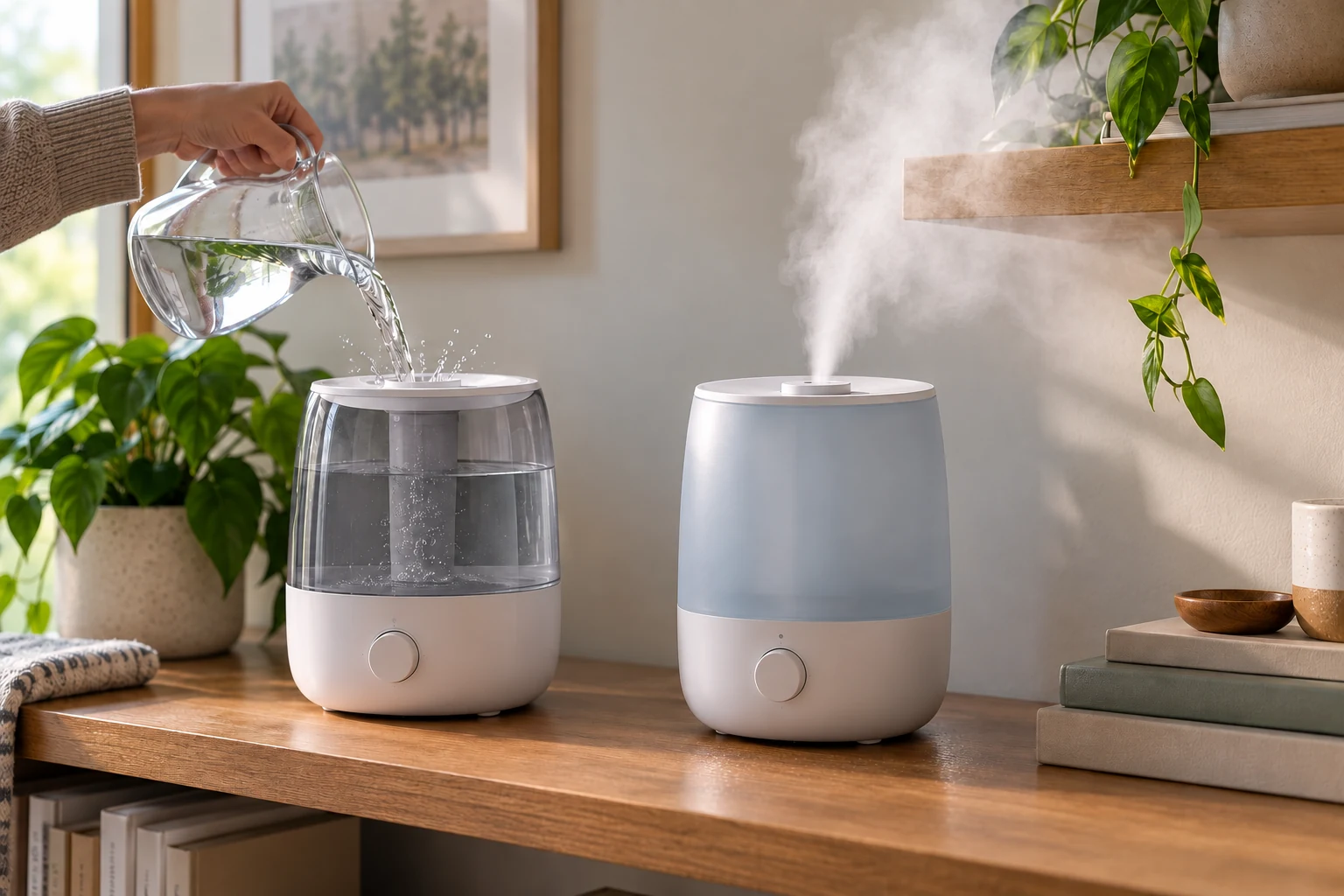
A wet shelf beside a humidifier invites a quick diagnosis: the tank must be leaking, or the mist must be landing on the furniture. Neither conclusion follows from the patch of water alone. A humidifier wet shelf question starts with timing. Was the surface damp as soon as you filled the tank, or did it become damp after the unit ran? Write down that answer before wiping everything away, because it determines what to inspect next.
Record the wet patch before changing the setup
Look at the shelf, the outside of the tank, and the area around the fill opening. Note where water is visible and whether the humidifier has been running. A patch beside the unit just after filling could be water left by the refill. Dampness that appears only later raises a different question about the unit, the outlet, and nearby surfaces. This observation does not diagnose a defect. It tells you which period of the routine needs a closer look.
Keep the first note short enough that you will actually use it: time of refill, whether the outside of the tank was dry when you set it down, whether the unit was on, and where the first damp spot appeared. If you cannot tell when the spot formed, mark that as unknown. Cleaning the shelf is sensible, but do not let a wiped surface become a claim that the problem has been solved. The next refill is a chance to collect a clearer observation.
Both current products in this guide are described as top-fill humidifiers. That common feature makes the refill moment worth watching, while their tank capacities and controls differ. The native product pages do not report a leak, a recurring wet-shelf fault, or a repair procedure for either exact model. The article therefore stays with what a reader can observe and the questions that belong in the model-specific instructions.
Keep the two DREO accounts separate
The DREO DR-HHM009S White smart humidifier account identifies a complete white ultrasonic unit with a 3-liter top-fill tank, app and touch controls, and a stated coverage figure of 300 square feet. The title also uses HM409S and names a night light. The single gallery image shows a DREO-marked blue-and-white unit beside a phone display. The page supports the tank and control facts; the picture does not establish why a shelf might get wet.
The DREO DR-HHM004 Blue 6-liter humidifier account lists a top-fill tank, digital touch controls, adjustable humidity control, a 12-hour timer, a night light, and a stated runtime of up to 60 hours. Its one gallery image shows a blue DREO tank and touch display. Those claims belong to DR-HHM004 Blue. Do not carry its 6-liter capacity or timer into the 3-liter smart model merely because both units share a brand and a blue-toned gallery image.
The listed capacities are useful for identifying which tank you are reading about, but they are not evidence that one model spills more or makes a nearby surface wetter. “Top-fill” says where the page places the filling action; it does not establish a leak path. The first unit's app controls and the second unit's touch controls can help you identify which interface you used, but a display or app screenshot is not a diagnosis. Keep the model number at the top of your observation note.
Check the refill moment first
On the next refill, make room around the unit so you can see the shelf and the tank exterior. Follow the exact model's filling instructions. Before you resume normal operation, note whether water is already visible on the outside or beneath the unit. If it is, the wet shelf was present before the mist period you were about to test. You still need to establish where that water came from; you have simply ruled out the next running interval as the first moment it appeared.
A dry exterior at that point creates a different observation. Record it, place the unit as the manual directs, and check the surrounding surface later at a consistent interval. A new patch may prompt you to examine mist direction, nearby obstructions, or the unit itself, but the location of water alone does not prove which one is responsible. Avoid changing the setting, position, fill method, and furniture cover all at once. If several things change, a later dry shelf will not tell you which change mattered.
Suppose you find a few drops beside the tank immediately after pouring water into the top opening. Put that in the refill column, even if the unit later runs normally. Suppose instead the surface is dry after filling and becomes damp later. Put that in the running column. These are hypothetical records, not reports about either DREO product. They show how a timestamp keeps two possible paths from being treated as the same failure.
Observe the running period without borrowing a setting
For DR-HHM009S White, the native account names app and touch controls. For DR-HHM004 Blue, it names digital touch controls, adjustable humidity control, and a timer. When you make an observation, write which model and which control you used. A control name from one page should not be used to explain the other unit's behavior. If you are unsure what a symbol, mode, or indicator means, use the exact model's instructions rather than guessing from the product photo.
The pages do not provide a wet-shelf test, a mist-output measurement beside furniture, or a manufacturer conclusion about water found below either model. That is why a simple before-and-after note matters. It cannot replace a manual or service assessment, but it can show whether the first visible water belongs to filling, to a later running period, or to a time you did not observe. Keep unknowns marked as unknown instead of turning them into a fault label.
Notice the surface as well as the appliance. A shelf edge, wall, window, or object placed close to the outlet may affect where visible moisture appears, but these particular native accounts do not specify a safe placement distance for your furniture. Use the exact model guidance for placement. If the shelf remains wet after you have followed that guidance and the refill exterior was dry, record the sequence and seek model-specific help. Do not open the housing or invent a repair from an unrelated humidifier.
Make a one-change observation log
A useful log has four columns: when, state of the tank exterior, whether the unit was running, and first location of water. Add the exact model number in the heading. A fifth column can record a single change you intentionally made after checking the manual, such as a different approved placement or a corrected filling step. Leave the column blank if you made no controlled change. The four lines keep a refill, a setting change, and the first damp spot in the order they happened.
Here is one hypothetical entry: “8:10 p.m., DR-HHM009S White, outside dry after top-fill, shelf dry; 8:40 p.m., unit running, damp patch first seen near the wall.” That entry does not prove a leak, condensation, or a particular mist direction. It tells you that the first visible patch was later than the refill. A second entry might read: “7:00 a.m., DR-HHM004 Blue, water already on shelf before the controls were used.” That gives you a reason to focus on the refill routine before blaming a running mode. Neither example claims the actual products behaved this way.
Keep the interval and room setup as consistent as is practical when you compare two observations. If one entry was made just after pouring and the next was made hours later after the unit ran, do not call them equivalent tests. If you moved the appliance or changed the shelf covering, record that too. The record is most useful when someone else can see what you observed without having to infer the order of events.
Map the first damp spot, not the largest one
A puddle can spread across a smooth shelf after it forms. By the time you notice it, the widest part may be far from its starting point. On your observation note, mark the first visible spot if you saw it form. If you found the water only later, draw the outline you saw and write “first point unknown.” Do not turn the nearest edge of the unit into a leak location just because the water collected there.
Keep a dry cloth nearby for the outside of the tank and the shelf during the refill, following the model's care instructions. Record whether you wiped either surface before the unit ran. If you did, that is part of the history; it does not invalidate the next observation. It helps you distinguish a new patch from water that may have been left on the outside when the tank was filled. A before photo can help you remember the location, but it is still a record of appearance rather than a diagnosis of an internal part.
The two DREO galleries show complete units, not their internal water paths. You can see a blue tank and controls, but you cannot see a seal condition or a leak test in those single images. A photograph should therefore be used to confirm that you have the right model and visible layout. Use the model's own instructions for care steps that are not present in the retail account. This keeps a visual clue from becoming an invented repair procedure.
Separate a moisture question from a settings question
It is tempting to change the mist setting as soon as the shelf feels damp. Before you do, ask what you are testing. If water was present immediately after filling, a changed running setting cannot explain the first appearance. If the shelf stayed dry until later, the setting may be one item to record, but it is not automatically the cause. Write the setting exactly as the model interface describes it, and make any change according to the manual. Avoid translating an app label on DR-HHM009S White into a touch-control label on DR-HHM004 Blue.
A note such as “unit on, controls unchanged, damp patch first seen near the rear edge” is useful even without a conclusion. It gives the seller or manufacturer a sequence to evaluate. A note such as “it leaked because it was on auto” goes beyond the evidence in these product pages and may hide the simpler possibility that the surface was wet before operation. Separate observation, suspected cause, and confirmed cause into different lines if you need to contact support.
Once you have the sequence, decide whether you need another observation or model-specific assistance. If the first appearance remains uncertain, repeat the observation under the instructions for that exact unit. If water repeatedly appears and you have ruled out a refill spill by observation, describe the pattern and ask for the maker's next step. Do not keep changing several controls in search of a dry shelf; that makes the record less clear and still does not reveal an internal cause.
Know when the product page has run out of answers
The two native product pages answer which DREO models and tank capacities you are looking at. They do not provide an exploded view, seal inspection procedure, or a diagnosis for water found on furniture. If a wet patch returns after a careful, manual-guided refill and observation, the next source should be the exact model's instructions or the seller or manufacturer for that model. Bring the model number and the short timing log. A generic tip for a different humidifier may send you to a part or setting these listings never establish.
Water management for a dehumidifier is a neighboring but different question. The dehumidifier drainage troubleshooting guide traces a tank, hose, and pump route for equipment that removes moisture from room air. Its checks should not be imported as if either top-fill DREO humidifier had that drain setup. The seasonal dehumidifier placement guide deals with a room change and exact unit operating conditions, not a humidifier refill patch. Both are useful reminders to keep water-path and placement claims attached to the right appliance.
Use the timing to choose your next question. Water present before operation points you back to the filling interval. Water first seen later points you to the running interval and model-specific placement guidance. Water whose first appearance you missed calls for a clearer observation. Keep those three outcomes separate and use the exact DREO model identity when you seek an answer.
Note when the shelf becomes wet before blaming the tank or the mist.