Crypto Commerce
HOWORK 5-quart stand mixer vs Moss & Stone for everyday baking batches
Compare HOWORK 5-quart stand mixer by bowl size, speed controls, timer, attachments, counter clearance, and the batch limits to verify.
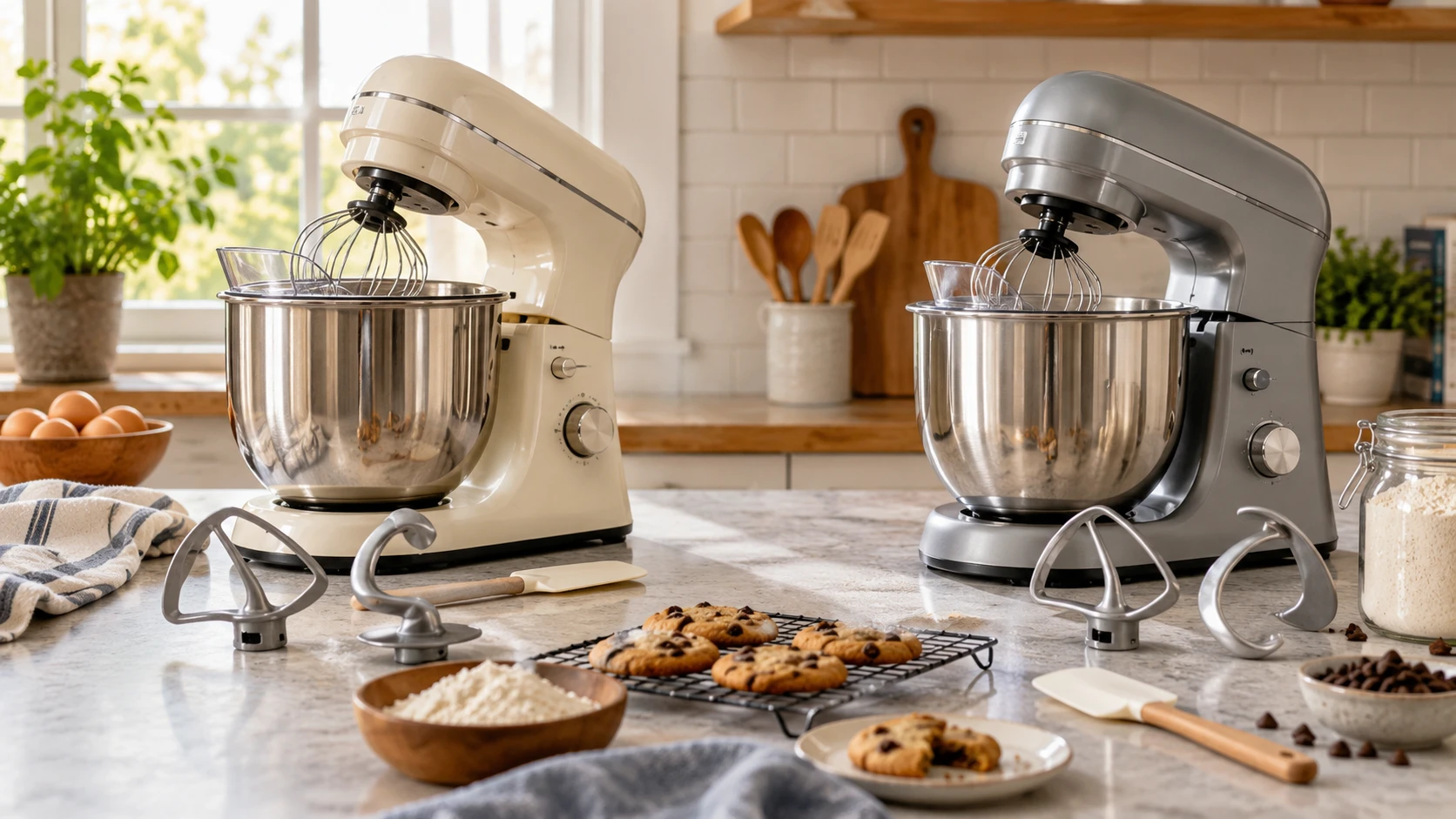
Two stand mixers can look similar on a counter yet ask for different habits. HOWORK's saved listing describes a five-quart bowl, ten speed settings, a tilt head, and a light body weighing less than 8.57 pounds. Moss & Stone lists a 5.5-quart bowl, six speeds plus pulse, a timer display that shuts the mixer off when time is up, and suction feet. The half-quart difference is one detail to check, but your usual recipe and how you add ingredients will tell you more about which design fits your kitchen.
The HOWORK 5-quart stand mixer comes with a whisk, dough hook, beater, bowl, spatula, and splash guard with an ingredient hatch according to its saved description. Moss & Stone lists a whisk, dough hook, beater, baking spatula, and a splash lid with an access hatch. Both give you the three main mixing tools in their short catalog entries. Their control layouts and physical sizes deserve a closer look before you decide that one extra attachment or one extra half-quart will change your baking.
Begin with a recipe you make often — Moss & Stone 5.5-quart stand mixer
A bowl's labeled volume is not the same as a recommended working batch. HOWORK lists five quarts; Moss & Stone lists 5.5. Neither short description states maximum flour weight, minimum egg-whipping quantity, or how far above the ingredients the beater runs. If you usually make one cake or a small batch of cookies, either capacity may be generous. If you regularly knead a dense dough, the maker's dough limit matters more than a half-quart of empty space.
The published guide on stand mixer bowl capacity and batch size gives a useful method for that check. Write down the ingredients in your heaviest recipe, especially flour and any stiff additions, then compare them with the model manuals' capacity guidance. Do not assume a larger bowl means a stronger dough machine. A wide bowl can also leave a tiny batch below the whisk or beater's effective reach. Ask how each model handles both your largest and smallest common recipes.
Try staging a recipe on paper. Put the bowl in place, imagine adding dry ingredients while the head is down, and check whether the splash guard's hatch is large enough for your usual measuring cup. HOWORK and Moss & Stone both list a hatch, but the descriptions do not supply its dimensions or show how the guard attaches. If you often pause to scrape the bowl, find out whether the guard can remain in place during that step or must be removed. Check where the guard, tools, and bowl will dry after washing; their storage space belongs in the counter plan too.
Moss & Stone's bowl has a stated 5.5-quart capacity and stainless-steel construction. HOWORK also lists a stainless-steel bowl. Neither excerpt tells you the bowl's empty weight, handle design, or whether it can go in a dishwasher. Those details matter when you lift batter into a pan or wash up afterward. A bigger bowl is useful only if it is comfortable to handle and gives you the batch range you need.
Controls: more speed steps or a timed stop — Moss & Stone 5.5-quart stand mixer
HOWORK advertises ten speeds and a blue LED power indicator. Moss & Stone lists six speeds, pulse, and an LED display with a preset timer that stops mixing when the time expires. Ten versus six does not establish that HOWORK offers a wider actual speed range or finer low-speed control. Get each manual's speed chart and look for the settings recommended for folding, creaming, whipping, and kneading. A dedicated pulse can be useful for brief additions, but confirm how it operates and whether it is allowed with every attachment.
A timed stop may suit a baker who has several tasks running while dough mixes. It does not remove the need to watch a recipe that can change texture quickly. For Moss & Stone, verify the timer range, whether it counts down during every mode, and whether the machine can be restarted easily after it stops. HOWORK's short listing does not mention a timer. That is a source gap, not proof the control panel has none. Check the current model before buying for a specific feature.
The HOWORK description calls its 380-watt motor powerful and claims noise no more than 60 dB. Moss & Stone lists a 500-watt motor but gives no comparable noise figure. Wattage is an electrical rating, not a common test of torque at the beater or endurance with dense dough. Do not infer that Moss & Stone handles more bread from the larger number, or that HOWORK will be quieter in your kitchen from an unverified listing claim. A maker's maximum dough guidance and independent use evidence would be more useful.
Both machines have tilt heads. Moss & Stone also mentions a tilt lock; HOWORK says the head gives access to the bowl and accessories. Learn how each head releases, how much vertical room it needs when raised, and whether the beater can be changed without removing the bowl. A tilt-head mixer that fits under a cabinet while closed may need to be pulled forward for every ingredient addition. Measure that movement before choosing a permanent counter spot.
Tools, stability, and counter fit — Moss & Stone 5.5-quart stand mixer
The included whisks, dough hooks, and beaters should be compared by their actual shape and care instructions. A whisk that reaches the bottom of a bowl can handle a small amount of cream better than one that leaves it untouched, but the saved sources do not show that performance. Check whether any beater height adjustment is supported and whether replacements are available. When a tool wears or gets lost, the ability to buy the exact part can matter more than an extra speed position.
HOWORK calls its attachment package six pieces when the bowl and guard are counted. Moss & Stone names three mixing tools plus a spatula and splash lid. Do not compare the headline item counts without listing the pieces. A bowl is necessary equipment, not an additional mixing method. Both products provide a dough hook and a whisk in the saved descriptions, so the practical question is whether those tools suit your recipes and are easy to clean.
Moss & Stone's saved dimensions are 8 inches deep, 14.8 inches wide, and 12 inches high. HOWORK lists a height of 13.77 inches and a weight under 8.57 pounds but does not supply a full footprint in the excerpt. Confirm all dimensions in the manuals. If a mixer lives on the counter, include the open-head height and room to move the bowl. If it lives in a cupboard, include its weight and where you can grip it safely. A light appliance is easier to store but still needs a stable working surface.
Moss & Stone describes anti-slip silicone suction feet. HOWORK's short listing does not detail its feet. Check how each machine stays in place on your particular counter, especially when mixing stiff dough. Suction feet may work differently on a textured or uneven surface. Do not place a mixer near an edge and assume its feet make it immovable. Watch the first heavy batch and follow the maker's loading and speed instructions.
The splash guards and ingredient hatches can reduce mess, but they also add parts to wash and store. Find out which attachments and bowls are dishwasher-safe and which must be hand-washed. Neither saved excerpt gives a complete cleaning table. After a sticky dough, you will need to clean the hook, bowl, head area, and perhaps the guard. A straightforward cleaning routine can make a mixer more useful than a feature you rarely select.
Source claims and purchase decision — stand mixer bowl capacity and batch size
Moss & Stone's saved listing states a one-year warranty. HOWORK's excerpt says a team is available for support but does not give comparable coverage terms. Verify the current warranty, Republeq's catalog, and replacement-part route for both. The saved catalog also does not establish how either machine performs over years of weekly dough mixing. A recipe-specific capacity and repair path are better grounds for a purchase than the phrase "professional performance" in a product description.
At the September 30 catalog capture, both products were marked available. HOWORK was listed at $240 and Moss & Stone at $210. Those historical prices may have changed and do not confirm shipping or return terms. Compare the current total, bowl and attachment contents, and whether a spare tool is sold for your exact model. A small saved price gap is not meaningful if one machine requires another accessory for your everyday recipe.
HOWORK deserves a closer look if you want a lighter listed body, ten speed positions, and a five-quart bowl that matches your usual batch. Confirm its full footprint, timer status, and maximum dough guidance. Moss & Stone deserves a closer look if its timer, pulse control, 5.5-quart bowl, and published dimensions suit your workflow. The Moss & Stone 5.5-quart stand mixer gives a clearer saved description of timed mixing, while HOWORK offers more listed speed steps. A trial with your own recipe, or detailed model guidance, would resolve the questions neither short listing can answer.