Bedding & Bath
Hookless shower curtain liner replacement: compare the usable cost
Check care, attachment, dimensions and current quotes before buying a liner or complete curtain set.
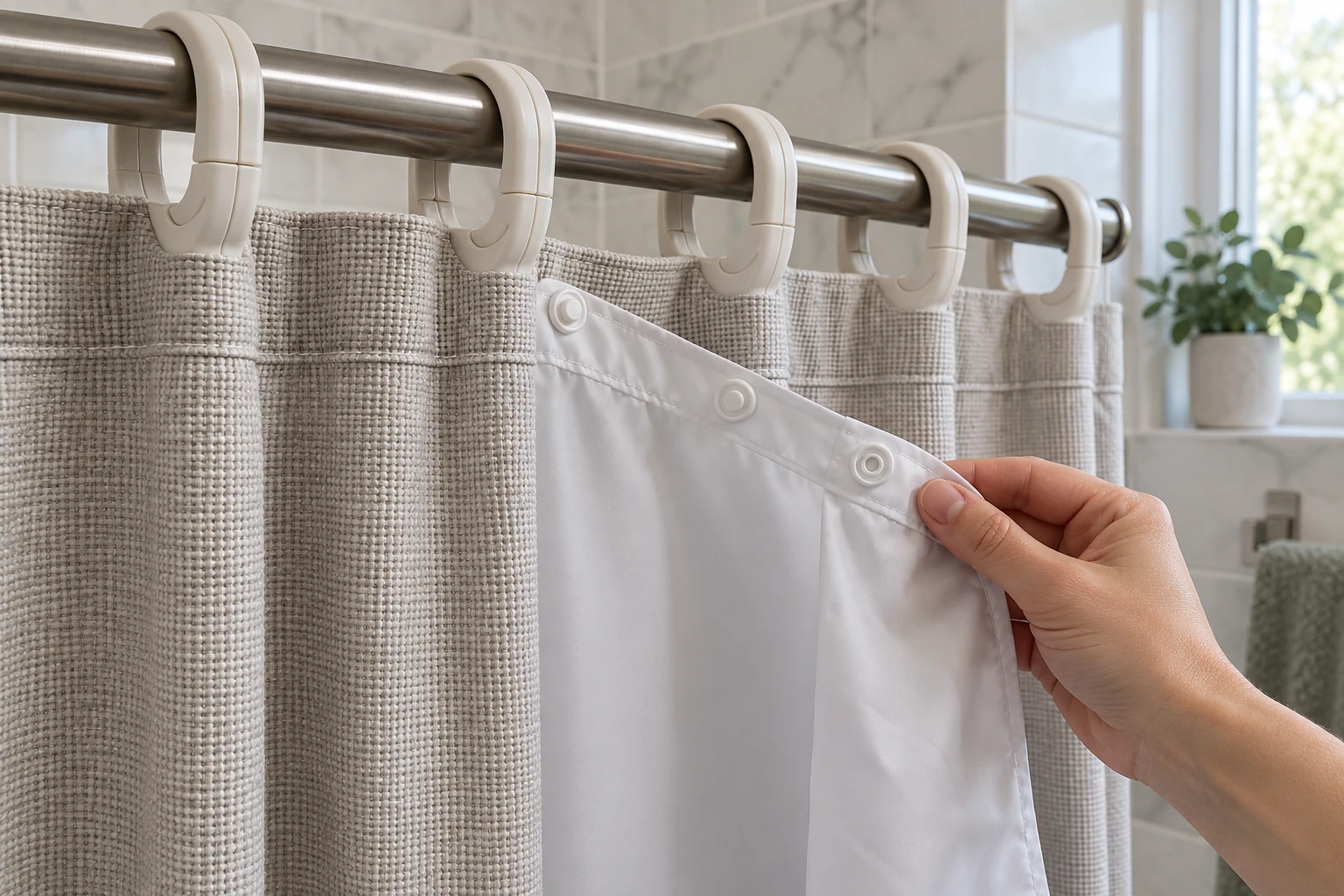
A hookless shower curtain liner replacement can be a smaller decision than replacing the entire curtain, but only if the liner can actually be separated, cleaned or purchased for the exact system you own. A tired inner panel does not automatically mean the outer curtain and rod have failed. Start with the parts in front of you: identify how the curtain attaches to the rod, how the liner attaches to the curtain, and which part has the problem. That short inventory protects you from buying a full set to solve a liner-only issue, or buying a loose liner that cannot attach to your curtain.
Identify the part that needs attention
Pull the curtain closed and look at it from inside and outside the tub. The outer curtain may still hang neatly while the inner liner has a torn snap, stubborn discoloration or a bottom edge that no longer hangs where you need it. A damaged outer header, split ring or seam is a different repair question. Do not assume a liner swap will fix a curtain that cannot stay on the rod.
Check the care label before deciding that visible buildup is permanent. Some fabric liners can be washed under their own instructions; other materials or attached details call for different care. If a wash is allowed and the liner remains sound, cleaning may postpone any purchase. If the liner is torn or its attachments no longer hold, washing will not restore the missing connection. Keep the assessment practical: what works after proper care, and what still fails?
Make a quick note of the failure. “Liner stained at bottom” is more useful than “curtain old.” “Two top snaps broken” points to an attachment problem. “Whole curtain slides off rod” points elsewhere. This keeps a quote or product search tied to the actual part you intend to replace.
Confirm the curtain system before comparing options
A hookless curtain typically uses an integrated opening or split-ring header that goes directly around a compatible rod. Its inner liner may connect by snaps or another product-specific method. A standard curtain on separate rings is a different system. Do not buy by the word “shower curtain” alone. Look at the top edge, the liner connection and the measured dimensions of the curtain you own.
The public shower rod accessory-fit guide covers the separate ring and hook decision. This article addresses whether the inner panel of an existing hookless setup can be kept, cleaned or replaced without paying for an unnecessary outer curtain. If your system uses loose rings, follow its attachment path instead of assuming a snap-in liner will fit.
Read the current product listing in full, including package contents and the actual size option, before comparing it with what you have. A phrase such as “snap-in liner” tells you there is a liner in a pictured set; it does not prove that a spare liner is sold separately or that another maker's snaps line up. Count and inspect your connection points and ask the seller for an exact compatible replacement if the listing does not identify one.
Measure the installed curtain rather than relying on a remembered size. Width and drop can differ across baths and rods. Check the bottom edge from the tub side: it should reach the place intended by the product without bunching against the floor. A curtain that is too short for the actual opening may leave water outside; one that is too long can fold and stay wet. A product dimension is an option to compare, not a promise of fit in your bathroom.
Use product pages as evidence, not as universal fit charts
One current Republeq listing is a 54-by-78-inch floral spring hookless curtain set. Its page describes built-in split rings and a detachable snap-on fabric liner. It supplies a useful example of the two-part arrangement, including the fact that the outer curtain and liner are sold together in that listing. It does not establish a separately available spare liner, a compatible snap pattern for another curtain or the right drop for your tub.
A second 60-by-72-inch floral hookless set also describes built-in split rings and a removable liner. The different listed dimensions are a reason to check your measurements, not a reason to guess that all liners in the family interchange. Both listings are examples of a removable-liner design; neither replaces a model-specific compatibility answer.
The pages describe washing the curtain and liner as part of their care discussion. Follow the instructions for the actual purchased model and its materials. Do not transfer a cleaning method to an unknown liner merely because it looks similar. Also distinguish a product set that includes a liner from a replacement liner sold on its own. If the standalone part cannot be found and confirmed compatible, record that uncertainty before calling a liner-only path cheaper.
Build a real replacement-cost comparison
Make three columns: care for the current liner, buy a verified compatible liner, and buy a complete compatible curtain-and-liner set. The first column can include cleaning supplies you would otherwise buy, time and any care limits. The second should include the exact replacement item, shipping, taxes and any necessary attachment pieces. The third should include the set and any other parts required to use it with the existing rod. Use actual current quotes; do not use a remembered price or a different size to decide which path costs less.
Start with the “no purchase” result if cleaning restores the liner and attachments. This is a valid outcome only after inspecting the condition and following the care instructions. It is not a reason to keep a liner that still fails its job. Write down the result after the liner dries and is hung again, because a clean folded liner can look fine while an attachment point fails under normal use.
For a separate replacement, ask whether the seller identifies the exact compatible curtain model and size. Include delivery charges and any return limits in the comparison. A cheap loose liner with the wrong snap spacing has no usable value for that setup. If compatibility remains unproved, keep it out of the “usable liner” column until the question is answered.
For a complete set, confirm its header works with the actual rod, its dimensions cover the opening and the included liner connects as described. A set may be the only documented path if a spare liner is unavailable. Even then, avoid treating the new outer curtain as a free extra: it is part of the cost and part of the material you will need to use, store or dispose of. The fair comparison is the total cost of a usable result.
The public shower rod total-cost guide covers the different decision to replace or install a rod and its mounting parts. Bring that cost into this worksheet only if the current rod actually needs attention. A liner problem by itself does not justify buying a new rod.
Check the swap before discarding the old part
When a compatible liner is confirmed, lay it out and compare its width, drop and attachment points with the old one. Look for the same orientation and the connection method specified for the curtain. Do not force a snap that does not align. A connection that holds only when stretched may fail during normal use. Keep the old liner until the new one hangs and performs as intended, unless keeping it creates a hygiene problem.
Follow the product's installation directions. Work from a stable floor, keep the tub surface dry enough to stand safely, and avoid tugging hard on the rod or curtain header. If a split ring or curtain header breaks while you work, stop and reassess the outer curtain; a liner-only purchase no longer resolves the full problem. If the rod shifts or has to be removed, check its own instructions before re-seating it.
Close the curtain as it will be used. Check that the liner hangs on the correct side, reaches the intended area and stays attached through a gentle opening and closing. Watch for gaps at the ends and bunching at the bottom. This is an observation of your installed setup, not a claim that a listed set guarantees splash control in every bathroom. If the result fails, document the mismatch while the order and return details are still available.
Choose the smallest verified usable outcome
A cost-saving decision is not automatically the lowest listed price. It is the least costly option that leaves a working, compatible curtain system after care, shipping, required parts and the actual condition of the outer curtain are considered. Clean and keep a sound liner when care restores it. Replace only the liner when an exact compatible part is available. Choose a full set when its fit is confirmed and the liner-only route cannot be made usable.
Keep a brief record for next time: outer curtain model if known, measured size, liner attachment type, care instructions and the seller's answer about replacement availability. You do not need a complicated bathroom inventory. One note prevents the next search from starting with a generic “shower curtain liner” and ending with another set that does not fit what is already hanging.
Keep the comparison tied to your bathroom
Size labels deserve a second look. The two example sets on Republeq carry different dimensions, but a similar design does not make one a substitute for the other. Write down the width of the existing outer curtain and the usable drop from rod to tub before you place an order. If the old curtain has shrunk, measure the opening as well as the fabric. Those numbers answer different questions: what you have and what you need the installed curtain to cover.
Do not decide from a photo that a liner reaches into a particular tub. Product images are composed in one setting and may show another size option. The bottom edge matters most when the curtain is in daily use, so plan to verify that result after installation. The page can tell you the stated dimensions and construction; your bathroom supplies the real fit test.
Think about the outer curtain's remaining life. If its header is intact and the fabric is still suitable, discarding it solely because a removable liner needs care may waste a usable part. If its split rings are cracked or the curtain itself cannot be cleaned under its instructions, the full set deserves consideration. This is not an argument to repair every textile indefinitely. It is a way to avoid confusing one worn component with a worn system.
Where a seller cannot confirm that a separately sold liner fits the exact curtain, write “compatibility unknown” in the worksheet. Do not fill the gap with an assumption that all snap-in liners share spacing, dimensions or magnets. Product listings may describe the included liner in detail while saying nothing about spare parts. A true quote for a usable liner requires an identified part and a means to attach it.
If you are comparing a complete set with a replacement liner, compare like time periods. A full set with a new outer curtain is a different purchase from a liner alone. The set may be reasonable if the old outer curtain is also near the end of its useful life, but the article cannot assign a lifespan to your particular curtain. Record your own observed wear and the product's care limitations. The decision should reflect the condition you can see.
Consider the practical cost of an unusable return. A missing liner compatibility answer can lead to another shipment, delay or a package you cannot return under the seller's terms. Check those terms before purchase and keep the packaging until the new part has been compared with the old one. This is especially useful when a listing bundles the curtain and liner and the exact spare part is unclear.
Finally, decide what to do with the old material only after the new setup works. Follow local textile or plastic disposal options where available; do not assume all liners can be recycled. If the old part is still sound after cleaning, keeping it as a spare may be useful only if you have dry storage and a reason to use it. Otherwise, the record of its measurements and attachment type is more useful than an unlabeled folded liner in a cabinet.