Bedding & Bath
Shower curtain rod accessory fit: rings, hooks and mounts
Identify the exact rod, connector travel path, curtain holes and mounting parts before choosing replacement rings or hooks.
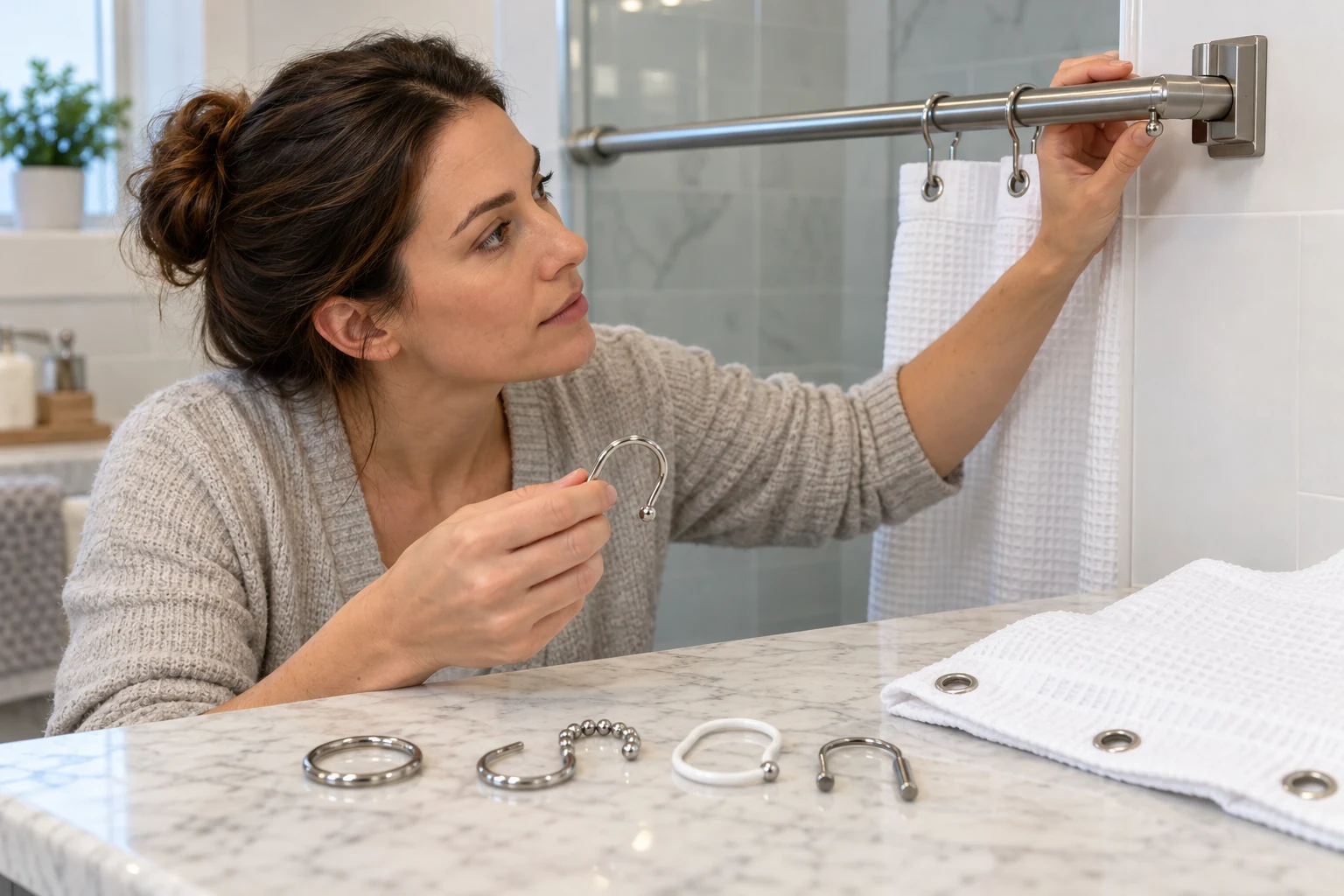
Shower curtain rod accessory fit is a chain, not a single measurement. A curtain or liner connects to a ring or hook; that connector moves along a rod; the rod ends at a bracket or wall contact. If one link does not match, a package labeled "universal" may still hang badly or not install. Start with the exact rod and the accessories you already own, then check each interface before ordering replacements.
Identify the rod before choosing a ring
Find the rod's model or installation sheet if available. Record its shape, finish, approximate outside diameter, and how its ends connect to brackets or walls. A straight rod, curved rod and D-shaped assembly can create different paths for moving a curtain. The visible shape is a clue, but the model's dimensions and the actual installed route are what determine whether a connector can travel through the intended area.
Measure only where you can reach safely. If the shower is wet or the rod is unstable, leave the measurement until it can be done without pulling on hardware. A flexible tape around an accessible straight segment can help, but do not claim a precise nominal diameter from an awkward measurement near a bracket. The maker's dimensional drawing is a better source when it exists.
Look at the transitions as well as the middle of the rod. A ring may clear the smooth tube but stop at a splice, bend, cap or bracket. Before buying a full set, compare the connector's stated opening and the rod's actual path. If the seller does not describe how it passes an obstruction, ask instead of assuming that a larger ring will solve every movement problem.
Note whether the current curtain uses open hooks, closed rings, roller rings, or another connector. An open hook can be easier to remove but may detach in some uses; a closed ring cannot be slipped over every installed end. Those are handling differences, not a general ranking. Check the maker's mounting and removal instructions for the exact rod and avoid taking apart a secure installation merely to test an accessory.
Read rod shape and mounting claims separately
The Bobrick B-207x72 listing identifies a 72-inch shower rod with concealed mounting. That establishes an offered rod type, but its short description does not give every connector or bracket dimension needed for ring selection. A concealed mount at the end is not automatically a smooth passage for a closed ring. Ask for the exact installation drawing when deciding how a curtain will be attached or removed.
The Kingston Brass D-shaped rod listing identifies an adjustable D-shaped assembly and says required installation hardware is included. That is a seller's package statement for the offered variant, not proof that any curtain ring traverses its bends or supports. Separate the installation hardware question from the hanging-accessory question and confirm both for the exact configuration.
A rod's color or finish does not tell you its diameter or accessory interface. "Matte black" and "satin" are visual descriptions. Do not choose replacement rings by matching their color alone. Two components may look coordinated while their openings, closure styles or travel paths differ. Fit first; appearance can be considered among options that actually work.
Also distinguish the rod's length from the curtain's width. A 72-inch rod label does not mean every 72-inch curtain will produce the drape, coverage or overlap desired in the installed opening. Read the curtain and liner dimensions, the placement of attachment holes, and any maker guidance. The rod length is one input, not a complete compatibility statement.
Check the curtain and liner attachment points
Count the holes or grommets across the curtain and liner you intend to hang. Count the usable connectors in a proposed package. These counts may differ, and some households hang a liner and outer curtain together while others use separate connectors. Do not assume a package photograph shows exactly how many pieces are included. Confirm the seller's unit count and whether it means hooks, pairs or sets.
Inspect the size and condition of attachment holes. A thick reinforced grommet and a soft buttonhole may interact differently with the same hook. If a hook has to be forced through a hole, stop and compare the stated dimensions. Do not enlarge a curtain hole as a routine fix; that may weaken the material and make later connectors behave unpredictably.
Consider how the curtain and liner hang together. A connector with two separate arms may be described for a layered setup, while a single ring may gather both layers. That description does not guarantee that the two fabrics will move evenly on the installed rod. If the current arrangement works except for one missing connector, identifying the exact existing part may be simpler than changing the whole set.
Check whether the curtain needs to be removed regularly for cleaning. If so, the removal method matters as much as daily travel. A closed ring around a permanently mounted rod may require a specific bracket or end-cap procedure to remove. Ask how the exact assembly is serviced before choosing a connector that makes routine care difficult.
Trace the connector's travel path
Imagine the curtain moving from its usual open position to closed. Mark any bend, wall return, support bracket, splice or decorative end it would meet. You do not need to pull hard on the existing curtain to discover a stop. Move it gently only if the rod is secure. A snag near one support is a path problem, not proof that the ring is too small everywhere.
For a D-shaped or other framed assembly, ask which section carries the curtain and whether the connector is intended to pass any corner or support. The outline in a product photograph may not show the usable travel segment. A rod may provide enclosure coverage through its shape while using a particular hanging route. The exact maker drawing or support answer should settle that path.
On a straight concealed-mount rod, ask whether end mounting must be loosened to install closed rings and whether that is permitted under its instructions. Do not remove a load-bearing bracket just to test one ring. If the answer is uncertain, an appropriate open connector or professionally installed set may be worth discussing, but only after its own fit is confirmed.
Wheels or rollers on a connector can change how it glides along a smooth section. They do not erase an obstruction at a bracket or bend. Avoid buying a roller set based only on a claim of effortless movement. The actual path and contact surfaces determine whether that feature can be used on this rod.
Keep mounting accessories distinct from hanging accessories
A mounting bracket, flange or end cap secures or finishes the rod assembly. A hook or ring carries the curtain. Their roles should stay separate in the shopping list. The phrase "all hardware included" may refer to installation parts rather than rings or curtain hooks. Read the package inventory for each role and ask about any missing component before ordering.
If replacing a bracket, match the exact rod model and mounting surface. Similar-looking brackets may differ in tube size, fastener pattern or load path. Do not borrow a bracket from another rod solely because its finish matches. If the existing mount is loose or the wall is damaged, resolve that condition before adding a heavier curtain or trying a new connector.
A tension rod uses end contact instead of the concealed or screw-mounted brackets shown in other products. The slipping tension rod guide owns the separate question of an installed rod that will not stay put. A new ring cannot correct an unsuitable wall contact or extension span. Handle that stability issue before judging how the curtain moves.
The shower rod setup comparison guide addresses the separate decision of a complete usable installation. Its package checklist helps distinguish rod, mount and hanging parts. The present question is narrower: whether a proposed accessory works with a specific installed rod and curtain, not which entire setup to buy.
Make a small compatibility record
Write the rod model and shape at the top of a page. Under it, note the accessible outside diameter or official drawing dimension, any support that interrupts travel, the curtain's attachment-hole count, and the connector style you currently use. Add the proposed accessory's stated opening, closure and package count. Leave unknown fields blank rather than filling them with a visual guess.
For example, "closed ring opens wider than smooth rod diameter" is only one part of the answer. You also need to know whether the ring can be placed on the installed rod and whether it can pass the section needed for normal curtain travel. If a fixed support interrupts that path, a bigger ring may not be the right solution. Ask the maker about the intended connector.
Carry this record to the seller or installer. Ask one concrete question: "Will these exact hooks attach to this curtain and move through the usable length of this rod without removing the mounting hardware?" Include model numbers or product links and a safe photograph of the installed bracket. A specific question is more useful than asking whether the hooks are universally compatible.
Keep the answer with the order details. If the accessory does not work as expected, you can compare the promised fit with the actual rod and identify which interface failed. That helps with a return or a corrected selection without replacing unrelated parts. It also prevents a later household member from assuming that the matching color established compatibility.
When the accessory is installed, move the curtain gently through its normal range. Confirm that connectors stay attached at the curtain holes, travel where intended and do not catch on a bracket or bend. Stop if the rod shifts or the mounting hardware moves; that is no longer a ring-selection test. The rod's stability needs its own assessment.
Do not use a crowded product title as a substitute for the dimensional record. It may mention a rod length, an adjustable shape and several finishes while omitting the outside diameter or the route a ring can travel. Save the exact variant you are considering. A support answer for one finish or size should not automatically be transferred to another when the mounting parts may differ. Ask for the drawing or specification tied to the exact model.
For layered curtains, count both fabric panels and the total number of attachment points you intend to use. If one layer has a different hole spacing, the fabric may bunch even when every hook technically fits. That is an arrangement problem, not necessarily a defective connector. A small trial with the existing parts can reveal the issue, provided the rod is stable and the test does not require dismantling its mount.
Think about the edge of the shower as well as the rod. A curtain that is too short or too narrow for the installed opening will not provide the intended coverage merely because its rings fit. A liner may need to hang inside while a decorative curtain hangs outside. The precise arrangement depends on the fixtures and materials you own. Keep coverage and water containment questions separate from the connector's mechanical fit.
If a connector rubs or leaves marks on a finish, do not immediately polish or coat the rod. First identify the connector material, the rod finish and the place where contact occurs. The maker may have care guidance for the finish or an intended accessory type. An improvised lubricant or abrasive can change the surface without resolving an incompatible ring shape. Record the observation and ask before altering either component.
When comparing two potential accessories, use the same installed rod, curtain and travel path for both. One connector may be easy to attach but catch at a support; another may glide on the center section but require a disassembly step you cannot perform safely. Write those results in plain language. The best match is the one that works through the complete normal use and maintenance routine, not simply the one with the largest opening.
Shower curtain rod accessory fit depends on the actual rod route, connector opening and closure, curtain attachment points, and how the assembly is mounted. Checking each interface makes the choice concrete. It also keeps an accessory change from becoming an unintended rod repair or a guess about the strength of an unfamiliar bracket.