Audio & Video
Holiday record-player gifts: name the Bluetooth audio direction
State whether the recipient wants phone audio into a player or record audio out to a separate wireless device, retaining exact product limits.
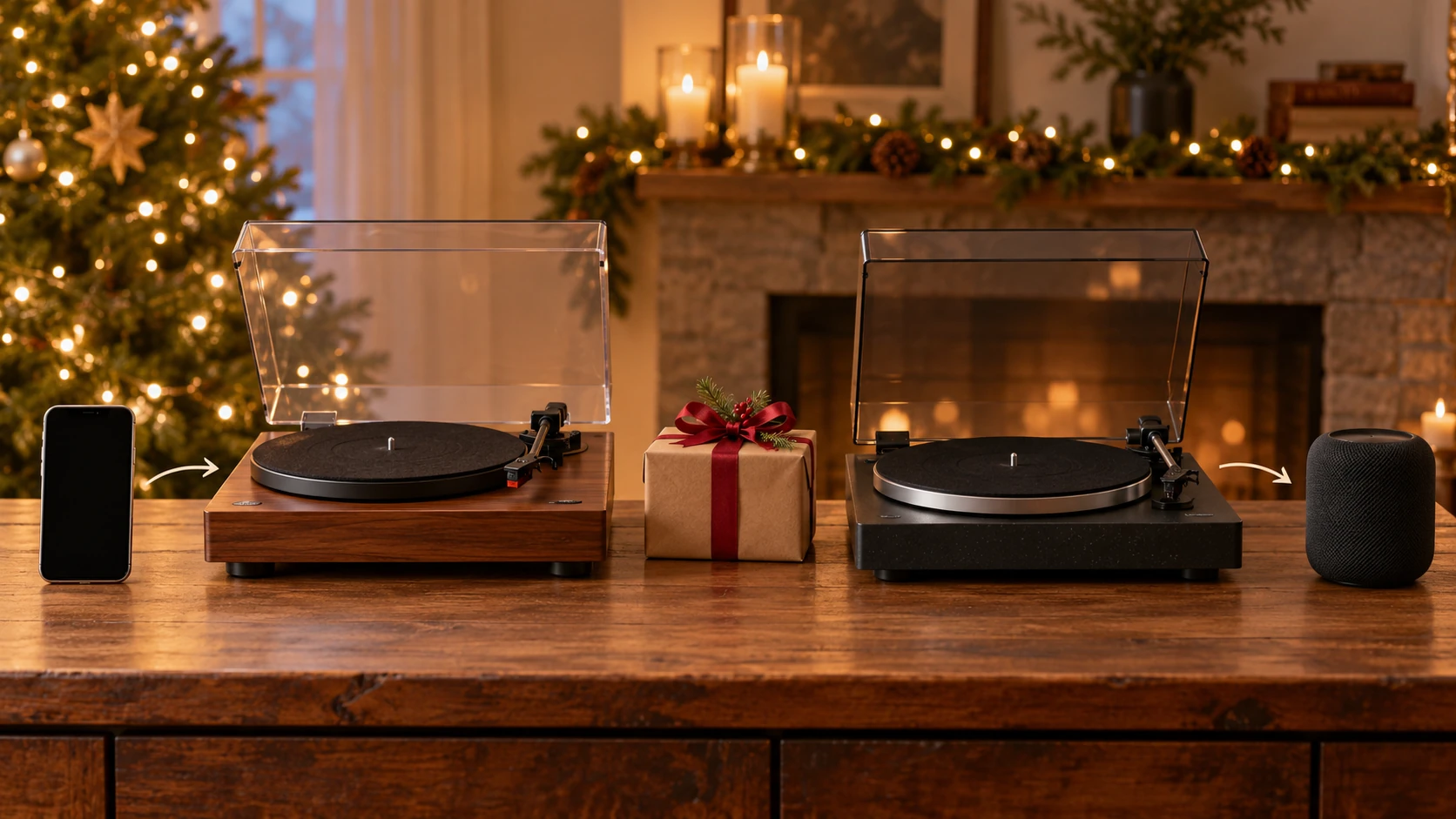
Ask where the holiday music should go
Holiday record-player gifts start with a more useful question than whether the box says Bluetooth. Does the recipient want to send phone audio into a player's speakers, or send record audio out to a separate wireless listening device? Write the intended route before choosing the gift. Those requests name different sources and destinations. This guide uses actual product accounts to make the distinction visible, without pairing devices, certifying an endpoint combination or promising an effortless holiday opening. The aim is a gift brief that says what the recipient actually wants to hear and where.
A description can mention wireless connectivity while leaving part of that brief unanswered. Keep the missing part visible. If you are buying for someone else, a short question about the intended listening arrangement can be more useful than guessing from a familiar feature word. You can preserve the surprise of a particular gift while clarifying the function it needs to support. This article provides no universal method for connecting a player to a phone, speaker or headphones; actual operation needs the matching instructions and supported equipment.
Read the Eastwood gallery's output wording
The Eastwood II record-player listing names built-in speakers. Its first gallery graphic explicitly labels VinylStream as Bluetooth Out, while another describes wireless audio via VinylStream to external speakers. All ten gallery images were read. These are source-specific output statements, not a successful pairing result or a guarantee for any speaker or headphones. This guide adopts no cartridge-performance, sound-quality, endurance or easy-setup promise from the account, and supplies no device-specific controls or pairing sequence.
An output statement can answer the direction part of a gift question while leaving the actual endpoint to establish. Keep those two findings separate. If the recipient has a particular external device in mind, name it in the enquiry and ask what the applicable information supports. Do not convert a statement about external speakers into an unqualified promise for every wireless listening device. A useful answer can remain narrower than the gift you first imagined, without becoming either a blanket endorsement or a finding of incompatibility.
Read the suitcase account's phone input wording
The turquoise suitcase record-player listing explicitly describes streaming smartphone audio through the turntable's built-in Bluetooth speakers. Its nine gallery images were read, including staged color variants that do not certify a particular delivered finish here. That phone-to-player statement does not establish wireless output from records to another device. Missing output wording remains an unanswered question, rather than proof of absence or inability. This guide adopts no sound-quality, range, vibration-control or setup-in-minutes claim from the account.
Keep the described route intact when reporting it to another buyer. An answer about receiving phone audio should not be shortened to a note that silently approves an outward route as well. Conversely, an unanswered outward question does not erase the narrower statement the source actually supplied. Record the supported wording and the remaining question beside the selected offer. That lets someone continue the enquiry without having to reconstruct which part of the proposed holiday listening arrangement was established and which part was only hoped for.
Give two fictional gifts different briefs
Imagine two explicitly invented holiday plans. Nia wants to play a phone playlist through the gift player's own speakers while decorating. Owen wants to listen to records through a separate wireless speaker in a reading corner. Neither person has selected equipment or performed a connection test in this example. Their briefs share the word music, but the proposed routes differ. Nia names the phone as the source and the player as the listening destination. Owen names the record player as the source and a separate speaker as the destination.
A buyer can write those requests before comparing offers. The written route does not prove any combination works; it identifies the question the product information needs to answer. If a supplier's response covers only one route, retain that scope instead of treating the reply as incomplete evidence for everything else. The fictional examples do not rank the actual offers. They show why the intended holiday use should be clear before a familiar connectivity label is allowed to stand in for a complete gift decision.
Keep both ends in the enquiry
A useful clarification request names the exact offered player, what is supposed to supply the audio and where the recipient wants to hear it. This is more precise than asking whether the product works with Bluetooth. The broader question may receive a broad answer that still leaves the intended route unstated. Keep the request in ordinary language, so another person can understand it without needing to infer the direction from a copied icon, a color choice or a photograph of several devices together.
If the response identifies an applicable model list or instructions, retain those conditions with the answer. If it leaves a particular endpoint unresolved, keep that question open. This guide supplies no codec requirement, transmission range, operating-system guarantee or workaround for an unsupported combination. A complete route description is a question to investigate, not a technical certification. Naming the two ends helps keep the answer relevant while leaving room for the actual documentation to establish limitations you have not yet confirmed.
Do not merge wired and wireless questions
Consider a hypothetical product note that mentions a wired listening connection. That statement would need to stay with its own connection type. It would not automatically answer whether a different wireless route is supported. The same reading rule applies in the opposite direction: a wireless statement does not identify every cable, socket or electrical condition for a separate wired arrangement. This invented note explains how to keep questions distinct without supplying a connection procedure for either selected record player.
If the holiday plan changes from one arrangement to another, revise the brief openly. Do not leave the earlier answer in place as though it covered the new requirement. Someone may decide that a different listening arrangement would be acceptable, but that is a change in preference to confirm with the intended recipient. It is not evidence that the original equipment combination works. Retain what changed so the next person helping with the gift does not mistake a compromise in the plan for a verified technical finding.
Keep the surprise separate from essential clarification
A surprise need not depend on guessing an essential feature. You might ask whether the recipient imagines using phone music through the player or records through another listening device, without naming a brand or appearance. That is a hypothetical conversation prompt, rather than a rule about how every person wants gifts chosen. If the answer itself would spoil the intended surprise, acknowledge the uncertainty in your purchasing note. Do not turn an unasked question into an assumed preference merely to make the gift plan look complete.
A person helping you buy can keep the same distinction. Give them the functional requirement and the questions still pending, rather than only a photograph of an attractive player. If they propose a substitute, return to its own account. Similar styling or a shared wireless word does not transfer another model's supported direction or endpoints. A clear handoff can preserve both the gift's intended meaning and the limits of the available information, without forcing the helper to improvise an answer the product evidence has not supplied.
Leave undocumented capabilities unresolved
An account that answers one direction does not necessarily describe every capability of the item. Treat silence carefully. It can justify a clarification request, but it does not by itself establish that a feature is absent. This distinction matters when a gift plan depends on an outward route while the available description concentrates on an inward one. Retain the unanswered question in those terms. Avoid declaring the product unsuitable from missing wording alone, and avoid approving it by assuming the unstated capability must exist.
Likewise, an affirmative direction statement is not a report that the recipient's exact devices were tested together. Keep the actual endpoint and applicable conditions in the enquiry. A source can provide useful evidence without settling the entire gift. If the remaining answer cannot be obtained before you intend to choose, leave the purchase undecided or revisit the requirement with the recipient. The holiday date does not provide the missing compatibility evidence, and a completed shopping list should not conceal an unresolved feature essential to the intended use.
Plan an honest opening-day handoff
When a gift is eventually selected, include the applicable documentation and the clarification on which the choice depended. Describe the supported intended use without promising that a particular connection will take a certain number of minutes. This article has performed no setup trial and provides no sequence for using controls, resetting a device or disconnecting existing equipment. Let the recipient consult the matching instructions before trying the actual arrangement. A gift note can be helpful without presenting itself as an operating manual.
If a feature remains pending, say so plainly rather than arranging an improvised demonstration during the celebration. Keep an uncertain setup separate from the enjoyment you hoped the gift would bring. The point is not to guarantee an opening-day result from a product description. It is to hand over an understandable choice, its supporting information and any remaining question. That gives the recipient a clearer starting point while avoiding unsupported assurances about their own phone, speaker, headphones or listening space.
Keep adjacent music guides in their own scopes
The record-player RPM label guide explains mixed-number fractions and distinguishes exact source notation from deliberately approximate paper arithmetic. Its teaching model supplies no Bluetooth direction, endpoint support or connection instruction. Here the holiday gift decision concerns where audio is intended to originate and where it should be heard. Keeping the topics separate prevents a familiar speed label from being treated as an answer to an unrelated wireless listening requirement.
The summer swim headphones guide separates water and dry-deck listening and keeps onboard music distinct from an unverified underwater wireless path. Those seasonal and product conditions do not become rules for a record-player gift. This article supplies no water-use recommendation, swim playlist or headphone suitability finding. Its narrower seasonal task is a holiday brief with an explicitly named audio route. A useful shared habit is to state the intended use accurately, while each actual product and setting retains its own evidence.
Keep the purchase with the selected gift
If you consider an order through republeq.com and prefer crypto such as USDT, keep the exact gift and any unresolved audio-route questions together before choosing payment. For the particular offer being considered, a payment preference cannot establish wireless output, certify the recipient's endpoint or replace applicable operating instructions. Review the selected item and any clarification on which the gift choice depends. Then read the methods displayed for the actual transaction instead of assuming that a general cryptocurrency reference guarantees a particular asset, network or transfer route. This guide supplies no receiving address, payment procedure or promise of acceptance. Leave the order undecided while a feature essential to the intended listening arrangement remains unclear. Check the delivery and return information applicable to that purchase as well. A holiday gathering date does not establish arrival, and the payment method creates no special exchange arrangement. If somebody proposes another player while arranging the order, return to its own input and output account rather than transferring an earlier answer across. The recipient's intended route stays useful even when the proposed model changes. Should you place an order, retain the confirmation and the exact product response that supported your choice. A completed transaction would record a purchase; it would not prove a connection between the recipient's devices or guarantee an opening-day result. Keep the purchasing record, the intended audio route and the operating documentation understandable as separate records. A later person helping with the gift should be able to identify the question actually answered without treating payment success as a technical test of the player or its proposed wireless endpoint.
Give the remaining question a clear owner
If someone else continues the enquiry, tell them which route remains unresolved and which exact offer it concerns. They can ask a focused question without repeating an answered inventory or appearance question. Preserve the response with its conditions instead of replacing it with a broad note such as fully compatible. A narrower, accurate record is easier to use when the recipient later consults the information or when a different model is suggested during gift planning.
Holiday record-player gifts become easier to choose when the intended route is written plainly. Phone audio into a player and record audio out to a separate listening device are different requests. Keep each source statement with the direction and endpoint it actually names, retain missing answers honestly, and avoid promising a live pairing result. The useful holiday handoff is a gift choice whose intended use and supporting information another person can understand.