Home & Living
holiday greeting card display: give incoming cards a place
Choose a measured spot for arriving holiday cards, compare a magnetic wall holder with a freestanding rack, and decide which greetings stay on view.
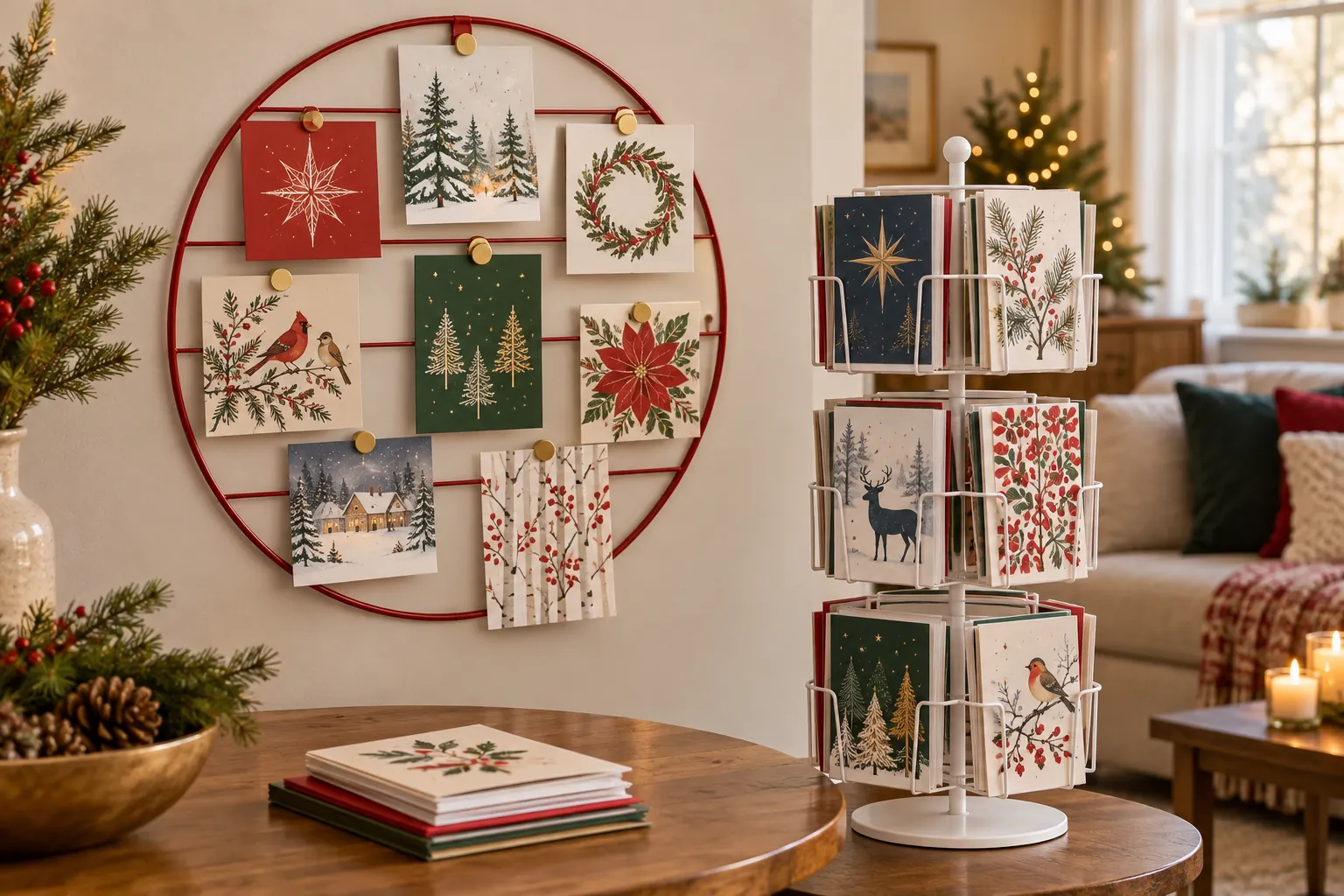
Holiday cards often arrive a few at a time. One goes on the counter, another leans against a shelf, and soon the place where you open the mail becomes the display. A holiday greeting card display works better when you decide where cards will go before the first handful accumulates. That decision can be modest: choose one surface, decide how many cards you want visible there, and leave a place for the rest.
Set a display spot for arriving holiday cards and leave room for later rotation.
Start with the cards you actually receive and the space you can use. A wall sign with magnets and a freestanding rack offer two different ways to hold them. Neither product page can tell you whether your wall, floor area, or particular cards suit the display. A quick measurement and a trial with your own cards answer more than a staged photograph.
Choose the spot before the holder
Walk through the room where cards would be seen. The entry may catch the mail, but a narrow passage may leave little room to stop and read a card. A wall near a table may have space for a hanging display; a freestanding rack needs a clear footprint and a place where its contents will not be brushed past. Note the location you prefer, then measure it. Use the actual wall area or floor area, including whatever else already lives there.
If you rent or cannot make holes in that wall, settle the mounting question before treating any wall product as a candidate. The listing for a wall sign shows it hanging in room photographs, but those pictures do not establish which fasteners are included or what your wall can support. The rack asks a different question: is there enough stable space for its base and enough room to reach and turn it? Measure the available space rather than assuming a title such as “portable” settles placement.
Write the chosen spot on a small card or note. It sounds fussy until the next batch of mail arrives and someone puts it wherever there is room. A named display spot gives the household a consistent answer.
Sort cards by what you want to show
Lay the incoming cards flat and look at their actual sizes and formats. Some may open sideways; others may be thick, folded, or accompanied by photographs. Do not infer that a holder accepts every format from a product photograph. Keep one sample of each awkward size for a dry fit when the display is in hand. Leave envelopes out of the display decision unless they have a reason to stay with a card.
Decide which side of each card faces the room. A seasonal illustration may be welcome in a shared space, while a personal message may be meant for the recipient alone. Turn over or set aside cards that reveal an address, a private note, or a photograph the sender did not expect to be displayed. This is a household choice, not a feature of either holder.
Make three simple groups: display now, keep nearby for a later rotation, and store privately. The groups can change as new cards arrive. You do not need to decide that every greeting has earned a public place, and you do not need to throw anything away to keep the display orderly.
Read the wall holder as a specific offer
The red Christmas card wall holder is a circular metal “Merry Christmas” sign supplied with 30 magnets according to its current listing. Its gallery shows cards and photos held around the ring. A detail image labels the display 28 inches vertically and 22.8 inches horizontally; those are two different measurements, so the 28-inch title should not be read as its width.
The magnets give you a way to rearrange cards without assigning each one a fixed pocket. They do not promise that 30 cards will fit legibly. Card size, overlap, and the amount of lettering you want exposed all affect the result. Before planning a full arrangement, hold one of your cards in the place you would like it to occupy and check how much of its front can be seen. If a card hangs over the edge or covers most of another, show fewer cards.
The photographs also show a hanging loop. They do not establish a fastener for your wall, a load rating, or permission to use a particular surface. Verify those details with the actual package and your wall before installation. The product description makes broad claims about material and outdoor endurance; those claims are not a substitute for site-specific mounting guidance or evidence of how long this item will last.
Read the rack as another kind of display
The white rotating greeting card rack offer describes a two-pack of metal, three-tier racks. It lists each rack as 30 by 30 by 80 centimeters, or about 11.8 by 11.8 by 31.5 inches, and names screws, a thumb screw, and a wrench in the packing list. Its single gallery image shows the two freestanding racks holding cards in wire pockets.
This is a noticeably taller object than a small desktop card holder. Mark its stated floor footprint with paper or tape in the intended location, then check the space above it and the path around it. The listing's dimensions are a starting point for placement, not proof that your assembled rack will fit a tight corner exactly. Verify the supplied pieces and the assembled result when it arrives.
Pockets organize cards differently from magnets: each card needs a pocket position, and a card behind another may disappear from view. The listing does not state a universal greeting-card size or a safe number of heavy, folded cards for each pocket. Try your actual cards and turn the rack gently in its chosen place before deciding how much to display. If the rack is within reach of children, pets, or a busy doorway, use the observed stability and the manufacturer's instructions to decide whether that location makes sense.
Match the display to the arrivals
Count what is already on hand before choosing a layout. If the first week brings three cards, either display can look sparse. If a later week brings many more, you may need a rotation rule rather than a larger holder. A useful rule is to put up new arrivals first and move older displayed cards to a nearby box after you have enjoyed them. Another household may choose to keep cards from people visiting soon in view. Pick one rule that you can explain to the person who also opens the mail.
For the wall sign, sketch where a few large and small cards might go without covering the seasonal lettering or each other. For the rack, think about which pockets are easiest to see from the usual approach. These are trial layouts, not calculations based on the advertised magnet count or the number of tiers. An empty wall sign and an empty rack tell you little about the view once your own cards are in place.
Leave one small tray or envelope for cards waiting to be sorted. Without it, the display spot and the mail-opening spot can merge again. Put the waiting stack where it will not be mistaken for cards that have already been read or answered.
Make a short installation or assembly check
When the holder arrives, compare its actual parts with the listing before starting. For the wall sign, look for the sign, magnets, and any mounting instructions or hardware included with your package. If hardware is absent or the wall material is uncertain, pause and use guidance suited to that wall. For the rack, check the two racks and listed assembly pieces, then follow the included instructions. The product photograph is not an assembly diagram.
Set the display in its chosen place while empty. Check whether you can reach it comfortably, whether it blocks a door or common task, and whether its presence changes where people walk. Only then add a few cards. If the mounting, assembly, or stability is uncertain, keep the cards in a safe temporary spot and resolve the physical issue before loading the display.
Take a photograph of the finished arrangement if that helps with later rotation. The photograph is a record of your own placement, not evidence that someone else's wall or rack will behave the same way.
Keep nearby holiday projects separate
A card from a friend is different from the name card placed at a dinner setting. The holiday place-card keepsake guide covers what a guest may take home and who owns the tabletop holder. That decision does not decide which received greetings belong on a wall or rack.
The same separation helps with other decorations. The tree-and-garland ornament plan assigns pieces between two display areas after checking their attachment. Greeting cards need their own location and privacy decision. A card rack is not an ornament stand just because both can sit near a tree.
Check the view from where people stand
A wall arrangement and a rack can hold the same cards yet make very different views. Stand where a visitor would naturally pause. Can you see the cards without leaning into a walkway or reaching across furniture? Move a large card to the edge of the wall sign and then to the center. On the rack, try a card in a high pocket and another lower down. Notice which one disappears behind other cards when the rack faces the room. This is a practical test of your placement, not a promise about either product's capacity.
Think about who will change the display. If one person opens the mail and another person updates the cards, agree on where the waiting stack sits and how to tell which cards are ready for display. A small note on the storage envelope can record that a private message stays inside. When a card must be moved to reach another, ask whether the holder is too crowded for the household's ordinary routine. Leave enough space to make one change without pulling down the whole arrangement.
Close the display without losing the cards
Decide now what happens when the season ends. Remove cards one at a time, check whether a note or photograph should be kept private, and place the cards you want to save in a labeled envelope or box. Do not leave magnets attached to a card merely because it was displayed that way; count and store the holder's separate parts with the holder. For the rack, empty pockets before moving or disassembling it.
Write down anything that made this year's setup awkward: a card too large for the pockets, a wall position that caught glare, or a rack that crowded a passage. Next season, that short note will be more useful than trying to remember how a staged listing photo looked. The display served its purpose if people could enjoy the greetings and the cards reached the right place afterward.