Learning & Creative
Holiday cut and choose: check each person’s own value
Check a two-person holiday paper-share procedure with declared subjective values, an equal-value cut and a chooser preference, with clear limits.
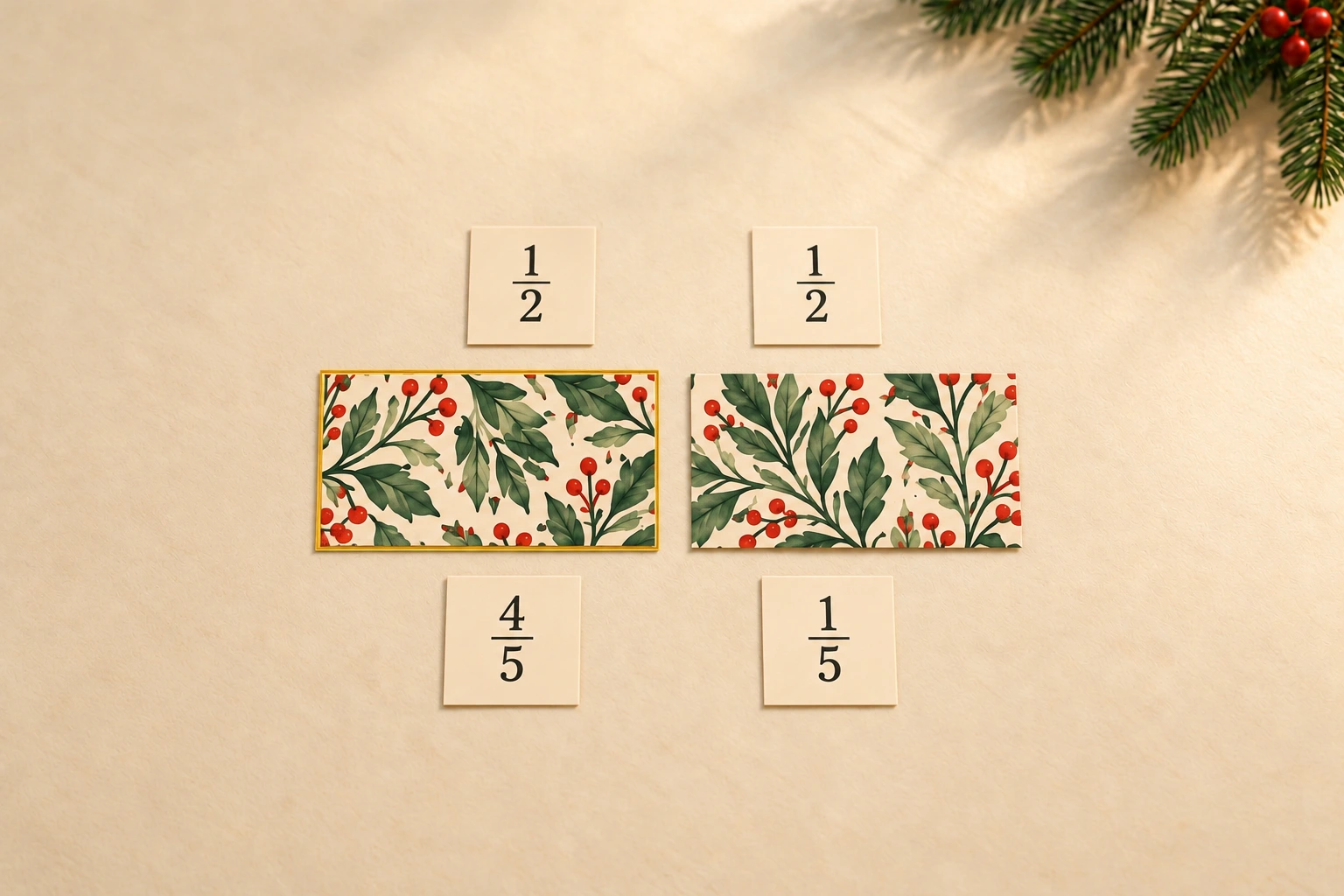
Holiday cut and choose can be checked on a fictional paper strip without claiming to measure anyone's real preferences. One participant divides the strip into two pieces equal by that participant's own value. The other chooses a preferred piece, and the cutter receives the remainder. The useful conclusion concerns two separate comparisons: each person values their own share at least as highly as the other's share. It does not compare one person's numerical satisfaction with another's.
The gingerbread stocking-holder account is separate seasonal catalog context. All seven images concern six coherent decorative bases with hooks, including two matching tree designs. Mantel scenes include stockings and peripheral decorations; the native description excludes accessories. Material, weight, dimensions, load, stability, installed performance and maker authenticity are not established here. Those objects do not supply the values assigned to the paper strip.
Define the strip and the two value scales
Use a divisible strip represented by the interval from zero to one. Every point's position is just a coordinate in the exercise. Two participants, A and B, each assign a total value of one to the complete strip. Values are nonnegative and additive across disjoint pieces. Additive means that when separate pieces are combined, that participant's values for them add. Neither participant receives credit for the same piece twice. These declared mathematical values are not prices, ratings or observations about a household.
Give A a uniform value along the strip. A values an interval by its length, so the left half and right half are each worth one half to A. Give B a different declared scale. B values the left half at four fifths and the right half at one fifth. Within each half, B's value is proportional to length. Equivalently, each unit of length within the left half contributes eight fifths of value, while each unit within the right half contributes two fifths.
Those rules give B total value one: half of eight fifths plus half of two fifths equals four fifths plus one fifth. They also specify how to evaluate a quarter-strip later, rather than leaving that smaller piece's value unstated. A and B can agree on the strip's coordinates while assigning different values to the same physical piece. Uniform length and subjective value have separate roles. Equal lengths happen to be equal A-values in this chosen example because A's scale is uniform.
Have the cutter make an equal-value division
Let A be the cutter. A divides at coordinate one half, producing a left piece from zero to one half and a right piece from one half to one. The pieces cover the original strip without overlapping interiors or omitting any positive-length portion. Their shared endpoint has zero value under these specified proportional rules, so assigning the boundary point to either piece does not alter a value. A assigns one half to each piece and is indifferent between receiving the left or the right.
The equal-value requirement belongs to A's scale. B does not need to agree that the pieces have equal value. In fact B assigns four fifths to the left and one fifth to the right, so B strictly prefers the left. Requiring both people to call the pieces equal would change the procedure and would fail at this proposed cut. The point of keeping separate value records is to evaluate each required condition using the person whose condition it is.
Do not treat a mark at the visual middle as a universal equal-value cut. That works for A's declared uniform scale here. If a different cutter valued locations unevenly, the same coordinate might not divide that cutter's value in half. A claim that a suitable cut can always be found for every imaginable value rule would need additional assumptions. The guarantee below is conditional on an attainable division into two pieces equal by the cutter's value, with the stated complete-allocation rules.
Let the chooser select and allocate the remainder
B now chooses a piece that B values at least as highly as the other. Under the declared scale, B chooses the left piece, worth four fifths. A receives the right piece, worth one half to A. Save the complete assignment: B gets left, A gets right. A cut by itself is not an allocation, and a chooser's preference by itself does not identify what happens to the remainder. Both pieces must have exactly one recipient for this two-person exercise.
Check A's comparison using only A's values. A's own right piece is worth one half, and B's left piece is also worth one half to A. Therefore A does not prefer B's share to A's own. Check B's comparison using only B's values. B's own left piece is worth four fifths, while A's right piece is worth one fifth to B. B also does not prefer the other share. These are the two inequalities required for the conclusion.
Call this allocation envy-free in the specific mathematical sense just checked: each participant values their own piece at least as highly as the other participant's piece under that same participant's value scale. The label does not establish an emotion, a prediction about behavior, or agreement that the whole holiday arrangement is fair in every respect. The stipulated two-piece comparison is the complete test used here. Other requirements would need to be stated and evaluated separately.
Prove the guarantee under the stated conditions
The cutter's argument does not depend on which equal-valued piece the chooser takes. If A values both pieces at one half, the piece left for A has value one half and so does the piece assigned to B. A's own-share comparison holds either way. The chooser's argument follows from the selection rule: B chooses a piece whose B-value is no smaller than the B-value of the other piece. That rule establishes B's own-share comparison directly.
There is also a half-of-total conclusion for B. The two B-values are nonnegative and add to one. Their larger value cannot be less than one half, because then both would be less than one half and their sum would be less than one. Choosing a no-smaller piece therefore gives B at least one half by B's own scale. A receives exactly one half by A's scale. These statements use each person's normalization of the complete strip to one.
Our particular allocation gives B four fifths and A one half, but those two numbers are not an interpersonal ranking of how well the people did. B's four fifths measures B's selected piece against B's total scale; A's one half uses A's different scale. To check envy, compare each piece with the other piece using the same observer's scale. Reading four fifths as proof that B received a greater physical share would also be wrong here: the selected pieces have equal length.
The holiday squared-load allocation guide minimizes a shared score for identical integer counters in named trays. It uses improving transfers and a terminal count pattern. This worksheet instead evaluates a two-piece allocation with two separate value scales, without minimizing a common squared-count objective.
Use a bad cut to test the prerequisite
Move A's cut to coordinate one quarter while leaving the value scales unchanged. A now values the left piece at one quarter and the rest at three quarters. The pieces are not equal by A's value, so the required cutter condition is absent. Calculate B's values from the declared proportional rule. The left quarter lies wholly within the first half and has B-value eight fifths times one quarter, or two fifths. The remaining piece has B-value three fifths.
B follows the choice rule correctly by taking the remainder from one quarter to one, worth three fifths to B. A receives the left quarter. A values that own share at one quarter and B's share at three quarters, so A strictly prefers the other's share. B's correct choice cannot repair A's unequal division. This counterexample identifies the failed prerequisite rather than blaming the chooser or silently changing the meaning of envy-free after observing the result.
Keep the successful and failed records separately. With the half cut, A's two piece-values are one half and one half, and B chooses left. With the quarter cut, A's values are one quarter and three quarters, and B chooses right. The chooser does not always take the left piece; the choice follows the values of the pieces actually offered. A preserved cut coordinate and two value calculations make the difference reproducible.
Check ties and the boundary of the model
If B values the two offered pieces equally, either can be selected under the no-smaller-choice rule. B then receives exactly one half by B's scale, and A still receives one half by A's scale. The procedure's conclusion does not identify a unique physical allocation in that tie case. A separate tie convention can make the record deterministic, but either permitted selection meets the stated own-value comparison. Do not infer uniqueness from the existence of one checked assignment.
A finite exact control varies B's value for the left offered half through every hundredth from zero to one, assigning the complementary value to the right. A continues to value each half at one half. For each of the 101 rational pairs, choosing the no-smaller B-value leaves B at least one half and leaves A indifferent. These finite checks catch arithmetic and comparison mistakes in that collection. The preceding conditional argument supplies the explanation over all allowed two-piece values, beyond those tested fractions.
Divisibility and the ability to make the cutter's equal-value split remain material. An indivisible object that A values at one cannot simply be declared two pieces worth one half each if splitting is forbidden. Similarly, assigning the two pieces to three people would leave the procedure's two-recipient specification behind. The argument does not promise an allocation for that changed problem. Negative values, omitted pieces, overlapping ownership or a chooser taking a less-valued piece would also require their own rules and checks.
The photo stocking-holder account has two images showing complete snowflake tops with integral photo apertures, bases and front hooks. MELROSE insert labels are visible without authenticating a maker. Native Multicolor wording is retained despite the silver-and-black appearance. Material, dimensions, load and stability remain unverified; the aperture is an integral feature, not evidence of a separately supplied frame.
The mixed strategy security guide proves an expected-points floor for independent simultaneous choices in a zero-sum table. No probabilities or adversarial expected payoff are used in this allocation. Its guarantee comes from an equal-own-value split followed by a no-smaller-piece choice.
A reader considering a real item order on republeq.com should examine the particular offer and checkout independently of this paper-share exercise. The assigned values are invented fractions, not prices, payment amounts or evidence about a merchant. If USDT is being considered, first verify whether the current checkout actually offers that cryptocurrency method for the intended purchase. An article mention provides no availability evidence. Before authorizing any transfer, clarify the requested asset, network, amount, receiving destination and order reference with the responsible service. Review the actual item identity, quantity, delivery details, total charge and applicable terms for that order. Any fee, conversion term or exchange rate requires current evidence of its own; none is supplied by the strip or the envy comparison. Determine the applicable cancellation, return and refund process before relying on one, including how a refund would be handled for the selected payment method. Keep the relevant instructions and transaction records, including dates and confirmed references. Retain any acknowledgement with the exact order details. If a payment or order status remains uncertain, reconcile that status with the responsible service before considering another transfer. A selected paper piece does not show that an order was accepted, and a correct value calculation cannot verify a receiving destination. This exercise supplies no wallet address, transfer guarantee, recovery procedure or assessment of a counterparty. Completing the mathematical worksheet requires no purchase and no payment. Decide whether to proceed only after the relevant conditions for the particular transaction are clear, and keep its records separate from the invented participant preferences and allocation.
Retain the values behind each comparison
The complete successful record includes A's uniform scale, B's two proportional regions, the half cut, B's left-piece choice and A's right-piece remainder. Keep A's comparison one half against one half separate from B's comparison four fifths against one fifth. Those records establish the claimed two-person own-value result. The quarter-cut failure and indivisible-object boundary explain why its conditions cannot be discarded, while leaving real preferences and actual holiday purchases outside the conclusion.