Learning & Creative
Holiday counter allocation: minimize squared tray loads
Move one fictional counter from a larger tray load to a smaller one and prove which eleven-counter allocations minimize the squared-load score.
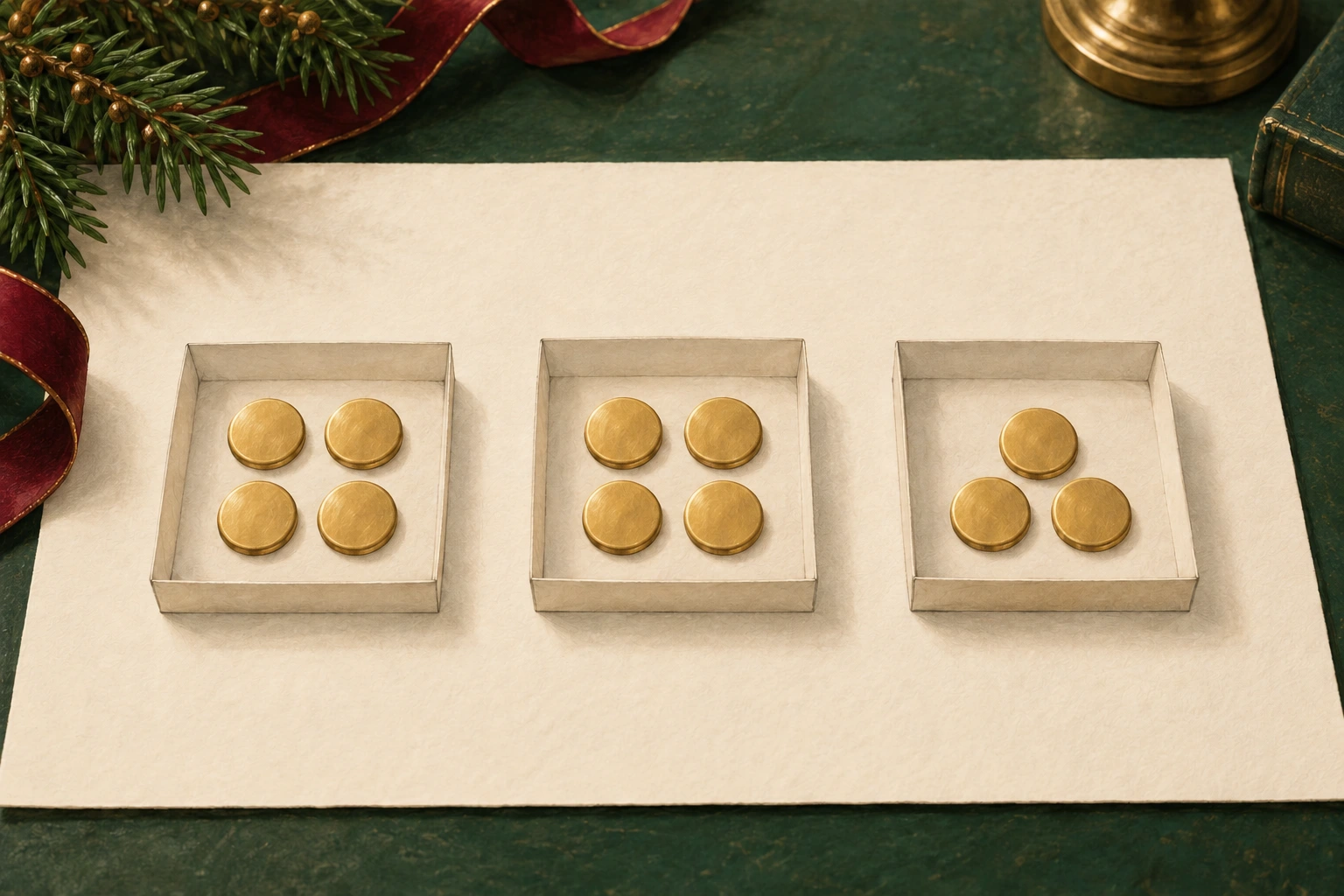
Holiday counter allocation can be explored with a fictional score that penalizes uneven counts. Put eleven identical counters into three named trays, A, B and C. The counts must be nonnegative whole numbers adding to eleven. Define the score as the square of A's count plus the square of B's count plus the square of C's count. The smallest possible score is forty-one, attained by counts four, four and three in any tray order.
This original holiday worksheet concerns a declared mathematical score. It supplies no physical load rating, staffing plan, fairness measurement or claim about time, effort or money. Identical counters carry no different task identities. The trays are named positions in the exercise, with no capacity limits or restrictions on transfers beyond keeping the counts nonnegative.
Separate the fixed total from the score
Record an allocation as an ordered triple: A's count first, B's second and C's third. Thus the record seven, three, one means A has seven counters, B has three and C has one. Their total is eleven, so the allocation is allowed. Its score is forty-nine plus nine plus one, or fifty-nine.
The total and score answer different questions. Adding the counts verifies that all eleven counters remain allocated. Adding their squares evaluates the stated objective. Every permitted allocation has the same total, but it need not have the same squared-count score. A proposed improvement must preserve the first quantity while lowering the second.
Zero is permitted. For example, eleven, zero, zero is an allowed allocation with score one hundred twenty-one. There is no separate requirement that every tray receive something. The eventual optimal counts are positive because of this objective and total, rather than because a minimum-one rule was inserted into the exercise.
Keep each count as an integer. A proposed three-way equal split of eleven thirds per tray is outside the permitted allocations. Fractional values could belong to another mathematical model, but counters here cannot be divided. The word identical removes differences between counters without allowing fractional pieces.
Calculate the effect of moving one counter
Suppose one tray has count a and another has count b, with a at least two greater than b. Move one counter from the larger count to the smaller count. The pair changes from a, b to a minus one, b plus one. Their sum stays a plus b, and the third tray is unchanged.
Before the move, the pair contributes a squared plus b squared. Afterward it contributes the square of a minus one plus the square of b plus one. Expand those two squares: the new contribution is a squared minus twice a plus one, plus b squared plus twice b plus one.
Subtract the new contribution from the old one. The a squared and b squared terms cancel, leaving twice a minus twice b minus two. That equals twice the quantity a minus b minus one. Since a minus b is at least two, this reduction is positive.
The move is allowed because the larger count is at least two and therefore contains a counter to transfer. Both new counts remain nonnegative integers. The total stays eleven, while the score strictly falls. This calculation gives a checkable reason to improve any allocation containing such a gap.
If the two counts differ by exactly one, the same transfer merely exchanges their values. For four and three, moving one gives three and four, so the pair score stays twenty-five. This is consistent with the formula: two times the quantity four minus three minus one is zero.
If the counts are equal, moving one from one to the other makes them less even and increases the pair score by two. For four and four, the score thirty-two becomes the score thirty-four at three and five. Apply the improvement rule only when the donor exceeds the recipient by at least two.
Follow a complete improving sequence
Begin with seven, three, one and score fifty-nine. Transfer one counter from A's seven to C's one. The new allocation is six, three, two. Its score is thirty-six plus nine plus four, or forty-nine. The reduction is ten, matching two times the quantity six minus one.
The largest count is now six and the smallest is two. Move another counter from A to C. The result is five, three, three. The score is twenty-five plus nine plus nine, or forty-three. The previous gap was four, so the reduction is two times the quantity four minus one, which is six.
Now A's five exceeds B's three by two. Transfer one counter from A to B. The result is four, four, three, with score sixteen plus sixteen plus nine, or forty-one. The reduction is two, agreeing with two times the quantity two minus one.
Each parenthesized formula for the reduction means twice the quantity gap minus one. Write the parentheses when checking it numerically: two times the quantity six minus one is ten; two times the quantity four minus one is six. Treating the expression as twice the gap followed by subtracting one would give incorrect reductions.
Keep the old and new triples beside their scores. The sequence fifty-nine, forty-nine, forty-three, forty-one confirms improvement for these moves. It does not yet establish global optimality, since one promising sequence alone cannot rule out a better allowed allocation elsewhere.
Show that improvement must stop
Continue applying the transfer whenever some count is at least two above another. The score is a nonnegative integer because it is a sum of squares of nonnegative integer counts. Every applied transfer lowers it by a positive integer. A strictly decreasing sequence of such scores cannot continue forever.
When no further improving transfer is available, every pair of counts differs by at most one. Otherwise a pair with a larger gap would supply another permitted reduction. This stopping property follows from the exact condition for making a transfer, rather than from a visual impression that the trays look balanced.
Three integer counts with total eleven and pairwise differences at most one must consist of two fours and one three. To check that claim, let the smallest count be q. Each other count is either q or q plus one. The total is therefore three times q plus the number of counts taking the larger value.
Dividing eleven by three leaves quotient three and remainder two. Hence q is three and exactly two counts are four. The allocation has squared score two times sixteen plus nine, which is forty-one. Naming the trays does not change this numerical score.
Use the terminal form to prove the minimum
Every allocation that is not balanced contains a gap of at least two and admits a strictly lower score. Such an allocation cannot be a minimum. Repeated improvements from any allowed starting allocation reach a balanced one with score forty-one, so no starting allocation has a score below forty-one.
The balanced allocation four, four, three is itself allowed and has score forty-one. The lower conclusion and the explicit witness establish the minimum together. This avoids assuming that a state with no improving move must always be globally optimal in every optimization problem. Here the common terminal form supplies the needed justification.
There are three minimizing ordered triples: four, four, three; four, three, four; and three, four, four. Each is identified by the named tray holding three counters. Exchanging the two trays holding four creates no new count record because both recorded values remain four.
These are allocations of counts, rather than assignments of distinguishable jobs. If eleven separately named tasks replaced the identical counters, choosing which tasks went into each share would create additional records. The present three-minimizer conclusion applies only to the ordered tray totals under the stated identical-counter model.
Check another total and preserve the declared objective
For a separate twelve-counter exercise with the same three trays and score rule, division by three has quotient four and remainder zero. The terminal counts are four, four, four, with score forty-eight. There is one ordered count record of that form because every tray has the same value.
That score is larger than the eleven-counter minimum even though the twelve-counter allocation is perfectly equal. The two exercises have different fixed totals. Comparing their raw scores does not show the extra counter made the eleven-counter allocation inferior within its own allowed set.
For ten counters, the balanced counts are four, three, three, with score sixteen plus nine plus nine, or thirty-four. The three named-tray minimizers are identified by the position of the four. These examples show how the quotient and remainder specify the terminal count pattern without prescribing an actual holiday workload.
A finite check enumerates all seventy-eight nonnegative integer triples totaling eleven. Exactly three have the smallest score forty-one. A broader control checks every allowed count vector for totals zero through twelve and one through four trays, covering 2,379 starting vectors. Each transfer preserves the total, lowers the score by its calculated amount and ends at the quotient-and-remainder pattern.
Those controls check the arithmetic over a defined finite range. The exchange and integer-descent proof explains the method for any fixed nonnegative integer total and positive number of named trays under the same unrestricted rules. A real capacity limit or forbidden transfer would change those rules and require a fresh argument.
Keep neighboring mathematical scopes distinct
The imaginary-unit pair model defines a product on ordered real pairs and proves a sum-of-squares product identity. Its scalar measure is not an allocation objective. This worksheet uses ordinary integer squares and a one-counter transfer, with no cross-coordinate multiplication rule.
The holiday task assignment count gives four distinct task cards to three named helpers, requiring every helper to receive one. It counts thirty-six owner records. Here counters are identical, empty trays are permitted, and the question is which count triples minimize a declared squared score.
Keep the native towel accounts within their evidence
The pink floral towel-pair listing has eight gallery images: coherent pink checkered-floral textiles, a pair, lifestyle views, marketing and a size diagram, plus one blank white placeholder. That blank supplies no product evidence. Dimensions, cotton, absorbency, quick drying and care remain unverified listing statements; props are not established supplied contents.
The YOKOU three-piece bathroom-set listing describes one bath towel, one hand towel and one washcloth. All seven images show the same yellow, gray and white wave design, consistent with its native description despite the Gray catalog title. Material, size, softness, drying, care and maker authenticity remain unverified.
Separate any purchasing question from the fictional score
A reader considering an unrelated purchase on republeq.com could ask whether USDT is offered as a cryptocurrency payment method for the intended order. Such an enquiry would need to identify the exact offer and quantity so any answer concerns that transaction. The scores in this exercise are invented mathematical values; they are neither prices nor token amounts. Before deciding whether to proceed, the reader could review the actual choices and terms presented for the proposed purchase and ask the responsible merchant to clarify essential missing information. If a cryptocurrency option is available, the transaction information would need to specify the asset, network, receiving destination, amount and reference linking a payment to the order. A token name alone would not settle those details. Any delivery, cancellation, return or refund question would also need an answer for that same offer, including the applicable refund denomination and conditions. An answer about an earlier basket would not establish the terms of a changed order. This article gives no wallet address, transfer instruction, conversion rate, fee estimate or assurance of recovery. It promises no current USDT acceptance or transaction outcome. The reader can finish the mathematical worksheet without making a purchase. If an order or payment status is uncertain, clarify that status through the responsible merchant before considering another payment. Keep any eventual acknowledgement and transaction record with its own order information. A correct score minimum cannot establish that funds were sent, accepted or reconciled, and a payment record cannot validate a proposed allocation. Each question needs the evidence appropriate to the decision being made.
For the original eleven-counter holiday counter allocation, retain the fixed total, integer rule and squared-score definition beside the three minimizing records. The answer forty-one follows from the permitted exchange and common terminal pattern. The initial seven, three, one record remains useful for checking each reduction on a complete route to four, four, three.