Product Compatibility & Accessories
Hex bit socket compatibility: match the square drive
Separate a hex bit socket’s square drive from its tip size. Read TEKTON’s 1/4-drive ratchet and 3/8-drive bit kits against both requirements.
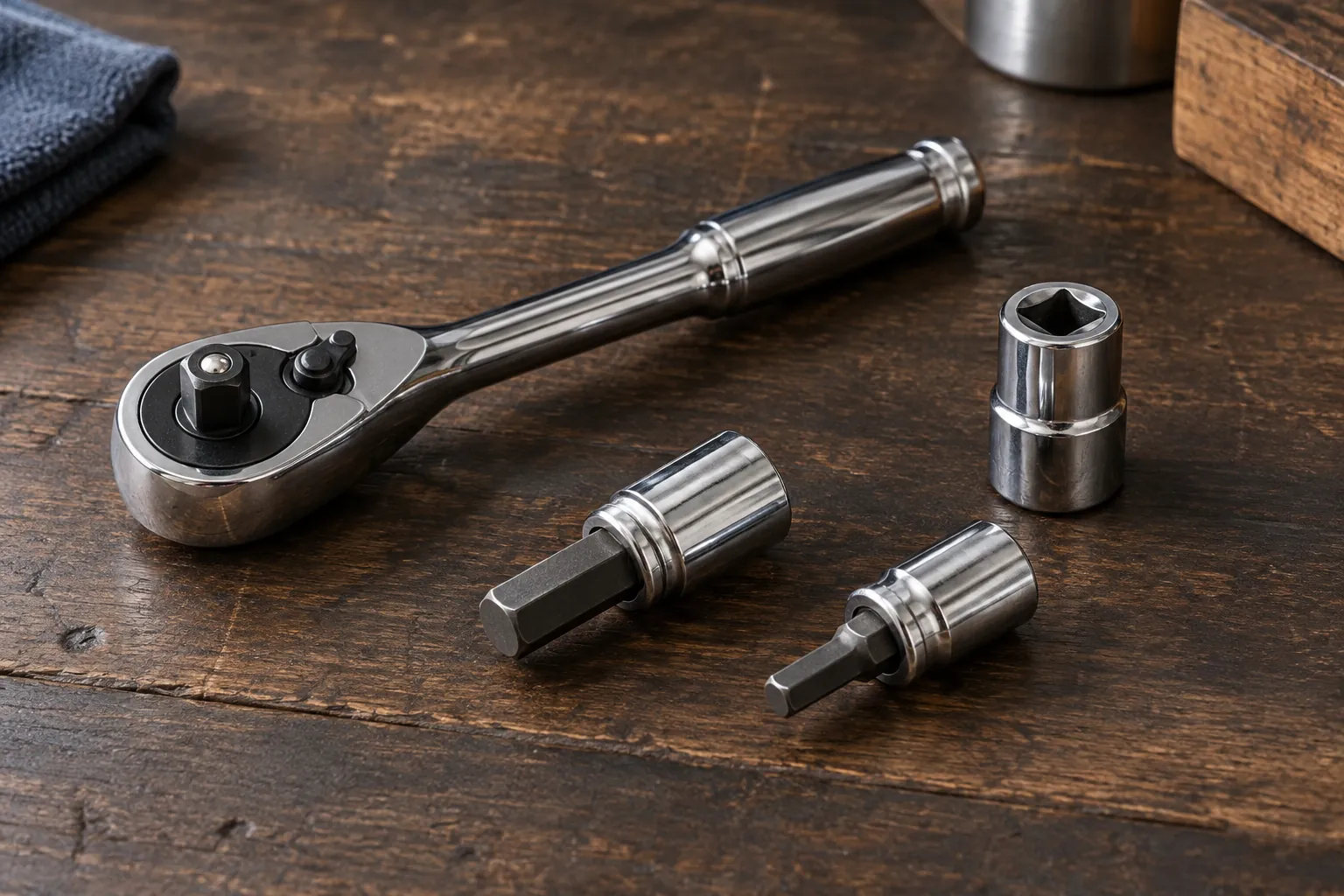
Hex bit socket compatibility involves two connections: the socket's drive end meets the driving tool, while the projecting hex tip meets the fastener's recess. Identify both before choosing an accessory. A quarter-inch figure can refer to one end of a tool without establishing the size or shape of its other end.
The TEKTON SDR99009 ratchet-and-spinner kit and SHB91316 hex-bit socket kit illustrate the distinction. The former is a 1/4-inch-drive set. The latter is a 3/8-inch-drive set whose hex-bit range includes inch and metric sizes. These two kits do not form a direct square-drive pairing just because some numbers in their titles resemble one another.
Start at the connection to the ratchet
The TEKTON SDR99009 ratchet and spinner-handle set is explicitly labeled 1/4 Inch Drive. Its description names a 90-tooth gear, a four-degree swing arc, a compact head and a non-quick-release style. Those feature statements do not change its named drive size.
TEKTON's exact SDR99009 page identifies the five-piece set as non-quick-release and lists several ratchet lengths plus a spinner handle. It also calls out a 1/4-inch drive square. That square-drive designation is the relevant starting point when choosing a socket to connect directly to the kit's driving tools.
Ask the connection question in full: what square-drive size does the actual socket require, and what square-drive size does the actual driving tool provide? This names the relationship to establish. Asking only whether a tool is quarter inch leaves open which part or measurement the speaker means.
Square drive size versus hex bit size
For square drive size versus hex bit size, follow the tool from the ratchet connection to the fastener-facing tip. The square-drive label identifies the driving-tool interface. The hex-bit size identifies the hex tip intended for a matching recess. Keep the shape and location with each measurement rather than reading every inch figure as the same connection.
The TEKTON SHB91316 hex-bit socket set is labeled 3/8 Inch Drive, with a stated range of 1/8–3/8 inches and 3–10 millimetres. The drive label and bit-size ranges have different jobs in that title. The range does not turn the socket bodies into a collection of different square-drive sizes.
The manufacturer's March 2025 catalog places SHB91316 in its 3/8-drive hand-drive bit-socket section. Its exact entry describes 38 standard and long hex pieces in those inch and metric ranges. That is source support for the set's configuration, without relying on a photograph to invent which drive belongs to an individual socket.
Matching a ratchet to a bit socket needs the drive label
For matching a ratchet to a bit socket, the selected kits give a clear nominal mismatch: a 1/4-inch drive on SDR99009 and a 3/8-inch drive requirement on SHB91316. Treat them as different direct-connection sizes. The hex tip chosen for the fastener does not remove that mismatch at the other end.
Imagine someone who owns the SDR99009 kit and needs a quarter-inch hex bit for a particular documented fastener. Seeing quarter inch within SHB91316's bit range answers a question about the tip selection. It does not answer the separate question about attaching that 3/8-drive socket to the person's 1/4-drive tool.
A more complete accessory enquiry states both requirements: the identified tool's square drive and the required hex tip. The supplier can then address the proposed tool and fastener requirements together. A reply confirming only the presence of a quarter-inch hex bit remains useful about the tip, but leaves the driving-tool connection unresolved.
Two ends can share a number without sharing a shape
A square-drive measurement and a hex-tip measurement can use the same unit and even the same numerical size. They still describe different geometric interfaces. The hex tip belongs at the fastener end of this kind of socket. A familiar number on that tip is not evidence that the ratchet connection has the same designation.
Picture a loose bit socket on a bench, without connecting it to anything. Identify which end carries the projecting hex bit and which end belongs to the driving tool. Then read the documented size for each role. This is an identification exercise, without an instruction to try an uncertain fit, force parts together or use the tool on a fastener.
The native SHB91316 account says its S2-steel bit is press-fit into the socket as a permanent connection. That statement describes a bit-socket assembly. Do not silently reclassify the product as a pack of loose removable bits when asking about another kind of bit holder. The complete offered component is what the compatibility enquiry needs to identify.
Inch and metric sizes belong to the fastener question
SHB91316's inch and metric ranges provide two sets of tip-size information. Preserve the required fastener's actual size and form when choosing within them. A millimetre label and an inch label should retain their units; similar-looking numbers or nearby positions in a storage case do not establish the same fit.
The presence of both unit systems does not make every tip suitable for every hex recess. Read the applicable fastener requirement rather than selecting by approximate appearance. If the required size is unknown, identify it before asking a supplier to confirm an accessory. This guide provides no method of testing an uncertain tip in an installed or damaged fastener.
Conversely, identifying the correct tip size completes only that part of the enquiry. You still need the socket's drive to match the intended driving tool, along with applicable use requirements. Keep these as two positive requirements to satisfy, rather than allowing one confirmed size to stand in for the complete combination.
Standard and long describe another dimension
The official SHB91316 catalog entry distinguishes standard and long hex pieces while keeping the set under the same 3/8-drive heading. Length and drive therefore remain separate entries. A longer bit is not the manufacturer's label for changing the square-drive connection to a different size.
A person may need to investigate access around a particular fastener after establishing its tip size and the tool's drive. That is a real additional question, but a standard-or-long label alone does not document every surrounding clearance. Identify the actual access requirement and the relevant component dimensions before treating a length choice as a confirmed solution.
Keep any access answer attached to the configuration it concerns. If a supplier discusses one long bit and a particular driving tool, do not expand that answer to every piece in the set. Likewise, an acceptable nominal square drive does not prove that the assembled tool reaches every intended location.
Ratchet length and swing arc do not select a socket drive
SDR99009's 90-tooth and four-degree statements describe its ratchet mechanism. They are different information from the 1/4-inch-drive label. A four-degree figure is an angle, not a fraction-inch socket connection. Read it with the ratchet feature it describes rather than moving the number into the accessory-size question.
The manufacturer's named ratchet lengths likewise identify pieces within that kit. A longer handle does not relabel a 1/4-inch driving interface as 3/8 inch. This article supplies no extension, leverage or torque procedure, and no permission to modify a handle or use a tool beyond its applicable requirements.
The SHB91316 description separately names four detent grooves for engagement with the drive tool. That is an attributed retention feature. The groove count does not supply an adapter, change the nominal drive size or establish that two differently labeled square drives connect directly.
Separate the interface from a performance feature
The microscope eyepiece-fit guide separates a 10X optical-power label from the mounting-size requirement. Its EP10X23P pointer account names a 23mm mounting size, while the selected 10X pair names 30mm. Those actual examples show why the power and mounting labels must retain their roles. An optical-power match cannot supply the mechanical fit, just as a matching hex-tip size cannot supply the socket's ratchet interface.
The comparison provides no optical dimension to use for these tools. It helps organize the enquiry: identify the performance or working-end requirement and the separate connection requirement. For the selected TEKTON kits, the decisive direct-connection labels remain 1/4-inch drive and 3/8-inch drive.
A larger kit is not a different compatibility answer
The binding-spine compatibility guide keeps comb and wire formats, stated pitch and document-capacity figures distinct. Its supplied-spine examples show why a large machine capacity does not establish the required supply. Here, a 38-piece bit kit likewise needs the correct drive for the intended driving tool, regardless of how many tip sizes it supplies.
Use the piece count to understand the identified package, without treating it as evidence of a different interface. The five-piece SDR99009 account concerns ratchets and a spinner handle. The 38-piece SHB91316 account concerns bit sockets in the stated configuration. Neither count changes the two drive labels.
Put two size fields in an accessory enquiry
Consider a fictional request for a hex-bit socket for an already identified 3/8-square-drive hand tool and a documented quarter-inch hex recess. The catalogue's quarter-inch hex entry addresses the working end, while SHB91316's 3/8-drive designation addresses the driving end. Those nominal labels answer the two requested size fields. Applicable tool, fastener and use requirements still belong to the actual task; this is no report of an assembly being tested.
Now change the request to an identified 1/4-square-drive hand tool with a documented six-millimetre hex recess. The selected SHB91316 range contains the six-millimetre tip size, but its 3/8-drive label remains unchanged. That makes it an incomplete direct match for this request. Seek an accessory account that addresses both stated requirements instead of treating the presence of the six-millimetre bit as the complete compatibility answer.
Finally, imagine an enquiry that says only three-eighths socket, without explaining whether the number concerns the drive or the fastener-facing tip. Ask which interface the measurement identifies. The same fraction can occupy either size field in a description of a particular bit socket. A full reply should name the component, its drive and its hex size, so another person can understand the proposed combination without guessing which end was meant.
Confirm the intended combination before choosing the accessory
In an enquiry about the two selected offers, identify SDR99009 as the 1/4-drive kit and SHB91316 as the 3/8-drive bit-socket kit. Ask for the appropriate directly matching accessory or driving-tool configuration, with the required hex size included. This article has not verified an adapter arrangement or approved powered-tool use.
If the proposed answer introduces another component, give that component its own exact reference and applicable requirements. Do not assume an unnamed adapter arrives with either selected package. A complete answer needs to identify the actual combination being proposed, rather than silently change the direct-connection question into a different assembly.
Hex bit socket compatibility is clearer when the drive square, hex tip and any access requirement are stated separately. The selected TEKTON ratchet kit's 1/4-inch drive and bit kit's 3/8-inch drive remain different. Match the driving-tool interface first, then confirm the actual fastener-facing size and the requirements of the intended configuration.
Hex bit socket compatibility concerns the drive and working ends separately; conceptual cover shows generic unconnected hand tools without exact-model, dimensional-fit or operating claims.