Product Compatibility & Accessories
Microscope eyepiece fit: 10X and mounting size are separate
Compare microscope eyepiece fit through the actual EP10X23P pointer and two-eyepiece 30mm offer, keeping 10X, field width and mounting statements separate.
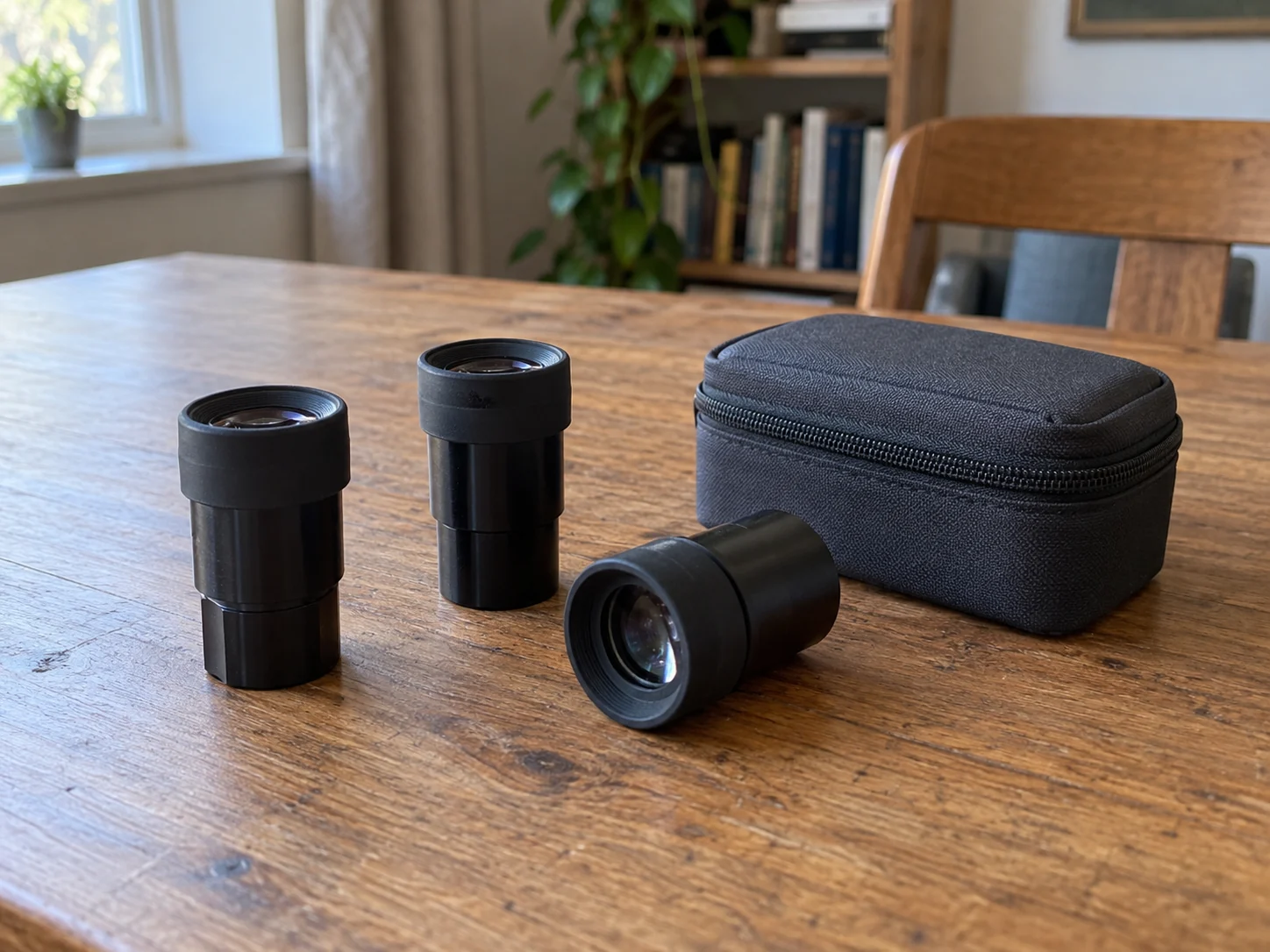
Microscope eyepiece fit cannot be established from a 10X label alone. Magnifying power and mounting diameter describe different properties. Two eyepieces can carry the same power label while their mounting-size descriptions differ. Keep the microscope's actual requirements beside the accessory's mechanical and optical specifications before choosing a replacement.
The selected offers make that distinction concrete. The AmScope EP10X23P names a WF10X pointer eyepiece with a 23mm mounting statement. The other offer names two 10X super-widefield eyepieces with a 30mm mounting statement and a separate 20mm field-of-view statement. Retain each millimetre value with its field or mounting label.
Eyepiece mounting diameter is a separate specification
For eyepiece mounting diameter, start with the number explicitly labelled mounting size. The AmScope EP10X23P pointer-eyepiece offer states a 23mm mounting diameter and a built-in pointer. Its name supplies the WF10X designation. Its brief description calls the view widefield without giving a numeric field width.
The AmScope two-eyepiece super-widefield offer states 10X magnifying power, 20mm super-wide field of view and a 30mm mounting diameter. Read 20mm as the stated field figure and 30mm as the stated mounting diameter. The source does not call twenty millimetres the mounting diameter, and it does not call thirty millimetres the field-of-view measurement.
A replacement decision needs the microscope's own documented interface as well as the accessory's statement. A photograph of a similar black barrel does not provide that interface. Neither a familiar brand nor an apparently similar body establishes the diameter or the complete compatibility of the actual combination.
This guide supplies no removal, insertion, sleeve modification or other optics-changing procedure. Establish the actual instrument and applicable accessory requirements before arranging the change. A compatibility question that remains open is not resolved by attempting to force an unverified component into place.
Preserve the EP10X23P manufacturer wording
The manufacturer's current EP10X23P page titles the item as one eyepiece with 10X magnification, a 23.2mm diameter and a pointer reticle. Its descriptive text calls the outside diameter approximately 23mm, while its feature list and mounting table use 23mm. Retain those actual forms rather than rewriting the selected retail label as an independently measured value.
Those labels do not supply a tolerance rule. Do not infer that every instrument described as 23mm or 23.2mm accepts every accessory described by either figure. The page's broad statement about fitting common compound microscopes is not a model-specific approval for an unexamined instrument.
Use the exact EP10X23P identifier when asking about the supplied accessory and the microscope's actual model when asking about fit. Keep the manufacturer's dimensional wording in the question if the instrument's documentation uses a different form. A reply should address that combination rather than merely repeat that the accessory is a common size.
The manufacturer's page also describes this eyepiece as non-focusable. That is a statement about this accessory, not a statement that the microscope has no focusing controls. It does not turn the pointer into an adjustable ocular diopter or supply a way to replace the instrument's documented relative-focus adjustment.
Keep 20mm field wording with the 30mm pair
The manufacturer's EP10X30 page describes a pair of WH10X/20MM eyepieces with an approximately 30mm outside diameter, a 20mm super-wide field-of-view statement and a high-eyepoint design. Those claims help explain the separate power, field and mounting labels. The selected retail offer has its own title and contents account; this reference does not independently confirm every delivered variant or package detail.
Retain the stated 20mm super-wide field wording. It is not a measurement of the specimen or a promise that a twenty-millimetre-wide object will be visible under every microscope configuration. Nor does that figure identify the width of the opening into which the eyepiece should be fitted.
The retail pointer description supplies no comparable numeric field width. That omission does not establish a zero field, an inferior image or a particular difference from the pair. It means the two selected descriptions do not provide a matched numeric field comparison. A super-widefield label alone also supplies no controlled image-quality test.
The high-eyepoint wording belongs to the manufacturer's described pair. It does not establish comfort for a particular observer or identify the actual eye position that will work for someone. Keep a viewing preference separate from the mechanical interface and from an unperformed comparison of the two products.
Read standard-size and application wording with the dimensions
Both manufacturer descriptions use achromatic and international DIN/JIS standard-size wording. The pointer account still gives an approximately 23mm outside diameter, while the pair account gives approximately 30mm. The shared standard-size language does not remove those different dimensional statements. Preserve the actual diameter when requesting compatibility information instead of shortening either description to “standard microscope eyepiece.”
The pointer manufacturer page describes fitting common compound microscopes, while the pair page describes common stereo microscopes. Those are broad application accounts. They do not identify every model in either class or approve all instruments that share a general category. A reply about a specific microscope should address its interface and supported accessory arrangement, including any relevant model or revision distinction.
The second retail title does not include the manufacturer's EP10X30 identifier, even though its stated 10X, 20mm field and 30mm mounting figures correspond to the reference page discussed here. Treat that correspondence as useful source context. It does not independently confirm the exact supplied manufacturer variant or turn a general page into a packing receipt for the selected offer. Resolve that identity if it affects the accessory decision.
Pointer eyepiece versus a pair changes the inventory question
For pointer eyepiece versus a pair, first identify what the intended change requires. EP10X23P is presented as a pointer eyepiece, and the manufacturer's title identifies one. The other selected offer explicitly names two eyepieces. One special-purpose ocular and a pair are different package accounts even when their power labels both say 10X.
A built-in pointer is a named viewing feature. The selected description does not provide a graduated measuring scale, calibration method or certified measurement result. Do not turn the pointer wording into a claim that an observed object can be measured from that feature alone.
If the task requires a pointer, confirm that the selected unit and the actual microscope arrangement support that task. If it requires replacing a matched pair, establish the relevant pair requirements and supplied quantity. Buying one item because its title says 10X does not establish that the entire intended binocular arrangement has been supplied.
This is not a directive to buy two pointer eyepieces or to combine the pointer with an unspecified existing ocular. The actual instrument's instructions and supported configuration determine the appropriate arrangement. Keep the number of pieces needed as a requirement to confirm, rather than deriving it from a general description of a binocular head.
A matching power label is only part of the question
The 120 Series manual used in the B120C binocular-view guide requires matching eyepiece magnifications for its installed pair. That is an optical pairing requirement. It is not an approval for either accessory here simply because its title includes 10X.
That actual guide preserves a separate source discrepancy between the B120C retail interpupillary range and the 120 Series manual, and keeps the SE305R-AZ stereo account separate. Its alignment and diopter instructions concern an already correctly set-up instrument. They provide no replacement-eyepiece installation or dimensional-tolerance rule.
In the 120 Series reference, the eyepiece interface is described as 23.2mm. The SE305R-AZ retail account describes a 30.5mm eyepiece specification. Those source statements do not independently approve the selected 23mm-labelled pointer or the 30mm-labelled pair for either microscope. Preserve the actual values and obtain exact compatibility documentation instead of rounding them into a fit claim.
Keep interpupillary adjustment separate from mounting diameter too. One concerns the observer's alignment with the ocular tubes; the other concerns the accessory's mechanical mounting description. Changing the observer's spacing cannot establish an unverified replacement's mechanical fit.
Work through the actual requirement before ordering
Consider a fictional request for an accessory to an instrument whose documentation states a 30.5mm interface. The selected pair's mounting statement says 30mm. Record both values. This guide supplies no permission to treat the difference as a known clearance, an acceptable tolerance or proof that the parts cannot fit; the exact combination remains to be confirmed.
In another fictional request, a teacher wants a pointer feature for an already supported viewing arrangement. The relevant inventory question includes whether the supplied item is the EP10X23P pointer and whether that exact arrangement is supported. A pair of standard eyepieces would not answer the pointer-feature question merely by supplying two pieces.
A third request might be for a wider view while retaining the existing microscope. The 20mm super-wide field statement is relevant to investigate, but the actual instrument and optical configuration still matter. Establish compatibility and the intended viewing result separately rather than treating a field label as a complete upgrade plan.
Ask about the specific mounting or configuration requirement. Name the instrument, the selected offer and the requirement that would change the decision. A response about broad brand compatibility would not establish the missing mounting or configuration detail. A response about image clarity would not, by itself, identify which package is supplied.
Do not borrow a different meaning of X
The actual camera zoom-ratio guide reads the Canon G7 X Mark II kit's advertised 4.2X optical zoom and equivalent focal-length range beside a separate 1000mm manual-lens designation. Its ratio concerns a camera lens's range, not a microscope eyepiece's mounting diameter.
That distinction is useful when comparing optics listings across categories. A shared X character does not establish a common mechanical interface or an equivalent viewing result. No Canon camera compatibility statement, focal-length figure or camera zoom ratio is transferred to the microscope accessories in this guide.
The selected 10X eyepiece labels remain magnifying-power statements. They do not supply the microscope's complete optical arrangement, a measured image resolution or a guarantee that the two offers give an identical view. Keep the accessory requirement tied to the actual instrument and the specific task.
Retain the confirmed combination and package
Before placing an order, keep the selected offer and any model-specific confirmation together. Preserve whether the answer concerns one pointer eyepiece or the two-eyepiece pair, and retain the exact mounting wording used. A later answer about a different accessory variant should not silently replace the confirmation for the item you intended to buy.
If the relevant detail remains unresolved, leave it as the next product question. The two descriptions already provide useful distinctions: power, mounting size, field wording and pointer or pair inventory. Use those distinctions to identify the mounting or package question that remains.
Use microscope eyepiece fit for the actual combination you need to establish. Keep the power, mounting diameter and field statement beside the selected offer. Confirm the supported instrument and package, then follow its applicable accessory instructions for any eventual change.
Microscope eyepiece fit requires the actual mounting and optical requirements; this conceptual cover shows generic inactive eyepieces without a measured diameter, reticle view or installed combination.