Product Compatibility & Accessories
Heritage banjo capo compatibility: read standard and wide limits
Read Heritage banjo capo compatibility across standard and wide variants: the nut-width statements overlap, and neck width is a separate requirement.
Heritage banjo capo compatibility starts with the width statements behind the standard and wide labels. G7th publishes width statements for both Heritage banjo variants, and the stated nut-width figures overlap. Keep the instrument reference and the particular variant together while checking those statements. Use the numbers to screen a proposed pair; a physical fit assessment still needs the actual instrument.
This guide compares the S1S and S1W retail offers with G7th's actual banjo-width information. It supplies no attaching sequence, pressure setting, tension adjustment or instrument modification. Establish the applicable match before carrying out any operation under the instrument and capo instructions.
Identify the standard and wide Heritage banjo capos
The Heritage Banjo S1S offer names Standard String Spacing and gives item number G7HTGB1S. The separate Heritage Banjo S1W offer identifies model G7HTGB1W and describes wide string spacing.
Keep those references when comparing standard and wide Heritage banjo capos. The final letter is part of the item you are investigating, rather than a detail to discard after finding the brand. If someone sends a link to another Heritage variant, read that proposed item separately instead of carrying the first offer's identity into the new answer.
Identify the actual banjo too. If you are buying for another player, obtain that person's instrument reference and the information relevant to the proposed use. A general description such as a friend's banjo leaves the eventual compatibility answer without a specific instrument to address.
Read the manufacturer's stated width limits
G7th's sales presentation lists Standard Banjo as fitting up to 36 mm nut width, and Wide Banjo as fitting 35 mm and wider nut widths. Its actual wide-banjo product page also states a maximum neck width of 45 mm.
These are the maker's stated millimeter figures. Keep nut width and neck width attached to their respective statements. Do not rewrite the wide page's maximum neck-width footnote as a different maximum nut-width specification. The location and meaning of a dimension belong with its value when you compare the instrument against it.
The figures also should not acquire extra precision through a conversion exercise. This article uses the maker's millimeter statements without presenting them as measured manufacturing tolerances. If a borderline instrument needs a more specific answer, ask for the applicable guidance rather than adding decimal places to a published figure.
The nut-width statements overlap
The stated nut-width ranges share the interval from 35 to 36 mm. That is why the word wide cannot be turned into an invented rule that every banjo at or above the lower figure must use only the wide variant. Equally, the overlap does not establish that both capos are interchangeable in every respect or that either will fit at every intended playing position.
Consider a fictional five-string banjo whose documented nut width is 34 mm. That number is below the wide variant's stated starting figure and within the standard variant's stated upper limit. It gives the enquiry a direction, while leaving the actual instrument and any remaining fit requirements to be checked. It does not supply an installation or adjustment instruction.
Now imagine a different instrument documented at 35.5 mm at the nut. That fictional figure sits within the overlap of the published nut-width statements. Choosing from the labels alone would hide the question rather than settle it. Keep both candidate references in the enquiry and ask which variant is appropriate for the actual instrument and intended use.
A third fictional instrument has a documented nut width of 37 mm. That exceeds the standard statement and meets the wide statement's minimum. It still leaves the separately stated neck-width maximum and the actual application to establish. Meeting one numeric statement should not be reported as a completed assessment of every requirement.
Keep banjo nut width and neck width distinct
The phrase banjo nut width and neck width identifies two descriptions that need their stated context. A number taken from the instrument's documentation must retain what was measured and where. Do not replace one description with the other merely because the same ruler unit appears beside both.
For the fictional instrument in the overlap, the next enquiry can name the documented nut-width value and ask what additional information is needed for the proposed position. This guide supplies no measurement procedure, fret-location rule or clearance allowance. Use the instrument's applicable information and the maker's guidance to establish any remaining dimension.
If a reply provides a measurement, retain its location and meaning. A bare number copied into a shopping message can lose the qualification that made it useful. Someone reviewing the proposed pair later should be able to tell which part of the instrument the information describes.
A string-spacing label is not a measurement method
The retail offers use string-spacing wording, while the manufacturer statements above name nut width and neck width. Do not treat a nut-width value as the distance between strings. Nor does a string count by itself provide either width. Keep the supplier's variant name and the actual quantity being checked as separate pieces of the comparison.
This matters when a helper sends a photograph with a note that the spacing looks standard. A photograph can identify which instrument or item is being discussed, but that note does not establish the dimension required by a particular source statement. Ask for the actual information needed instead of turning an impression into a measured value.
A reply that simply repeats standard or wide can therefore leave the important question open. Retain the full model reference and ask which published requirement the answer addresses. The answer becomes more useful when it identifies the instrument, the variant and the relevant specification together.
Keep the individual playing position in the enquiry
An answer about one instrument and use should remain attached to that situation. If the intended position changes during the discussion, state the change rather than assuming the earlier answer automatically covers it. This is a request for applicable fit information, not an invitation to try extra force or invent a modification.
For a shared instrument, describe what each person expects to do before deciding that one answer settles both uses. The purpose is to identify the actual question the manufacturer or knowledgeable supplier needs to answer. A response about an unidentified banjo cannot become more specific merely because it is copied into a group conversation.
Separate a feature from the width requirement
A familiar feature name or control description does not remove the need to read the variant's stated scope. If an answer discusses how a capo adjusts, keep that explanation separate from whether the selected item suits the actual instrument. Knowing what a control does and establishing the proposed match are different tasks.
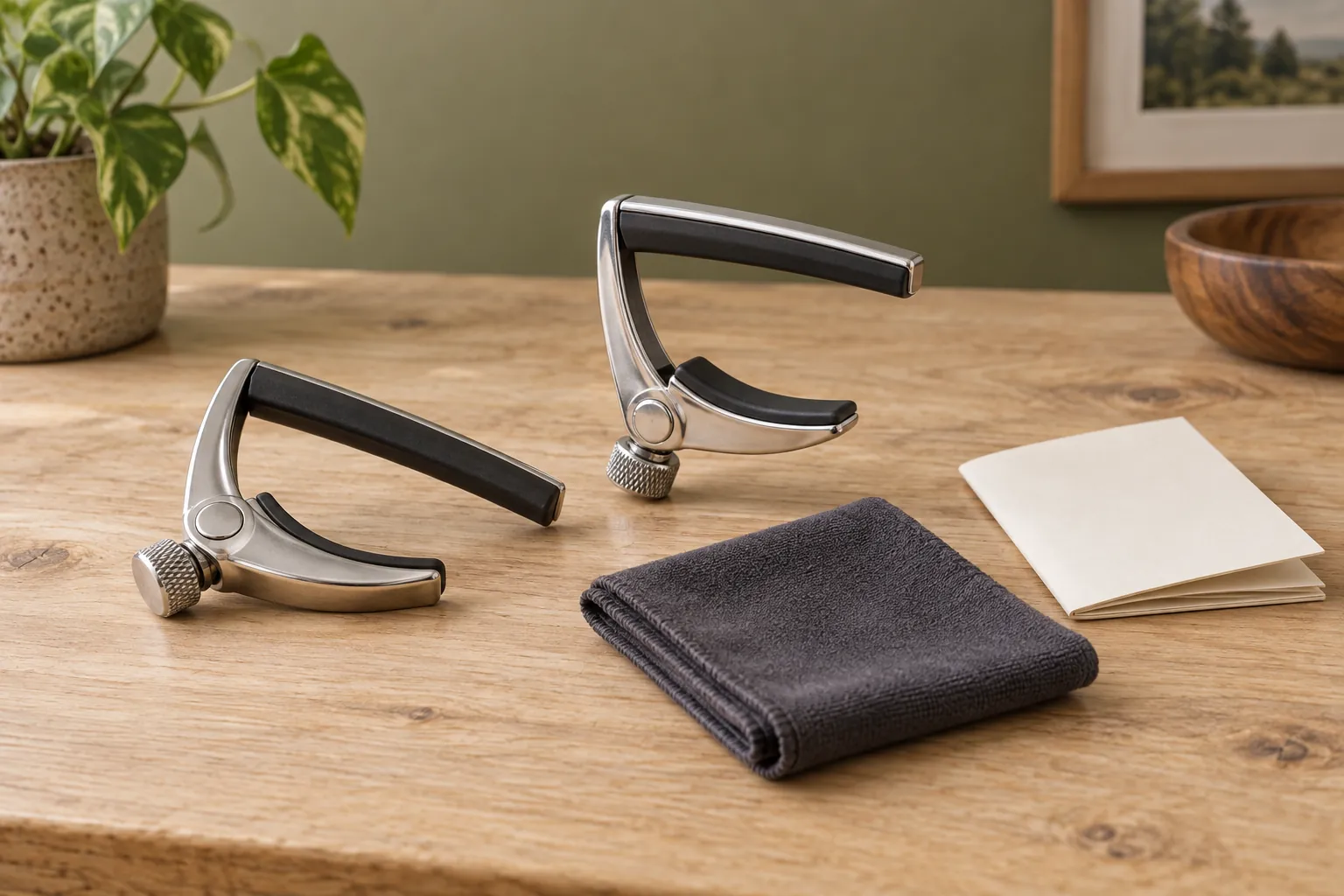
This comparison does not use a product photograph as a dimensional drawing. The generic cover also supplies no scale, fit evidence or model identification. Use the actual item reference and the applicable published information, rather than estimating a usable opening from an image.
Read the earlier instrument-variant guide at its scope
The capo instrument-variant guide compares Performance 3 and Newport offers. Its question is which instrument and particular variant an account actually identifies. Those are different models from the two Heritage offers here, so its range descriptions do not supply substitute Heritage width specifications.
The Heritage comparison addresses a specific numerical question: the published nut-width statements overlap, while another statement describes neck width. Retain the exact quantity and the Heritage variant when asking about that issue.
A second specification can remain unresolved
The binding-spine compatibility guide keeps format, pitch and sheet-capacity information separate. Its office examples supply no capo dimensions. The same reasoning applies here: an answer about one requirement can leave another requirement open.
Apply that care to a response about the nut-width screening figure. Keep any remaining instrument or neck-width question visible. A partial answer can still be useful when its limits are stated, and it should not acquire a broader meaning as it passes from one person to another.
Read a recommendation against the question it answers
Imagine that you send the fictional overlap case to a supplier and receive this reply: “Choose the wide one.” That is a recommendation, but it leaves you to guess which offer the supplier reviewed. Respond with the item reference and ask whether the answer applies to the instrument you described. A short answer can be sufficient when the question was complete; a short answer to an incomplete question needs clarification.
Now imagine that the reply discusses a different banjo owned by the same player. The advice may be perfectly useful for that other instrument, but it has not answered your enquiry. Correct the instrument reference before accepting the recommendation. This is especially easy to miss when someone forwards an older conversation and the new recipient sees only the latest message.
A third reply might explain the meaning of a specification without recommending a variant. You have learned something useful, yet the choice remains open. Ask the outstanding question directly. Do not turn an explanation into an endorsement by writing “the supplier confirmed compatibility” when the supplier only clarified a term.
Resolve conflicting descriptions before choosing an offer
Suppose the player calls an instrument “wide neck” while its documentation uses a model name and a dimension. Send the actual documentation reference with the enquiry. The everyday description can stay in the message as context, but it should not replace the information the recipient needs to evaluate the proposed match.
If two documents appear to describe the same instrument differently, check whether both concern the same version before drawing a conclusion. A useful clarification identifies which document applies to the instrument in hand. Averaging two values, selecting the more convenient description or treating one as a correction without evidence would leave the original uncertainty unresolved.
For a gift, this may mean asking the player for information before selecting the variant. A surprise is less useful if the recipient must work out which instrument the recommendation concerned. You can keep the occasion private while asking an ordinary equipment question. Once an applicable answer arrives, choose the offer it actually identifies.
Write the final fit question around the actual pair
A clear enquiry identifies the banjo, the chosen Heritage item and the specific point that remains to be established. For the fictional overlap case, include the documented instrument information and ask which variant is appropriate for the intended application. This is an invented example of an enquiry, not an actual manufacturer approval.
If the answer recommends a different item, check that item's own reference and applicable information. Do not leave the original S1S or S1W offer attached to a recommendation for something else. The item eventually selected should be the one the answer actually addresses.
Heritage banjo capo compatibility is clearer when the published limits retain their quantities and the answer retains the instrument and variant. Use the overlap to ask a precise question. Complete the choice only when the remaining requirements for that actual pair have an applicable answer.
Heritage banjo capo compatibility concept with two complete generic uninstalled capos; the cover is not an exact model, dimensional comparison or fit demonstration.