Educational & Explainer Articles
Handbell and deskbell actions: ringing or pressing
A consumer explanation of hand ringing and desk pressing, using actual offer limitations and separately identified manufacturer accounts.
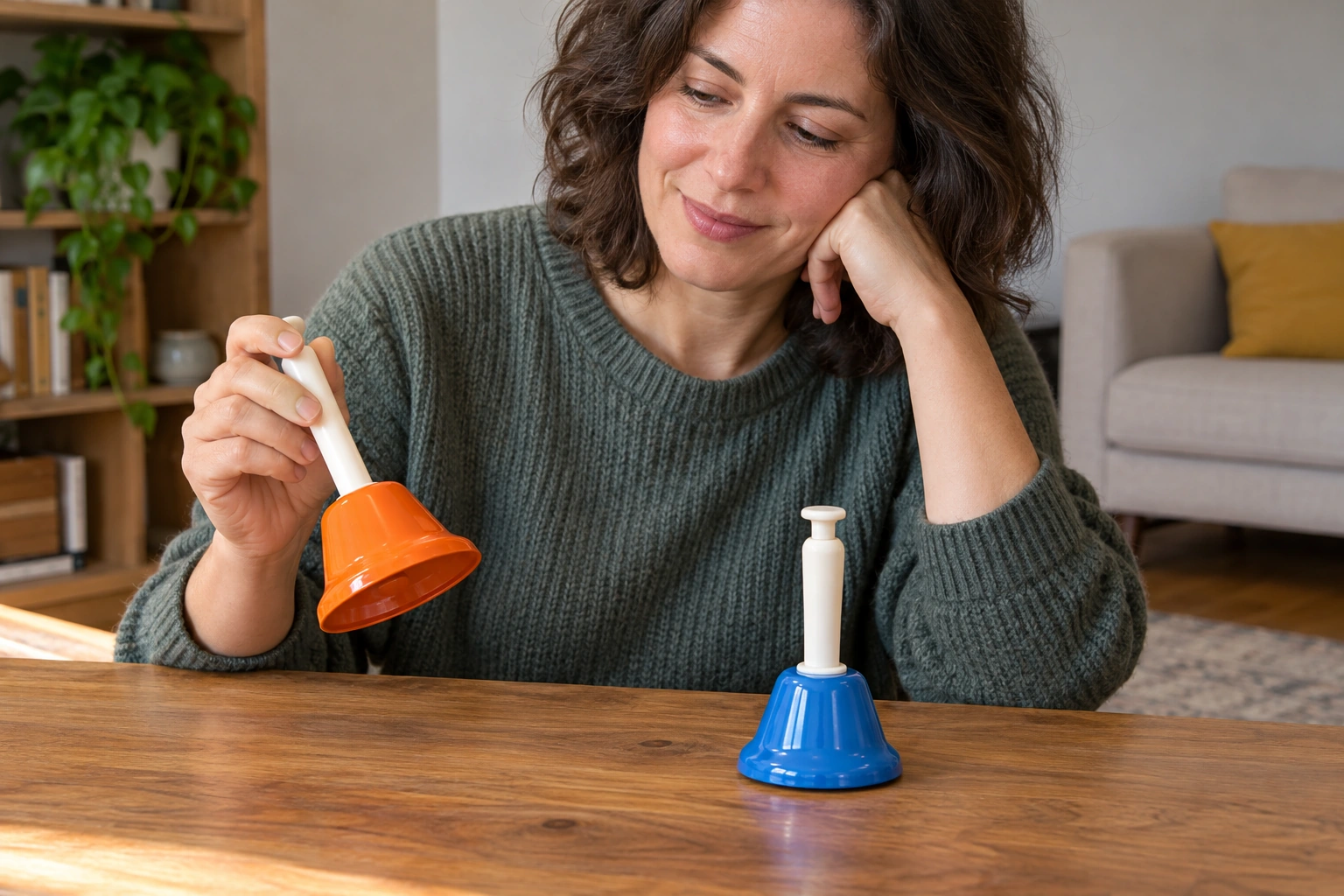
Handbell and deskbell actions describe how a player starts a sound. A hand-ringing arrangement moves the bell; a desk-playing arrangement provides an action while the instrument is supported. Read the product's stated method before treating a coloured top as a button or assuming that a bell intended for one action permits another. This explanation gives no playing trial or model-specific operating sequence.
The distinction matters when choosing equipment for a musical activity. Someone may want bells that can be picked up for ringing, while another arrangement calls for instruments that remain in place. Establish the intended activity and the applicable instructions first. A title containing both hand and desk does not settle every question about the selected set, its controls or its contents.
Describe the movement you want to use when asking about equipment. If bells are to remain on a table, say that. If the activity involves picking them up and putting them down between entries, say that instead. The answer should address the chosen model and the intended arrangement. A general assurance that bells are easy to play leaves those practical questions open.
You can also ask for a demonstration tied to the selected item and its instructions. Look for the action being shown, where the instrument is supported and which control or handle the person uses. Keep an unanswered question visible if the demonstration shows a different model. Watching an unspecified bell does not establish an operating sequence for the one you plan to order.
The bell body and the part that strikes it
A bell is a struck percussion instrument. Its body vibrates after a strike, with the hollow sides acting as a resonator. The striking part can be an internal clapper or an external hammer; a small enclosed jingle bell can instead contain a loose sphere. Knowing that an object is called a bell does not identify every part of its striking mechanism.
The general bell description also includes several possible materials, rather than requiring every bell to have the same alloy. That matters when looking at a bright painted surface. Colour alone does not identify the material beneath it. Use the actual item's specifications when the material affects your purchase, and keep an illustration of a typical bell separate from evidence about a particular retail instrument.
The part you move and the body that rings need to remain distinguishable in your explanation. A handle gives a person an interface with the instrument; a clapper or other striker makes contact with the sounding body. An action name describes a way of initiating that contact. It is not a complete account of construction, permitted handling or the musical result of a particular attempt.
Hand ringing uses the internal bell clapper
An internal bell clapper is part of the general handbell account: the player moves the bell so that the clapper strikes its inside. An individual handbell can be used for signalling, and tuned sets can be used for music. Those uses do not establish a single universal handle, clapper mounting or movement for all products carrying the name.
English-style handbells provide a specific example. Their clapper is hinged to move in one plane, and a spring keeps it away from the bell after a strike so the body can ring. That description belongs to that form of instrument. It should not be assigned automatically to a small educational set because a photograph also shows a handle and something inside a bell.
Starting a sound and stopping it are separate parts of playing. The general handbell account describes a ringing tone decaying unless it is damped. It also describes specialist techniques for particular instruments. This article supplies no damping method for either retail set. A product's named playing action does not by itself establish an automatic duration or permission to apply a technique taken from another instrument.
A desk bell push button needs an actual product statement
A desk bell push button is an interface question to resolve for the model you intend to buy. A round cap or coloured marker in a photograph is not an operating instruction. Ask whether the actual product permits a pressing action, how the instrument is meant to be supported and where its complete instructions can be found. Leave an unspecified action unresolved rather than testing a guess against the goods.
The Rhythm Band Kid's Play hand/desk offer explicitly describes playing by a push button or hand ringing, with a mechanism claimed to reduce double ringing. Its title names a seven-note extension set, while its description says complete thirteen-note full-octave set. Confirm the selected contents; those conflicting accounts are not reconciled here.
The Stagg eight-note C-C handbell offer describes colour-coded notes. Its photograph shows long handles and exposed ball-ended parts inside some bells, with HB SET on the box. The captured description gives no desk-pressing instruction. Obtain the actual model's guidance rather than assigning it the other offer's stated button action.
A musical desk set and a service call bell have different purposes
A call bell is used to summon an attendant or give notice. The familiar reception or service bell belongs to that purpose: someone sounds it to attract the attention of the person responsible for helping. That use does not require the bell to be part of a pitched musical set. Read the intended purpose alongside the physical action when a shopping term is ambiguous.
A musical activity has its own requirements beyond attracting attention. The fact that an instrument can be sounded at a table does not supply the note or passage you want to play. Likewise, a service function does not supply a musical arrangement. Keep those intended uses distinct while reading a title, without expecting the word desk to answer both the playing-action question and the music question.
Read Stagg's actual note identification separately
Stagg's HB SET manufacturer page identifies eight notes with colours: C red, D orange, E yellow, F green, G light blue, A dark blue, B violet and C white. That is the maker's stated identification for this set. It gives you an actual mapping to read instead of treating a colour by itself as a note name.
Keep the model reference with the mapping when discussing the equipment with another person. If you use music or a learning resource that names a note, find the corresponding identification in the applicable instrument information. Do not replace a missing answer with the colour you remember from another toy. This article supplies no verification that unrelated manufacturers use the same scheme.
The two C entries in Stagg's list also have different colours. Retain the complete sequence rather than reducing it to a statement that any red or white object will serve the same role. The manufacturer's page does not give an individual measured pitch or a test of the delivered retail set here. Identification information remains separate from an observed performance result.
A single-ring feature describes a mechanism claim
Rhythm Band's separate seven-note Single Ring Melody Bells Expansion Set page describes a modified clapper intended for traditional handbell technique. It says a rest built into the handle prevents rolling and describes the modified clapper as creating a single ring. That is a different named product account from the ambiguous hand/desk retail offer above; do not merge their identities.
The manufacturer also lists the notes included in that single-ring expansion product. A named mechanism feature and a supplied-note list answer different questions. Read each with the exact product it describes. The presence of the word expansion in two titles does not establish that their bells, playing interfaces or inventories are identical.
For the retail hand/desk offer, the double-ringing wording remains a product claim. This article reports no matched playing test against the Stagg set and no measured benefit for a particular player. If that feature determines your choice, obtain the applicable information for the selected version instead of borrowing an explanation from a differently named product.
Connect the action with the musical task
The short-passage metronome tutorial begins with a known passage and its intended pulse before choosing controls. That is useful when planning a bell activity too: establish the task and appropriate instruction. A steady pulse does not tell you which bell to choose or provide a handling method for either set.
The C-major harmonica tutorial keeps note names attached to hole and breath direction on a specific layout. Those directions belong to that instrument. The relevant habit is retaining the actual instrument reference when reading a musical instruction, rather than importing one instrument's action-to-note relationship into another.
Considering a purchase through cryptocurrency
A prospective bell-set purchase at republeq.com may raise a separate question about cryptocurrency. If USDT is your preferred crypto option, look at the payment choices displayed for the order you are considering. This discussion does not confirm that the preference will be available. The musical equipment decision comes first: choose the item and clarify the information that matters to the planned activity. Leave an ambiguous product selection open while seeking an answer instead of allowing a payment preference to settle it. Consider the quantity and condition offered, the contents expected and the documentation needed to use the equipment. If other people are helping choose the purchase, give them the exact offer so their answer addresses the same goods. Checkout information belongs to that transaction and should be read in its current form, including applicable terms. Seek clarification from the seller when a detail changes whether you want to authorize payment. Review delivery information against the activity you have in mind, without assuming that purchasing now establishes an arrival date. You can adapt the activity or arrange appropriate equipment already available while an order remains undecided. Return provisions are another part of the choice to resolve before proceeding. Following a purchase, retain the confirmation and identifying payment information for any later discussion with the merchant. A transaction whose status cannot be established calls for reconciliation of that specific record. Do not make an additional payment simply to replace an unanswered question about the first. The order and its financial record concern obtaining the goods; neither demonstrates an instrument, checks its tones or provides a participant with playing instructions. When the equipment is available, use its own documentation for the intended arrangement. A USDT preference has no bearing on which musical task was chosen or which physical action the maker permits for that instrument.
Choose the interface the information actually supports
Keep handbell and deskbell actions attached to the exact product statement. Separate the movement that starts a sound from note identification, supplied contents and any claim about the mechanism. Resolve the missing information that matters to the planned activity before buying, and use the actual equipment's instructions when it is time to play.