Crypto Commerce
Hamilton Beach Professional five-quart stand mixer vs BENTISM stand mixers: hub or timed batch work?
Compare Hamilton Beach Professional five-quart stand mixer by batch size, speed control, included tools, hub accessories and cleanup.
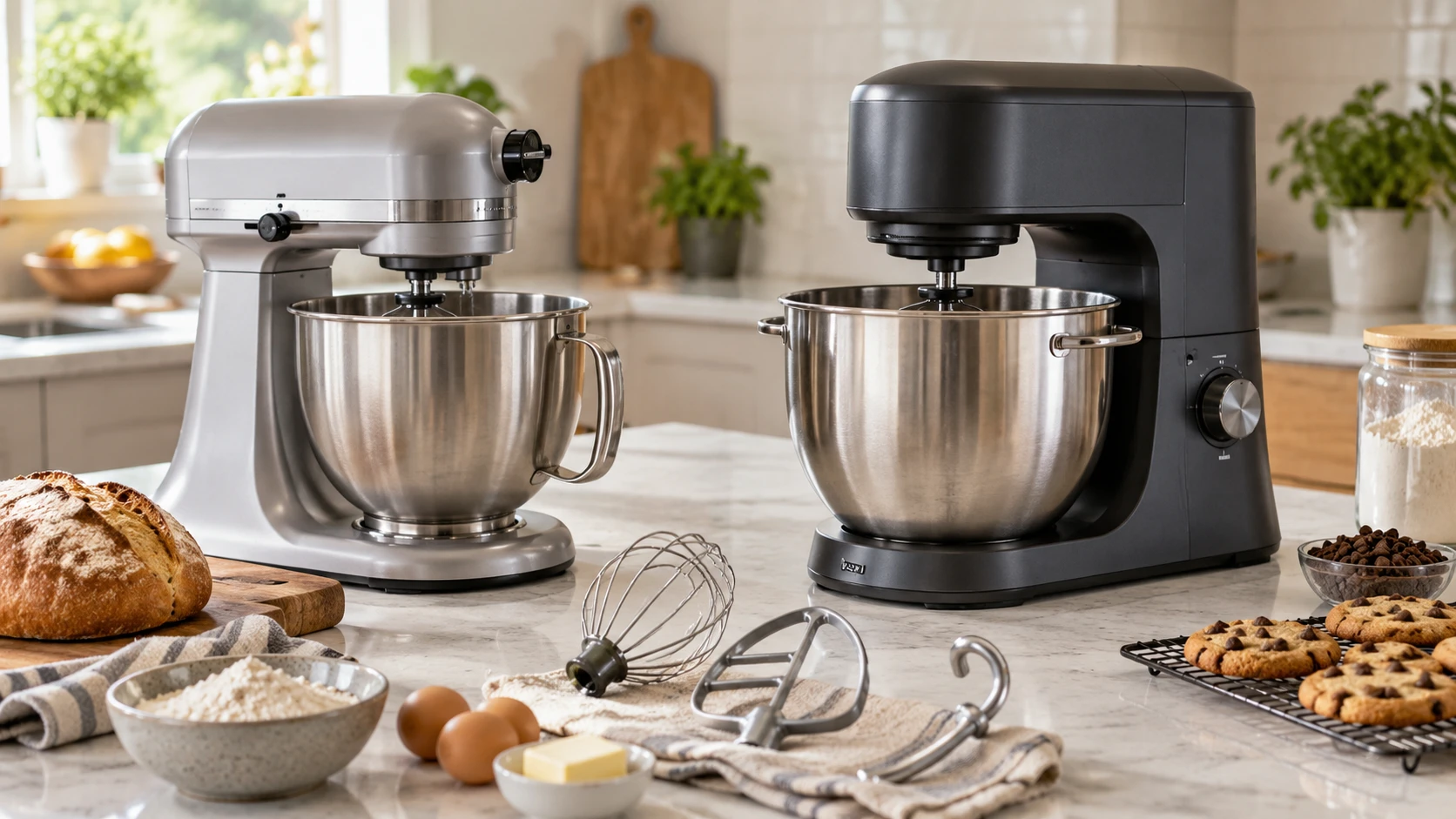
The Hamilton Beach Professional five-quart mixer and BENTISM 7.4-quart mixer offer different ways to organize baking. Hamilton Beach lists 12 speeds, a specialty attachment hub, a five-quart handled bowl, and a five-year limited warranty. BENTISM lists six speeds, an LCD timer with auto-stop, a larger bowl, and a silicone-edged beater. Neither listing is a side-by-side test of how the machines handle bread dough or delicate batter. Choose a real recipe and think through setup, mixing, cleanup, and storage before treating capacity or motor wattage as a winner.
The September 30 catalog snapshot listed both products available, with minimum prices of $349.99 for Hamilton Beach and $224 for BENTISM. The historical gap is $125.99. Both exact product pages and the related guide returned HTTP 200 on October 3, but a reachable page does not establish today's price or package contents. Confirm the exact model, accessories, warranty issuer, and return terms on the offer you plan to buy. The descriptions below are claims in Republeq's catalog; they do not establish identical test conditions or long-term durability.
Start with the batch you actually make — stand mixer bowl capacity and batch size
The Hamilton Beach Professional five-quart stand mixer has a listed five-quart, or 4.7-liter, stainless-steel bowl with a handle. BENTISM lists a 7.4-quart stainless-steel bowl. The larger number can help when a recipe needs more working space, but bowl volume is not the same as recommended dough capacity. A stiff dough, whipped cream, and a thin cake batter place different demands on a mixer. Find the current manuals' batch limits for the ingredients and methods you use rather than converting quarts directly into loaves.
BENTISM's source claims its bowl can handle ingredients for 45 buns, six loaves of bread, or 1.5 liters of light cream. Those examples do not specify bun size, flour weight, dough hydration, or how full the bowl was during testing. Treat them as prompts for questions, not guaranteed yields. For your usual bread recipe, record flour weight and total dough weight, then compare the manufacturer's approved capacity. For small jobs, ask whether the beater reaches a modest quantity at the bottom of a large bowl. A bigger bowl may save splitting one batch while still being awkward for a single egg white.
The published guide on stand mixer bowl capacity and batch size explains why the stated bowl volume needs to be checked against a real recipe. Use its measurement approach for both machines, then verify each model's own limits. The guide does not certify either mixer's dough capacity. If you alternate between a small weekly cake and a large holiday batch, note the ingredients for each. It may be better to make two controlled batches than to force a thick mixture near the bowl rim merely because the bowl has a generous quart rating.
Bowl access can matter as much as volume. Hamilton Beach says its bowl has a handle and a splash/pour shield. BENTISM says its tilt head gives access to the bowl and that a splash-proof cover is included. Check how much space is needed to raise the head, remove the bowl, and pour batter without hitting an overhead cabinet. The source excerpts do not give exterior dimensions or machine weights. Measure your counter and storage shelf before ordering, especially if the mixer will be lifted out only on baking days.
Compare mixing control, not just speed counts — BENTISM 7.4-quart timed stand mixer
Hamilton Beach advertises a 450-watt motor that maintains speed through heavy mixing, along with planetary action that moves attachments around the bowl. It lists 12 speed settings. BENTISM advertises a 660-watt gear-driven copper motor, planetary mixing, and six speeds. The watt figures describe electrical input in Republeq's product-page text; they are not direct measurements of kneading force or proof that one handles a larger dough safely. Gear design, thermal protection, load, and mixing time all affect real performance. Check current manuals for duty cycles and approved recipes.
The number of speeds matters only if the steps between them suit your work. For meringue, you may want a slow beginning before raising speed. For bread, the manual may restrict which speeds are safe with a dough hook. Walk through one recipe's sequence: add ingredients, mix slowly, stop to scrape, then knead or whip at the prescribed setting. Ask whether either control can be adjusted easily with sticky hands and whether the bowl remains stable when a thick dough moves around. The listings do not provide an independent test of vibration or noise.
BENTISM's LCD panel shows remaining time and lets the user set different durations; Republeq's catalog says auto-stop ends a timed run. That can help with a recipe that specifies a consistent mixing interval while you prepare the next ingredient. It does not mean the mixer can judge when dough is fully developed. Check whether the timer can be changed or stopped promptly, and verify what happens after a power interruption. Stay close enough to inspect the mixture rather than leaving a heavy batch unattended solely because the display has a countdown.
Hamilton Beach's description does not name a timer. Its 12 speed settings may instead be useful for manual adjustments during a recipe, but the saved text does not say how fine the steps are or whether the control returns to a preferred setting. If you normally mix by sight and touch, an extra speed option may be more useful than auto-stop. If you repeat the same recipe every week, a timer may reduce guesswork. Compare the actual steps you take, not the feature count in isolation.
Check the attachments and future uses — BENTISM 7.4-quart timed stand mixer
Hamilton Beach includes a flat beater, whisk, spiral dough hook, and splash/pour shield according to its listing. It also describes a specialty attachment power hub. Republeq's catalog says compatible Hamilton Beach Professional and KitchenAid stand-mixer accessories can be used, while noting that the KitchenAid name does not imply an affiliation. Compatibility is a claim that needs exact part numbers: a hub connection, attachment drive, bowl clearance, and safe speed can vary. If pasta rolling or grinding meat is a reason to buy, confirm the specific accessory and any adapter before paying for the mixer.
BENTISM lists a dough hook, flat beater, whisk, scraper, and splash-proof cover. It says the three mixer attachments are dishwasher safe and that the bowl is dishwasher safe. Its flat beater has a soft silicone edge that Republeq's catalog says scrapes sticky ingredients from the bowl. Check whether that edge contacts the bowl consistently with your recipes and how the manufacturer says to inspect or replace it. A self-scraping claim can reduce stopping to scrape, but it does not remove the need to check unmixed ingredients at the bottom or near the shield.
The saved BENTISM description does not document a comparable power hub. That absence is a reason to verify its accessory ecosystem before planning future jobs, rather than proof that no accessories exist. If baking cakes and bread is all you expect, included tools may matter more than a hub. If you intend to add a pasta roller, a slicer, or a grinder, price and verify those parts with the Hamilton Beach model. An attachment purchased later can change the total cost and the amount of shelf space devoted to the machine.
Work through cleanup and storage — BENTISM 7.4-quart timed stand mixer
For Hamilton Beach, Republeq's product description describes a stainless bowl, a shield, and three mixing tools, but the excerpt does not specify which parts are dishwasher safe. Check the current care instructions before putting a beater or shield in the dishwasher. For BENTISM, the listing explicitly names dishwasher-safe bowl and attachments; still confirm the manual for the exact model and any limits on detergents or drying. Dough can hide around a hub, at the beater joint, or along a silicone edge, so inspect those areas after a sticky recipe.
Consider where each tool will go. A handled bowl is easier to carry when full, but the handle also affects cabinet space. A tilt head needs overhead clearance; a splash shield needs a place to rest after removal. The listings do not give dimensions, so draw the proposed counter footprint and the path from storage to the outlet. If you bake only occasionally, the weight and grip of the whole mixer may matter more than a small difference in mixing time. Ask for exact weight before assuming either is comfortable to lift.
Hamilton Beach advertises a five-year limited warranty. The BENTISM excerpt does not state a comparable term. Warranty length alone does not tell you which repairs are covered, who handles shipping, or whether accessories are included. Read the terms for the selected offer and confirm that the Republeq's catalog product is eligible. Ask about replacement beaters and bowls before an older part becomes difficult to find. These questions matter when the mixer's value depends on using it repeatedly over several years.
Pick the workflow you will use — BENTISM 7.4-quart timed stand mixer
Hamilton Beach is the stronger candidate to investigate when you want a five-quart handled bowl, many speed choices, and a verified path to specific hub attachments. Check the exact accessory compatibility and manual limits for stiff dough, and compare the five-year warranty terms with the Republeq's offer. The higher historical price may make sense if the hub replaces another appliance in your kitchen, but the source alone cannot establish savings or superior mixing results.
The BENTISM 7.4-quart timed stand mixer deserves a look when a larger bowl, timed auto-stop, and a silicone-edged beater match your repeat recipes. Verify the claimed batch examples against the manual, the space needed for its tilt head, and the exact included tools. Its lower saved price leaves a budget gap, but it does not prove equal durability or suitable handling for every large dough.
Before ordering, choose one small and one large recipe. Write down flour or batter weight, the speed and mixing time, each required attachment, and where the dirty parts will be cleaned and stored. Check the manuals against those two jobs. A mixer that completes both with manageable setup and cleanup will earn its counter space more reliably than one chosen by watts, quarts, or speed count alone.