Crypto Commerce
Hamilton Beach HBFRF3030 chest freezer — Decide how much frozen storage the household will actually use
Compare Hamilton Beach HBFRF3030 chest freezer by footprint, storage routine, controls, and installation checks.
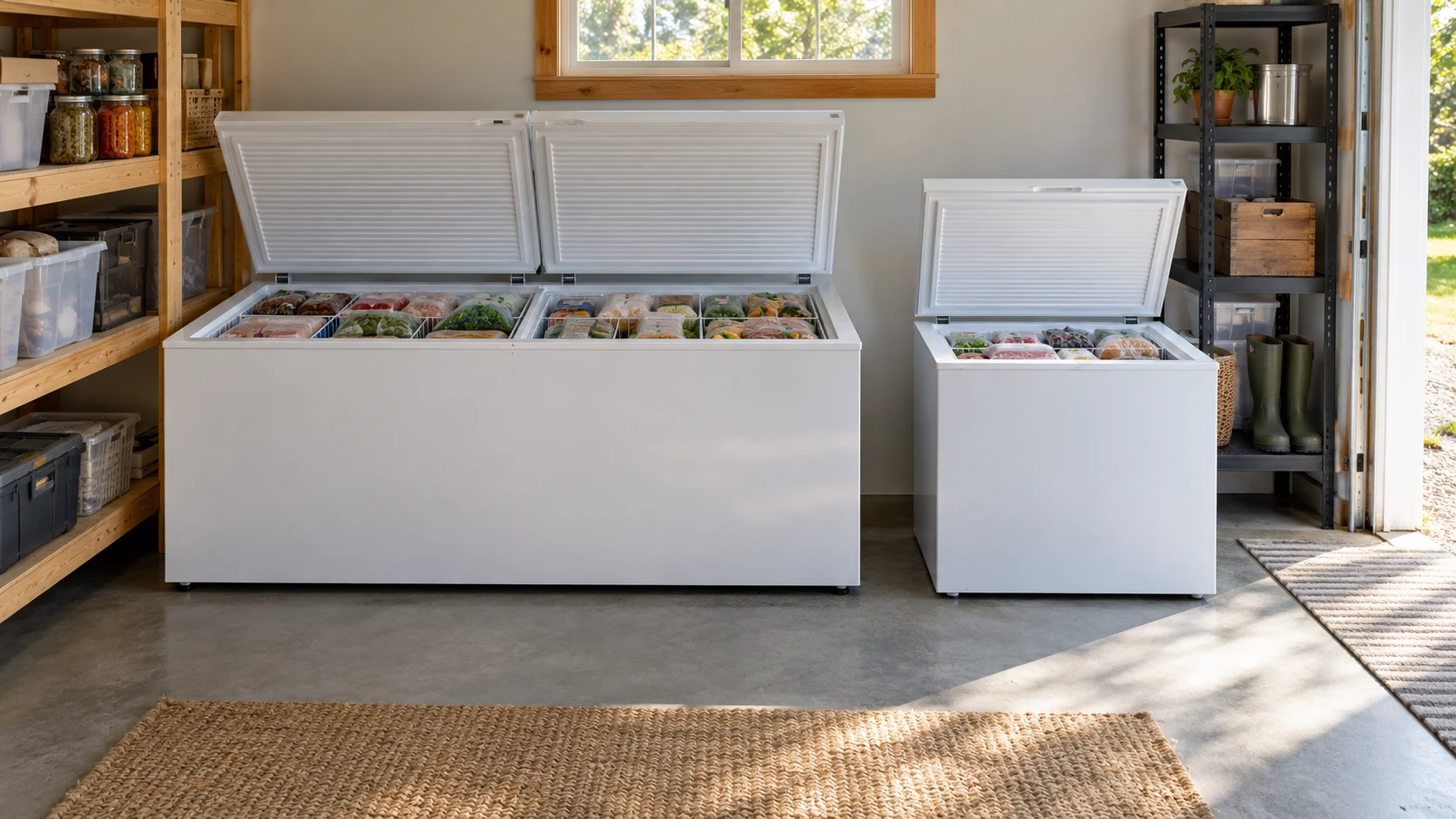
The Hamilton Beach HBFRF3030 chest freezer is listed at 30 cubic feet with two top doors. Koolatron's KTCF195 is described as a roughly 7-cubic-foot, single-lid unit. They serve very different storage plans. The larger machine could hold bulk purchases or several categories of food at once; the smaller one may be easier to place in an ordinary room. Capacity alone does not tell you how much food you can reach, organize, or rotate before it ages out.
Estimate the space you need from your own shopping pattern. List the frozen items bought in a normal month, the occasional bulk purchase, and the food already stored in another freezer. Then consider how often you can use that stock before it loses quality. A 30-cubic-foot cavity may be wasteful if it stays mostly empty, while seven cubic feet may require careful stacking if the household freezes large batches. Do not choose from the advertised number alone: ask for the current internal dimensions and basket arrangement, then compare them with the containers and packages you regularly use.
It helps to draw a simple inventory map before shopping. Reserve one area for food to use this week, another for ingredients stored longer, and a clearly labeled place for new purchases. A freezer packed without such a routine can hide a bargain until its quality declines. The larger Hamilton Beach unit might support more categories, yet the extra space also makes it easier to lose track of packages at the bottom. Koolatron's smaller cavity could be easier to survey, though it may force more frequent shopping. Neither listing reports how much storage remains after baskets and door mechanisms occupy space.
The Koolatron listing itself uses two figures, 7.0 cubic feet in its title and 6.9 cubic feet in the description, alongside 195 liters. The difference is small, but it shows why the exact model specification sheet matters. Confirm the rated volume and usable interior dimensions for KTCF195 rather than silently picking one number. The Hamilton Beach excerpt states 30 cubic feet, but it does not provide a diagram of the usable cavity or how the pair of doors divides access. Treat both figures as claims to resolve with manufacturer documents.
Measure the route to the final position — Koolatron KTCF195 chest freezer
Hamilton Beach gives outside dimensions of 78.7 inches wide, 31.4 inches long, and 37.4 inches high in the saved listing. The word "long" is unusual in a three-dimensional appliance description, so confirm the manufacturer's width, depth, and height labels before planning a tight fit. Measure the path from the delivery entrance through doorways, turns, stairs, and the intended room. Include space for packaging removal, lid opening, ventilation, and future service. A large freezer that fits its final floor rectangle may still fail to pass through the doorway or open fully under shelving.
The Koolatron excerpt gives no overall dimensions. It says the smooth metal-backed design can sit flush with a wall, but that statement is not a complete clearance specification. Obtain its installation diagram and check any required room around the compressor, sides, and opening lid. A chest freezer needs accessible space above it as well as beside it. If the location is a low-ceiling storage room or a workbench alcove, measure the height needed to hold the lid open and remove baskets without bending awkwardly.
Both machines need an approved electrical location. Neither saved excerpt gives the plug, current draw, cord length, or circuit requirements. Use the exact manuals and rating labels before placing either freezer far from an outlet. Avoid planning around an extension cord unless the manufacturer explicitly permits the arrangement. Ask a qualified professional to assess any questionable outlet or circuit. Also confirm the supported floor load and level surface for a freezer filled with food; the short descriptions do not supply loaded weights.
Location affects performance. Koolatron supplies a temperature range at a stated ambient condition of 25 degrees C, or 77 degrees F. That does not establish its approved minimum and maximum room temperatures. Hamilton Beach's excerpt gives no ambient limits. If you want a freezer in a garage, shed, or other space with seasonal temperature swings, request each model's allowed environment in writing. A label that says "chest freezer" is insufficient evidence for a hot summer garage or freezing winter room.
Plan access before filling the bin — Koolatron KTCF195 chest freezer
Hamilton Beach's two top doors may let you open one side while leaving the other closed, but the listing does not show a partition, door dimensions, or independent zones. Do not infer separate temperatures or compartments from the two-door arrangement. Ask for photographs and the interior plan. If the design is one broad cavity, you may still need bins or a written inventory to prevent older food from disappearing at the bottom. Check what accessories the manufacturer approves and whether they obstruct airflow or lid sealing.
Koolatron includes a removable basket for small items and a single flip-up, stay-open lid. The basket could put frequently used food near the top while keeping the main cavity for larger packages. Confirm the basket's dimensions, maximum load, and where it sits. A stay-open lid may make loading easier, but it does not tell you how far the lid swings or how much overhead clearance it requires. Test the lid with the basket in place if possible, especially if the freezer will sit against cabinets or under a shelf.
Hamilton Beach also lists a removable vinyl-coated wire basket. The saved description does not state how many baskets are included or whether more can be installed. Compare what each unit actually ships with. One basket in a 30-cubic-foot space may leave substantial storage that needs another organization method. Simple labels on packages and a rotation list can be more useful than maximizing the amount stacked in a bin. Think about whether every household member can reach the bottom safely.
The published guide on chest freezer capacity and controls explores similar questions for different models. Use its comparison method rather than transferring its product claims to these two freezers. For this pair, make a floor plan, a rough inventory of frozen food, and a list of the items you need to retrieve weekly. The right volume is the one that can be placed and managed in your home.
Understand the thermostat and defrost routine — chest freezer capacity and controls
Hamilton Beach describes an adjustable thermostat with seven settings. The listing does not connect those numbers to internal temperatures, state how accurately they hold a set point, or describe any alarm. Koolatron lists an adjustable thermostat from 0 degrees C to minus 24 degrees C at a 25-degree-C ambient condition. That range is a product claim under a stated test environment, not an assurance that every load reaches every setting in every room. Use a suitable freezer thermometer and follow the manual for initial cooldown and placement of food.
Do not treat a dial marked one through seven as seven known food-storage temperatures. Check the manufacturer's setup instructions, allow the appliance to stabilize, and measure the actual temperature in the loaded space. Opening the lid, adding warm food, and a changed room temperature may affect readings. If the freezer will hold food for long periods, plan a routine for checking temperature and power. Neither short excerpt promises an audible alarm, phone alert, or automatic backup after an outage.
Koolatron explicitly calls for manual defrost and lists a front-access defrost drain. That is useful planning information: reserve a way to remove food temporarily and collect water when ice buildup requires a defrost. The description does not give a schedule, drain-hose accessory, or approved scraping method. Follow its current manual rather than using a sharp tool near the liner. Hamilton Beach's saved excerpt does not say whether it is manual defrost. Verify its method and drain arrangement before assuming the larger machine involves less upkeep.
Koolatron lists a power indicator light and an Energy Star rating. The light may help show that power is reaching the appliance, but it is not a temperature reading. The rating does not give this household's annual energy cost. Hamilton Beach's excerpt provides no energy figure, so comparing running expense from these descriptions would be guesswork. Seek current model-specific energy labels or measured annual consumption under comparable conditions, then account for electricity rates and the room where the machine will operate.
Think about what happens during an outage as part of the storage plan. A larger stock represents more food at risk, but the saved descriptions do not state holdover times or alarm features for either freezer. Ask what the manuals recommend for a power interruption and how to judge food safety afterward. Keep the freezer closed as directed, monitor temperatures with an appropriate device, and follow current food-safety guidance rather than estimating safety by how cold a package feels. This consideration may influence whether one very large freezer or a smaller supplemental unit makes sense for the household.
The Koolatron KTCF195 chest freezer is a candidate for a more modest stock of frozen food when a single accessible basket, known manual-defrost setup, and smaller volume suit the routine. Its exact dimensions and the 6.9-versus-7.0-cubic-foot wording still need confirmation. Hamilton Beach offers a much larger stated capacity and two doors, but its interior layout, defrost method, and installation details remain open in the saved excerpt. Choose only after measuring the delivery route and final space, checking the model manuals, and deciding how you will organize and monitor the food you intend to keep.