Crypto Commerce
Ecotronic vs WAA chest freezers: capacity and controls
The listed Ecotronic chest freezer has a stated capacity of 3.8 cubic feet, while the WAA model lists 1.8 cubic feet. Both descriptions specify seven temperature settings, but their stated ranges differ: Ecotronic lists -5.8°F to 10.4°F, and WAA lists -7.6°F to 6.8°F. Those details give you a starting point for choosing between them: how much frozen food you intend to keep and how each model's controls relate to that use.
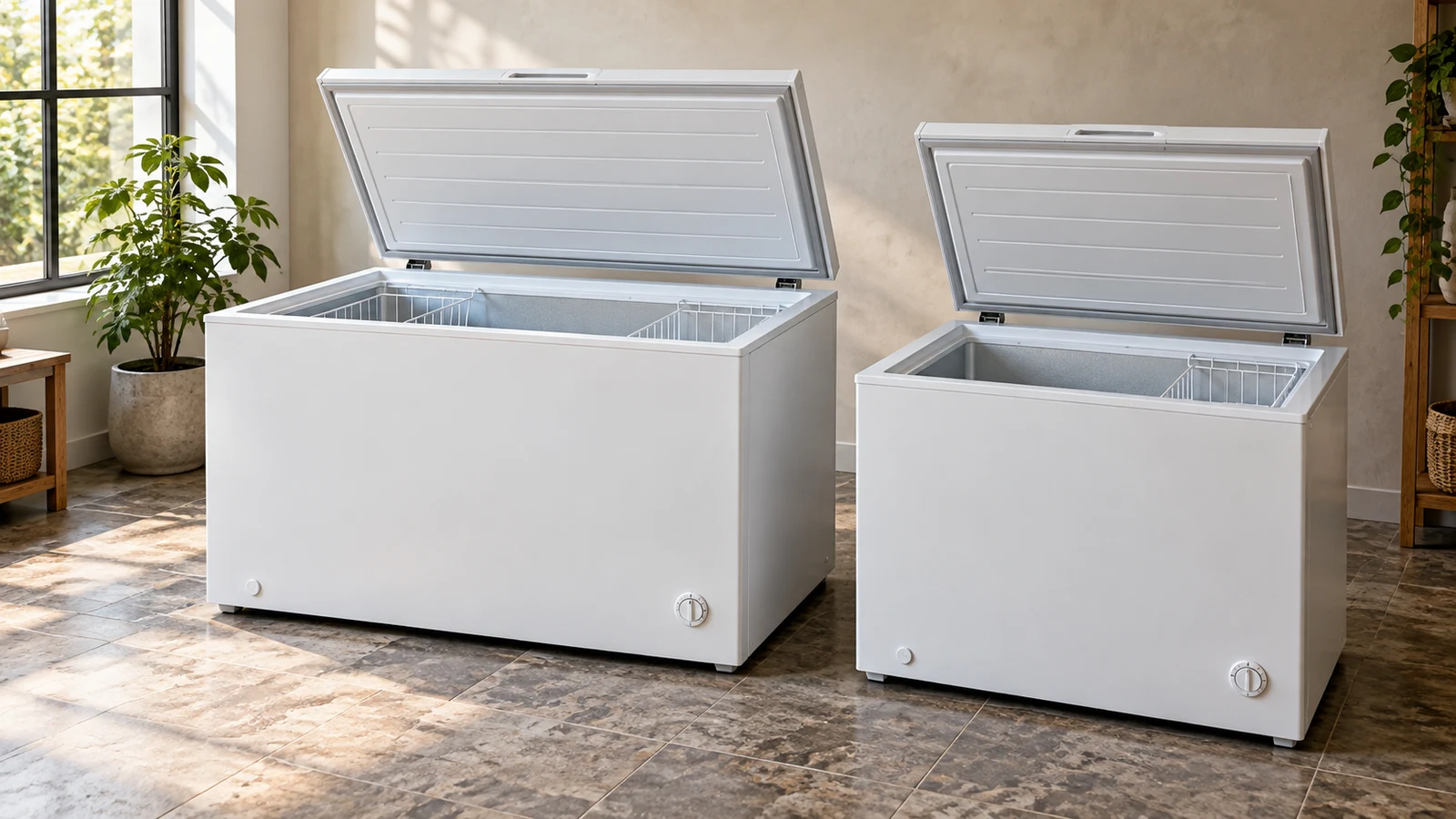
The listed Ecotronic chest freezer has a stated capacity of 3.8 cubic feet, while the WAA model lists 1.8 cubic feet. Both descriptions specify seven temperature settings, but their stated ranges differ: Ecotronic lists -5.8°F to 10.4°F, and WAA lists -7.6°F to 6.8°F. Those details give you a starting point for choosing between them: how much frozen food you intend to keep and how each model's controls relate to that use.
Neither description supplies the exterior measurements needed to settle the floor-space question. A smaller stated storage volume does not, by itself, establish the width or depth of the cabinet. Treat this comparison as a way to narrow your choice before checking dimensions and operating instructions for the exact appliance. The descriptions support a capacity comparison and a comparison of stated control ranges; they do not establish which freezer maintains temperature more consistently in your home.
WAA Freezer Alternative: What The Capacity Figures Tell You
The Ecotronic product description identifies a 3.8-cubic-foot chest freezer with seven adjustable temperature settings. That stated volume makes it the larger storage option in this pair. If your reason for buying is to accommodate a substantial frozen-food reserve, start by examining whether that capacity matches what you actually plan to store. Keep the decision tied to your food purchases rather than assuming the larger figure is automatically preferable.
The WAA freezer alternative lists 1.8 cubic feet and two included storage baskets. It deserves consideration if you want a limited amount of additional frozen storage and can identify what will go into it. The description's smaller volume is relevant to that narrower job. It does not establish the number of meal containers, grocery bags or large packages that will fit.
Begin with the food you expect to have on hand immediately after shopping. Write down the packages you would put into the new freezer at that point, including anything left from the previous shop. This gives you a more useful picture than looking at an almost-empty freezer just before restocking. Include occasional purchases only if you genuinely expect to make them; a hypothetical stockpile can distort the choice as easily as overlooking your usual groceries.
For example, someone buying extra storage for a few recurring frozen items has a different capacity question from someone setting aside space for several batches of prepared meals. In the first case, the smaller model may warrant closer inspection. In the second, the larger model may be the more useful candidate. These are shopping scenarios, not tested loading plans for either freezer. Package measurements and the actual interior layout still determine whether a particular arrangement works.
Pay attention to the largest awkward package on your list. Ask for usable interior dimensions and any internal obstructions before deciding that it will fit. Neither supplied description gives those measurements. Avoid turning cubic feet into a promised package count or weight allowance: doing so would introduce assumptions about shape and packing that the descriptions do not resolve. A photograph can help explain the layout, but it should not substitute for measurements when a particular container matters.
The included baskets are a documented WAA feature, although their dimensions are not provided. If you intend to use them for your existing containers, ask how those containers would fit and how much room remains beneath them. Ecotronic's description does not specify basket contents. That silence is a reason to ask what comes with the exact model, not a basis for saying it includes none or for assuming it matches WAA's arrangement.
WAA Freezer Alternative: Reading The Seven Settings
Seven settings sound similar across the two descriptions, but the number of positions alone does not establish equivalent temperature control. Ecotronic gives a range from -5.8°F to 10.4°F without mapping each intermediate position to a temperature. WAA identifies level 1 as 6.8°F and level 7 as -7.6°F. Its description also leaves the intermediate values unspecified. Keep the endpoints attached to the correct product when comparing them.
Do not transfer a setting number from one freezer to the other. If you have previously used a numbered freezer control, that experience does not tell you what the same number means here. Ask for the operating instructions showing how the exact model's settings should be selected. A seven-level description also does not establish a digital temperature display, an alarm or direct temperature entry; neither supplied description confirms those features.
The stated ranges are useful for identifying what each seller describes, but they are not temperature-stability measurements. They do not tell you how closely the appliance holds a selected temperature under a particular load, or how conditions vary inside the cabinet. WAA's lower stated endpoint therefore cannot support a broad claim that it preserves food better. Likewise, Ecotronic's larger stated volume provides no evidence that its temperature control is stronger or weaker.
If you are comparing the models for a particular food-storage requirement, keep that requirement separate from the control labels. Check the food's storage instructions and ask whether the appliance's documented operating guidance accommodates them. Avoid choosing the warmest or coldest position simply because of its place on the scale. This comparison does not establish a suitable setting for every food, and the supplied descriptions are not a substitute for the operating manual.
A useful seller question is specific: ask for the recommended initial setting and the instructions for checking temperature after an adjustment. You can also ask whether there are restrictions on changing settings or loading the freezer. These questions request the missing operating detail without assuming either product has a particular procedure. Keep the reply associated with the exact model so that guidance for another freezer does not accidentally become part of your decision.
Compare Refrigerator Compartment Capacity Beyond The Total: Keep The Purchases Separate
If you are also considering replacing a refrigerator, Compare refrigerator compartment capacity beyond the total addresses that separate comparison. Here, the narrower decision is between the stated storage volumes and controls of two chest freezers. Establish whether you want an additional appliance before comparing these models further. That choice determines whether either belongs on your shortlist and whether you are willing to assign floor space to it.
Write down the location you would use and the amount of floor area you are prepared to allocate. Then request each model's exterior width, depth and height. Neither description gives a complete dimensional specification, so there is no supported basis for declaring one a better fit for a particular opening. Words such as compact describe the products broadly; they cannot resolve a close measurement or tell you how much space remains beside the cabinet.
Keep cabinet dimensions separate from the space required for operation. Ask for the manufacturer's placement guidance, including any required clearances and the permitted surrounding conditions. No clearance figure is established in the supplied descriptions. Avoid sketching a final layout around a guessed gap or assuming that an appliance can be enclosed because its body fits. The missing measurements need not prevent comparison, but they leave the location decision unfinished.
Access from above also needs attention. Ecotronic's description says its top-opening door can stay open between 45° and 90°. That is a relevant feature if you want the lid to remain open while you reach inside, but it does not provide the total height with the lid raised. Ask for that measurement if you are considering a position near a shelf or other overhead obstruction. Do not infer reach comfort from the hinge angle alone.
WAA's description identifies a swing door with a recessed handle, but it does not specify an equivalent stay-open angle. If lid behavior would affect your choice, request clarification about how its door operates. You may also want the opening dimensions to assess access for the packages on your storage list. This is a practical distinction between a documented Ecotronic detail and an unanswered WAA question, rather than proof that one design is easier for every person.
The descriptions mention different positioning features: Ecotronic lists two wheels at the bottom, while WAA lists adjustable feet. Consider whether either feature matters in your intended location, then consult the relevant instructions. The wheel description does not establish that moving a loaded appliance is permitted. Adjustable feet do not provide a stated range of adjustment. Neither feature removes the need to confirm that the proposed position meets the model's placement requirements.
WAA Freezer Alternative: Turn The Comparison Into A Purchase Choice
After examining the volume and location questions, write a short purchase brief in your own terms. It might say that you need storage for your usual frozen purchases after restocking, want controls you can understand from the manual, and have a defined space available. Avoid making the brief a list of every advertised feature. Its purpose is to identify which unanswered questions could change your choice between these two specific appliances.
Ecotronic is the larger-capacity candidate here, with a stated 3.8-cubic-foot volume and a documented stay-open lid angle. Give it closer attention when that storage volume is relevant to your intended food reserve. Before selecting it, resolve its exterior and usable interior measurements, package contents and operating guidance. The capacity advantage is documented; suitability for your particular location and loading plan still depends on those details.
WAA is the smaller-capacity candidate, with a stated 1.8-cubic-foot volume, two included baskets and explicitly identified temperature endpoints for levels 1 and 7. It may suit a deliberately limited storage plan, subject to confirming package fit and placement. Its lower stated temperature endpoint should remain one specification in the comparison. It is not a reason to disregard capacity if the food you intend to store needs more room than the model can accommodate.
Leave any unresolved question visible in your notes. If the dimensions are missing, record them as unknown instead of awarding either model a space-saving advantage. If control instructions are missing, do not assume both appliances work alike because they share a setting count. This makes it easier to see whether you have enough information to choose or whether a single seller response could materially change the comparison.
Before ordering, match the product page and selected item to the freezer you evaluated. Brand recognition alone is insufficient: check the stated capacity and product identity so that a different model does not inherit your earlier conclusions. Recheck current availability and the amount payable at purchase. The descriptions used for this comparison do not establish what will be in stock or the final order total when you decide to buy.
Read the applicable delivery and return terms for the selected item, especially where an unresolved fit question might affect your decision. Do not assume that two appliances sold through the same site have identical handling arrangements or that a return will be available under any circumstances. If checkout presents payment-specific terms, review those for your chosen method. No particular fee, payment network or refund timetable is needed to make this capacity comparison.
Use the product pages above to compare the exact models, then ask for the missing measurements and control instructions that matter to your plan. Choose according to the food you expect to store and the space you can properly allocate. If both models satisfy those needs, the documented lid and basket details can help settle the choice without turning an untested specification into a performance promise.