Seasonal & Holiday Content
Half Christmas tree placement: plan the wall and the viewing sides
A room-planning comparison of actual half and full artificial-tree offers, keeping viewing positions, stated dimensions and unresolved depth visible.
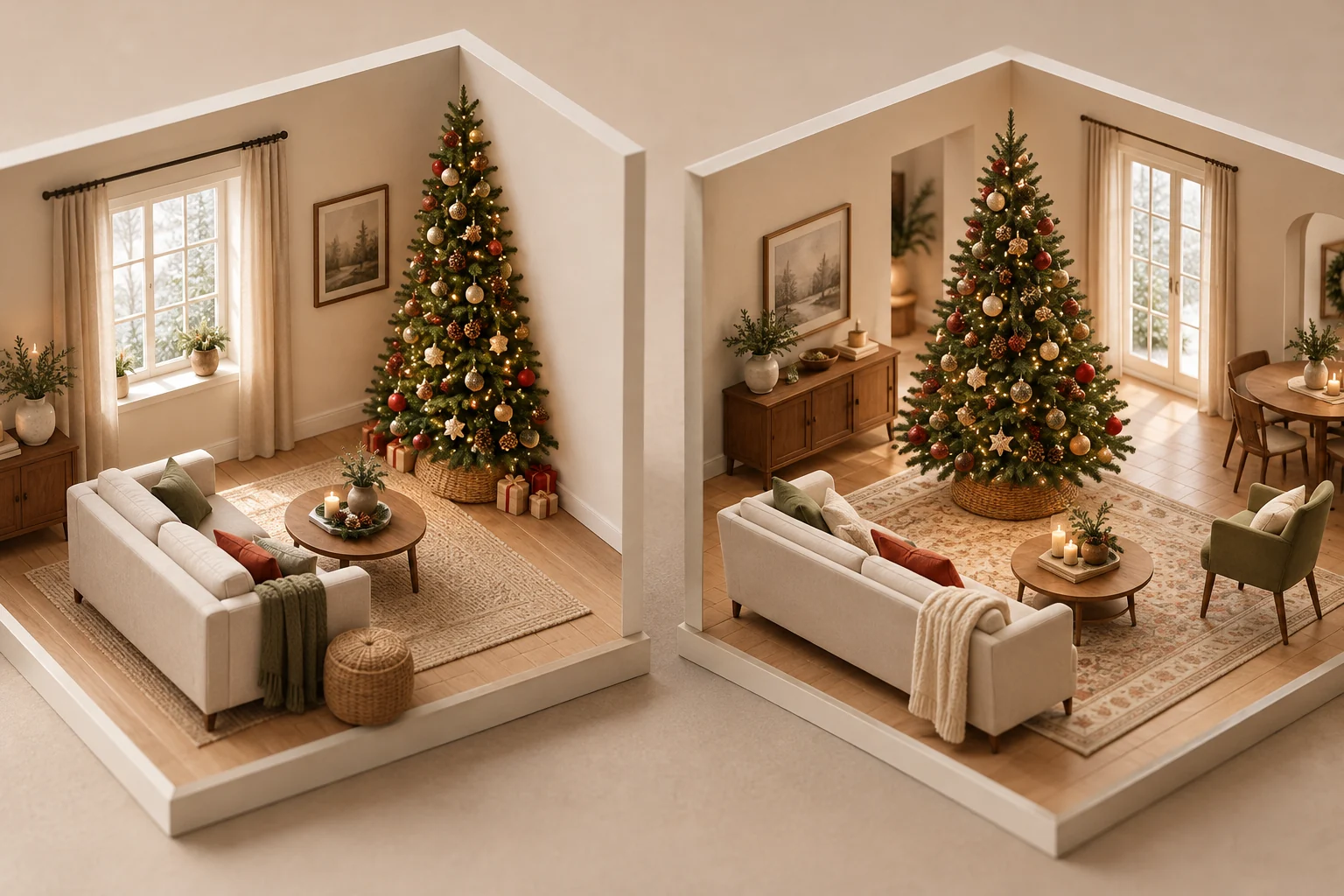
Half Christmas tree placement starts with the part of the room you want the tree to occupy and the directions from which people will see it. A flat back can suit a display facing into a room. A tree that will be viewed from several sides presents a different choice. Decide where the back belongs before treating a seasonal product photograph as a plan for your own home.
For one household, the tree may sit against an uninterrupted wall throughout December. Another household may move furniture for a gathering and reveal the side that was previously hidden. Draw the intended arrangement with the furniture in its seasonal positions. That gives the shape of the display a purpose before you compare heights or branch counts.
Read the wall-backed Christmas tree dimensions
The National Tree Company Montgomery half tree, model PEME8-308-65, is described as flat backed, with hinged branches and 300 pre-strung clear incandescent lights. Its stated dimensions are 41 by 41 by 78 inches. Its gallery shows an asymmetric side view. These retail figures have not been independently measured.
Keep both stated horizontal dimensions. The word half supplies no measured depth. Obtain the assembled wall projection and support footprint for the actual unit before drawing a smaller outline.
Keep the full-tree offer separate
The Canadian Fir Grande offer, model 34247146, describes a 7.5-foot artificial tree with a 50-inch diameter, 1,100 branch tips and three hinged center-pole sections. A stand is included. Its description supplies no matching pre-lit-lighting specification.
Choose the comparison you actually need. If height is fixed by a decoration you already intend to use, hold that requirement constant while looking at forms. If shape matters more, compare the other differences you are willing to accept. This exercise records your preferences; it supplies no ranking of the actual trees.
Give each viewing position a place on the drawing
Sketch the room from above and mark the place where you expect the tree's back to face. Mark fixed furniture you cannot move before comparing arrangements that assume an empty wall. Then mark the seats people will use most often. Include a doorway through which the display is visible if that view matters to you. You can decide how each position should relate to the tree without making a claim about either product's appearance from an unshown angle.
Suppose a fictional living room has a sofa opposite a solid wall and a reading chair beside that sofa. The household wants both seated views to face the decorated display. It also plans to keep the reading chair in place for a December visit. This arrangement gives the household specific views to examine when considering a flat-backed form.
Now change that imagined arrangement: the reading chair moves behind the proposed tree for a gathering. The household has created another viewing position. It can reconsider the tree's location, move the chair somewhere else or choose a different display form. The room drawing makes that choice visible before someone orders a tree on the assumption that the original furniture arrangement will last all month.
A window can introduce a separate preference. You may want the display to face the room, face the window or be visible from both directions. State which view you intend to favor. If the room has a mirror, include the reflected view when that reflection matters to your display. A photograph taken from the front cannot establish what another person will see from the opposite side of a particular assembled product.
Compare the artificial tree footprint with the room plan
For an artificial tree footprint comparison, suppose a household marks a hypothetical 58-inch-wide display space. The full-tree offer's stated 50-inch diameter leaves eight inches in that drawing, or four inches on either side if centered. That nominal comparison establishes neither usable access nor actual assembled fit.
The household must decide what else needs to happen beside the marked space. Perhaps someone opens a cupboard there, or the room has a door that swings across part of the proposed display area. Draw those movements separately. A static outline and an opening door answer different questions, even when both appear within the same corner of the room.
For the wall-backed Christmas tree candidate, mark an unknown depth honestly until you have the applicable assembled measurement. You can still decide which way the display should face and whether a wall-backed form suits your intended views. Leave the purchase comparison open where a necessary dimension remains unresolved. An invented smaller outline would conceal the very information the room plan needs.
You can also use an outline to compare locations before choosing a product. Draw a display area beside the bookcase and another against the opposite wall. Use the same assumed size in both sketches and label it as an assumption. That exercise compares your proposed locations; it does not establish that either actual tree will fit one of them.
Try the room with its December furniture arrangement
Consider two more layouts for the fictional household. In the first, the sofa stays opposite the solid wall and the dining table remains in another room. The household wants one view of the tree while sitting together in the evening. It can mark that view with an arrow and leave the unused corner behind the display outside its intended viewing area.
In the second layout, the household brings the dining table into the living room for a holiday meal. One end of the table faces the side of the proposed tree location. The person sitting there would have a view the first sketch did not address. Add that seat to the drawing before deciding whether the original location still produces the display the household wants.
The household could move the table, choose another location for the display or accept that the view from that seat will be different. Each is a preference it can discuss while looking at the same sketch. It can also return to the everyday layout after the meal. Recording both arrangements lets it decide whether a temporary view matters enough to change the tree purchase, without assigning either product an unverified appearance from that position.
Check the height you intend to display
Measure the available height where the tree will stand, then identify everything you intend to place above its supplied form. A topper belongs in your own display plan. Keep its intended size separate from the height stated for a tree. Establish how the actual product's dimensions are measured before deciding that a seasonal arrangement fits beneath a ceiling or other overhead feature.
A household that wants a particular heirloom topper can begin with that preference. It can measure the decoration and consider how it intends to use it, following the applicable instructions. Another household may prefer the tree's own top without an additional decoration. These choices can lead to different height requirements in the same room.
Furniture can affect the height someone pictures, too. A console table beside the proposed display may make a tree look taller or shorter in a sketch, but the furniture supplies no measurement of the tree itself. Keep the floor position in the drawing so a decorative arrangement does not quietly turn into an assumption that the product should stand on a raised surface.
Separate the support from the visible branches
Include the actual support in your footprint enquiry. Branch spread and the parts resting on the floor can describe different outlines. Obtain the applicable dimensions and setup instructions rather than treating an illustration of foliage as a complete installation drawing. This guide supplies no support, anchoring or assembly procedure for either tree.
The guide to planning a changed holiday tree and stand concerns real-tree stand offers and separates advertised tree height from trunk diameter. Those support requirements belong to that subject. They do not establish a replacement stand or a support method for the artificial trees discussed here.
If a family changes from a real tree to an artificial one, revisit the equipment it intended to reuse. A familiar place in the room can remain the preferred location while the actual tree and supplied components change. Follow the instructions for the selected product. A room plan can record where you want the display without approving an improvised combination of parts.
Decide what the seasonal display includes
Draw any gift area beside the tree as its own chosen space. Decide whether packages will remain there throughout the season or arrive only for a gathering. This prevents a photograph of staged presents from determining how much of your floor you intend to use. The household can choose a smaller gift area or another location independently of its preferred tree form.
Apply the same approach to other decorations. If you want a small village beside the display, give that arrangement its own place on the drawing. A separate holiday scene may be important to the room even when it appears in no product photograph. Decide which decorations you want together before using a tree outline as the boundary of the entire seasonal display.
Choose decorations according to your own display plan. When looking at product photographs, distinguish the item identified in the offer from anything used to dress the scene. A favorite color arrangement can remain an idea for your room without turning every pictured accessory into something you expect to receive.
Keep display space separate from storage space
The Christmas storage-bag guide distinguishes a seasonal print on a toy organizer from a bag described for storing a Christmas tree. Its naming distinction is useful when you later choose a container. It does not establish that a particular bag accepts either tree in this comparison.
For your own storage plan, find out how the selected unit is prepared for storage under its instructions and obtain the relevant packed dimensions. A December display outline cannot answer whether the stored tree will fit on an existing shelf. Keep the proposed storage location on a separate sketch so a room-placement preference does not silently become a storage assumption.
Choose a form for the room you intend to use
Return to the seasonal furniture drawing before choosing between the actual offers. Identify the intended back of the display, the views you care about and the dimensions that still need an applicable answer. A wall-backed form can remain your preference while a necessary measurement stays open. A preference becomes a purchase decision when the actual product and your intended location have enough matching information.
If the furniture arrangement changes, revise the drawing at the point of change. Reconsider the newly exposed view or the movement beside the tree, rather than starting the whole comparison over from a staged photograph. Keep the selected offer's identity with the final room plan so its dimensions and supplied components remain attached to the tree you actually intend to bring home.