Crypto Commerce
H2O Audio Interval Surge S+ swimming earbuds Surge S+ vs LOBKIN X30 for swimming laps
Compare H2O Audio Interval Surge S+ swimming earbuds by fit, goggle mounting, onboard music, water claims, battery life, and source-device checks.
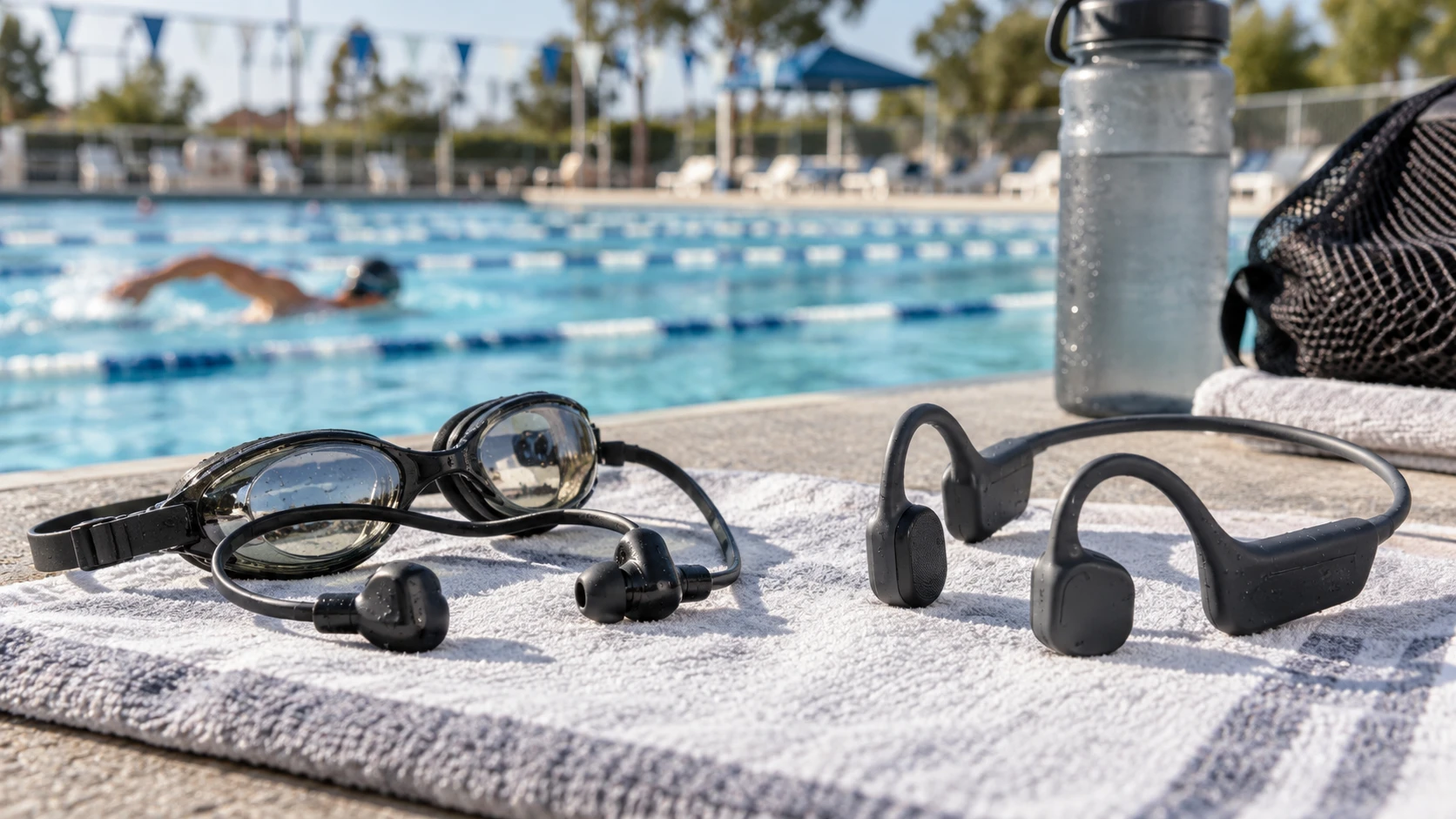
The H2O Audio Interval Surge S+ swimming earbuds sit in the ear and attach to swim goggles. LOBKIN X30-Green uses an open-ear bone-conduction frame and advertises an onboard MP3 mode for underwater listening. That difference matters more than the shared word "swimming" on their listings. One approach asks you to find an earplug seal that stays comfortable through a session. The other leaves the ear canal open but asks you to manage music files and confirm that the frame holds its position through your strokes.
The published guide on Bluetooth audio pairing direction is useful before either headset goes in the water. A phone or watch must send sound to the headset you intend to hear. Pairing on a dry deck can establish that the devices recognize each other, yet it does not establish reliable audio while submerged. Water, body position, and the source device's location can affect a wireless link. The product descriptions do not supply a controlled underwater connection test for this pair. Plan a short pool trial with the exact watch or phone you will use.
The LOBKIN X30-Green swimming headphones offer a different route: the listing says to use MP3 mode underwater. That lets stored tracks play without a live Bluetooth stream, provided the files transfer and the controls work as expected. Its title calls the memory 8GB, while its description calls it 6G and says it holds more than 3,000 tracks. Those statements conflict. Confirm usable storage, supported file formats, and the transfer method for the actual unit before counting on a particular library size.
Fit is the first pool test — LOBKIN X30-Green swimming headphones
H2O Audio describes its Surge S+ earpieces as sitting flush with the ear to reduce drag during strokes. The package lists five sets of elastomer earplugs from XS through XL and one set of "Tree Tip" plugs for added isolation and protection. Choice of plug size is valuable only if a set makes a stable, comfortable seal in your ears. Fit each side separately before swimming, since the same size need not feel identical in both ears. A plug that hurts on the deck is unlikely to become pleasant after a long workout.
The H2O listing also names integrated goggle loops that attach to swim goggles. Check the loops against your own strap and goggles, then turn your head and push off a wall in a controlled trial. A headset that stays attached while standing may move when a strap stretches or when you put on a cap. The saved description does not give strap dimensions or a compatibility list. If you switch between goggles, repeat the fit check with each pair. Keep the attachment method in mind when removing the goggles too, so a tug on the strap does not pull an earpiece unexpectedly.
LOBKIN describes an open-ear frame that conducts sound through vibration while leaving the ear canal open. It lists a flexible titanium-alloy frame, a soft coating, memory-foam ear tips, and a weight of 26 grams. The description does not explain exactly how the foam tips are used with the open-ear frame, so inspect the product photographs and manual before treating them as an in-ear seal. A frame can feel light in your hands and still press against one spot after repeated turns. Try it with your goggles and cap, because those items share space around the temples and back of the head.
Open ears can help you hear surroundings during a run or walk, which is one of LOBKIN's stated uses. In a busy pool, test whether you can still hear instructions and other swimmers at the volume you choose. The listing's open-ear design does not guarantee any particular degree of awareness, especially when water and pool noise are present. H2O's isolating plugs change that balance in the opposite direction. Neither design replaces attention to lane traffic or facility rules about audio devices. Ask the pool whether headphones are permitted before relying on either for a routine there.
Separate water ratings from usable modes — LOBKIN X30-Green swimming headphones
H2O Audio assigns Surge S+ an IPX8 waterproof rating and describes it for swimming and other underwater sports. Its saved listing does not state a tested depth, immersion duration, or whether the rating covers every accessory in the package. IPX8 alone is not an invitation to assume unlimited submersion. Read the exact manual for the permitted water conditions, charging-port care, and any maintenance after a swim. In particular, check whether its goggle attachment and earplugs are meant to stay fitted throughout the water activity you have planned.
LOBKIN calls X30-Green IP68 and says it operates for more than two hours at depths down to 10 feet. It specifically directs underwater use to MP3 mode. Those are Republeq's product descriptions, not evidence that the headset will keep a Bluetooth link to a watch at that depth. Ask whether the depth and duration apply in a pool, whether buttons can be used underwater, and what cleaning or drying the manual requires after exposure. An IP68 label without the maker's precise test conditions is a poor substitute for those instructions.
Neither listing says how the device responds to repeated shallow dives, a forceful wall push-off, or a cap that presses on its controls. Start a short trial in conditions permitted by the manual, with volume low enough to hear staff. The rating code alone cannot show whether the headset stays put during your strokes. Confirm playback before entering, then check fit and control access at the wall. If a device shifts, pause and adjust it on deck. Do not continue merely to see whether a loose headset survives another length.
Decide where the music will come from — Bluetooth audio pairing direction
H2O Audio advertises Bluetooth pairing with an Apple Watch and up to six hours of playtime. The listing does not claim onboard storage for Surge S+, and it does not identify every supported watch model or app. If you buy it to use with a watch, verify the exact watch model, operating system, and playback source against H2O's current compatibility instructions. Download a track or playlist if the app and watch allow it, then test playback away from the phone. That separates a true watch-to-earbud setup from one that quietly depends on a phone at the pool edge.
LOBKIN lists Bluetooth 5.4 and an MP3 player in the same headset. Its instruction to use MP3 underwater makes the source choice unusually clear: load music before the session and verify that the player can find it without a phone connection. The storage discrepancy between 8GB in the title and 6G in the description should be resolved with the Republeq's catalog or a screenshot of the device's usable capacity. The claim of more than 3,000 tracks also depends on track size and encoding, neither of which the pinned description specifies. Use a few of your own files as the first test.
For dry use, LOBKIN also advertises a microphone with noise cancellation for calls. Try a call on land if that matters to you. The listing does not establish microphone performance underwater, and a swim session is a poor place to assume calls will be available. H2O's saved description focuses on playback and does not give comparable call specifications. If calls are a purchase criterion, request the current manual or a direct Republeq's catalog answer rather than assigning that function to the earbuds from the mere presence of Bluetooth.
A Bluetooth pairing screen confirms an initial link. Test whether playback continues through turns and submersion before planning a whole swim around that connection. A source device left in a locker is a different arrangement from a watch worn beside the headset. Test the exact arrangement. LOBKIN's stored-file mode may avoid a wireless-stream problem in the water, but it introduces a file-transfer and library-management task. H2O's watch pairing may be simpler for someone who already keeps a compatible music library on the watch, if the in-water trial succeeds.
Compare the daily upkeep — LOBKIN X30-Green swimming headphones
Surge S+ lists up to six hours of playback; LOBKIN lists up to eight hours and around two hours for magnetic charging. The two playback figures lack common test conditions. Volume, mode, and battery age can change the time you actually get, so the advertised two-hour difference does not prove a winner for your sessions. Charge each device according to its manual, then time a normal workout from full charge. Ask H2O for its charger and charging-time details, which are absent from the pinned excerpt. For LOBKIN, check whether its magnetic charging cable is included and easy to replace.
Maintenance follows fit. H2O supplies multiple plug sizes, which gives you spare fittings to track and clean. Its goggle loops add another part to inspect for wear. LOBKIN's frame and soft contact surfaces need a different check: see whether the coating stays comfortable and whether the frame retains its shape after being stored in a bag. The pinned descriptions do not provide replacement-part availability for either headset. Find that out if small parts tend to disappear in your swim kit. Follow each maker's instructions for drying before charging or storage.
The H2O title spells "Appel Watch," while its description says Apple Watch. Confirm the model name Surge S+ and the watch-compatibility list with the Republeq's catalog. LOBKIN identifies X30-Green and provides a SKU and UPC, but its memory claims disagree. Match those identifiers to the package before opening it, then verify the capacity with the device itself. A photograph of a different model can make a listing look more complete than the unit delivered. Keep the confirmation from Republeq with your order records if compatibility or storage is decisive.
Make the choice with a short trial — LOBKIN X30-Green swimming headphones
Choose the H2O headset to investigate if you prefer a sealed in-ear fit, already swim with compatible goggles, and want to try audio from an Apple Watch. Its plug assortment and goggle loops deserve hands-on testing. Choose LOBKIN to investigate if an open ear feels better and stored music is practical for your routine. Its MP3 instruction gives a specific underwater playback path, subject to confirming the actual capacity and supported files. Neither listing supplies enough evidence to promise that its fit or audio will work for every swimmer.
Set up the exact source and playlist before a first swim. Check the manual's water limits, fit the headset with your goggles and cap, and play one familiar track in a supervised pool session. Observe whether it shifts on a push-off, whether controls remain reachable at the wall, and whether you can still hear what you need to hear. On deck afterward, note battery use and inspect the fittings before charging. Those observations will tell you which design fits your laps better than a comparison of IP codes or Bluetooth versions alone.