Sewing & Crafts
glue stick pack count: check the inner pack and case
Read two glue-stick pack structures and confirm the checkout unit before budgeting a classroom supply.
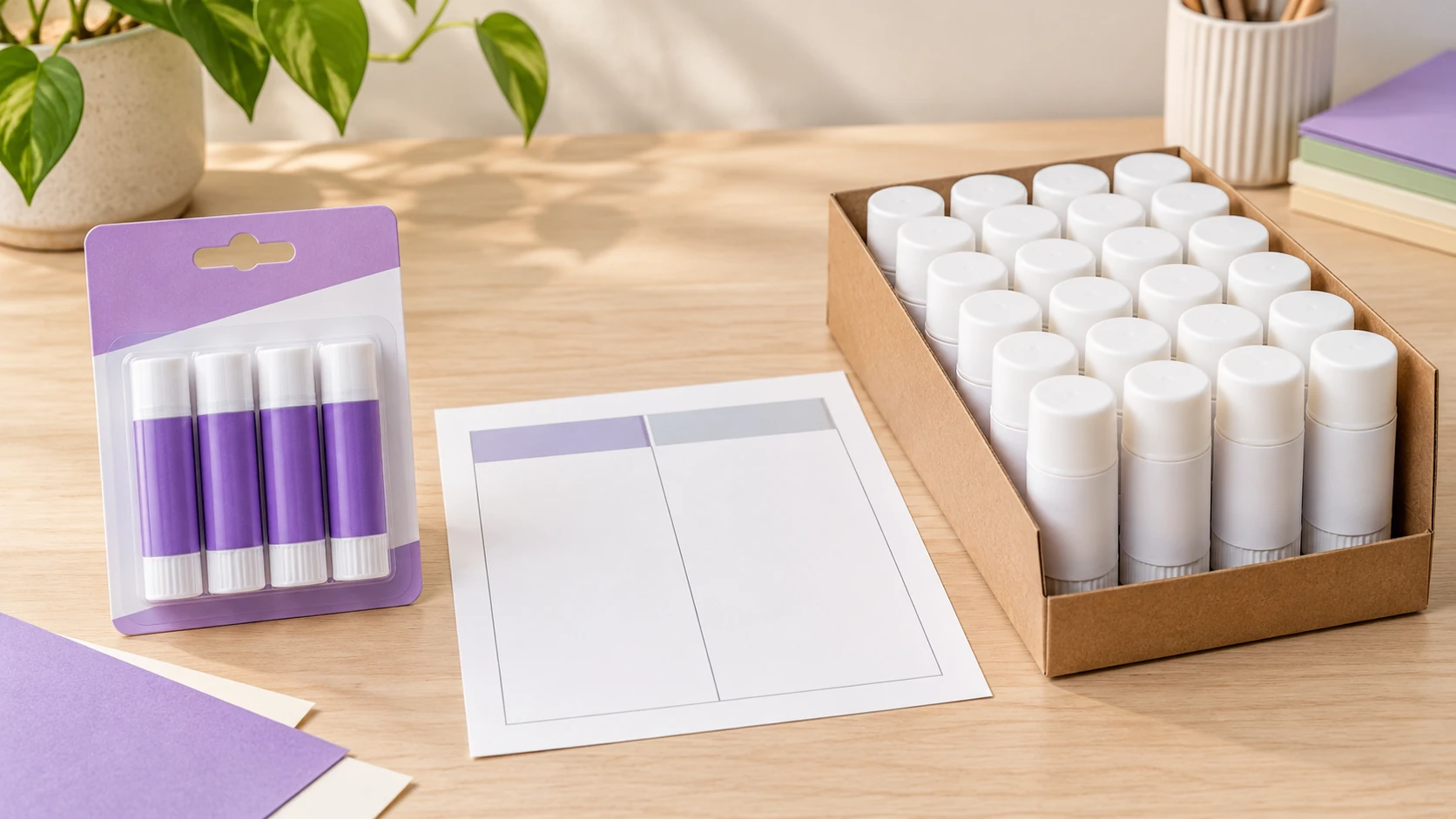
A glue-stick order for a classroom sounds simple until the listing uses two kinds of “pack.” A glue stick pack count needs the inner unit and case unit kept separate. One BAZIC page describes four purple sticks in an inner pack and 24 packs in the offer. Another describes 30 white sticks per pack and 20 packs in a classroom offer. Those labels suggest very different supply quantities, but a product photograph shows only the pictured unit. Before spending a supplies budget, decide how many sticks the activity needs, then ask the seller which unit the order actually buys.
The useful question is not which listing displays the larger number. A class that needs a small reserve for a single session has a different purchasing problem from a program replenishing several rooms. The seller describes the purple offer as four 8 g sticks per pack across 24 packs. The white offer describes 20 packs of 30 8 g sticks, or 600 units. Treat those figures as listing statements that need confirmation at checkout. They are a starting point for planning, not a count of items independently checked inside a shipped case.
Separate an inner pack count from a case count
Begin with the smallest unit a person will use: one twist-up paper or craft BAZIC purple glue stick. The native product page calls each stick 8 g and describes a four-stick pack. Its gallery shows four sticks on a retail card with a “24 pack” callout. That image is useful for recognizing the inner unit. It cannot by itself show whether the checkout quantity is one retail card, 24 cards, or another fulfillment arrangement. The page description says the source title lists four per pack and 24 packs, so record the inner pack count and case count separately.
The BAZIC white glue stick page presents a different structure: 20 packs of 30 sticks, each 8 g. Its gallery shows a tray of white glue sticks with individual sticks visible. The photograph supports the product’s physical role as a paper-craft adhesive. It does not provide a complete visual count of a 600-unit shipment. Use the page’s text for the stated pack structure, keep the photograph as identification evidence, and verify the commercial unit before relying on the stated total.
Write down “sticks per inner pack” and “inner packs per order” in separate columns. For the purple listing those entries are 4 and 24. For the white listing they are 30 and 20. A label such as “24-Pack” may refer to a case of retail cards rather than 24 individual sticks. Do not silently replace one interpretation with another because a thumbnail shows four. If the order page or seller confirmation conflicts with the native description, stop the calculation and resolve the unit first.
Turn the seller labels into a planning count
Multiplication gives a provisional planning count: 4 sticks per pack times 24 packs equals 96 sticks on the purple offer’s stated terms. Thirty sticks per pack times 20 packs equals 600 on the white offer’s stated terms. Keep “provisional” beside both totals. This arithmetic checks whether the pack language makes sense for the activity; it does not certify what will arrive. A useful purchasing note preserves the actual wording of the listing, the multiplication, the page URL, and the date checked. If a buyer must order before the seller clarifies the case unit, the buyer should not promise the calculated quantity to teachers or participants.
Next calculate demand from the work itself. Count the number of groups or tables that need a stick at the same time. Then consider how many will be opened, shared, and kept as a reserve. If each table can pass one stick around during a short paper activity, one stick per participant may be wasteful. If several groups work at once, a single central supply may cause a queue. These are planning choices for the activity leader, not performance claims about either product. Write the chosen sharing rule beside the required number so another purchaser can understand why it was chosen.
A reserve should reflect how the supply will be distributed. For example, a leader might put one inner pack at each table and keep one unopened pack for replacements. That is a distribution example, not a recommendation for any particular class size. The gallery of the purple offer makes a four-stick card easy to recognize as a unit to hand out. The white listing’s 30-stick pack may be easier to divide among several tables, but the native photograph does not prove how the shipped packs are wrapped. Confirm the actual inner packaging if sealed packs matter to your storage or handout plan.
Do not compare the provisional totals as if larger automatically means cheaper. Neither page’s count alone supplies a reliable price per delivered stick, and a listed price can change before checkout. Even if the two stated totals are accurate, the larger case may leave unused stock for a one-day activity. The smaller stated case may require another order for a continuing program. Record the needed stick count, the verified sale unit, the current checkout total, and any delivery terms before doing a cost-per-stick comparison. A budget decision should be based on the unit being purchased and the quantity likely to be used.
Match the product to the project
Both native pages identify twist-up sticks for paper and craft use. The purple page says its glue applies purple and dries clear, which can help someone see where they have made a pass. The white page describes an all-purpose white stick that dries clear. These are seller descriptions, not results of a side-by-side adhesion test. A buyer can choose based on whether visible coverage would help the participants, while keeping the pack calculation separate from the work of testing glue on the actual paper.
If the activity involves narrow paper edges or a project that already lifts after gluing, use a spare sample before allocating a whole case. The guide on glue stick not sticking to paper covers the coverage check and the small test for a lifted edge. That question belongs with the actual paper and application. The present decision concerns how to read a listing’s pack structure and budget the supply. A large quantity cannot fix a mismatch between adhesive, surface, and handling.
Product details also matter when sticks will be stored between sessions. Both listings describe 8 g sticks, but neither native gallery establishes shelf life in your storage conditions. Do not convert the stated total into a months-long usage forecast without a realistic schedule. Count only the sessions already planned, keep unopened stock where its product directions call for it, and check actual condition before the next event. A high nominal case count offers little budget value if the program cannot use the sticks before they stop serving the project well.
Think about who will receive the supply. An individual craft station may need a small number of immediately available sticks, while a shared project tray can hold replacements for several people. The portable craft project box guide shows a separate way to plan a ready tray and reserve for a project. That storage decision does not establish the glue-stick order quantity. It helps identify where unopened extras would go after the current activity, which is useful when assessing whether a case-sized order fits the program.
Ask about the exact fulfillment unit
When a listing gives both an inner count and a case count, ask about the exact fulfillment unit before ordering: “Does one checkout quantity contain 24 four-stick cards, or one four-stick card?” For the white listing, ask whether one checkout quantity contains 20 packs of 30 sticks, and whether those packs are separate units. Refer to the exact product URL or SKU so the seller answers the offer you reviewed. A generic question about “a box of glue” can be answered for a different configuration, especially when one brand has several similar stick sizes and colors.
Keep the answer with the purchase record. If the answer changes the order unit, redo the demand comparison using that confirmed unit. Do not preserve the earlier 96 or 600 figure as a promised delivery quantity once a seller gives a different configuration. If the seller cannot clarify, the pack ambiguity is a real purchasing risk. Select an offer whose unit is clear enough for the activity, or arrange a smaller test order if the program can tolerate the uncertainty. Do not make the participants’ supply plan depend on a multiplication that has not been checked against checkout.
Check the displayed product name, size, and pack wording immediately before purchase. The purple listing is a 2023 model with 8 g purple sticks; the white listing is a 2041 model with 8 g white sticks. Similar images and the shared BAZIC brand do not make their listings interchangeable. A substituted stick size or an offer with only one inner pack changes the calculation. The person placing the order should compare the final checkout line with the saved product page, including the SKU where shown, and record any difference for the activity lead.
Make the buying decision from the usable quantity
A simple worksheet can hold five entries: required sticks for planned simultaneous work, reserve sticks, seller-stated sticks per inner pack, seller-stated inner packs per order, and confirmed checkout unit. Calculate the required total first. Then compare it with the confirmed quantity for each offer. If either offer leaves a large surplus, ask whether the next scheduled project will use it. If one falls short, consider whether a second order or a different configuration is practical. Keep price, shipping, and tax as separate current checkout facts; this article supplies no stable price comparison.
The two BAZIC listings give useful examples because their numbers are arranged differently. Four times 24 and 30 times 20 are straightforward calculations once the unit is understood. The important work comes before the arithmetic: identify the inner pack in the native evidence, read the stated case structure, and confirm what one purchase line delivers. That sequence lets a buyer budget glue sticks for the planned activity without treating a product photo or an ambiguous “pack” label as proof of a shipped case.
After the order arrives, compare the delivered inner packs with the seller’s confirmed unit before distributing them. Record a shortfall or different configuration against the original order, and keep the unopened packs together until the count is settled. That receiving check closes the budgeting loop: the next activity can use the real supply on hand instead of repeating an assumption from the listing.