Outdoors & Mobility
Garden sign wording: match each message to its intended place
Prepare a location-to-message record for garden signs, keeping the approved wording, intended destination and unresolved product requirements together.
Garden sign wording needs an intended place as well as correct words. A message can be spelled exactly as agreed and still be assigned to the wrong garden area. Before ordering or marking a group of signs, give each proposed message a location record. Keep that record separate from the physical work of making or installing the sign.
This tutorial develops an original planning method for a household garden project. It does not identify plants, establish ownership, specify a legally required notice or prescribe ground installation. The people responsible for the actual garden supply the intended places and agreed words. Product instructions still govern any later writing, handling and placement of the purchased object.
1. Identify the intended places before counting signs
Walk through the proposed project in conversation or on a sketch you already have. Name each intended place in terms the people involved understand. A privately labeled photograph or a recognizable feature can help identify the area in the planning record. Do not turn a rough drawing into an instruction to insert a stake at a particular point.
Give each place a temporary reference that stays with its record while the wording changes. Your reference might be a letter on your own sketch. It need not appear on the public sign. Keeping it separate lets you change the sign's message without losing the connection to the place you meant. Ask a helper to identify the same area before assuming the reference is shared. If a photograph includes several similar places, note which feature you mean in the private record. Keep the original image or sketch available during that discussion. A cropped picture without its surrounding context may leave the next helper guessing which part of the project the note refers to. Clarify the reference before attaching an approved message to it.
Decide which proposed locations actually need a message. A garden area may have its own familiar name without needing a sign, while two separate areas may need the same wording. Count the intended sign copies after those choices. The number of areas on a sketch, the number of different messages and the number of physical signs are three separate entries in this project.
2. Read the supplied message surfaces as exact offers
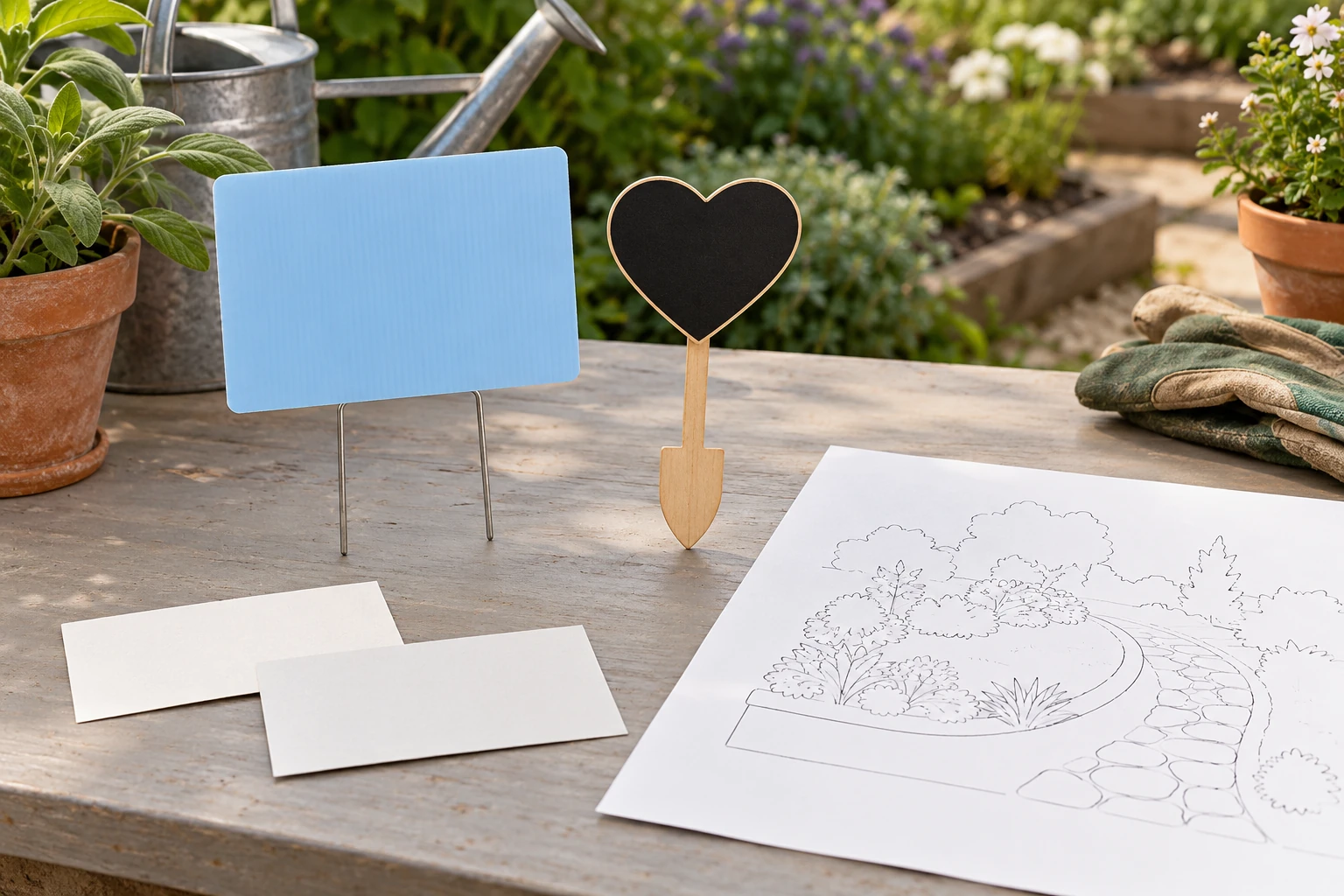
The fjiosa light-blue blank-sign offer describes ten corrugated plastic boards and ten wire stakes. Its whole gallery shows blank blue boards and H-shaped stakes. The native title and stake diagram give one stake height, while the description gives another. That discrepancy remains unresolved; this tutorial adopts neither height and gives no mounting or insertion method. Confirm the exact supplied version when that detail matters.
The Vivian-listed Melrose chalkboard stake is described as metal and wood. Its gallery shows a heart-shaped black message surface on a shovel-shaped stake. That identifies a different sign form from the blue board. The captured material does not establish a particular chalk or marker, an erasing method or the life of writing outdoors. Obtain the applicable information before treating it as a production instruction.
Both are complete garden-message sign forms rather than plant supports. A picture of a blank surface does not establish how your chosen lettering will fit or which writing material is compatible. Keep those product questions beside the proposed message. You can settle the location-to-message mapping on paper while leaving the purchase undecided, without pretending the object has already been tried.
3. Give each location one complete wording record
Write the proposed message in full beside the temporary place reference. Include punctuation and any name exactly as the responsible person intends it. If the proposal is only a garden nickname, identify it as that person's chosen name. This method supplies no authority for identifying a crop, verifying a botanical name or certifying what grows in a particular bed.
Keep unresolved wording visible as a question. A helper should not have to invent a family name, a dedication or a missing word merely because the sign order is waiting. Record who can answer and leave the draft unapproved until that person does. A complete-looking line of text is not evidence that the intended person agreed to it.
Check the record across the project, not just one line at a time. If two locations have the same proposed name, ask whether that repetition is deliberate. The answer may be yes. Preserve the two location references even when their messages match. A shared public label does not make the two physical destinations interchangeable in the private handoff record. You can retain a separate entry even when every visible word matches. The private reference exists for the people preparing the project, so it can carry distinctions that would be unnecessary on the sign itself. Ask whether those distinctions remain understandable when someone returns to the record after the original conversation has ended.
4. Separate message versions from physical copies
Suppose a hypothetical household calls two areas “Kitchen Garden.” One is beside a familiar path; the other is elsewhere on its private sketch. The household wants one message copy for each area. Its record therefore has two location rows with the same words. This is an invented planning example, with no measured garden, product installation or claim about how visitors will behave.
Now imagine that the household changes one area's chosen name. Update that location's message while keeping its reference. The other row still carries its original wording. Making the change in one master list of unique phrases would lose which place the revised words belong to. Review the location rows before producing another copy from an earlier message file.
A single place can also need more than one agreed copy. Give each intended copy a reference within that location record, and explain its intended role in ordinary language. This is a count and assignment decision. It does not establish viewing directions, a safe installation site, a required viewing distance or a promise that every reader will notice the finished signs.
5. Review the mapping with the person who will use it
Show the proposed record to the person helping with the project. Ask them to identify which message belongs to each referenced area without filling in the answer first. Compare their account with your intention. A disagreement tells you the private reference needs clarification. It is an observation about this conversation, not a measured test of either retail sign's readability or performance.
If they recognize the place but read different words in the message record, address the text. If they read the words correctly but identify another place, address the location reference. Changing the sign design would answer neither problem by itself. Preserve the specific question so the next discussion begins with the actual mismatch instead of restarting the entire project from memory.
Once the people responsible agree, identify the selected version and retain the earlier proposal separately. Keep the exact wording with its location reference. A photo of a blank sign or a saved product page cannot replace that agreement. Make the selected record easy to recognize among alternatives. If a message was approved verbally, write down the words and return them to the responsible person for confirmation before treating your recollection as the selected version. Keep any remaining qualification beside the message rather than in a separate conversation that the next helper will not see. The record should let a later helper distinguish an approved message from an idea that happened to be discussed at the same table.
6. Carry the record into the separate making decision
Before ordering or marking a surface, take the selected message and its unresolved product questions together. Confirm the exact item and applicable requirements with the relevant supplier or instructions. This article supplies no cutting, drilling, fastening, painting, cleaning or chalk application sequence. A location plan is still useful when a production question means the actual sign must wait.
After a sign has been prepared under the applicable instructions, compare its actual words with the selected record. Check which intended copy it represents before putting it into the project group. If it differs, retain the discrepancy and resolve it before presenting that copy as finished. A checked file and a finished object are different evidence about the project's state.
When another person takes over, pass along the location-to-message record and the status of the actual copies. Identify anything still undecided. Avoid a handoff that consists only of several similar signs and a remembered conversation. The helper needs the agreed destination for each copy; the physical installation remains a separate task governed by its own applicable information.
7. Keep related writing and display tasks in their own scope
The stamped-border planning guide develops motif positions and space around a short paper message. Use that separate composition discussion when decoration is the question. Here, the central record connects a message to its intended garden area. It does not choose a border, establish an alphabet's impression size or prescribe a printing process.
The Christmas gift-tag placement guide examines attachment and reading position on wrapped packages after recipient information is settled. Those package observations give no ground-stake installation advice. Keep the garden mapping with the garden project, including any unresolved copy, rather than transferring a tie-on or adhesive method from a gift to an outdoor sign.
Keep the purchase tied to the exact agreed sign form
Both captured product offers list cryptocurrency among accepted payment methods in structured data. That supports checking the current checkout if you choose to purchase. It does not establish which assets, networks or wallet services a later order will support. Payment availability also supplies no answer to the blank-board stake discrepancy, a writing-tool question or the approved destination of a particular message copy.
Before payment, retain the exact offer, selected option and stated supplied contents. Keep any written clarification with that order reference. A different color, package or sign form needs its own review rather than inheriting the first offer's details. If someone else places the order, give them the agreed selection and identify who will reconcile its status. Keep the private garden message record separate from payment credentials. An acknowledgement that payment was received does not confirm an unresolved contents question. Retain the actual answer instead of treating the checkout as product verification.
If cryptocurrency is chosen, read the amount, asset and network instructions shown for that transaction. Confirm receiving details in the actual payment flow. This article gives no wallet address, transfer procedure, exchange rate, fee estimate or network recommendation. Ask the merchant or payment provider when an essential detail is missing. Save the dated instructions so a later enquiry can identify the same order and attempt.
Check merchant order status as well as payment confirmation. Reconcile an uncertain existing attempt before sending another payment. Read current cancellation, return and refund conditions for the selected order, including cryptocurrency terms where relevant. Retain the confirmation and payment reference together. These records concern the purchase; the finished wording, copy identity and intended garden location still require their own checks against the selected project record.
Garden sign wording is ready to carry forward when the responsible people agree on the words and can identify which intended place each copy belongs to. Keep that mapping through the separate making and installation decisions. If a name or location changes, preserve the earlier record and reconcile the affected copies before treating the project as current.