Crypto Commerce
Frigidaire EFRF7013 vs LHRIVER 7 cu ft chest freezer placement
Compare two 7-cubic-foot chest freezers by garage placement, lid clearance, baskets, temperature controls, manual defrost, and saved energy claims.
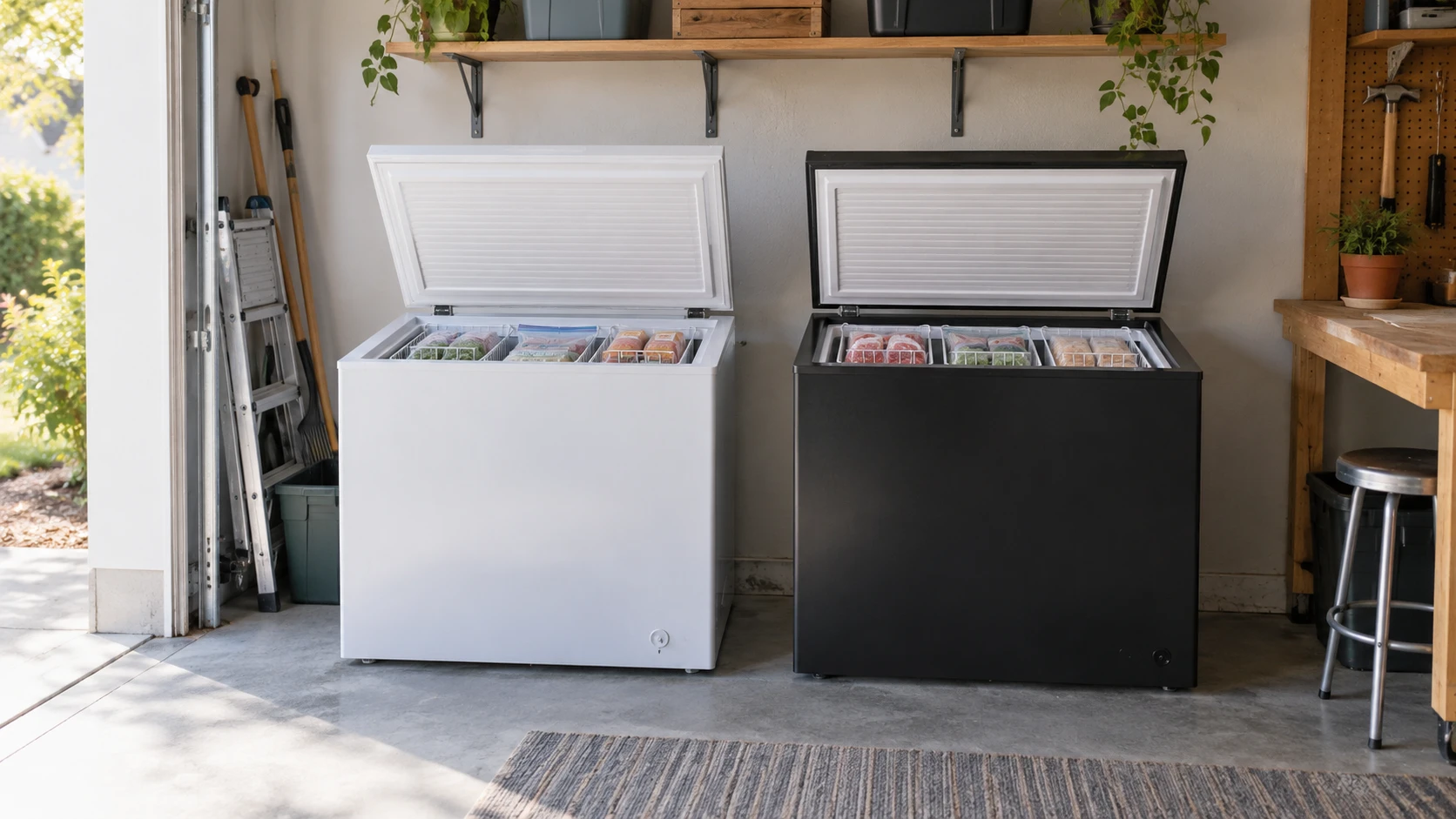
The Frigidaire EFRF7013 chest freezer and LHRIVER's black chest freezer both list 7.0 cubic feet of storage. Frigidaire emphasizes a garage-ready operating range, an external temperature control, and a defrost drain. LHRIVER gives exterior dimensions, three hanging baskets, and a seven-setting dial. The matching capacity labels do not show how either lid opens or how food will be arranged once the freezer is full.
Republeq’s product descriptions for both models contain no matched test of temperature stability or energy use. The Frigidaire row does not provide exterior measurements, while the LHRIVER row does. The LHRIVER description mentions garage placement without giving the same ambient-temperature certification as Frigidaire's claim. Check the current manufacturer documents for the exact model and intended room. Discovering a blocked lid after the freezer is full would make relocation difficult. Draw the lid arc on a side view of the planned spot, including any shelf or pipe above it. Mark where a person will stand while lifting a loaded basket. This takes a few minutes before delivery and reveals whether the appliance can be used comfortably, even if its cabinet dimensions fit on the floor.
Settle the garage question first
Frigidaire describes the EFRF7013 as garage ready and claims stable operation in ambient conditions from 0 to 110 degrees Fahrenheit. Confirm the stated operating range in the current manual and warranty terms. Measure or estimate the actual temperatures in the intended garage across the year. A garage can be much hotter or colder than the adjacent house, and the appliance still needs the clearances and electrical supply required by its installation instructions.
LHRIVER lists garages among suggested locations, along with kitchens, dorms, and offices. The saved row does not give a permitted ambient range. Do not carry Frigidaire's 0-to-110-degree claim over to the LHRIVER. Request a model-specific operating range and check whether the warranty covers use in the planned location. If the only available spot is an unconditioned garage, that missing information should be resolved before comparing the baskets or finish.
Consider the floor and nearby activity. A top-opening unit needs room above it and a level surface below it. Make sure the lid can be raised while a car is parked, cabinets are open, and other stored items are in their usual positions. Check for a suitable outlet without assuming an extension cord is permitted. The saved rows do not specify circuit requirements; use each manual rather than an electrical guess. Leave access around the cabinet for cleaning and for the ventilation space the manufacturer requires.
Before delivery, photograph the intended location with a tape measure showing the available floor and overhead space. Keep the model number from the order beside that measurement. This makes it easier to compare the installation drawing with the actual corner and to catch a substituted model before it is unpacked. Also plan a route for moving the freezer back out if service is needed. A tightly fitted cabinet that cannot be pulled forward may turn a small repair into a room rearrangement.
The published guide on chest-freezer capacity and controls compares different brands. Its method of separating nominal capacity from usable organization applies here, but its dimensions and controls belong to those other models. Take a tape measure to this purchase and use the exact Frigidaire and LHRIVER documents when deciding how either one fits.
Measure the footprint and the lid arc
LHRIVER lists 22.04 inches wide, 32.20 inches deep, and 33.66 inches high. Verify that orientation in the current dimension drawing; the saved row gives no diagram and an installation can fail when width and depth are assumed from a photo. Measure the tightest part of the delivery path as well as the final floor area. Add space for the lid and for the person lifting food out. A narrow corner may fit the cabinet but make it difficult to reach a package at the bottom.
The LHRIVER row describes a dual-action hinge that can hold the lid between 45 and 90 degrees. That may help keep it open during loading, but check the actual clearance to reach the hinge's useful positions. A low shelf overhead could force the lid to stop before the hinge can support it. Do not use a nominal 45-degree position as proof that the contents will be easy to see or remove. Try the movement with the deepest basket in mind.
Frigidaire's saved row does not list exterior dimensions or a lid-angle range. It describes a removable basket and a black-granite finish. Obtain the official dimension drawing and check the lid swing before giving the freezer a place in the room. The finish may look suitable next to other appliances, but it does not change the need for clearance or the practical reach into a deep chest.
The two equal volume labels do not establish equal usable shapes. A wide shallow compartment and a narrow deep one can hold very different arrangements of boxes and bags. Bring measurements of the largest item you expect to freeze, such as a prepared meal tray or bulk meat package, and compare it with the interior opening. The saved rows do not provide complete interior dimensions, so ask for them rather than assuming every seven-cubic-foot chest accepts the same containers.
Organize the top before the bottom fills
Frigidaire lists one removable basket for separating small items or making room for large ones. That gives a simple way to keep frequently used packages above the bulk storage. LHRIVER lists three corrosion-resistant hanging wire baskets, each stated as 11.8 by 8.3 inches, that move along sliding rails. Three baskets can separate small packages, but they also take up part of the opening used to reach large items below.
Think through a normal retrieval. If the household buys food in bulk monthly but pulls out dinner ingredients every day, put the daily items where they can be found without unpacking the chest. Label packages with contents and dates, and maintain a short inventory on the lid or nearby wall. Neither product row supplies a divider system for the deep section. Baskets help only if the food below them remains searchable.
LHRIVER's description claims space for items as large as a turkey weighing up to 24 pounds, among other foods. That is an example in Republeq’s product information, not a guarantee that every package shape fits with all three baskets installed. Frigidaire describes room for family frozen foods without a specific load example. Check the interior dimensions and loading guidance for the exact units if storing a particular bulky item is the reason for buying a chest freezer.
Check controls where they can be read
Frigidaire lists an external temperature control and a power-on indicator light. External adjustment avoids opening the lid just to reach the dial. The indicator shows that the unit has power; it does not measure food temperature or establish what happened during an outage. Ask whether the current model offers any temperature alarm, because the saved row does not establish one.
The LHRIVER 7.0-cubic-foot chest freezer row describes a seven-setting dial, with milder cooling at one end and deeper freezing at the other. It lists an adjustable range of minus 7.6 to 6.8 degrees Fahrenheit and a green operation light. Those numbers come from the saved Republeq catalog record; they are not a live reading of food at every shelf position. Use a freezer thermometer and the manual's adjustment procedure to learn how the chosen setting behaves in the room.
Temperature control is especially important after a large shopping trip. Newly loaded food, repeated lid opening, and room temperature can all affect the interior. The saved descriptions do not compare recovery time or holding performance during a power outage. Avoid turning a dial simply because the compressor is running; follow the manual and read a thermometer over time. If an outage is common, plan how food will be checked and when it should be moved.
Plan for defrost and operating cost
Frigidaire lists manual defrost and a drain for defrost water. The drain could make maintenance easier if there is a safe place for the water to go. LHRIVER's saved row does not describe a drain or a defrost method. Ask for its manual and inspect the drain arrangement before buying. For either unit, decide where food can be held while the freezer is turned off, and avoid tools that might puncture the liner when removing frost.
LHRIVER gives a stated 0.66 kilowatt-hours per day and a 38-decibel noise figure, along with a broad claim of energy savings against conventional models. The saved row does not name the comparison model or test conditions. Frigidaire's row does not provide a matched daily energy or noise figure. Request current EnergyGuide or manufacturer data for both exact units instead of ranking them from one-sided numbers. For an appliance that runs year-round, ask for comparable energy figures rather than relying on a percentage claim.
Frigidaire is the clearer candidate for a buyer who needs to investigate a stated garage operating range, wants an external control, and values a listed defrost drain. LHRIVER offers more baskets and more detailed exterior and control claims to examine. Verify installation clearance, ambient-temperature approval, interior shape, drain arrangement, and current energy data before choosing between two cabinets with the same nominal capacity.