Crypto Commerce
Foqnuq translation earbuds vs viaim Nano+ earbuds for translation and meeting notes
Compare Foqnuq translation earbuds by language claims, recording and transcription, noise control, battery wording, water resistance, and privacy questions.
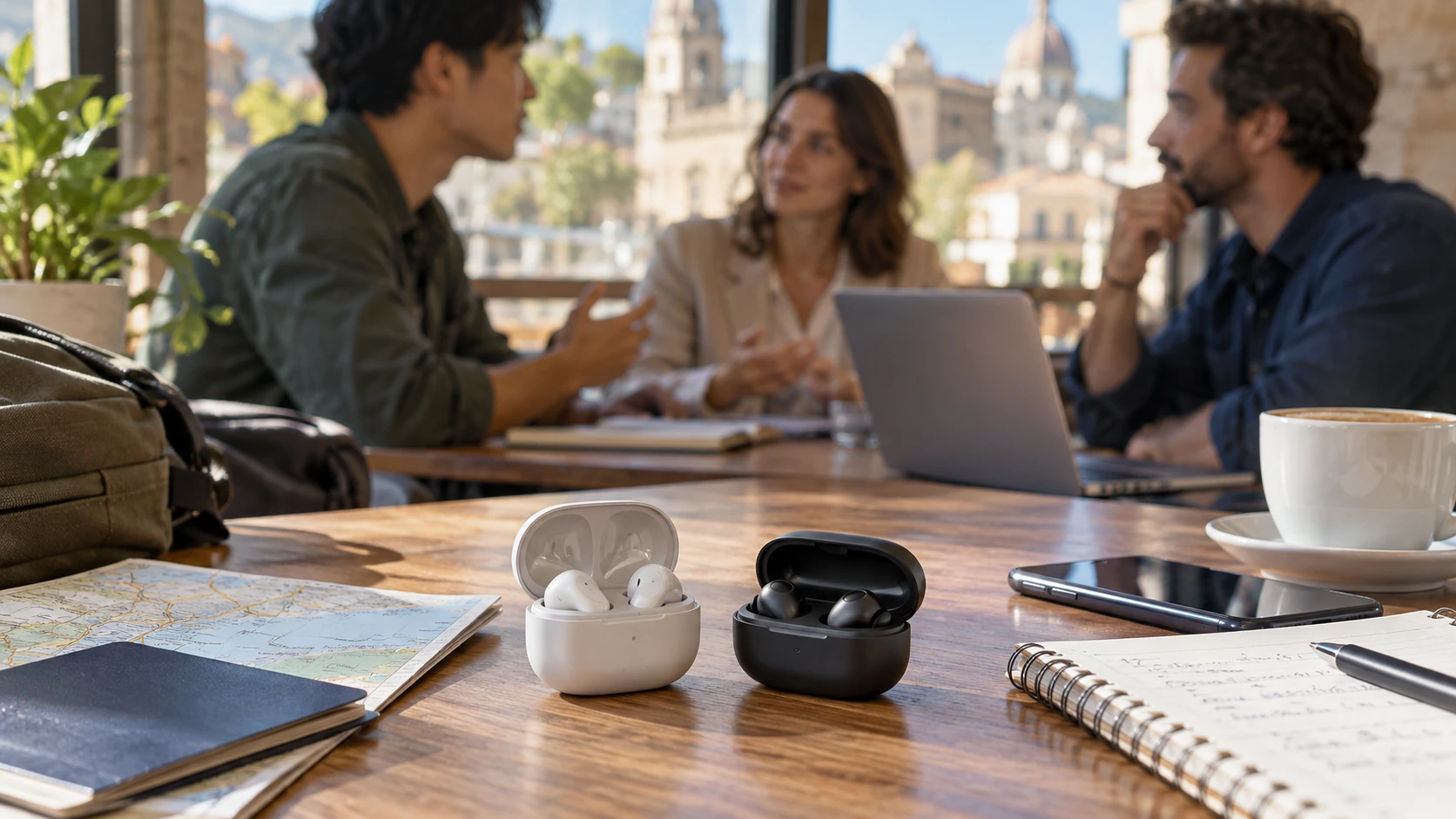
Earbuds that promise translation can serve several different jobs. A traveler may need to understand a brief exchange; a student may want a lecture note; a team member may want a record of decisions after a meeting. The saved listing for the Foqnuq translation earbuds emphasizes translation across more than 80 languages, three active-noise-cancellation modes, and up to 16 hours of playback. The viaim Nano+ listing emphasizes recording, speech-to-text transcription, meeting summaries, and translation across 11 languages. These are claims in Republeq's catalog with different purposes. A language count alone will not show whether either pair handles the conversation you need.
Write down the exact situation before comparing features: the language pair, number of speakers, background noise, whether a phone has network access, and whether a written record is needed. Translation while listening in a quiet room differs from recording a discussion across a table. Some contexts also require permission before audio is recorded. The saved product descriptions do not spell out microphone placement, app permissions, offline behavior, storage location, or the full translation workflow. Those missing facts should be resolved before relying on either product for work or travel.
Match the language claim to a real conversation — viaim Nano+ recorder earbuds
Foqnuq's description says it translates more than 80 languages. It does not list them, identify supported dialects, or specify whether both sides of every pair can be translated in both directions. A number on a product page may count source and target languages without proving fluent handling of a particular accent or technical vocabulary. Ask for the current supported-language list and try the precise pair needed. Include names, addresses, and numbers in the trial, since those details are often more consequential than the easy sentences used in demonstrations.
Viaim's source names 11 translation languages and gives English, Spanish, French, and Chinese as examples. It does not enumerate the other seven or define whether Chinese means Mandarin speech, written characters, or multiple varieties. Ask for its current language matrix and how translation appears to the user. Does the listener hear audio, read text on a phone, or both? Can two speakers alternate naturally, or must one person operate the app between turns? The saved excerpt does not answer. A shorter language list could still fit a buyer's actual needs if the required pair works well, while an 80-language headline may be irrelevant if the desired workflow does not.
Test under the conditions where a mistake would matter. A restaurant menu exchange might tolerate repetition; a medical, legal, or financial discussion can hinge on one word or a dose, date, or amount. Use a qualified human interpreter when accuracy has serious consequences. For routine use, ask the speaker to confirm the translated meaning when something sounds uncertain. Keep the original speech available when recording is permitted, so a translation can be checked rather than treated as an authoritative transcript.
Recording and transcription are separate functions — checking transcription accuracy
Viaim describes itself as a voice-recorder earbud for meetings, interviews, lectures, and travel. Its listing says a Flash Record control can capture audio quickly and mark points, and that software can produce minutes, summaries, and to-do lists. It also claims "up to 98%" speech-to-text accuracy and calls the transcription ChatGPT-powered. The excerpt gives no language-specific test conditions or independent evaluation. Ask whether the figure applies to clean single-speaker audio, noisy meetings, or another setup. Do not carry that percentage over to translation accuracy.
The published guide to checking transcription accuracy is useful if viaim is intended to produce a record. Compare the output with the original audio, especially names, figures, decisions, and negations. A summary can be fluent while omitting a caveat or assigning an action to the wrong person. Keep an ordinary meeting note that records who agreed to do what, then review generated minutes against it. If the audio quality is poor, no formatting feature can recover words that were never captured clearly.
Foqnuq's saved description mentions real-time translation and music playback but does not say it records meetings or creates transcripts. Do not infer those features from its translation label. If a written record is essential, ask for the exact app features, export formats, and any subscription requirements. If the task is simply understanding speech while moving, a recording tool may add unnecessary controls. The choice depends on whether the output needed is a live cue, a saved audio file, an editable transcript, or a reviewed set of meeting actions.
Check the app, connection, and privacy path — viaim Nano+ recorder earbuds
Both listings name Bluetooth 5.2. That tells the reader about a wireless specification, but it does not confirm which phone operating systems and versions are supported or whether translation continues without mobile data. Ask for the companion app name, current device requirements, and a description of what happens when the phone loses connectivity. Test the earbuds with the phone and call software actually used. A connection that works for music may behave differently when a translation app is also using the microphone.
For recording, learn where audio and transcripts are stored, who can access them, how long they are kept, and how they can be deleted. The saved viaim excerpt does not provide those answers. If work meetings contain confidential information, compare the service terms with the organization's policy before enabling cloud features. For a classroom or interview, obtain any required consent and tell participants what is being recorded. Even an easily reached Flash Record button should be used with the same care as a phone recorder.
Translation may also send speech through an online service. Neither saved excerpt documents its processing path. Ask whether audio leaves the device, whether text is retained, and whether the app offers a private or offline mode. A vendor's claim of fast or seamless translation does not answer those questions. For sensitive discussions, test performance with the needed language pair and review the data terms before relying on the earbuds.
Noise control, fit, and call use — viaim Nano+ recorder earbuds
Foqnuq lists active noise cancellation with three selectable modes. Viaim lists active noise cancellation "up to 45 dB." These claims use different descriptions and do not supply comparable test methods. One product's number should not be ranked against the other's mode count. Try each in the setting that matters: a bus, an office, or a room with several speakers. Cancellation of low background noise may make listening more comfortable, while a microphone can still struggle to capture a distant speaker. Ask about ambient or transparency behavior when awareness of surroundings matters.
Viaim says Bluetooth 5.2 supports switching between phone and PC calls, meetings, and media. Confirm whether that means simultaneous multipoint connection or simply easy reconnection between devices. Foqnuq's saved excerpt does not name a multipoint feature. If the user moves from a laptop meeting to a phone call, test that transition directly. Call quality depends on microphone pickup and processing as well as playback. Have a colleague listen to a sample in a quiet room and in a noisy one before relying on either pair for important calls.
Ear tip fit affects comfort, passive isolation, and how securely the earbuds stay put. Neither excerpt lists included tip sizes or a fit test. A long lecture and a short travel exchange may demand different comfort levels. Check the return policy if fit cannot be tried in person, and make sure hygiene rules allow a return after opening. A technically capable pair that becomes uncomfortable after an hour will not be useful for a full meeting or trip.
Read battery and water claims carefully — viaim Nano+ recorder earbuds
Foqnuq says playback can last up to 16 hours. Viaim says up to 40 hours of battery life and supports fast charging. The saved descriptions do not make clear whether those figures include the charging case, whether noise cancellation or translation was active, or how volume was set. Do not compare 16 and 40 as if they were the same measurement. Ask for separate earbud, case, translation, recording, and call figures. A full day of meetings may drain the microphone and app differently from music playback.
Plan a representative battery trial during the return period. Charge the case and earbuds, run the translation or recording mode used most often, and record how long the earbuds last before returning to the case. Repeat with noise cancellation enabled if that is part of the intended routine. Ask whether recordings or transcripts are saved safely if power runs out mid-session. For travel, check how many full earbud charges the case provides and which charging cable is included. A case total is less useful when the earbuds need a break every few hours.
Foqnuq lists IPX6 water resistance, while viaim lists IP55. These ratings describe different combinations of dust and water testing; neither makes an earbud suitable for swimming or washing under a tap unless the maker separately permits it. Check the manufacturer's care instructions for rain, sweat, and drying before charging. The case may have a different rating or none at all. A wet case can become the weak point even when the earbuds themselves have a stated resistance level.
Choose the output you need and verify it — viaim Nano+ recorder earbuds
Foqnuq's saved source centers broad language coverage, selectable noise cancellation, and audio playback. Viaim's source centers a smaller named language count and a fuller recording-to-notes workflow, including claimed transcription and generated minutes. Neither source independently validates translation quality, battery behavior in translation mode, or data handling. The strongest comparison begins with one real language pair and one real task, then tests the complete phone and app setup rather than reading the feature list alone.
If a trip needs brief spoken translation, confirm that Foqnuq supports the language, device, and network conditions on that route. If meetings need notes, verify consent, storage, transcript correction, and action-item review for the viaim Nano+ recorder earbuds. A test recording with the actual speakers and room is more informative than either language count or an accuracy percentage in a listing. Keep the original record and check every consequential detail before sharing generated notes.