Crypto Commerce
How to check transcription accuracy against original text
A typed passage can look convincing even when a small omission changes the instruction it was meant to preserve. To check transcription accuracy , put the typed copy beside the particular written original it came from, compare short corresponding portions, and note each difference before making a correction. Keep the original visible throughout. A discrepancy is evidence that the two texts differ; it is not, by itself, permission to edit the original's wording.
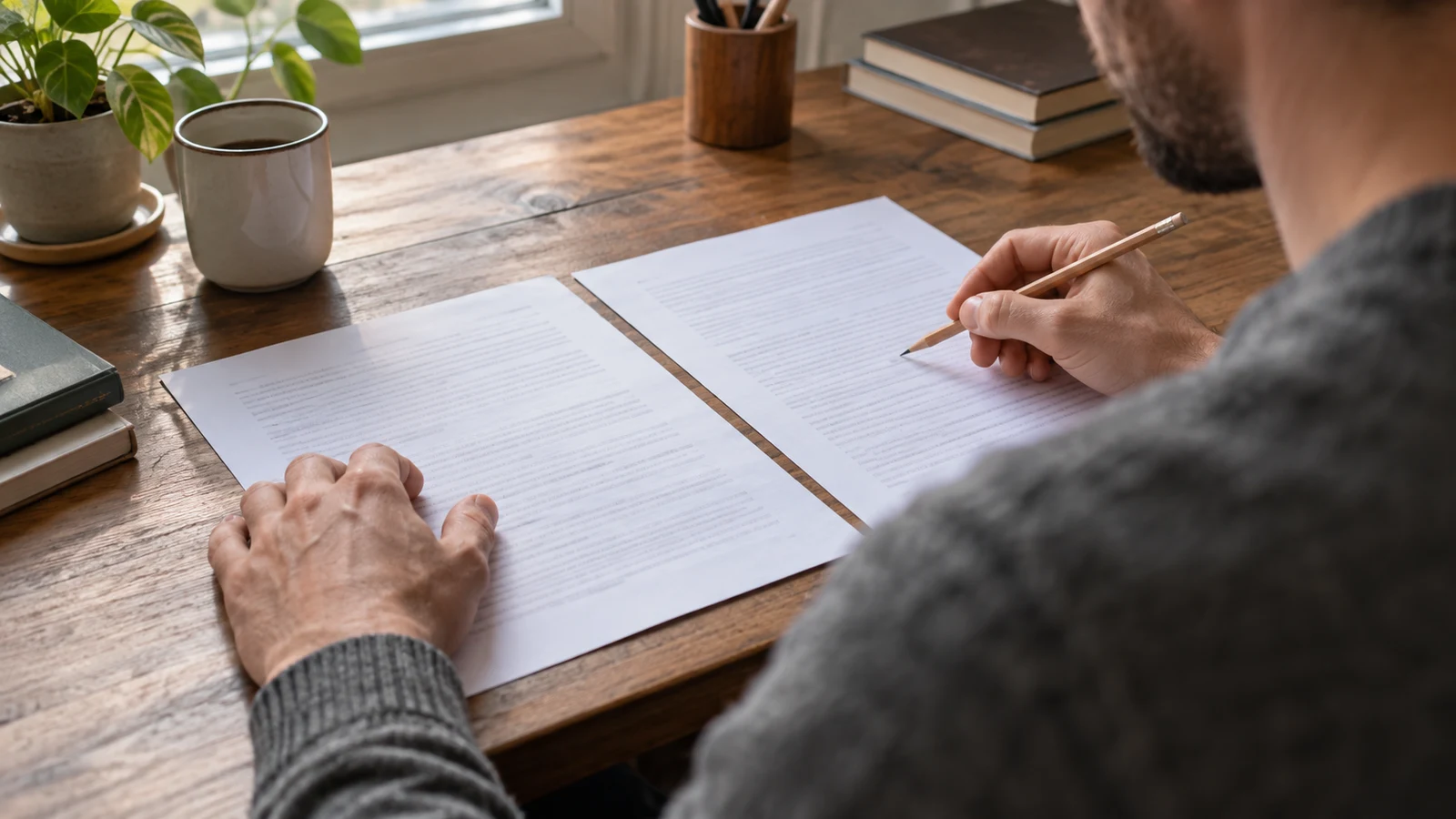
A typed passage can look convincing even when a small omission changes the instruction it was meant to preserve. To check transcription accuracy, put the typed copy beside the particular written original it came from, compare short corresponding portions, and note each difference before making a correction. Keep the original visible throughout. A discrepancy is evidence that the two texts differ; it is not, by itself, permission to edit the original's wording.
Suppose you are copying a brief notice from a page into a document you can search. You need a faithful record, including wording that seems awkward. The task ends with a checked copy and a small record of what you changed or could not determine. It does not end when the new text merely conveys a similar idea. That distinction matters when a missing word, repeated phrase, or changed number would give a later reader a different account of the page.
Tablet Text Comparison Starts With A Fixed Source
First decide which page and which passage are the authority for this copy. If the passage appears in more than one place, identify the specific instance you used, such as the paragraph under a named heading on your original page. A later rendition of similar text is not automatically the same source. Keeping the actual original in view gives you something definite to compare against whenever the typed copy seems more fluent than the source.
Next decide what exactness means for the task. For a literal transcription, check the order of words, their spelling, numbers, punctuation, capitalization, and paragraph breaks. If the source uses an abbreviation, retain that abbreviation. If a sentence in the source has awkward grammar, record it as written. Where a project expressly permits normalized formatting, make that rule before you start checking, and keep a separate account of changes made under it. Otherwise, a tidier copy can conceal a difference that the reader needed to see.
Visible line wrapping needs a different decision from paragraph boundaries. The same sentence may wrap after a different word when its display width changes; that alone does not make the typed passage inaccurate. An intentional paragraph break, however, separates parts of the text and may belong to the record you are copying. If you cannot tell whether a break is part of the source or merely the way it is displayed, flag that point instead of making a silent formatting choice.
A simple working arrangement is enough: keep the source stable on one surface and the copy on another, or place them where you can alternate your attention without losing the sentence. The Dell Inspiron 15.6-inch FHD touchscreen laptop is an optional workspace for examining a typed copy while you check transcription accuracy. This describes a possible use, not a claim that the laptop includes a particular editing application. Check whether your intended document format is accessible on whatever device you plan to use.
If you prefer a separate source-reading surface, the listed refurbished iPad 6th Gen model A1893 is another item to consider for tablet text comparison. Verify that your original can be viewed in the needed format on that tablet before choosing the arrangement. You do not need two devices to follow the method, and the product descriptions alone do not establish that the devices exchange documents or share software. The practical requirement is a source you can read consistently while checking the corresponding typed text.
Tablet Text Comparison Needs A Reliable Place Marker
Choose a short portion of the original and locate its counterpart in the copy. You might mark the source by paragraph and sentence, then move through a few words at a time. When you pause, note the last word you have actually verified and a nearby distinctive phrase. Do not resume merely at the next familiar word. A passage with repeated language can make a jump to the wrong occurrence look like a correct continuation.
For example, if the source says "leave the form on the desk" twice in neighboring sentences, finding that phrase in the copy tells you little about which occurrence you have reached. Use its sentence position and the words before and after it. If one occurrence has been omitted, a comparison that restarts at the second may miss the omission altogether. The place marker is a way to maintain alignment, not a substitute for reading the words between markers.
Tablet Text Comparison Can Expose Three Different Copying Errors
Consider a fictional original notice: "Bring the blue folder to Room 14. Leave the form on the desk, then leave the form on the desk for the next group." This odd repetition is intentional in the example. Imagine the typed copy reads: "Bring folder to Room 41. Leave the form on the desk, then leave the form on the desk, then leave the form on the desk for the next group." The copy looks related to the original, but it differs in several distinct places.
Start at the beginning of the first sentence. The source has "the blue folder" while the typed copy has "folder." Record the source words and the copied words at that location; "the blue" is missing from the copy. Next, the source has "Room 14" while the copy has "Room 41." Treat that as a substituted number, not a harmless variation in presentation. Because the number's order matters, reread the original characters directly rather than relying on your memory of the instruction.
In the second sentence, the source contains "leave the form on the desk" twice and the copy contains it three times. Record the extra occurrence in the copy and where it appears relative to "then" and "for the next group." A note that simply says "repeated phrase" would be ambiguous because the original also contains a repetition. The surrounding words explain which instance belongs to the source and which was introduced during typing.
A compact discrepancy record can use plain language: paragraph one, sentence one, source "the blue folder," copy "folder," restore missing words; sentence one, source "14," copy "41," correct number; sentence two, source phrase occurs twice, copy phrase occurs three times, remove the third occurrence. The point is to make each edit traceable to a particular reading of the original. You can annotate on paper or in a separate note. Keep that note distinct from the text you intend to present as the faithful copy.
Correct each clear copying error against the source rather than editing for style as you go. In this example the corrected copy will still sound repetitive. If you remove both occurrences of the phrase because the sentence seems clumsy, you have changed the content you were supposed to reproduce. The same restraint applies to punctuation and unusual capitalization when those features fall within the exactness rule you chose at the start.
Tablet Text Comparison Should Leave Source Questions Visible
Sometimes an apparent error is already in the original. Suppose the page plainly says "Bring teh folder," and your assignment calls for a literal copy. Typing "Bring the folder" makes a different text, even though the correction may seem obvious. Preserve "teh" in the transcription and, if an explanation is useful, put the observation in a separate note. That lets a later reader tell the difference between what the page says and what you think its writer intended.
A different problem arises when you cannot confidently read a portion of the original. Record its location and mark the reading as unresolved in your working notes; do not supply a plausible word from the surrounding sentence and call it verified. If the intended output requires a complete exact copy, leave the unresolved point visibly unsettled until the source can be read. A comparison can identify uncertainty without resolving it. Your discrepancy record should distinguish a confirmed mismatch from a source reading that remains open.
Preserve Meaning When Paraphrasing Or Reproduce The Original Wording
Ask what the final reader needs. If the purpose is to show what the page actually said, a transcription must retain its particular words, including repetition and awkwardness within the chosen scope. A paraphrase answers another question: how can the idea be expressed in new words without changing its meaning? Someone preparing a summary may want the latter; someone checking an exact quotation cannot use a summary as evidence that the quotation matches its source.
Using the fictional notice, "Take a folder to the indicated room and leave a form for the next group" conveys some of the instructions, yet it drops the folder's color, the room number, and the unusual repeated action. It therefore cannot replace the checked transcription. If your actual assignment is to restate an idea, the separate guide on how to preserve meaning when paraphrasing addresses that task. Keep the two outputs labeled so that a reader will not mistake your restatement for the original page's wording.
The difference also guides your editing decisions. A transcription correction has a location in the source and a specific copied reading to replace. A paraphrase has to be evaluated for the meaning it carries, not for word-for-word agreement. If you discover halfway through that the task calls for a paraphrase instead, set the checked copy aside as reference material and prepare a distinct output. Quietly changing the transcription into smoother prose would leave the reader unsure which words came from the original.
Tablet Text Comparison Ends With A Recheck Of Every Edit
After correcting the copy, return to each discrepancy. Read the changed words against the original and include a little surrounding text on both sides. This catches a correction placed at the wrong occurrence of a repeated phrase and helps confirm that deleting an extra phrase has not removed one of the source's two intended occurrences. Then read through the full short passage once more from the beginning, maintaining the same source and matching rule rather than relying on the fact that you already made edits.
For the fictional notice, the revised copy should have "the blue folder," "Room 14," and exactly the two occurrences of "leave the form on the desk" present in the original. Mark those three mismatches resolved only after checking their new context. If a character or break in a different source passage remains uncertain, leave its entry open instead of including it among the resolved corrections. A clean-looking copy is not evidence that every source question has been answered.
The finished record can be brief: identify the source passage, note what features were required to match, list the corrections you checked, and separate any unresolved reading. Keep it with the copy if the reader needs to understand a marked uncertainty; otherwise use it as your own checking record. To check transcription accuracy before treating the result as an exact reproduction, compare its wording to the original you actually used, not to a remembered or polished version of it.