Cleaning & Vacuums
Flagged broom bristles: what split tips mean
An original buyer's question separates a documented split-tip design from an unresolved condition observation, without a cleaning test or bristle treatment.
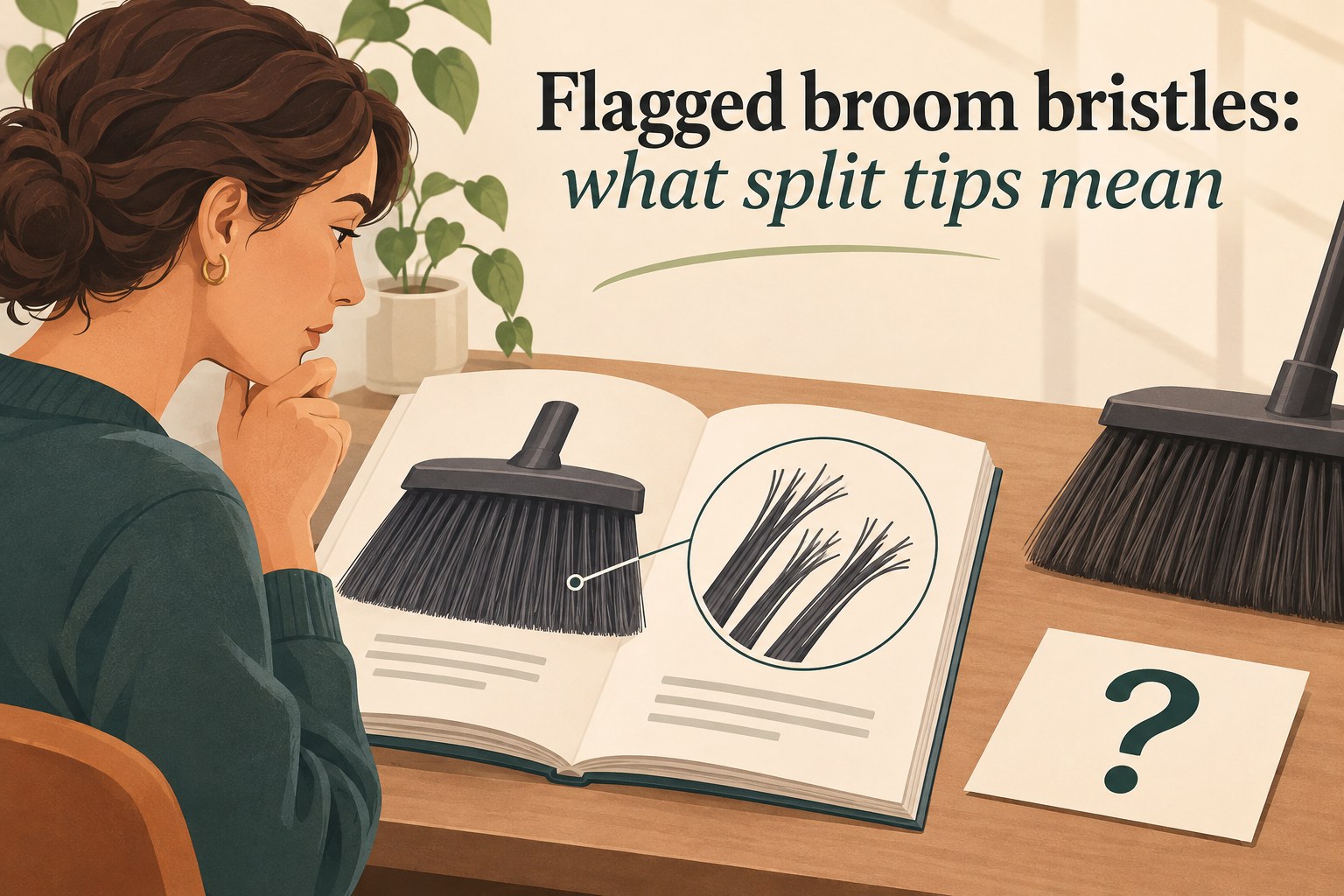
A fuzzy-looking end needs a better question
Flagged broom bristles can make a catalog photograph look puzzling. The ends seem fuzzy, and “worn out” may be the first description that comes to mind. Before applying that description to an offer, read what the seller actually calls its bristles. A named tip finish and the condition of a particular broom are separate questions. This guide explains the wording and follows one fictional buyer as she corrects her question without pretending to inspect an item she has never held.
In RS Quality's technical reference about plastic bristles, flagged ends are described as splintered or bushy, while unflagged ends are straight. That definition gives the fuzzy-looking end a possible design context. It does not turn every irregular end into intentional flagging, identify a manufacturing method, or establish the condition of an individual broom. The reference concerns plastic bristles; carry that scope along with the definition rather than treating the term as a diagnosis for every fiber or cleaning tool.
split bristle tips
The phrase split bristle tips directs attention to the end of a bristle. For a buyer reading a listing, that is a more precise starting point than an overall judgment such as “the broom looks bad.” Keep the description tied to what prompted it: perhaps the catalog image has a fuzzy outline, or the offer explicitly uses “flagged.” Neither observation tells you what a delivered unit will look like. A picture can raise a question without supplying the answer to that different question.
It also helps to keep the location of an observation in the sentence. “The pictured ends look fuzzy” says something different from “a bristle is bent along its length” or “a connection appears broken.” Those are examples of different descriptions, not a diagnostic checklist. A buyer should not change one into another merely because a familiar word is available. When the actual observation concerns an owned item, describe that item and what was observed rather than borrowing a condition verdict from a catalog.
Two offers that actually use the term
The Libman 1115 angle broom offer describes flagged fibers. The Rubbermaid RCP637400BKCT lobby broom offer describes flagged polypropylene bristles. These are two concrete uses of the designation in native catalog accounts. They are examples of wording to read, not proof that the pictured tools have identical tips or that one is the better choice for a particular floor.
Their sole catalog images show dark broom heads and visible handle portions; the upper handles extend outside the frames. No readable maker or model mark in those images independently settles identity. The images also do not authenticate delivered quantities, an individual unit's condition, or cleaning performance. Keep those limitations attached to the examples. An offer's text and photograph can be useful catalog context while leaving questions about the exact purchase unresolved.
There is no need to extract an extra claim from the examples to make the term useful. You can recognize that a seller has named a finish and still ask for clarification about an item. Avoid turning a pack statement into a counted delivery, a cropped image into a whole-tool inspection, or a model suffix into a decoded quantity. If a purchasing decision depends on one of those details, leave it open until there is evidence that addresses that detail directly.
Mira changes the question before she changes the broom
Consider Mira, a fictional adult buyer comparing catalog descriptions. She sees fuzzy-looking ends in a broom image and types a note: “Damaged broom?” She has no delivered item in front of her, no before-and-after photograph, and no account of how that pictured tool was handled. Her note records an impression, but its noun has already become a verdict. That is the point at which she pauses, before the impression hardens into a reason to reject or alter a tool.
Mira then finds the word “flagged” in the offer and reads the plastic-bristle definition. She rewrites her note: “Does this offer describe the pictured tip finish as its intended design?” The new wording is deliberately modest. She has not learned that every visible irregularity is acceptable. She has learned why the fuzzy outline alone did not justify her first label. The revised question asks about a documented design feature while keeping actual condition unresolved.
In this example, no merchant reply arrives and no product is tested. Mira does not trim, reshape, wash, or otherwise treat the bristles to make them match her first expectation. Her useful action is a correction in her own description. She keeps the image reference and the offer name beside the question so that a later answer, if she seeks one, can address the same thing she was looking at. An answer about another model would not settle her original uncertainty.
Suppose Mira later owns a broom and notices that its appearance has changed. This is a new situation, not confirmation of her earlier catalog guess. Her note should say what changed, which item she means, and what comparison she actually has. If she lacks an earlier observation, she can say so. The design term remains background vocabulary; it does not supply a missing history or determine whether the change is damage. No catalog explanation should erase a specific unresolved observation.
broom bristle condition
A question about broom bristle condition needs evidence about the broom in question. Keep “the offer says flagged” alongside, rather than in place of, “this is what I observed.” That wording makes room for both pieces of information without forcing agreement between them. It also avoids the opposite mistake: treating a fuzzy-looking catalog image as proof of a defect. At this stage the honest answer may simply be that the description is understood and the individual condition is still unknown.
For correspondence, a short, specific note is easier to assess than a broad accusation or an assurance copied from a product description. Mira might identify the exact offer, describe the part of the image that prompted her question, and ask whether the named finish refers to those ends. If she is asking about an owned unit, she would identify that separate context instead. These are examples of question framing, not a promise that a seller will confirm condition or accept a return.
Separate records are useful when the questions diverge. One note can retain the catalog designation; another can retain a dated observation of an actual item. Do not fill an empty field with an inference just to make the notes look complete. “Not observed” is more informative than a confident statement whose source was a different tool or a marketing image. The aim is to preserve the difference between what was read, what was seen, and what still needs an answer.
Mira can check a later reply against the question it actually answers. If a response merely repeats the design name, she should not file it as confirmation that a particular delivered unit was inspected. If the reply addresses a different item, her original question remains open. This simple comparison prevents a plausible explanation from becoming evidence for an outcome nobody has observed in the example.
Leave other broom decisions in their own context
Knowing a tip designation does not resolve every cleaning problem. The guide to a push broom that leaves debris addresses bristle contact, floor context, and collection after sweeping. Those are different questions from interpreting a named finish in a catalog. If debris is the actual issue, take that observation to the relevant discussion rather than expecting the word “flagged” to explain what happened.
Likewise, the guide to a broom missing cabinet edges distinguishes head access from debris left after contact. A tip term alone does not answer whether a head reaches a particular space. These links mark the boundary of this explainer: its task is to clarify a design description and improve a condition question, not prescribe a floor choice, a room arrangement, or a cleaning technique.
Keep performance and care claims out of the gap between those topics. This article does not establish that flagged ends are universally softer, safer for a surface, or better at pickup. It does not provide a wet-use, food-area, or hygiene approval. Nor does it recommend a treatment for ends that look unexpected. A clearer vocabulary is valuable because it lets a buyer ask the relevant next question without disguising an unanswered practical question as a settled technical fact.
Keep the payment decision conditional
If you consider purchasing through republeq.com, keep the payment question separate from the broom question. USDT is relevant only if the actual checkout presented to you supports it for that transaction. This article has not established that either linked offer has a particular payment method available. Do not interpret the presence of a product link or this discussion as a promise of stock, a completed order, or a usable crypto checkout. Read the live order information before deciding to proceed, and retain the exact offer identity so that a payment screen does not become detached from the item you intended to buy. If USDT appears as an option, check the instructions shown there rather than borrowing a network, address, or amount from an earlier purchase. This guide supplies none of those details. A statement about flagged tips cannot validate a transfer destination, and a payment option cannot validate an individual broom's condition. If the checkout leaves you unsure what you are being asked to authorize, stop at that uncertainty rather than treating this article as missing transaction guidance. You can also defer a purchase while a product question remains unanswered. Completing a payment would not convert an unresolved condition question into an inspection result. Keep any order confirmation and any product clarification as different records, each supporting only what it actually says. The buyer in the fictional example has not ordered anything, received a merchant reply, or completed a transfer. Her revised question is the result of the example; no commercial outcome is implied. Before making your own choice, assess the actual offer and checkout presented at that time, including any terms you need to understand. Nothing here establishes a transaction fee, exchange outcome, delivery commitment, or remedy for an individual order.
Finish with an accurate description
Mira's revised note leaves her with a usable next step and a visible limit. She can ask about the named design without calling an unseen delivery damaged. If she later observes an actual unit, she can describe that observation without using a general definition to dismiss it. The distinction is small enough to fit in a sentence, yet it keeps the decision grounded: understand the catalog's words, identify the thing you are asking about, and leave its condition open until the evidence addresses it.
Conceptual editorial illustration of a broom-tip design discussion; no delivered condition, exact model or cleaning result is depicted.