Learning & Creative
Build a finite differences worksheet for a stated quadratic
An original unit-spaced worksheet reconstructs a quadratic from three stipulated values, derives its coefficients through second differences and checks class consistency.
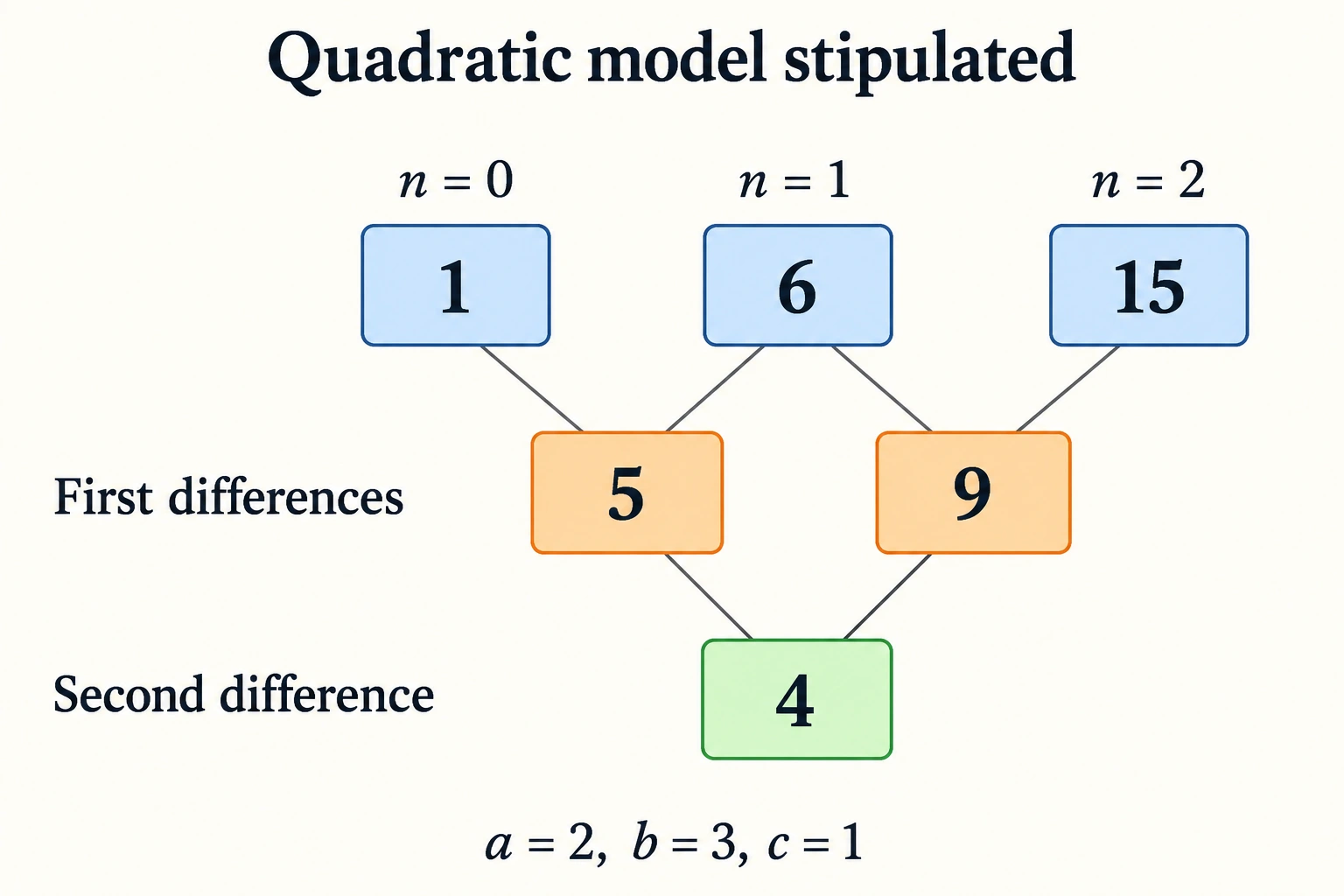
A finite differences worksheet can recover unknown quadratic coefficients when the quadratic family is supplied as part of the problem. In this original exercise, stipulate f(n) = an² + bn + c for every nonnegative integer n, with fixed real coefficients a, b and c. The exact given values are f(0) = 1, f(1) = 6 and f(2) = 15.
The task is to find the coefficients within that stated family, verify the three values and calculate what the model requires at index three. First differences five and nine give second difference four. The algebra below turns those differences into a = 2, b = 3 and c = 1, producing a conditional fourth value of twenty-eight.
Put the premise beside the input rows
Write the quadratic expression above the worksheet before entering any differences. The family permits a to be zero, so it includes linear and constant functions as special cases. It also permits real coefficients rather than requiring whole-number coefficients. Those are the rules of the exercise, not conclusions inferred from the three displayed values.
Keep the indices and values in separate columns. The first row has index zero and value one; the second has index one and value six; the third has index two and value fifteen. These are stipulated exact numbers. They are not measurements, product dimensions, forecasts or rounded observations from a device.
The one-unit spacing between indices matters to the calculation. Moving from index zero to one and from one to two uses equal steps of one. The relation between second differences and the coefficient a that we derive here belongs to that spacing. A row number on a page should not silently replace the actual index attached to a value.
Subtract adjacent values in one direction
For the first interval, subtract the earlier value one from the later value six. The result is five. Place that first difference between the rows for indices zero and one. For the next interval, subtract six from fifteen, giving nine. Place it between the rows for indices one and two.
Continue to read every subtraction as later value minus earlier value. Reversing only one subtraction would create a sign error before any coefficient was calculated. Here the first-difference row is five, nine. Each entry describes an interval between two input rows, so three input values produce two first differences.
Now subtract the earlier first difference five from the later first difference nine. The second difference is four. It belongs between the two first differences. The triangular worksheet therefore contains three values, two first differences and one second difference. Keeping that layout makes it clear which quantities were compared.
Derive the link between differences and a
Use the stipulated expression to write f(n + 1) = a(n + 1)² + b(n + 1) + c. Expand the square to n² + 2n + 1 and distribute the coefficients. The result is an² + 2an + a + bn + b + c.
Subtract f(n) = an² + bn + c from that result. The an², bn and c terms cancel, leaving 2an + a + b. Thus the first difference from index n to n + 1 equals 2an + a + b inside the stated quadratic family.
The next first difference, from n + 1 to n + 2, is 2a(n + 1) + a + b. Expanding gives 2an + 3a + b. Subtract the earlier first difference 2an + a + b, and the result is 2a. The second difference is therefore twice the quadratic coefficient for every one-unit step in this family.
This identity supplies the reason for dividing the worksheet's four by two. It gives 2a = 4 and hence a = 2. The calculation does not assume that a equals the second difference itself. Using a = 4 would miss the factor of two established by the expansion.
Recover b and c from the indexed values
At n = 0, the first-difference expression 2an + a + b reduces to a + b. The worksheet's first difference is five, so a + b = 5. With a already equal to two, b must equal three. The first difference supplies a relation between a and b rather than naming b directly.
The value at index zero supplies c. Substituting n = 0 into an² + bn + c removes the terms containing n, leaving f(0) = c. Since the given f(0) is one, c = 1. This is why retaining the zero index beside the first value matters.
The recovered expression is f(n) = 2n² + 3n + 1. All three coefficients now have a visible source in the working: a comes from half the second difference, b from the first difference after accounting for a, and c from the value at zero. Keep those relations beside the numerical answers.
Interpret the recovered coefficients inside the family
The phrase degree at most two allowed a linear member, with a equal to zero. Such a member would have first difference b at every one-unit step, so its two first differences would be equal. The supplied differences five and nine rule out that special case here. A constant member would also fail, because its first differences would both be zero.
The whole-number coefficients in this example are a result of its chosen values. The premise allowed real coefficients, so the method would not justify rounding a recovered fraction to an integer in another worksheet. The relation a equals half the second difference should be applied exactly. Any additional requirement that coefficients be integers would need to be stated as a separate restriction before checking a different input set.
Verify every supplied value
At index zero, the expression gives two times zero squared plus three times zero plus one, which is one. At index one, it gives two plus three plus one, which is six. At index two, it gives eight plus six plus one, which is fifteen. These are exactly the three stipulated values.
Checking only the final value fifteen would leave the first two constraints untested. Keep all three substitutions in the verification record. A transcription error in c or b might be hidden by another arithmetic error at one index while still causing disagreement elsewhere.
The same reasoning establishes uniqueness within the supplied family. Any quadratic member matching these three values must have c = 1, first differences five and nine, and therefore a = 2 and b = 3. No different choice of its three coefficients remains available after those relations have been satisfied.
Extend the worksheet under the same premise
The second-difference identity says each successive first difference increases by four for this recovered model. After five and nine, the next first difference is thirteen. Add thirteen to the last supplied value fifteen to obtain twenty-eight. Place that value at index three and mark it as the model's calculated extension.
A direct substitution checks the extension independently: f(3) = 2 × 9 + 3 × 3 + 1 = 18 + 9 + 1 = 28. The extended first differences are five, nine and thirteen, while their two successive differences are four and four. Both calculations agree under the explicit quadratic premise.
The word conditional belongs with this extension. The exercise supplied a global quadratic form at the beginning; the calculation follows that form. The worksheet is not a statistical procedure for establishing that an actual changing quantity follows a quadratic law. Its values and its family were declared inputs.
Test a fourth supplied value without changing it
For a separate consistency control, suppose a worksheet supplies twenty-seven at index three while retaining the first three values and the same quadratic premise. Preserve twenty-seven in that record. Its first differences become five, nine and twelve. The successive second differences are then four and three, which disagree.
A member of the stated family must have a constant second difference of 2a across these unit-spaced rows. The first three values already require a = 2 and thus second difference four. The supplied twenty-seven therefore cannot fit all four conditions within this family. The recovered model requires twenty-eight instead.
That finding identifies an inconsistency between the complete input record and the stipulated class. It does not identify which input or premise should be changed in a real investigation. Do not quietly replace twenty-seven with twenty-eight and present the resulting table as if every original condition had passed.
Check signs, spacing and the coefficient relation
If a reconstruction produces a = 4, return to the second-difference identity before altering later values. The worksheet's second difference is four, but the identity is 2a, giving a = 2. Correcting the coefficient relation should be followed by recomputing b and checking every original value.
If someone proposes b = 5 because five is the first difference, inspect its index. At zero the difference equals a + b. With a = 2, setting b to five would make the first difference seven and the value at one eight, contradicting the given six. The failed substitution exposes the missing a term.
Finally, read the index column before applying either relation. The expression 2an + a + b was derived by comparing n + 1 with n. Gaps of a different size or unequal gaps require a calculation using those actual indices. Reusing the same visible difference row without its spacing would discard one of this worksheet's premises.
Keep nearby polynomial questions separate
The nested polynomial evaluation guide begins with known coefficients and a given input, then computes the value through multiply-and-add stages. This worksheet instead reconstructs unknown coefficients within an already specified quadratic family. It does not use that guide's accumulator procedure as its fitting method.
The missing-rule sequence guide explains why a finite prefix alone does not supply a unique continuation rule. Its countermodel construction remains that guide's subject. Here the quadratic class is an explicit premise from the first line, and the work recovers and checks coefficients inside it.
Two native coaster accounts
The Highcool coaster listing declares a four-piece set, while its sole photograph shows pale stacked slices. The page uses a generic catalog name and places the offer under Restored Tools. Different listed size accounts, material identity, origin, bumpers and protective performance are unverified; no dimension is selected as a measurement here.
The Serein Wellness pink coaster listing describes round rose-quartz cup mats under Shop all Kitchen & Dining. Its eight photographs show pink round discs in stacked and spread views. The images do not authenticate the maker or material, measure the pieces or establish protective performance. They supply none of the worksheet's numbers.
A conditional purchasing enquiry stays separate
A reader considering a hypothetical order through republeq.com could ask whether USDT is offered as a cryptocurrency payment method for the intended transaction. That enquiry establishes no actual merchant acceptance, checkout option or agreed transfer. It could identify the exact offer and quantity so a reply addresses the proposed order. If the method is available, the responsible merchant or checkout would need to specify the asset, required network, receiving destination, payable amount and order reference. A familiar token name alone does not resolve those details. The reader could also ask about current delivery, cancellation and return terms before deciding whether to proceed, including how a refund due would be handled. Keep any answer attached to the transaction it identifies rather than assuming it governs another purchase. This article supplies no wallet address, transfer procedure, exchange rate, fee estimate or assurance that a transfer can be recovered. If an order or payment status remains uncertain, clarify that status through the responsible merchant before considering another payment. The worksheet's values and coefficients are invented mathematical inputs and outputs, not prices, token quantities or evidence that funds have arrived. A correct reconstruction also supplies no evidence that a checkout accepted a transaction. The entire exercise can be completed without purchasing anything. A merchant may decline the requested method, an enquiry may remain unanswered, or the reader may decide not to order. None of those outcomes changes the stipulated function family, the index spacing or the coefficient calculation. Any later purchasing decision requires its own current instructions, terms and evidence, independently of the algebra on the page.
Save the class and checks with the recovered rule
A complete record retains f(n) = an² + bn + c as the supplied family, the unit-spaced indices and all three given values. Keep first differences five and nine, second difference four, recovered coefficients two, three and one, and the three verification substitutions. Record twenty-eight at index three as a consequence of that model. If twenty-seven is supplied instead, retain the inconsistency finding alongside the unchanged input.