Office Supplies & Stationery
Next term rule mismatch: ask which rule was given
A fictional prefix diagnosis uses two explicit positive-integer sequences to separate an arithmetic error from a missing generation rule.
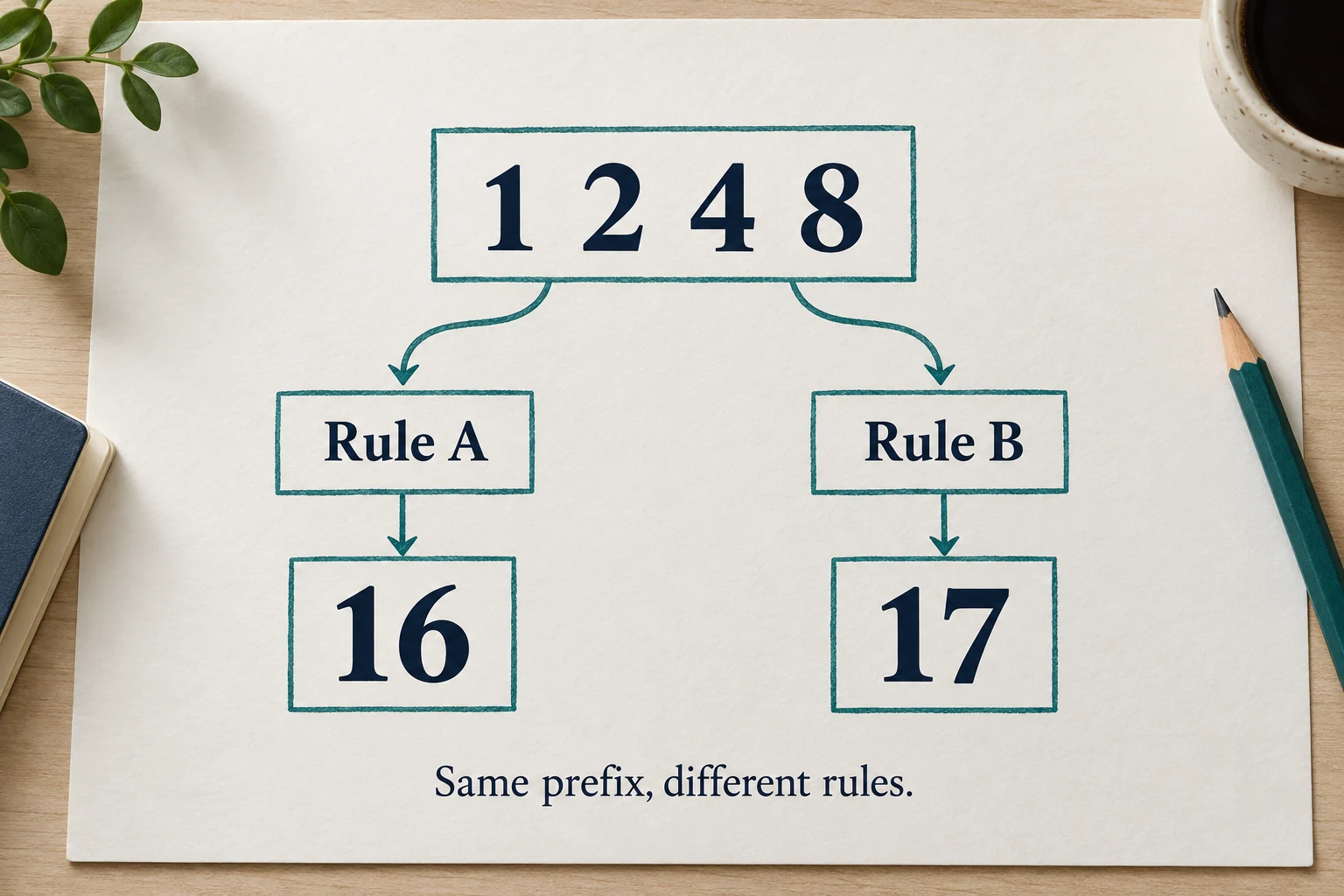
Four entries leave a question open
A next term rule mismatch can begin with a perfectly ordinary worksheet. Someone writes 1, 2, 4, 8 and asks for the next entry. Sixteen is an easy answer to propose: each displayed number is twice the previous one. But suppose the question supplies only those four positive integers, without saying that doubling continues. The proposal then needs a reason beyond the four entries. This article uses a fictional worksheet to identify the missing instruction and show exactly how to repair it. Nothing here describes measured data or a fault in a purchased product.
Keep the positions fixed as n = 1, 2, 3, 4. One possible rule is A(n) = 2^(n−1), with n a positive integer. It gives the displayed prefix and then gives 16 at position five. We will construct another positive-integer rule that gives exactly the same prefix and then gives 17. That second construction is enough to settle the logical question: the supplied prefix alone does not force a unique fifth entry. It does not tell us which rule a particular teacher intended, and it does not assign probabilities to either answer.
Build a change that vanishes at the supplied positions
Define P(n) = (n−1)(n−2)(n−3)(n−4)/24. At each of the first four positions, one of the four factors is zero. When n is one, the first factor vanishes; when n is two, the second does; the third and fourth positions work in the same way. Thus P(1), P(2), P(3), and P(4) are all zero. The denominator does not interfere with those equalities because zero divided by 24 is zero. This is a deliberately designed correction term whose effect is invisible in the information already supplied.
Now define B(n) = A(n) + P(n). Adding zero at the first four positions keeps every displayed entry intact. At the fifth position the product is 4 × 3 × 2 × 1, so P(5) = 1. Therefore B(5) = 16 + 1 = 17. At position six the product is 5 × 4 × 3 × 2, giving P(6) = 5 and B(6) = 32 + 5 = 37. The difference between the rules appears after the prefix, exactly where the worksheet asks the reader to extend it.
Write the first seven values of each defined sequence in order. Rule A gives 1, 2, 4, 8, 16, 32, 64. The correction P gives 0, 0, 0, 0, 1, 5, 15. Rule B consequently gives 1, 2, 4, 8, 17, 37, 79. These are values of explicit formulas, rather than guesses copied from an answer key. Checking the fifth value alone proves that A and B differ; checking the sixth and seventh makes the construction easier to inspect and catches a possible mistake in multiplying the factors.
Check that the alternative stays inside the stated domain
A counterexample must respect the question's actual restrictions. If the question calls for a sequence of positive integers, a formula that later produces fractions or negative values would leave a real gap in the argument. For n at least five, the numerator of P(n) is a product of four consecutive positive integers. Among four consecutive integers there is a multiple of four and another even integer, so their product contains at least three factors of two. It is divisible by eight. At least one of the four integers is also a multiple of three.
Since eight and three have no common prime factor, that numerator is divisible by 24. P(n) is therefore a positive integer for every n at least five. At the first four positions it is zero, as already checked. A(n) is a positive integer at every positive integer position. Adding P(n) leaves B(n) a positive integer everywhere in its domain. This supplies the domain check for the whole sequence, not merely for the first six entries that happened to be calculated. The argument needs no rounding convention or appeal to a visual trend.
There are infinitely many continuations of this form. Choose any nonnegative integer c and define C_c(n) = A(n) + cP(n). The first four entries stay unchanged because c times zero is still zero. The fifth entry becomes 16 + c, so different choices of c give different fifth entries. Nonnegative c also keeps every later value positive and integral. This family establishes infinitely many admissible rules under the stated restriction. It does not describe every possible continuation, and it does not show that fifth entries below sixteen are impossible. Those would be different claims requiring different arguments.
Separate agreement from an instruction to continue
The finite prefix lets a reader reject a proposed formula that misses one of its entries. For example, a proposed rule giving three at position two fails immediately. Passing all four checks is weaker: it shows agreement at those four positions, but says nothing by itself about position five. A and B both pass every check supplied by the prefix. Their disagreement at the next position exposes the distinction. More examples of the same finite kind might constrain the answer further, yet a question still needs some defined class of allowed rules or an explicit generating instruction to justify uniqueness.
A reader may prefer doubling because its description is short or because similar exercises often use it. That preference can be useful when trying to infer an author's intention. It is a separate judgment from proving that no other positive-integer continuation exists. The formulas here do not establish that A and B are equally simple, equally likely, or equally suitable for a classroom. Nor do they say that every intended pattern question is defective. They show why a claim of logical necessity needs an assumption that the displayed numbers alone do not supply.
Repair the question with an explicit recurrence
A precise replacement is: start with a(1) = 1, and for every positive integer n set a(n+1) = 2a(n); find a(5). The seed fixes the first value, and the recurrence fixes each following value from its predecessor. Applying it four times gives 2, 4, 8, and 16. There is no remaining choice at the fifth position under this repaired question. Any other sequence satisfying both the seed and every recurrence step must agree successively at each position, because the same previous value is multiplied by the same number.
B fails the repaired instruction at the step from position four to position five: its fourth value is eight, while its fifth value is seventeen rather than twice eight. That failure is expected. The repair adds a condition that the original prefix did not contain. It would be misleading to treat the new condition as if it had always been present and then accuse B of contradicting the original four entries. Keep the original question and the repaired question side by side so that the extra assumption remains visible to anyone checking the reasoning.
When revising a worksheet, write the permitted domain and the generating rule next to the question before deciding whether an answer is wrong. If the goal is to practice doubling, state the recurrence. If the goal is to discuss possible patterns, ask for a rule and its next value, then require the rule to reproduce the prefix. If the goal is to prove uniqueness within a restricted class, name that class and supply enough conditions for that proof. These requests test different work, so an answer key should say which request it is assessing.
Keep the supporting references separate
The account for the DecMode divided magazine holder identifies a complete holder. Its saved photograph supports discussion of its visible open form and divider. It does not authenticate material composition, dimensions, load capacity, or a mathematical rule for the worksheet. The holder is optional organizational context for keeping printed examples together.
The account for the transparent desktop magazine holder shows clear panels and a loop-shaped upper assembly. Magazines and surrounding scene objects do not establish supplied contents. No fit, stability, material, or grip performance is inferred here. This second holder also supplies no evidence for the sequence proof.
The guide on evaluating a supplied polynomial addresses a calculation with known coefficients and a given input. That is a different task from choosing an unstated generating rule. Use its defined calculation context only; agreement with four prefix entries does not turn this article into a coefficient-fitting or evaluation exercise.
The guide on following a stated recurrence provides a related comparison for the repaired question. A recurrence and its starting information define what must be followed. This article instead diagnoses the earlier missing-rule problem, using two explicit countermodels before adding a recurrence as the repair.
Payment choices do not supply the missing rule
If a reader later considers buying a holder or another item while organizing these worksheets, payment deserves its own check. A lesson about sequences does not establish what a seller accepts, what a checkout will charge, or what protection a particular payment method provides. Someone considering USDT should first verify the actual checkout instructions, supported network, recipient details, and total amount before authorizing a transfer. The presence of a cryptocurrency reference in an article is no evidence that a specific listing accepts it. Treat any visit to republeq.com as a separate purchasing decision with its own current information. Read the listing and applicable terms, check the seller and delivery details, and resolve missing information before deciding to pay. An unfamiliar recipient address or network mismatch needs clarification at checkout; the number pattern above offers no way to validate either one. Keep a record of the stated price, currency, shipping charge, and any disclosed payment charge so that a total can be compared on the same basis. Do not infer a refund procedure, exchange rate, transfer timing, or buyer protection from the fact that a method uses digital tokens. Those details depend on the actual service and transaction terms and need their own evidence. A buyer who cannot verify the instructions can defer the purchase while asking for the missing information. There is no need to complete a transaction to understand why the two sequence rules disagree. The mathematical example uses invented entries and exact definitions, whereas a purchase involves an actual item, recipient, and set of terms. Keeping those contexts separate prevents a tidy worksheet from becoming an unsupported recommendation about money. Choose a payment method only after its relevant conditions are clear for that particular order.
Record the missing assumption with the answer
For the original prefix, record both formulas and their fifth values: A gives sixteen, B gives seventeen, and both give one, two, four, eight at the supplied positions. Keep the integer-domain proof with that record. For the repaired question, record the seed and doubling recurrence before writing sixteen as the forced answer. This leaves a reviewer with the exact evidence behind each conclusion. The next time a proposed continuation clashes with an answer key, the useful first check is whether the rule was supplied, inferred, or added during the discussion.