Furniture & Home Organization
file storage box quantity plan for a real paper collection
Count usable archive groups and existing boxes before comparing a one-pack with a four-pack at current checkout prices.
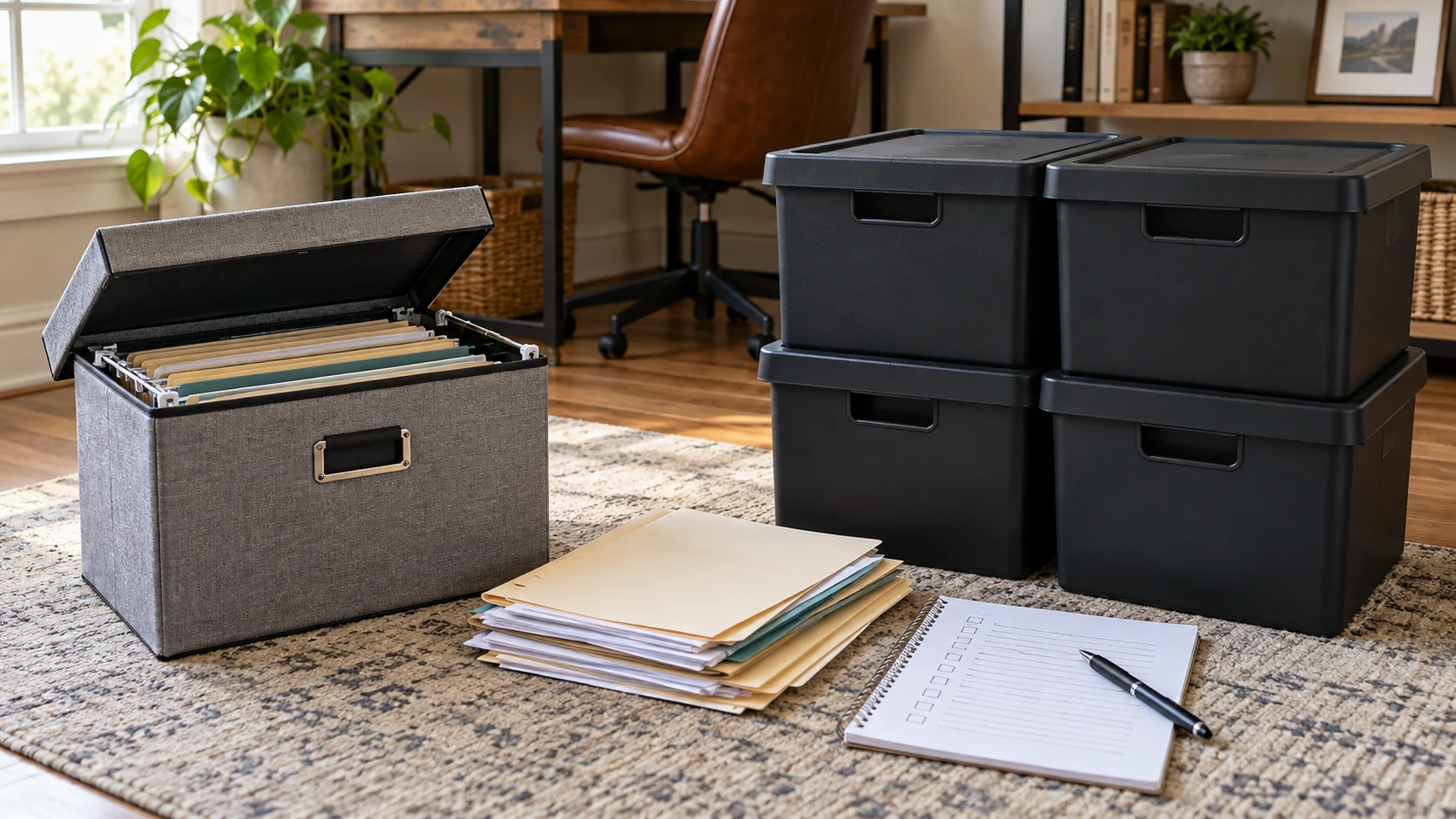
A file storage box quantity plan starts with the papers you will actually keep. A four-pack can look efficient when the price per box is lower, but it still takes room and money to own three unused boxes. A single box can be enough for one finished project, while several separate archives may justify a larger purchase. Count the groups, check the kind of folders in each, and compare the real checkout totals for the exact products. The goal is to buy the number of usable boxes your papers require, with a reserve only if you have a specific use for it.
Count groups before counting boxes
Put the papers into groups that should stay together: one completed tax year, a closed project, a set of school records, or another collection with a clear retrieval purpose. A group is not automatically a box. A small group can share a box with another group if separators make both easy to find. A large group may need more than one box. Write a short name and rough volume for each group, then decide which ones need their own container. This makes the number of boxes an output of your archive plan rather than a guess made from the number of piles on a desk.
Separate active papers from archive papers. A box closed and stored on a shelf is less convenient for forms you handle every week. Keep active material in the system you already use, then count only the material that is ready to be stored. Otherwise you may buy extra boxes, move active papers into them, and later buy another organizer to bring those papers back into reach. The comparison can be made without assuming any universal retention period. Decide what belongs in an archive using the requirements that apply to your own records.
Check the folder system inside
Before assigning a group to a box, note whether it uses hanging folders, ordinary folders, envelopes, or loose papers. A box that accommodates one format may not support another as intended. The captured Highcool one-pack file box describes two plastic hanging rails and letter-size files; its listing says folders are not included. The captured black four-pack plastic file boxes describes a hanging-file ledge for letter- or legal-size files. Those are listing claims for the selected products, not proof that every folder brand, tab style, or overfilled file will fit.
Use one sample folder with actual papers to check the needed width and depth. If the files hang, check how the hooks sit on the rail or ledge and whether the lid closes without pressing the tabs. The hanging-folder fit guide covers the folder support question in detail. This article uses that fit decision as an input to a purchase count: a box that does not hold the chosen folder system is not a usable unit, however attractive the pack arithmetic looks.
Translate the groups into a box count
Make a simple table with each archive group, its estimated volume, the chosen folder format, and a proposed box. If two groups share one box, note the divider or labeling method that will keep them distinct. If one group fills a box beyond comfortable retrieval, split it across two and label the continuation. Recheck the table with the physical papers before finalizing the count. A few large folders can use more practical space than many thin sheets, so a raw page count is a weak substitute for a trial fit.
For example, imagine three finished projects. The first fits a short row of letter-size hanging folders; the second uses ordinary envelopes; the third is still active and should stay at the desk. You might need one archive box for the first group and another container you already own for the envelopes. You would not count the active project as an archive box yet. This is hypothetical planning arithmetic, not a claim about the capacity of either selected product. Use your own folders and available containers to replace the example.
Give a reserve box a named purpose
A reserve can be sensible when another known project is close to completion or when you regularly archive a new batch on a defined schedule. Write that use beside the reserve in the table. “Might need it someday” is a different reason and may not justify taking storage space now. If you own a suitable empty box already, count it before buying a new one. Also count any box that is damaged or too small as unavailable rather than letting the inventory look more useful than it is.
Be cautious about multiplying every archive group by a speculative growth factor. Paper volume changes, but the amount and timing are specific to the household or office. If you cannot estimate the next batch, buy for confirmed groups and revisit the count when it arrives. If shipping or stock conditions make a future order costly, include those actual costs in your own comparison instead of treating a vague worry as a fixed number. The plan should show which assumption led to each additional box.
Compare a single box with a four-pack honestly
The Highcool listing identifies a Large-1 Pack option. The plastic file-box listing identifies a 4 Pack. That is the clear numerical difference available from the captured sources. If your checked inventory needs one suitable box, the four-pack would leave three units without an assigned archive group. If it needs four suitable boxes, the one-pack would require a different purchasing decision. The listed pack count does not tell you which choice costs less at checkout; the products also differ in construction and folder support, and actual offers can change.
Write down the current total for the exact one-pack option and the current total for the exact four-pack option, including any shipping or taxes shown at your checkout. Then divide the four-pack total by four only if all four boxes will be used and are suitable for the planned files. A lower cost per unit is not a saving when the extra units have no use. Conversely, four separate single-box purchases may cost more than a suitable four-pack when four boxes are genuinely needed. Use the prices you can actually buy at, not a number quoted in an older article or a different variant.
Account for the boxes you already own
Open the storage area and inspect existing containers before ordering. Some may be empty, some may contain records that can be consolidated, and others may have labels that make their contents hard to find. Do not discard records merely to make a purchase count smaller. The point is to distinguish usable empty capacity from occupied capacity. If a box is partly full, ask whether the new group belongs with its contents and whether you can still retrieve both groups easily.
A familiar box that fits the folder system may be worth using even if it does not match new containers. Matching appearance is an aesthetic preference, while the quantity calculation concerns the number of suitable storage places. If you want a uniform row of boxes, make that preference explicit in the comparison so it does not masquerade as a paper-capacity need. Measure the shelf or closet where the boxes will live before counting a newly purchased pack as practical storage.
Include the space cost
Four boxes have to be stored even when only one contains files. Picture the exact place where each new container would go, including the units you plan to leave empty for a while. Check the product measurements for the variant you would actually order and compare them with the shelf or closet opening. A pack that looks tidy in a product photograph may still be awkward in a small room. Treat the practical space used by spare units as part of the purchase decision, alongside the checkout total.
Mark the proposed box locations on a shelf or floor. Consider both the stored shape and the route for lifting a box out. A container behind other items may have nominal space but poor access when you need one record. If several new containers would force a shelving purchase, include that actual expense and space in the decision. If you expect to fill a box immediately, judge the space it occupies when used rather than only the shape it has in the package.
Do not let a pack count dictate the archive method
An archive is useful when you can find a record later. Label each group in a way that makes sense to the people who will retrieve it, and keep a simple list of which box holds which group. A four-pack can help separate several projects, but the pack itself does not create an index. A single box can hold several groups if the folders and labels make each distinct. The right count follows the retrieval method. If the method is unclear, test it with one group before expanding the storage system.
Paper that rotates in and out may need a different arrangement from papers kept for long periods. The school-artwork rotation guide describes one way to move changing material through folders. Use that kind of rotation decision before treating every incoming sheet as a permanent box requirement. The article here focuses on the purchase count for material that has already earned a place in the archive.
Check real product fit at delivery
When the box arrives, compare the product, pack count, and included parts with the order. Check one container with the actual folders before opening and filling every unit. Close its lid, lift it the way you normally would, and place it at the planned storage spot. Follow the maker's instructions for loading and handling. A box that is awkward to carry or does not close over your folder tabs is not a suitable unit in your count, even if the package contains the number you expected.
Make a small trial archive before filling every container. Place the folder, close the lid, lift the box as you normally would, and put it on its intended shelf. If the papers do not fit or the location is awkward, stop and revise the plan before buying more. Preserve purchase and return information while you make that check. A pack can be the right numerical quantity and still be wrong for a specific file system or storage space.
Use the table for the final decision
At the end, your table should show confirmed archive groups, suitable boxes already owned, new boxes needed, any reserve with a named use, and the location where each box will live. Compare exact current offers only after that count is stable. The difference between a one-pack and a four-pack is easy arithmetic; the difficult part is knowing how many units you can use. A file storage box quantity plan keeps the arithmetic attached to the papers, folders, and space you actually have.
If the count changes later, update the table rather than treating the original purchase as proof that you should keep buying the same pack size. One more completed project may justify another box; it may also fit in a box already on the shelf. Make the next purchase from that new observation. This keeps the archive manageable and gives any claimed saving a real basis in current needs and current prices.