Garden Care & Watering
Fall leaf cleanup: sweep paved runoff paths before rain
Choose a limited paved area for autumn sweeping while keeping garden habitat, contaminated debris and public drain concerns with their appropriate next steps.
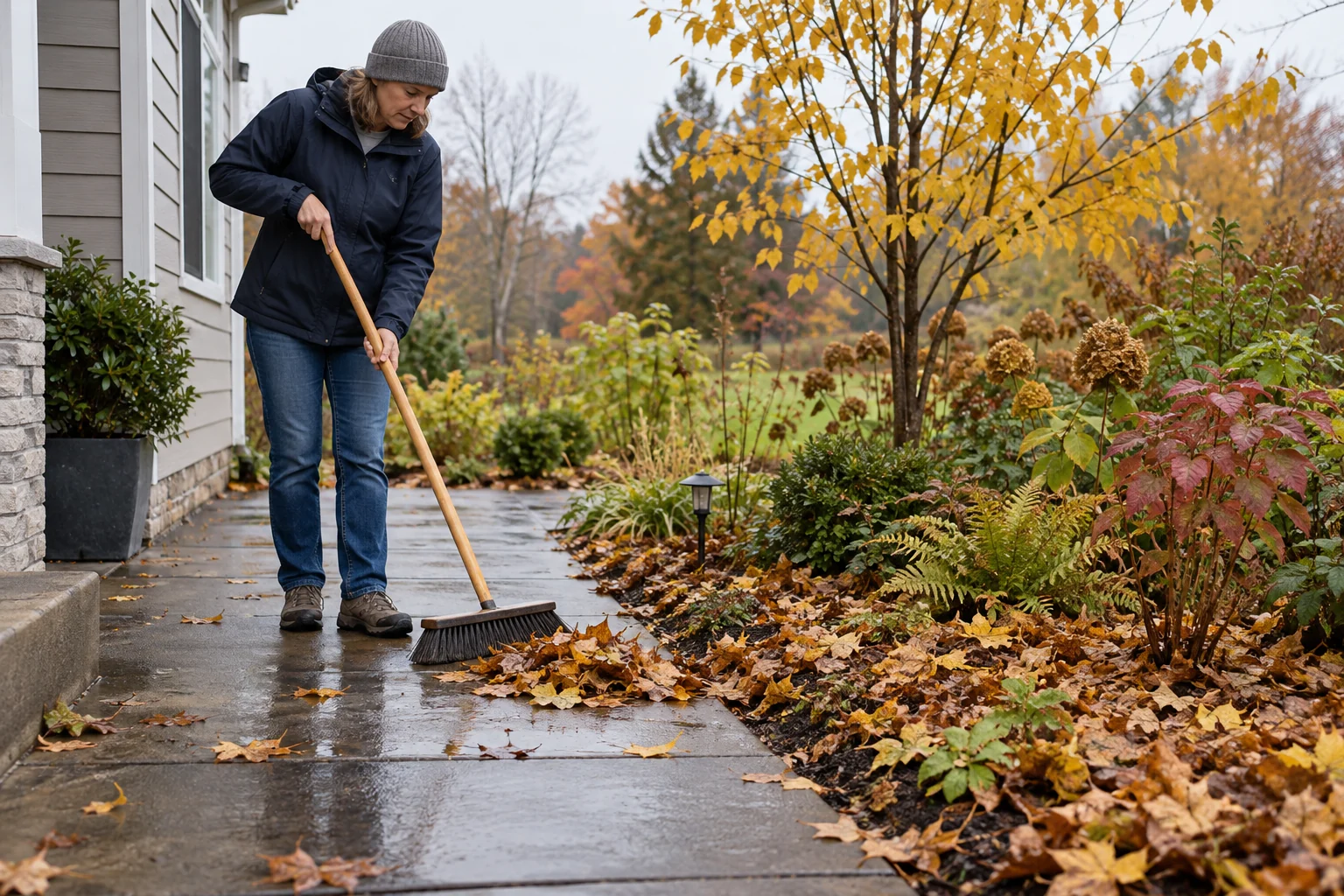
Fall leaf cleanup can begin with a short stretch of pavement rather than an empty yard. Look for leaves accumulating on your own walk or driveway where rain could carry them toward the street. The useful result is collected material with an appropriate destination, not a pile pushed beyond the property line. Choose a broom within that job, keeping public drainage work and local disposal rules with the authorities responsible for them.
Autumn pavement sweeping starts before the leaves reach the drain
The University of Minnesota’s Office of Sustainability explains that storm drains carry rainwater and snowmelt away from impervious surfaces. Its campus account describes untreated runoff reaching the Mississippi and other local waters, taking pollutants with it. Leaves and debris can also obstruct drains. The office asks people to sweep material away from streets and storm drains and report equipment needing repair.
For autumn pavement sweeping, treat the direction of movement as part of the job. Clearing the driveway by pushing its leaves into the road transfers the accumulation to another surface. Start with material you can address from your own accessible paved area. A broom purchase supplies no permission to enter traffic or work inside drainage equipment.
Keep garden leaves separate from pavement runoff
The University of Minnesota Water Resources Center describes a difference between leaves contributing organic matter in a woodland and leaves falling onto driveways, sidewalks and streets. On hard surfaces, they can obstruct drains or release nutrients that reach nearby water. Its account discusses municipal street-sweeping research in Minnesota and Wisconsin. Those studies concern particular neighborhoods and collection systems, not a measured result from a household broom.
That distinction gives the seasonal task a useful boundary. You can address leaves on an exposed paved route without treating every leaf in a planted area as waste. The source’s reported reductions from municipal sweeping do not establish a percentage improvement for your property. Nor does a visually clear walk prove that a downstream drain works. Keep the household task attached to removing reachable material, with drainage performance remaining a separate question.
The account also describes leaves releasing nutrients as they decompose in woodland ecosystems, supporting later growth. Their location helps explain why retaining appropriate garden material and removing leaves from pavement can serve different purposes.
Read the Harper push broom as a specific tool
The Harper Brush 3430A medium-surface push broom is listed as a red, thirty-inch medium-sweep broom. Its listed category is Brooms. The photograph shows a broad head, handle and supporting braces; that image is not an independent trial on wet leaves, grit or a particular driveway finish.
Consider the stated head size against the open paved space you actually intend to sweep. The description’s incomplete assembled measurement does not supply a complete stored footprint or handle length. Obtain applicable product instructions where surface suitability or handling matters. This offer establishes no clearing rate, ability to remove a compacted leaf mat, or approval for working in a flooded area. A wider head is a purchasing fact rather than proof that this is the right tool for every autumn task.
The Harper reference is 3430A. Keep that identity when requesting missing information; an answer for another broom width or another head in the same brand’s range may describe a different item.
Keep the orange four-broom offer’s identity intact
The orange four-piece outdoor broom offer has the actual catalog brand Unbranded, although its source title names Efoee. The description specifies four brooms, adjustable combination heights and angled bristles. It names corners, tight spaces and outdoor debris among the intended uses. The whole photograph shows four orange heads with black bristles and handles.
Read those features together with the offered quantity. They do not establish exact adjustment limits, bristle stiffness, scratch resistance or the time needed to clear your walkway. Four supplied brooms also need a reason to be purchased as four. If you want one item for a small entrance, the remaining quantity is still part of this order. Neither this description nor the Harper account provides a comparative sweeping test or a basis for declaring a universal winner.
Use Seattle’s guidance within its actual limits
Seattle Public Utilities encourages residents to gather yard leaves before they reach drains. Its Storm Drain Care page directs volunteers to wear gloves and bright colors, use tools rather than hands, and work from the sidewalk or curb. It also says to avoid hazardous items and major streets or arterials. These are meaningful limits on the work, not optional details a longer handle overcomes.
The same page distinguishes ordinary raked leaves, normally directed to yard waste or mulch, from grimy drain leaves, which Seattle directs to garbage because of pollution. That is Seattle’s instruction for those materials. It is not a nationwide disposal rule. If your accumulation includes contaminated street debris, obtain the applicable local direction. Do not describe a mixed load as clean garden leaves simply because most of what you can see is brown foliage.
Seattle identifies its Find It, Fix It app for clogged-drain reports and a separate urgent response route for flooding or sewer overflows. The page does not ask volunteers to solve every reported problem themselves.
Know when the next action is a report
Kitsap County’s autumn preparation bulletin recommends taking advantage of dry fall days before the rainy season. It advises reporting a blockage if clearing the surface does not help. It explicitly warns against removing a storm-drain lid, attempting to clean a drain in a busy street, or wading into water of uncertain depth. Those boundaries keep an ordinary seasonal cleanup from becoming improvised drainage work.
The bulletin also says not to blow or sweep leaves into roads, ditches or drains. Its disposal options include an appropriate composting route, curbside yard-waste bins or a local composting facility. Use those as examples of destinations to investigate, not confirmation of a service at your address. If the problem remains after the accessible loose material is removed, stop expanding the broom’s supposed role and contact the responsible local service. A persistent blockage is not evidence that another pass or another broom will solve it.
A city sweeper is not permission to deposit your leaves
Bothell’s Flood Prevention page addresses a familiar assumption: a street sweeper will eventually collect anything residents push into the road. The city says residents must not blow or place property leaves there. It explains that extra accumulations can create standing water and fill collection tanks faster, slowing the sweeping route. Its cited municipal prohibitions belong to Bothell, rather than establishing the law in every town.
The city also explains why its own crews may sometimes appear to do something similar. Staff can work within a coordinated two-step operation in which a sweeper follows to collect the material. Seeing that arrangement does not show that an uncoordinated household pile has the same collection plan. Check the current instructions for your own location. Avoid relying on a passing truck, a neighbor’s practice or a remembered schedule as authorization for where you leave the material.
Bothell prioritizes sweeping requests using factors including safety, property protection, staff availability and equipment efficiency. A submitted request therefore does not establish an immediate collection time for a new pile.
Leave appropriate habitat areas out of the sweeping target
The Xerces Society’s winter-habitat guidance explains that many insects and other invertebrates overwinter close to where they lived during summer. Fallen leaves, hollow stems, brush and soil provide different forms of shelter. Its examples include caterpillars sheltering in leaf piles and moth cocoons or butterfly chrysalises resembling dried leaves. Sweeping every planted corner bare would therefore be a different decision from clearing a paved runoff route.
Xerces says leaves can remain in designated areas rather than exactly where they fell. It also advises keeping them whole for habitat instead of shredding them. That habitat objective differs from advice directed at preparing material for a particular composting system. Decide which purpose applies to the area you are addressing, using its relevant guidance.
The society also recommends delaying a later spring garden cleanup until the season is well underway. Keeping a habitat area through winter has a different endpoint from collecting exposed pavement leaves before fall rain.
Follow collected leaves through the next step
The autumn leaf collection guide separates a gathering container from the container an actual receiving service accepts. It reads AJM kraft lawn-and-leaf bags and Highcool standable yard bags while keeping local presentation requirements unresolved until the service confirms them. That distinction matters once sweeping produces material you must move somewhere.
Use that guide for the collection-and-destination decision rather than treating it as approval of these brooms. Its bag capacities do not become safe carrying weights, and its product descriptions do not approve contaminated drain debris for compost. A temporary pile is still awaiting its next step. Establish the accepted route before describing the cleanup as finished, particularly if another person will take the gathered material away.
Keep the next season’s work arrangement separate
The before-the-first-snow preparation guide asks who is responsible for the areas needing attention and what winter equipment is actually available. Its SHENERDA detachable shovel and Soonbuy wheeled pusher are particular snow-tool offers. They do not supply this autumn task with a leaf-moving method or a broom specification.
The connection is seasonal responsibility. Clearing leaves today does not confirm who will address the entrance after snowfall or who maintains a shared outdoor area. Resolve the real arrangement with the relevant household member or property manager. Keep that winter conversation separate from the narrower decision about buying a broom for reachable autumn pavement; neither purchase automatically arranges the other person’s work.
Choose the first useful stretch rather than promising the whole property
Consider an illustrative entrance with a broad private driveway, a short walk beside a planted bed and a public road beyond. The driveway’s loose leaves, the bed’s retained leaf layer and a blocked road drain present different decisions. Treating all three as one sweeping job hides those differences. The open paved section may prompt a question about the Harper’s stated head width. A tighter section may prompt questions about the orange brooms’ actual dimensions and instructions. Neither question establishes that new equipment is necessary.
Begin with equipment already owned when it is suitable for the intended task under its instructions. Keep the planted area outside the pavement-clearing target where its leaves are being retained for an appropriate purpose. Leave any public drain concern with the applicable local process. You can complete a useful, limited cleanup while a separate service issue remains unresolved. The honest endpoint is what you actually collected and appropriately directed, without claiming to have prevented every flood or finished the entire season.
If the remaining uncertainty is the tool’s fit for your small paved area, answer that specific question before ordering. If the uncertainty is public drainage, another retail feature will not answer it. Keep the purchase decision proportional to the work you can actually undertake.