Gift Wrap & Party Supplies
fabric gift wrap cost-per-use plan for completed wraps
Track completed fabric wraps and actual returns before estimating cost per use or buying another cloth set.
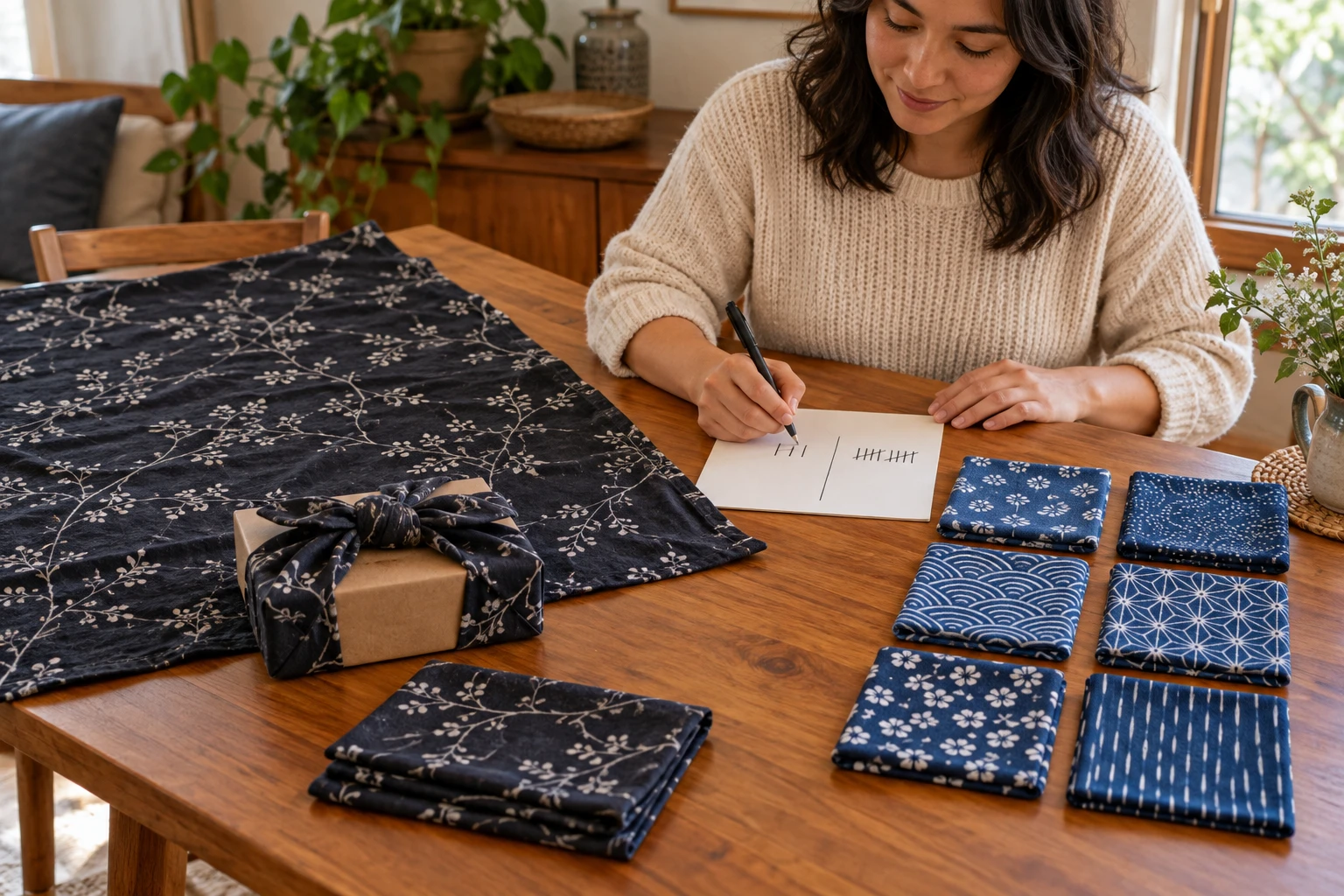
A fabric gift wrap cost-per-use plan starts with a question that a product page cannot answer: how many times will the cloth actually wrap a gift and come back for another use? A fabric square may be attractive, but its purchase price, fit, care, and return path all affect whether it saves money in your household. Count completed wraps rather than a promised lifetime. Choose one familiar gift size, identify what you usually use instead, and write down the cloth's real use after each handoff. A modest record is enough to make the decision clearer.
This article compares cloth wrapping and a household cost tally. It does not repeat the reusable gift-bag cost-per-handoff guide, which owns bags and their return problem. It also does not recalculate the wrapping-paper cost per square foot, which owns paper coverage and total spending. Cloth wrap has its own fit and reuse decisions: a large piece and a set of smaller napkin-size pieces are not substitutes for every gift, and neither saves anything when it sits unused.
Start with the gift you already wrap
Choose a typical box, book, or small object that you expect to give. Note the dimensions of the object and the way you currently wrap it. If you already own suitable reusable material, buying a new cloth may add beauty or convenience but may not replace a disposable purchase. If you usually buy paper for that gift, record the actual amount you spend from a current receipt when you have one. The comparison needs a real baseline, not an assumed retail average that could make cloth appear cheaper than it is.
Think about who receives the gift. A wrap given to someone outside your household may not return, and that can be entirely fine if the cloth itself is part of the gift. A wrap used within a household may come back more often. Do not count a future return as a completed reuse before it happens. Put the expected handoff type in your plan: keep-and-reuse at home, request a return, or give the cloth away. The cost question changes with that choice.
Measure the gift and test the wrapping method with a cloth you already own if possible. A square must cover the item and leave enough length for the chosen knot or fold. An 18-inch napkin and a much larger fabric piece can serve different gifts. Do not assume a listed length alone proves a neat wrap for every box shape. If a trial shows that the cloth is too small, do not stretch it or buy a pack hoping the knot will work. Choose a fitting size or another material.
Write the gift's approximate size beside the cloth you tested. That small note is more useful later than a broad claim that the wrap fits “most gifts.” A thin book and a rigid cube may need different amounts of fabric even if their longest sides match. A knot also uses material that cannot cover the box itself. Keep the test practical: the cloth should stay secure through an ordinary handoff and release without a struggle. If it fails, record the mismatch before doing any cost calculation.
Read two actual cloth inventories
The native listing for the 118 cm Black Dragon cotton furoshiki cloth describes a black cotton fabric piece for gift packaging and lists it under fabric. The source calls it a bolt of fabric; the record does not establish that it arrives as a hemmed, ready-to-use square. Confirm its actual finished dimensions and edge treatment before relying on it for a gift. The listed 118 cm dimension suggests a larger-format wrapping option, but the real object and knot need a fit test.
The separate QIHE six-piece Blue Lotus cotton napkin set native listing describes six 18-by-18-inch cotton napkins. It calls the model Furoshiki Wraps-Table Napkins and says the pieces are prewashed. Their napkin role matters: they may be used at a table as well as for a small wrap, but that does not make every dining use a completed gift-wrap reuse. The source describes block printing; it does not tell you how many gift exchanges the household will complete or whether a recipient will return a piece.
The product records offer two very different inventory units. One is a large black fabric listing whose finished edge needs confirmation; the other is a six-piece set of smaller napkins. Comparing only package counts would be misleading. A single large cloth can fit a different gift than six smaller cloths, and a pack of six only matters if six are actually used. The right question is which item can wrap your typical gift and follow a realistic return or keep-at-home path.
Do not transfer care details between the two listings. The QIHE source states that its cotton napkins are prewashed, but that does not specify a universal laundering method or prove the Black Dragon fabric will behave the same way. Check each product's actual care label before washing or ironing. Account for care in the household routine, and stop using a cloth that is torn, heavily stained, or no longer suitable for presentation. A wrap only counts as a useful completed use if it remains fit for the next handoff.
Make a simple completed-use ledger
Give each physical cloth a row with five columns: item, gift wrapped, recipient or return path, completed wraps, and condition after the handoff. Start the count at one when the cloth actually wraps and leaves with a gift, not when you purchase it or fold it on a shelf. Add a second use only after the same piece is recovered and used again. A package label saying reusable is a feature claim; the ledger shows whether reuse happens in your particular circle of gifts.
For a six-piece set, identify the pieces in a practical way, such as a small removable tag kept off the gift or a brief pattern note in the ledger. Avoid marking the fabric in a way that damages it. Counting the whole pack as one item can hide the fact that two pieces are used repeatedly while four stay folded. For a single larger piece, record the kinds of gifts it fits. Over time, the record reveals whether size or return behavior is the stronger limit.
When a recipient keeps the wrap, record a completed gift presentation but no return. That may be a desirable outcome if the cloth is intended as part of the present. Financially, however, it is a one-use wrapping cost to you unless the recipient's later reuse is independently known and relevant to your decision. Do not claim household savings from an imagined second life outside your view. You can value the gesture without turning it into a fabricated cost reduction.
When the cloth returns, note the time and care needed before reuse. A piece that comes back after several months may not be available for the next gift. If you must buy additional wrap because the first piece is away, that changes the inventory cost. A use-count plan should reflect timing as well as total cycles. The value of a reusable material depends on being available when the task occurs, not merely on surviving storage.
It can help to separate a household reuse count from a gifting count. A cloth returned to your drawer and used again is a household reuse. A cloth given away and perhaps used by the recipient is a different outcome. Do not combine the two just to make the denominator larger. If the recipient later tells you they wrapped another gift with it, that can be a satisfying story, but it is not part of the purchase comparison you can directly manage unless your accounting explicitly follows that shared use.
Calculate your own cost per completed wrap
Use the current purchase amount you actually paid for the exact cloth or set, then divide it by the number of completed wraps. For a six-piece set, you can divide the package amount across pieces with an explicit method; an equal share is simple, but it remains your allocation choice. Update the estimate as each piece gains uses. Do not publish a single number as a permanent product fact. Cost per use will be high after the first use and can fall only if actual repeated use occurs.
Compare that personal figure with your real baseline. If you otherwise would have used wrapping paper, the linked paper guide can help measure paper coverage and spending for the relevant gift. If you otherwise would have reused a bag, the linked bag guide owns that different handoff. Do not claim savings from replacing disposable paper when your actual alternative was already a reusable box or cloth. A credible comparison asks what you would really have done without the new purchase.
Include costs that matter to you without manufacturing precise values. Laundering, storage, and time spent asking for a cloth back may affect the choice. If you already wash similar napkins with the same load, the marginal care effort may be small; if a delicate wrap requires separate treatment, it may be material. Use your own current information or leave the savings line undecided. A blank cell is better than a false bargain.
Set a decision threshold rather than a guaranteed break-even date. For example, decide that you will not buy a second pack until the first pieces have each completed a reasonable number of wraps in your household. The exact number is yours to choose based on the current purchase and alternative. Avoid multiplying one busy holiday season into an assumed lifetime. The use ledger should guide the next purchase after you see normal gift habits, not after a hopeful forecast.
Revisit the calculation after the first few real handoffs. If one piece is repeatedly used while the other pieces stay unused, the next purchase should resemble the useful size, if any purchase is needed. If none of the cloth returns, a single-use gift presentation may still be worth choosing for personal reasons, but the cost-per-use line should say one. If care takes more effort than expected, note that too. A truthful ledger can lead to buying less without declaring the original choice a mistake.
Keep fit and presentation in the comparison
A cloth that is too small for the planned gift is not a cheaper wrap for that gift, even if its cost per piece is low. An oversized piece may be usable but awkward or need extra tying. Test the actual fold and knot before purchase when you can, or confirm measurements and return terms if you cannot. A good fit should protect the gift's presentation and make unwrapping straightforward. Do not treat a numerical cost calculation as proof that a frustrating wrapping method is worth repeating.
Presentation also affects return behavior. A recipient may think the cloth is part of the gift unless you say otherwise. If you want it back, communicate that clearly and kindly before relying on a return in your ledger. If asking would feel awkward, plan as though the cloth will be given away and compare the cost on that basis. The calculation can still support the choice, but it must describe the social reality of the exchange.
Store returned pieces where they are easy to find before the next event. Keep the larger cloth separate from smaller napkins so the right size is chosen without unfolding every item. Check condition before putting a piece back in use. The storage routine should be simple enough to survive the ordinary pace of birthdays and holidays. A beautiful fabric that repeatedly goes missing will not produce the repeated wraps assumed in a savings forecast.
Use the same rule for the next purchase: buy only for a specific gift size or recurring handoff pattern that your existing cloths cannot cover. Six small napkins may be useful for several modest gifts, while a larger cloth may suit a different box. Neither is a universal substitute for paper, bags, or every shape. The point of the cost-per-use plan is to learn the actual role of each item before adding more inventory.
A fabric gift wrap cost-per-use plan is a record of completed wraps, not a seller's promise of savings. The Black Dragon fabric listing and the QIHE six-napkin set describe different sizes and quantities. Confirm the large piece's finished form, test fit, count each real handoff, and record whether the cloth returns. Then compare your own cost per completed wrap with what you would actually have used instead. A sensible result may be reuse, gifting the cloth, or choosing no new wrap at all.