Gift Wrap & Party Supplies
Reusable gift bag cost per handoff: count returns before buying a bulk pack
Use actual receipts and completed gift handoffs to evaluate whether a reusable bag pack fits your calendar and returns.
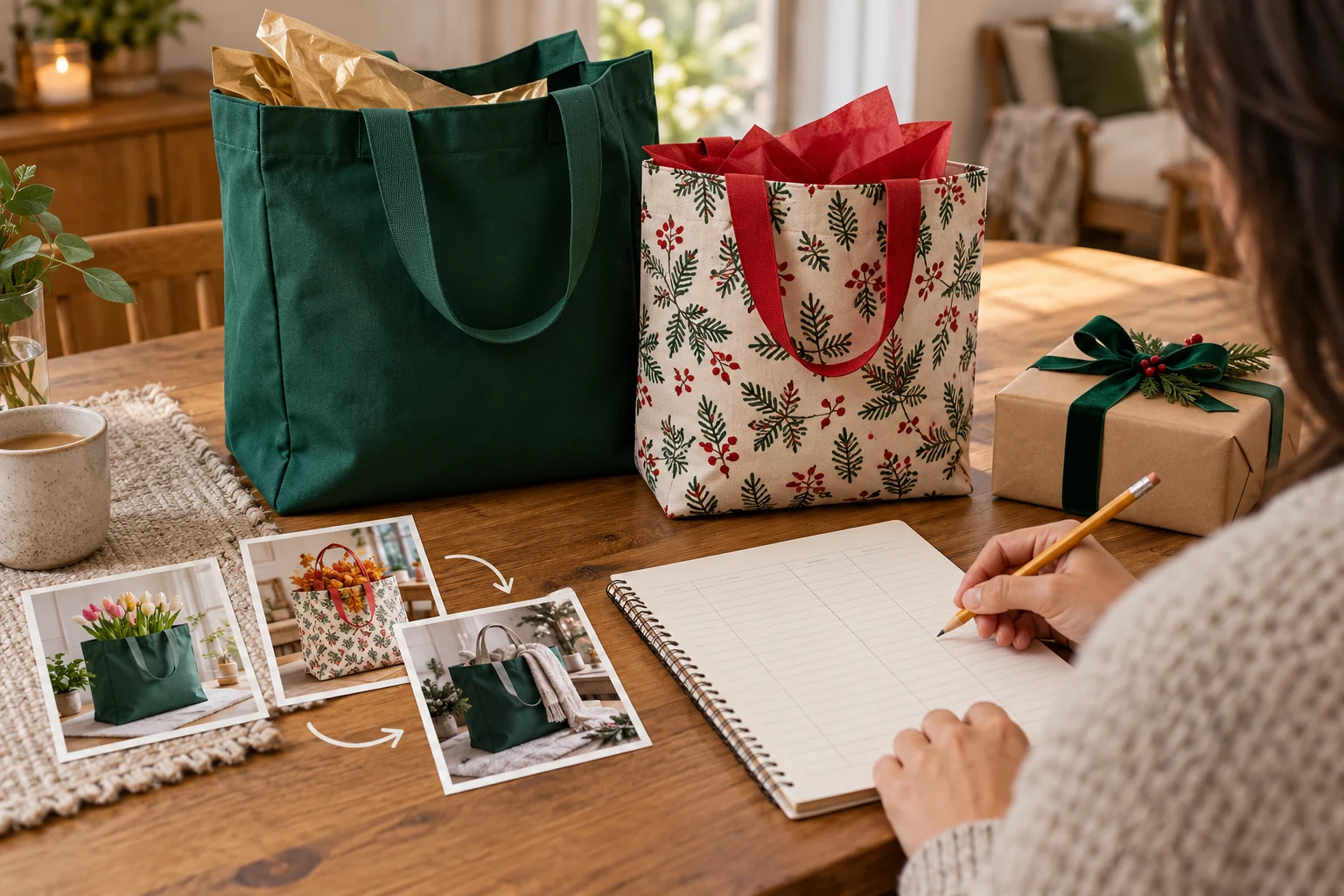
Reusable gift bag cost per handoff depends on how many times a bag actually carries a gift, not on the word “reusable” on its listing. A bag passed to someone outside your household may never return. One kept in a family gift rotation might carry several gifts over different occasions. Before ordering a large pack, count the gift handoffs you control, note whether bags are likely to come back, and compare the pack's real total with the wrapping or bags you would otherwise use. This is a household planning method, not a claim that every reusable bag saves money.
Define what counts as one use
For this calculation, one use is one completed gift handoff: a bag holds a gift and is given to its recipient. Carrying a bag from the closet to the table and back is not a second use. Nor is setting it beside a gift that ends up wrapped another way. If the same bag returns and later carries a different gift, count that later handoff as another use. This simple definition keeps the denominator tied to actual replacement of another wrapping choice.
Start with last year's occasions rather than a hypothetical busy year. List birthdays, school or office exchanges, holidays, and other events where you personally prepared a gift. Mark which gifts could have fit in a bag and which needed a box, protective wrap, or no wrapping. A box with tissue inside a gift bag may still use the bag, but include the box and tissue in the total if those materials are part of the comparison. Counting every gift as a bag opportunity can make a bulk pack appear useful when only a few gifts will actually fit.
The gift-bag fit guide covers the separate physical question of whether the opening and body hold a particular item. Make that fit decision before your cost worksheet. A bag that is too narrow, too shallow, or awkward to carry has no useful handoff count for that gift, even if its per-bag purchase cost looks low on paper.
Calculate the first handoff honestly
Take the total you would actually pay for a pack, including any delivery or tax you cannot avoid, and divide it by the number of bags in that pack. This yields an acquisition amount per bag, not a guaranteed cost per gift. If only some bags are usable for the gifts you plan, divide by the usable bags instead. Save the receipt rather than relying on a price that may change after you read a guide. This article does not quote a current product price or promise a particular saving.
The 24-pack multicolor non-woven gift bags is described as twelve colors with two bags of each color. The listing gives approximate bag dimensions of 15.7 by 11.8 by 5.9 inches and describes reinforced handles and a foldable body. Its gallery shows plain bags in different colors. Those facts make it a possible large-pack example when your handoff calendar has many recipients and varied occasions. The listing's claims about strength and washing are seller descriptions; inspect the seams, care instructions, and actual delivered count before assuming repeated-use life.
A bulk pack can lower acquisition cost per bag while raising total spending if most pieces sit unused. For example, a household with four suitable gifts in the next year should compare the cost of the whole 24-pack against buying or reusing four bags. Dividing the pack total by twenty-four is mathematically correct for inventory accounting, but it is misleading as a near-term gift budget if twenty bags stay in the closet. Record unused stock separately and carry it forward only when you have storage and likely future occasions.
Keep a return-and-reuse record
After each event, note the bag, recipient, occasion, and what happened next. Did the recipient keep it, return it, or hand it back during a family exchange? Do not call a bag reused until you see it carry another gift. If a bag tears or its handle loosens, record that outcome. If a recipient asks to keep it, that can still be a perfectly good gift presentation; it simply changes the cost calculation because you will not get another handoff from that same bag.
For bags that remain in your household, calculate actual cost per handoff by dividing the acquisition amount allocated to that bag by its completed handoffs. A bag used twice has half its acquisition amount assigned to each handoff. A bag used once has its entire amount assigned to that occasion. This is an accounting view, not a reason to ask guests to return a gift bag. The social setting decides whether reuse is practical; the worksheet describes what actually happened.
Do not treat all returned bags as identical. A plain color may work for a birthday, graduation, or holiday if the size suits the gift. A bag with an unmistakable Christmas design may be welcome again next December but less useful for a summer birthday. Keep seasonal and all-occasion inventory in separate rows. That makes a pack's true use window visible and reduces the temptation to assume every bag can serve every event.
Account for seasonal designs
The 12-pack of Christmas-pattern gift bags is described as reusable, non-woven, roughly 17-inch bags with reinforced handles. Its gallery shows festive Santa and snowman designs. This is a more specific visual role than the plain multicolor pack. It may suit a concentrated set of holiday gifts, but its seasonal look limits the occasions on which you might want to use it. The seller also describes moisture resistance; that is not a reason to expose a wrapped gift to rain or assume the contents are protected in every condition.
Count how many holiday gifts are the right size before assigning a benefit to twelve bags. If a household gives three suitable gifts at Christmas, the remaining nine may be inventory for later years, not savings realized this year. Storage space and changing family plans matter. You might enjoy using the same design again, or you might prefer a different presentation next season. Neither preference is a defect; both belong in the cost decision before a bulk purchase.
The two packs serve different gift calendars. Plain bags spread across occasions and recipients; printed Christmas bags concentrate use in a seasonal window. You do not need both. If your existing closet already has gift bags, count them first. Using a bag you already own can be a better near-term choice than ordering either pack to achieve a theoretical lower per-bag number.
Compare with the actual alternative
Write down what you would otherwise use for each eligible gift: a bag from your closet, a new paper gift bag, wrapping paper, a reused box, or simply handing over the gift. Compare the reusable bag only against that real alternative. If you already have a free box from a delivery, replacing it with a new tote does not create a cash saving. If a gift requires protective packing regardless of the outer bag, that packing cost stays in both options. The comparison should change only the materials that the new bag would actually replace.
For wrapping paper, measure or estimate the amount used on the gift and include tape, ribbon, and other supplies only if you would buy them for that presentation. The wrapping-paper cost guide works through the separate per-square-foot and total-spend question. Here the decision is how many gift handoffs a particular bag replaces. Keep the two calculations distinct so a low paper price per square foot is not confused with the total cost of wrapping several gifts.
Suppose the alternative is a new disposable bag for each of several planned gifts. The reusable pack's first-use total could be higher or lower; only the actual receipts tell you. If your reusable bag comes back and works again, its acquisition amount is spread across more handoffs while the disposable alternative would require another bag. If it does not come back, the first-use comparison remains the relevant one. Leave any environmental or waste-reduction claim outside the cash calculation unless you have separate evidence and a reason to include it.
Include care and replacement without inventing a lifespan
Inspect handles and seams after each use. A bag with a damaged handle should not carry a heavy or breakable gift. Follow the care instructions for the specific material if cleaning is needed. The multicolor listing describes washable non-woven fabric, while the Christmas listing describes a non-woven construction; neither page establishes how many washes or handoffs a delivered bag will survive. A predicted “lifetime use count” would be guesswork. Track observed uses and replace a bag when it is no longer suitable.
Cleaning, tissue paper, labels, or replacement handles can affect the comparison. You do not need a complicated accounting system for small supplies, but do not omit an item that is bought specifically because of the bag. If you add a new gift tag each time, include it on both sides of the comparison when both methods need one. If you spend time decorating a blank bag, treat that as a creative choice rather than a cash saving unless you have measured it in the way your household actually values.
Folding and storing the bags is part of making reuse possible. Keep dry, clean bags together where you prepare gifts. A bag forgotten in a car or damaged under heavy storage boxes may never make it into a second handoff. A small inventory note such as “plain large: six unused, three used once” is enough to prevent another pack purchase based on memory alone. It also tells you whether the most popular size is running low while other sizes remain.
Decide whether a pack size suits your calendar
Estimate the next twelve months of gift handoffs and divide them into likely bag sizes and occasions. Count only gifts for which a bag is practical. Then subtract usable bags already at home. The result is a buying quantity, not automatically a reason to choose the closest larger bulk pack. Compare that number with the pack counts and consider whether the extra pieces have a realistic future use. A larger pack may work for a school, office, or extended family exchange; a small household may need far fewer bags.
Revisit the decision after a few real events. If bags return in good condition and you repeatedly use them, your cost per handoff will change in a measurable direction. If bags leave with recipients, your record will show that the purchase is an attractive gift presentation rather than a repeat-use saving. Either result is useful. It makes the next order fit the way your household gives gifts instead of relying on a seller's broad “reusable” label.
Choose the bag for the gift and the occasion first. Keep the receipt, count completed handoffs, and preserve a simple inventory of what is still usable. The cost question then has an answer based on your own gifts: what you paid, how many bags you truly used, and whether each one came back for another occasion. Buy more only when the calendar and remaining inventory justify it.