Home & Living
How to place an event entrance flower stand for guests and photos
Frame an event entrance with a flower stand while keeping the door, walking path and signs usable for arriving guests.
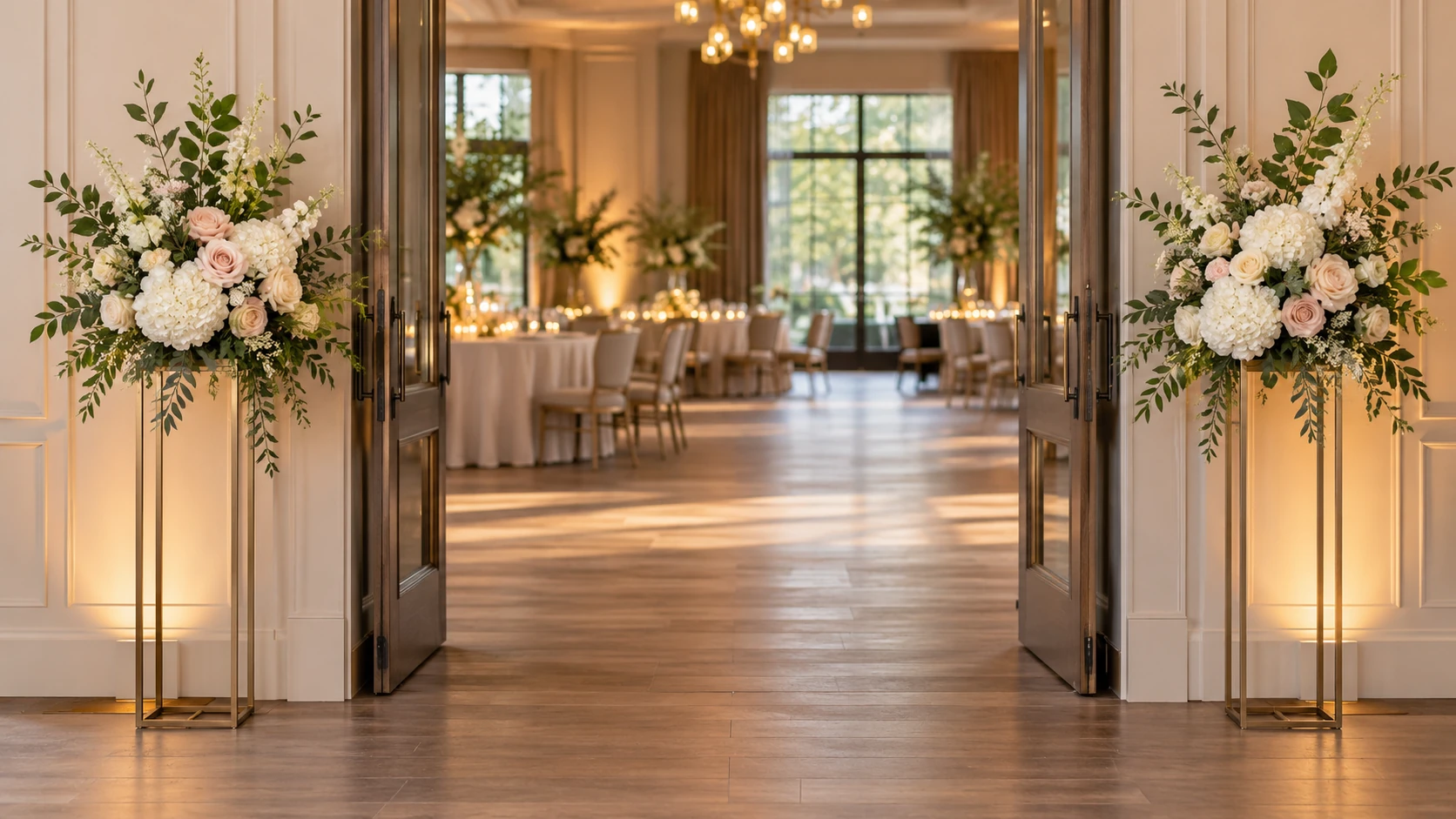
An event entrance flower stand can give guests a clear first view of the room, but the arrangement has to work with the doorway people will actually use. A photograph taken from outside the entrance may favor a pair of tall displays. Guests carrying bags, using mobility aids, or arriving in groups need an open path through that same space. Begin with the route into the room and the positions from which photographs will be made. Then choose where a flower stand can sit without becoming an obstacle. The two catalog examples below illustrate different decorative stands; their listings do not establish that either one fits a particular venue or can stand safely on every surface.
Walk the entrance before placing anything. Notice where the door swings, where a queue forms, and where someone first turns toward check-in, seating, or another room. Keep any required accessible route, fire exit, and venue clearance free according to the site's rules. A drawing of the entrance can help: mark the door's full travel, the usable passage, and a space where a display could sit outside that passage. If the venue has its own placement limits, use them before deciding on a visual composition. A flower stand does not earn space merely because it looks balanced in a mockup.
Choose the view that welcomes arriving guests
Stand where a guest first sees the entrance. A display placed on each side may frame the opening, but symmetry is only useful if both positions leave the necessary route clear. One side may contain a handrail, an inward-opening door, a sign, or a check-in table. In that case, a single stand on the open side can make more sense than forcing a matching pair into unequal spaces. Look again from the direction guests will actually approach. An arrangement that faces the photographer can turn its back to the people walking in.
The gold crystal flower stand is listed for wedding centerpieces and other event decoration. Its native description identifies an iron structure, a polished base, crystal rings, and hanging pendants. The listing also describes assembly from a base, rods, a top section, and crystals. Those details make it a useful example when planning a tall decorative accent, but the listing's reference to desktop use matters. Do not assume that a product shown as a centerpiece is an appropriate freestanding floor display. Check the exact assembled footprint, the venue surface, and the maker's placement instructions before using it near an entrance.
A second clear flower stand is listed under birthday party supplies and described as an acrylic-and-iron event backdrop with layered crystal pendants. Its description names a round base and connections intended to keep the assembled stand stable. It is another physical example, not proof of a safe placement beside a moving crowd. Neither listing gives the width of every possible floral arrangement or the space that people need to pass the finished display. Treat the decorated assembly, including flowers and trailing pieces, as the footprint you must evaluate.
Look at the display from seated and standing eye levels if the event has both. For an entrance, the immediate question is whether guests can read where to go and pass the decoration comfortably. The published flower centerpiece stand sightline guide addresses a different setting: views across event tables once guests are seated. It can help with nearby dining arrangements, but a clear line across a table does not settle the doorway path. Test the entrance where arrivals will move, not at the center of a place setting.
Separate the walking path from the photo frame
Photographs often crop away the floor. That crop can hide a base, a cord, a loose petal, or a stand that projects into the route. Set the camera position after the unobstructed route is marked. A slight shift in angle may frame the entrance while keeping the display outside the walking area. Photograph the full setup once without cropping so the event team can check the bases and nearby fixtures. The useful image is the one that shows how the arrangement occupies the space, not only how it looks behind a couple or group.
If a photographer wants two stands in the shot, place temporary markers at the proposed base positions and walk the route. Bring a second person through at the same time to see whether guests would need to sidestep one another. Repeat the walk with the door opening and closing. Do this before assembling a stand or adding flowers; a bare outline is easy to move. If the position is too tight, move the photographic viewpoint or reduce the display plan. Do not solve a clearance problem by asking guests to squeeze past an exposed base.
Consider the event's likely arrival pattern. A wedding party entrance may have several people moving together. A birthday party may have children approaching from different angles. A public venue may need staff to guide a line. These are planning scenarios, not claims about how either product performs. Ask the venue team where the line will form and how signs will be read. A stand set near the check-in point can compete with a name board or block a staff member's view. Give directional information a clear position before placing decorative accents around it.
Daylight and room lighting also change what the camera sees. Crystal details may catch light, but the listing and gallery cannot promise a particular effect under your venue's fixtures. Make a simple test photo with the actual lighting available at setup time. Look for glare, dark flowers against a dark doorway, or an arrangement that obscures a sign. Adjust the camera angle or the decoration within the allowed area. Do not treat a polished catalog photograph as a preview of the finished venue.
Plan around the assembled stand and its flowers
Review the seller's current assembly and load guidance for the exact delivered item. The gold stand listing describes an assembly sequence and says its metal structure supports floral arrangements, but its claim should be checked against the delivered parts and instructions. A top-heavy floral ball can change the practical stability of a tall structure even if the bare stand sits level. The clear stand's description likewise names a stable base and secure connections without proving performance on a sloped floor or beside moving guests. Keep the arrangement within the maker's limits and the venue's display rules.
Set each stand on the actual surface where it will be used. Check for a floor seam, carpet edge, uneven tile, or table that shifts when touched. If the stand is intended for a tabletop, use an approved, level supporting surface and evaluate that surface too. Do not put a tabletop centerpiece directly on the floor merely to reach a desired height, and do not stack it on an improvised box. The entrance display should work with the product's intended setup. If the available space calls for another kind of support, choose a suitable product instead of adapting a decorative stand beyond its instructions.
When the flowers are attached, step back and check the entire outline. Flower balls, leaves, ribbons, and crystal pendants can extend farther than the base. A loose piece may swing or be brushed as people pass. Keep the display outside the clear route with enough room for ordinary movement around it. Ask whoever is responsible for the installation to inspect the finished arrangement before guests arrive. The gallery shows the product's form, but it cannot verify the dimensions or balance of flowers supplied by a separate florist.
Do not rely on a stand to hold a sign, light, or other object unless its instructions permit that use. Extra weight, a cable, or an attachment above the top can change the arrangement. Keep electrical equipment and cords under the venue's own setup plan. If lighting is needed for a photograph, a photographer can position it separately without turning the flower stand into an improvised support. The visible goal is to frame the entrance; the practical goal is a stable display that leaves the route usable throughout the event.
Check the entrance during setup and arrival
Make a short setup check with the venue contact. Confirm the actual entrance in use, any alternate accessible entrance, and where guests will be directed if the room changes. Verify that doors open fully and signs remain readable. Place the stand only after those facts are settled. A plan based on an empty room can fail once a registration table, coat rack, or rope line appears. If another team changes the layout, revisit the stand position before guests arrive rather than assuming the original diagram still describes the space.
Take one wide photograph from outside and another from inside the doorway. The outside view shows the first impression and whether the floral display frames the way in. The inside view shows whether the stand blocks the return path, a door closer, or staff access. Try a photograph at the expected group position as well. A beautiful composition that requires people to stand in the doorway may create a queue; move the camera position or choose a nearby photo spot if that happens.
The holiday wreath changeover guide considers a decoration carried by a door and whether the door still moves normally. A flower stand has a separate base and occupies nearby floor or table space, so its placement needs its own check. The shared lesson is to observe the entrance in use. Avoid borrowing a wreath's mounting advice for a freestanding centerpiece, and avoid assuming a stand is harmless because it never touches the door.
Have someone walk the marked route while another person watches the arrangement. Does an arm or bag brush a flower? Does the stand hide a sign until the last moment? Do arriving guests naturally take the intended path? This rehearsal can expose a problem that a static image misses. Move the display within the approved area if needed, then repeat the walk. Where the venue controls a minimum clearance, follow that requirement even if the arrangement would look better closer to the doorway.
During the event, assign a person who can notice a shifted base or fallen decoration and respond under the venue's rules. An entrance is not finished when the first photo is taken; guests will keep using it. If the stand moves, a piece falls, or the route narrows as a line forms, clear the obstruction and reassess the layout. Do not leave an unstable decorative object in place while waiting for a later photo opportunity. The exact response belongs to the event team and venue, not to a catalog description.
Choose a composition that survives ordinary use
The strongest entrance arrangement may use one stand, a pair set farther back, or a display on a suitable surface away from the main path. Let the real doorway decide. Start with the usable route, identify the camera view, assemble the stand according to its instructions, and test the decorated footprint. Then ask whether the display still helps guests find their way in. If the answer changes as the room fills, move or remove the decoration under the venue's direction. A photograph is one moment; the entrance must work for every arrival.