Crypto Commerce
Eugene Color IPC-5100 camera tester 5-inch vs 4-inch CCTV testers for field checks
Compare Eugene Color IPC-5100 camera tester by stream formats, display claims, coax and network tools, PoE, battery estimates, and field workflow.
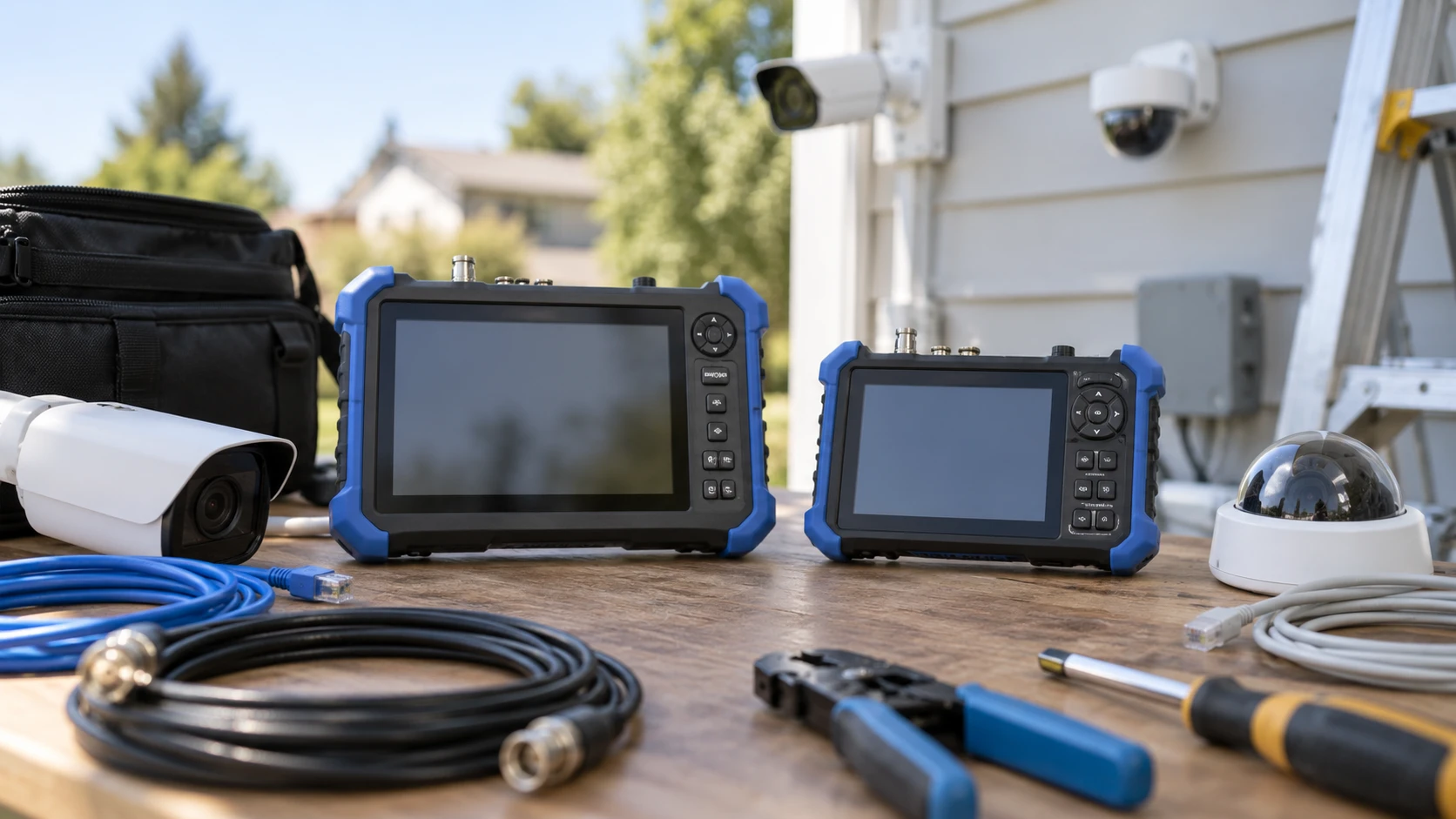
A camera tester is useful only when it accepts the signals and connections present at the job site. The saved listing for the Eugene Color IPC-5100 camera tester describes a five-inch IPS touchscreen, IP and coaxial camera support, PoE and cable checks, and an up-to-six-hour battery claim. Another Eugene Color listing describes a four-inch Engineering Bao tester with IP, AHD, CVI, TVI, and analog support, cable tracing, wireless camera viewing, and roughly nine hours of runtime. These are source descriptions of different tools, not a field test. Verify the exact model in the box before assuming either covers a particular installation.
Start with a list of the cameras and cables you actually service. An IP camera on Ethernet, an older analog feed on coax, and a wireless camera can require different inputs and test methods. Write down the camera's resolution, codec, control protocol, power method, and connector. Also note whether you need to diagnose the cable or only see an image. A small monitor may be enough for aiming a camera, while a technician tracing a damaged run may need network and power measurements. The more exact the job list, the easier it is to reject a feature that sounds impressive but will never be used.
Resolve the display claims — camera tester display and input checks
The IPC-5100 listing title mentions both 5.4 inches and five inches, and it names IPC-5100 and 5200Plus together. Its description specifies a five-inch IPS touchscreen at 1920 by 1080 pixels. Confirm with Republeq which exact model, panel size, and resolution are shipped under this product ID. Do not assume a title containing two sizes represents a selectable variant unless the option is shown in the current order. A technician working from a cramped ladder or a dim equipment room should also ask about brightness, touch response with gloves, and screen visibility, none of which the saved excerpt measures.
The Engineering Bao listing describes a four-inch screen and a keyboard, but does not state that screen's pixel resolution. It says the tester can handle an 8K H.265 main stream. That is an input-processing claim, not a statement that an eight-thousand-pixel-wide image is displayed at full native detail on a four-inch panel. Ask how the tester scales or crops a high-resolution camera feed and whether the actual image can be enlarged to inspect focus. A small screen can make framing quick while still hiding fine detail that should be checked later on a larger display or saved frame.
The published guide to camera tester display and input checks is relevant to this distinction. A screen resolution and an accepted camera resolution answer different questions. The tester must decode the signal, present controls the technician can use, and show enough detail for the decision at hand. If precise focus or small text is important, ask whether the tester can save a still image or send its display to another screen. Compare those actions in a demonstration with a camera similar to the one on site.
IP camera formats and control — camera tester display and input checks
The IPC-5100 description claims IP-camera testing up to 12 MP or 4K with H.265 and H.264 video. It names quick IP viewing, ONVIF or RTSP playback, and client-app support. The saved source spells one protocol name as "OVIF," so confirm the supported standards and firmware directly from the manual. It also says the tester can display a stream automatically and generate a report. Ask what the report includes, where it is stored, and whether it identifies firmware, address, or image settings accurately enough for the handover record.
The Engineering Bao description says it supports IP cameras and 8K H.265 main-stream testing. It adds a wireless module described at 150M speed and the ability to receive images from wireless network cameras. The excerpt does not define the exact Wi-Fi standard, security modes, or camera discovery process. Check whether the cameras used on site can connect in the required way, especially if they are managed by a vendor-specific app. A generic claim that a tester supports IP cameras does not guarantee login to a locked-down model or access to every control.
If Axis cameras are part of the job, the IPC-5100 source says an Axis test tool app must be installed through an automatic update before testing. Confirm that the intended site permits the update and that the app version works with the cameras present. The Engineering Bao excerpt does not make an equivalent Axis claim. For either tester, plan a first test in the workshop with a representative camera, account, and network. Discovering a missing app or incompatible codec at a customer site wastes the time the handheld tester was supposed to save.
Coaxial cameras and older systems — Eugene Color Engineering Bao CCTV tester
The IPC-5100 description lists TVI, AHD, and CVI testing up to 8 MP at 3840 by 2160, plus a BNC input for NTSC or PAL composite video. It also names OSD menu access and RS485 pan-tilt-zoom control with many protocols, including PELCO-D and PELCO-P. Those details make it a candidate for mixed old and new surveillance installations, provided the exact frame rates and control wiring match the cameras in use. Ask for the input chart and included leads before taking it to a job.
The Engineering Bao listing also names AHD, CVI, TVI, and analog formats, but its saved excerpt gives less detail about frame-rate limits, BNC connections, and PTZ protocols. Do not infer that every feature of the five-inch unit is present in the four-inch one. If the work involves a specific coaxial camera, request a model-specific compatibility statement or test it in the shop. Confirm whether the unit can send control commands or only display video. A clear image is not enough when the task is to aim a motorized camera or change its on-screen settings.
Some installations mix IP and coaxial devices in one building. Carrying one tester can simplify a visit, but conversion adapters, power leads, and cables may still be needed. List those accessories and compare them with the box contents; neither saved excerpt gives a complete packing list. Label any adapters so a technician does not mistake a signal cable for a power lead. Use the camera manufacturer's voltage and polarity requirements before connecting any tester output. A handheld tool that can provide power must be used within its specified limit.
Network cables, power, and reports — Eugene Color Engineering Bao CCTV tester
The IPC-5100 source names network-parameter setup, UTP cable tests, PoE tests, and RJ45 time-domain reflectometry for cable diagnosis. It also specifies IEEE 802.3af/at PoE support at 48 V with a maximum of 25.5 W, and it says a power manager shows 12 V output information. Check whether that 25.5 W rating is an output limit, a test capacity, or both. A camera needing more power should be supplied by approved equipment. For cable testing, ask how faults and distance estimates are presented and whether a calibration step is required.
The Engineering Bao description names UTP cable sorting, network-connection testing, and cable tracing. It does not state a PoE output rating in the saved excerpt. Ask whether it measures PoE or can power a camera at all; those are separate functions. It also describes screen casting so a phone or PC can see and remotely operate the tester's display. Verify the pairing and network requirements before relying on casting in a secured site. A feature useful during a demonstration may be unavailable where wireless devices are prohibited.
For a job report, decide what evidence must be retained. The IPC-5100 listing mentions snapshots, video recording, playback, and generated test reports. The Engineering Bao listing mentions a multi-channel preview of up to nine cameras but does not describe a report export in its saved excerpt. Ask what files each unit saves, how timestamps are set, and how data is transferred off the tester. A view on the screen is helpful during installation; a saved, identity-bound result is better for explaining what was checked later.
Battery estimates and field handling — Eugene Color Engineering Bao CCTV tester
The IPC-5100 listing gives a 7.4 V, 3,350 mAh battery, a three- to four-hour charge time, and up to six hours of operation. The Engineering Bao listing gives a 2,600 mAh battery, a similar charge time, and roughly nine hours of operation. Those runtimes may have been measured under different screen, wireless, decoding, and power-output workloads. Do not rank them by battery capacity alone. Ask for runtime with the exact functions used during a normal job, especially PoE output or wireless casting.
Before a long site visit, fully charge the tester and run a realistic sequence: open an IP stream, check a coax feed, test a cable, and save a result. Record battery decline and whether the display dims or shuts off during a power-output task. Check whether the tester can run from external power safely and which charger is approved. Bring the correct cable and any required adapters. A nominal six- or nine-hour figure means little if the tester spends much of the day supplying power to another device.
Physical handling matters too. The four-inch unit's keyboard may be easier for some technicians to operate with gloves; the five-inch touchscreen may make menus and image review more direct. The saved excerpts do not provide whole-unit weight, drop rating, or weather sealing. Try the grip, controls, and carry case before trusting either on a ladder or outdoors. A tool intended for camera installation can still be vulnerable to rain and dust. Follow the maker's environmental limits and keep the screen and connector caps protected between jobs.
The IPC-5100 source supplies more explicit figures for display pixels, IP and coaxial limits, PoE, and RS485 control, but its title leaves the exact five-inch or 5.4-inch identity to settle. The Eugene Color Engineering Bao CCTV tester names a smaller display, wireless viewing, screen casting, nine-camera preview, and a longer stated runtime, while leaving more connection limits unstated. Match the tester to an actual camera and cable inventory, verify the delivered model, and run a workshop trial before taking it to a field job.