Crypto Commerce
Equator countertop pizza oven vs FOHERE pizza ovens: decide how you want to bake
Compare Equator countertop pizza oven by a listed 12-inch stone or baking area, preset programs, heat claims, timers, and counter fit.
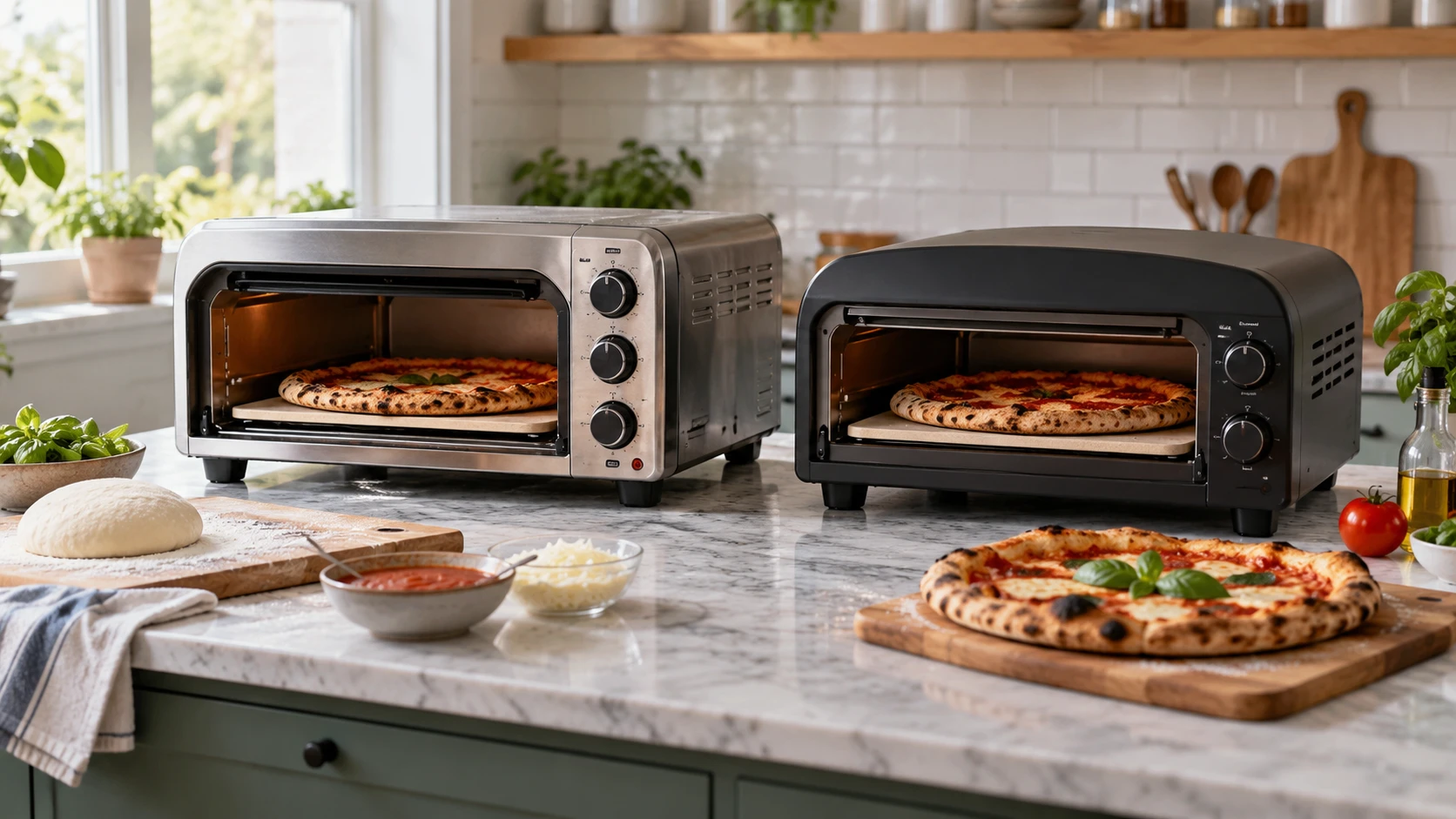
The Equator countertop pizza oven lists a 12-inch cordierite stone and six named pizza styles. This guide to oven-pan fit beyond advertised width gives a useful reason to measure food and cookware before trusting a size label. The FOHERE countertop pizza oven lists a 12-inch baking area, an audible timer, and a removable crumb tray. The guide discusses other ovens, so its product dimensions should not be applied to either of these models.
Both catalog entries point toward a 12-inch pizza, but they describe different ways to cook it. Equator names Neapolitan, Deep Dish, New York, Thin Crust, Frozen, and Custom settings. FOHERE emphasizes independent temperature control and claims a 1500 W oven reaches 662°F in eight minutes. The descriptions do not supply comparable chamber drawings or tests using the same dough and toppings. A buyer can narrow the choice by looking at the pizza they actually make, then confirming the controls and fit from the exact manuals.
A 12-inch label needs two measurements — guide to oven-pan fit beyond advertised width
Equator's saved entry says it includes a 12-inch cordierite pizza stone. FOHERE says its baking area accommodates a pizza up to 12 inches across. A nominal 12-inch pizza may still need clearance around the edge to slide in and out without touching the door or heating parts. If you use a pan, measure its outer rim and any handles. If you launch directly onto a stone, measure the peel as well as the dough. The stone's diameter and the food's diameter are different checks.
Ask for the exact internal width, depth, height, and door-opening measurements. Neither saved description supplies them. Equator also gives a 1.6-cu.-ft. volume claim, but cubic volume does not tell you which pan shape fits or how much headroom remains above a deep dish. FOHERE's entry names a 12-inch baking area without describing the vertical space. For a thick pizza or a small casserole, the height from cooking surface to upper element matters as much as the width.
Move the pan you own from its usual preparation spot toward the proposed oven location. Leave space for the peel, an oven-safe resting surface, and a place to put a finished hot pizza. A compact machine can fit near a wall while leaving no clear place to handle food. Request each oven's exterior dimensions and door clearance before committing to a corner of the kitchen.
If the oven will be stored between uses, include the carrying path and storage shelf in the measurement. Neither saved entry gives a weight. An oven called countertop may still be inconvenient to lift into a high cabinet every weekend. Check the current manual for permitted placement, ventilation clearance, and handling. The claim in Republeq's catalog that a unit fits most counters does not approve a particular shallow counter or enclosed cubby.
Presets versus direct control — FOHERE countertop pizza oven
Equator's six named programs could reduce setup time if they match the pizzas you make. A frozen supermarket pizza, a deep dish, and a thin homemade crust differ in thickness and toppings, but the listing does not say how each program sets heat or time. Get the current program table and check whether temperature and duration can be adjusted after selecting a style. The Custom setting may be useful for a recipe that does not fit a preset, though the saved text does not describe its available range.
FOHERE's entry says it has independent temperature control. It does not state in the short excerpt exactly which heating elements can be controlled separately or how the control panel is labeled. Its description does identify two built-in heating elements. Ask for the current panel diagram and temperature settings before treating independent control as a specific upper-versus-lower arrangement. If you often change toppings while keeping the same dough, control detail may matter more than the number of programs.
Equator lists an LED display for temperature and time, readable controls, and automatic shutoff after cooking. Check what the display measures and whether shutoff occurs at the end of every preset and Custom cycle. FOHERE names an audible alarm timer, but its saved entry does not say whether that timer turns off the heating elements. These are operational differences to verify, particularly if you prepare several pizzas back to back. An alarm is useful for attention; it should not be confused with automatic power control without documentation.
If dinner alternates between frozen pizza and homemade dough, check whether Equator's corresponding programs can be adjusted for the thickness and toppings you use. A cook who repeats one recipe may prefer to set a temperature directly and watch the crust. FOHERE's independent-control claim still needs a panel diagram before that becomes a reason to buy it. The program table and control instructions will say more about those routines than the names alone.
Temperature and timing claims need a source check — FOHERE countertop pizza oven
FOHERE's catalog description says its 1500 W oven reaches 662°F in eight minutes and cooks a pizza in five minutes at that temperature. Those figures come from the Republeq's product description, which does not name the starting temperature, pizza recipe, or test conditions. Use them to frame a question about preheat and cycle timing, not to promise dinner in thirteen minutes. The current manual should explain when preheating is complete and where food should sit during the bake.
Equator's source text gives a temperature span that appears to run from 175°F to 750°F and also mentions an 800°F maximum. The saved line is not clear enough to establish how the maximum relates to the controls or a particular program. Ask for the exact model's current temperature table and rating label rather than selecting the largest number. The same entry claims pizza can cook in as little as two minutes without stating the recipe or setup. It is a promotional minimum, not a matched comparison with FOHERE's five-minute line.
High temperatures can change the way a crust and toppings finish. A stone may affect the base differently from a metal tray, and a deep dish needs more time than a thin crust. Neither product excerpt reports a controlled side-by-side bake. If the underside of your pizza is usually pale or the cheese browns before the center cooks, ask about cooking-surface placement and element control on the exact model. Those details are more useful than an unqualified fastest-time claim.
Equator's title states 110 V. FOHERE's entry states 1500 W, but the saved excerpt does not give a complete electrical installation specification. Check the rating plate, plug, circuit requirements, and cord length for both ovens. A countertop location needs a suitable power arrangement as well as a suitable surface. Do not plan to solve a poor outlet position by stretching a cord across a preparation area. Use the current installation instructions for the exact model.
Accessories, cleaning, and repeated batches — FOHERE countertop pizza oven
Equator names a cordierite stone. Ask whether it is removable, how long it needs to cool, and which cleaning method the manufacturer allows. The saved description calls it a 12-inch stone but does not specify replacement-part availability. FOHERE names a removable crumb tray and a stainless steel top. Check how the tray comes out and whether crumbs from the cooking surface can be reached without disassembling the oven. Neither excerpt supplies a full maintenance procedure.
FOHERE says it can bake potatoes, bread, cakes, pies, pastries, and chicken wings in addition to pizza. That is a list of intended uses, not a guarantee that the baking area accommodates your pans for those foods. Equator's saved description emphasizes pizza styles and brick-oven-style heating. Ask both manufacturers which accessories and pan materials are approved if you plan to use the machine as a general oven. A pizza stone may be well suited to one recipe while a different dish needs another surface.
For several pizzas in one session, check how long each oven should recover between loads and whether the controls allow an immediate next bake. The saved entries do not describe temperature recovery or duty cycle. FOHERE's audible timer and Equator's display and programs can help an operator keep track, but they do not establish equal throughput. If the oven is intended for a cafe rather than occasional home use, request the service and warranty terms for that schedule.
Both listings mention home or commercial use in some form. That wording does not define a commercial duty rating or local approval. Ask for the exact model's certification and warranty scope if the oven will run for a business. At home, the same questions about safe placement and cleaning still apply. The Republeq's catalog intended-use sentence should lead to a manual check, not replace one.
Choose by the pizza and the counter — FOHERE countertop pizza oven
Equator may suit a cook who wants named pizza-style programs and a 12-inch stone, provided the current manual resolves its temperature line and explains the settings. FOHERE may suit someone who wants the stated 12-inch baking area, a removable crumb tray, and direct temperature control, provided the panel and timer behavior match that expectation. Measure your pizza, pan, or peel against the door opening and internal dimensions for each. Then confirm the available counter and outlet space.
The exact saved identities are Equator product ID prod_ee96c818004813a5b0bce6eb and FOHERE product ID prod_0c83363f640a4cdd400f838f. Use those IDs when requesting manuals, rating labels, and included-accessory lists. Bring the outer dimensions of your pan or peel to that document check.