Home Decor & Table Settings
entryway rug door clearance: test a 3×5 or 4×6 tassel rug
A door-swing and fringe check for two listed cardinal rug sizes, using the buyer’s actual entryway measurements.
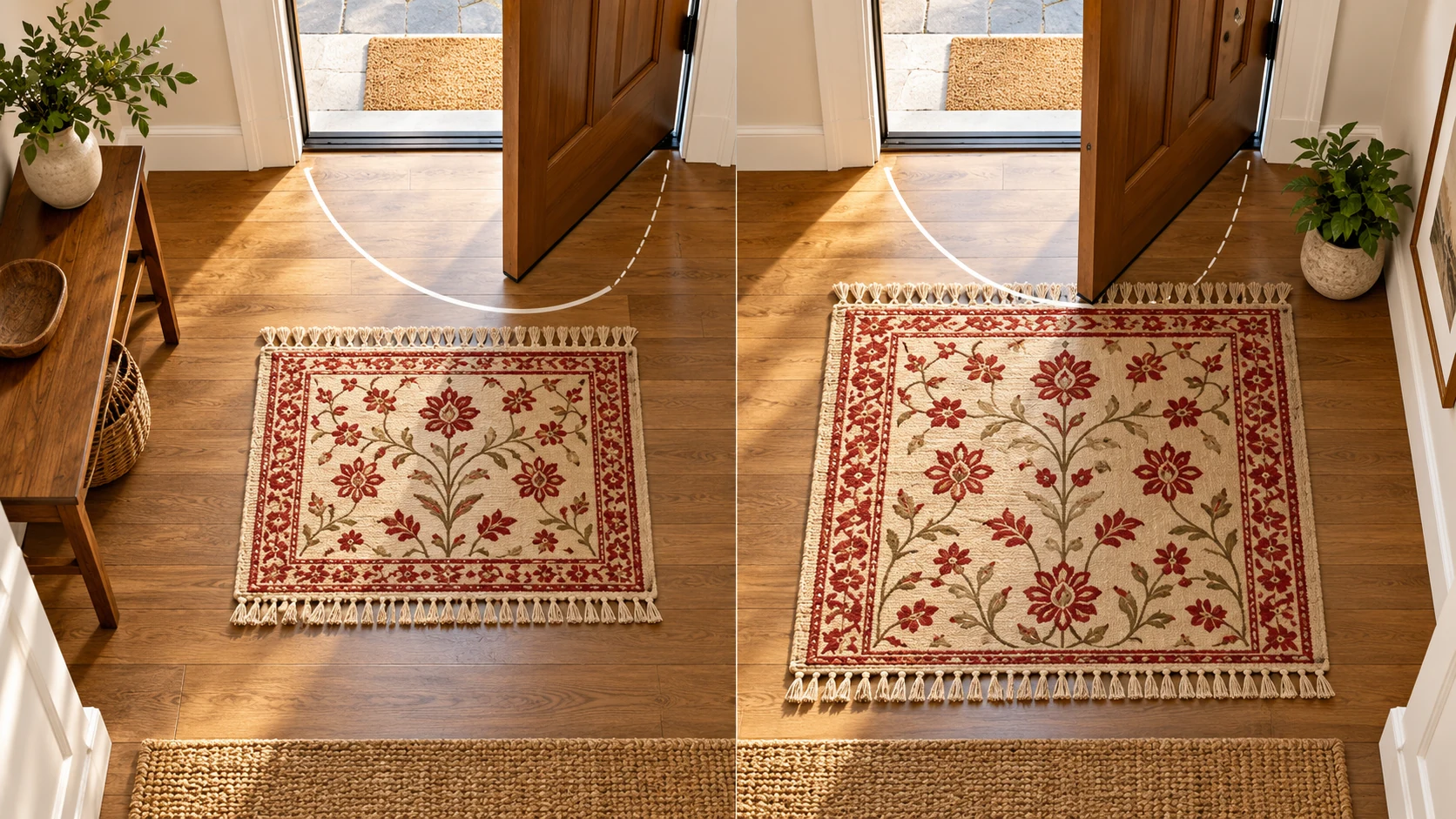
An entry rug can catch an inward-swinging door at its edge, even when the size on the listing sounds right for the room. Check the door in the entry where the rug will sit. A 3×5-foot rectangle and a 4×6-foot rectangle take up different amounts of floor, and tassels extend beyond the woven body. Mark both possible footprints, open the door all the way, and leave room for the normal walking route before choosing one.
The two examples here are the 3×5 cardinal tassel rug and the 4×6 cardinal tassel rug. Their current listings describe woven, fringed indoor rugs and give the nominal sizes. Neither page measures the gap under your door. The pictures show the rugs in styled rooms, so they cannot tell you how either size will behave at your threshold.
Find the point of contact
Open the door slowly while looking at the part of the floor where the rug would lie. Notice whether the lowest part of the door, a sweep, or another fitting passes close to the floor. Watch the full arc rather than the spot directly under the door when it is shut. A rug may clear the closed door and still meet it partway through the swing.
If a rug is already catching, look for the first point of contact before moving it. The door may touch the woven body, a raised corner, or the loose tassels. These lead to different placement questions. Sliding the body back may leave a fringe strand in the arc; moving a corner may put the walking route through a narrow gap. Do not force the door across the rug to see whether it will flatten.
If the door scrapes bare floor with the rug removed, or if you are investigating a line of daylight under the closed door, check the door hardware as its own issue. The door sweep gap guide explains how to locate an uneven bottom opening and examine sweep contact. That diagnosis does not establish that either cardinal rug will fit. Keep the door in its ordinary working condition during this article’s rug layout test; do not adjust a sweep to make a rug outline appear to clear.
Measure with the door as it is used. Keep the sweep or other hardware in its normal position. If the door moves across a threshold strip or an uneven floor, include that part of its travel. Record the smallest clearance you can actually observe. The seller pages do not provide an installed height for either rug in your home, so a nominal footprint alone cannot settle whether the door will clear.
Make a simple contact note as you inspect. Write down the door's direction, the location of the first touch, and whether it happened on opening or closing. A rug can shift after someone walks across it, so the note should describe the position at the moment of contact. Photographing the open and closed door from the same spot can help you remember the arc, but a photograph alone does not measure the gap. If there is already a rug on the floor, move it out of the doorway for the outline test rather than trying to judge the new footprint around it.
Check the door's full normal range. Some people stop it at a convenient angle, while others open it farther when carrying a package. Use the range this entry actually needs. Look at the door's low edge from more than one point along its width: the hinge side and the outer corner may travel over different parts of the floor. If a doorstop limits the swing, include its real stopping point. A placement that works only while someone holds the door at one angle is a fragile plan.
Separate a clearance problem from a rug movement problem. If the door catches a rug that has slid toward it, mark both the intended position and the position where contact occurred. The product listings call the rugs non-slip, but they do not establish that either one will stay fixed on your particular floor. A new rug may need a different placement even if the initial outline clears. Keep the entry route usable without depending on a backing claim you have not checked in the room.
Lay out both sizes on the floor
Use removable tape, paper, or another temporary marker to outline a 3×5-foot rectangle where the smaller rug might sit. Mark the outer edge where tassels would project as well as the main body. The listings and gallery show tassels, but an image is a poor ruler for their exact reach. Leave a margin you can confirm with the rug itself if it arrives.
Open and close the door through its complete ordinary travel while the outline is down. Trace the part of the outline that the door crosses. Then stand where a person enters and check how much of the walking route remains open. If a shoe, bag, or stroller commonly comes through the doorway, consider that real approach during the dry run. The placement check leaves the advertised backing untested on your floor.
Repeat the test with a 4×6-foot outline. Do not simply add one foot to each visible side of the first outline; place the larger rectangle where you would actually use it. Its longer edge may reach farther into the approach or under nearby furniture. The wider floor outline may also make a different edge the one closest to the door. Move the outline only to a position you could live with every day.
Picture a narrow entry with an inward door and a chair or console nearby. The 3×5 outline may fit beyond the door arc while the 4×6 outline reaches into it. In another entry, both could clear because the door swings across bare floor before reaching either outline. These are measurement examples, not dimensions from the product pages. The buyer's door arc decides which case applies.
Measure the floor between the door's travel zone and nearby fixed obstacles before deciding where to center an outline. A console, shoe rack, radiator, or the start of a hallway can leave less practical room than the wall-to-wall dimension suggests. Mark the rug where shoes will actually step, not in the middle of an empty photograph. If the rectangle must be pushed under furniture to escape the door, check whether the exposed part still serves the entry and whether the covered edge can be inspected later.
The outline should show the full rectangle rather than just two corners. Put a mark at each corner and connect the edges so you can see which side meets the door arc. If temporary tape is unsuitable for the floor finish, use loose paper markers that you remove after the test. The outline stands for the seller's nominal size. It does not show how the woven body or tassels will settle after delivery, so leave visible space beyond the line where the door passes close.
For a real comparison, keep one feature constant. You might put each rug's short end at the same distance from the threshold, then see where its far end lands; or keep the far end beside a piece of furniture and compare the threshold edge. Changing the starting point and the size at once makes the result hard to interpret. Write down the positions that clear the swing and still leave an approach you would use. If neither outline works in a plausible position, the answer is already useful: these two offered footprints are poor candidates for that entry.
Check the door from both sides of the threshold. A rug inside the entry may leave a clear path for a person entering but narrow the route for someone leaving, especially when the door is open. Turn as you normally would, then look at whether a foot would need to land on a loose fringe or step around the rug. This is a layout observation for your space. The listing does not certify the result for another doorway with a different hinge, floor, or furniture arrangement.
Check the edge and fringe separately
The cardinal rugs have visible tassels along their short ends. Before ordering, decide which end would face the door and whether the fringe could enter its path. A rug body that appears outside the swing can still leave tassels close to a moving sweep. The gallery shows what the edge looks like, but it does not establish the exact clearance needed at your door.
If an existing rug's tassels are the only part catching, try a different position that keeps the whole rug useful and the entry route clear. Avoid trimming, folding, or tucking fringe merely to make an unsuitable footprint seem to fit. Those changes alter the item and may not keep the edge where you put it. If the fringe cannot stay clear in a practical position, choose a different rug design or leave that part of the threshold bare.
A corner that lifts deserves its own check. See whether it rises when the door passes, when someone steps on it, or after the rug has been moved. Do not treat a seller's “non-slip” description as a tested result for your floor. The two listings make grip claims, but the actual floor finish, cleanliness, wear, and placement are outside those pages. Confirm how the rug sits in the room before relying on that claim.
Fringe needs its own mark because the listed 3×5 and 4×6 dimensions describe nominal rugs, while the photographs show loose tassels at the ends. Do not calculate a precise tassel allowance from the gallery: perspective and cropping make that unreliable. When you test an outline before purchase, allow extra room at the tasseled end. After delivery, check the actual outermost strands with the door moving slowly. If the door lifts, brushes, or traps them, the outline was too optimistic for that placement.
Look for a position that can be repeated. A rug shifted an inch for a photograph may appear to clear, but a household entry gets used from different directions. Notice whether the edge tends to move when shoes cross it or when the door creates a draft. You do not need to predict a universal amount of movement. You need enough room that the rug, as it actually sits, stays out of the door's path during ordinary use. If that cannot be observed, leave the clearance decision open.
Do not use the advertised washable construction as a fix for a clearance fault. Cleaning instructions concern care, while this issue concerns where the door travels. Likewise, an anti-slip description does not make a rug body thinner or shorten a tassel. Read the current listing for care and material details if those affect your purchase, but keep the door test tied to geometry and the item you receive.
Choose a workable footprint
Compare the tested outlines with the actual use of the entry. The smaller 3×5 option takes less nominal floor area; it may leave more bare floor in front of the door. The 4×6 option covers a larger rectangle and may extend farther into the room. If one outline crosses the swing arc, its artwork and larger coverage do not solve that conflict.
Keep the rug's long and short sides straight in your notes. A 3×5 rectangle turned ninety degrees has the same listed size but a different relationship to the door and walking route. The same is true of the 4×6. Mark the orientation you tested so you can compare it with the listing and repeat the check after delivery. This matters more than how the rug is oriented in a lifestyle photograph.
The reading nook rug shape guide uses floor outlines to judge how a chair zone looks and whether people can approach it. An entry door adds a moving clearance problem. Use the real swing and the rug's fringed edge here; a layout that looks balanced from across the room may still catch the door.
Before committing to one size, sketch the two tested positions with a few measurements you can check later: the distance from threshold to near edge, which side runs along the entry, and the nearest point of the swing arc. This can be a rough note rather than a scaled drawing. It helps you tell whether the delivered rug was placed where the outline passed, or whether it drifted into a new position. Keep the 3×5 and 4×6 notes separate; their fringe edges will not land at the same point.
Consider the part of the entry that gets cleaned and used. If a rug must sit so close to a wall that a door scrapes the opposite fringe, the fit is poor even when the main woven area is attractive. If the 4×6 outline leaves no sensible place for shoes to turn, its larger coverage is not useful in that room. If the 3×5 leaves a wide clear path but sits too far from the place people step, it may also miss your purpose. The floor test should answer both the contact problem and the reason you wanted a rug there.
When the rug arrives, set it down before treating the purchase decision as finished. Open the door slowly through the same arc you marked. Check the body, every corner near the swing, and the tassels. Walk the normal route and see whether the rug stays where it was placed. If the actual rug behaves differently from the outline, revise the placement or use another size or design. The installed rug must pass the same door-swing check as the outline.
Compare the delivered rug with the particular listing you chose. Confirm its size label, tassel ends, and general construction before discarding packaging. The gallery establishes what the offers depict; it is not a guarantee that every individual item will lie identically after shipping. If an edge is folded or uneven on arrival, follow the seller's care directions before making changes, and keep the door from dragging across it while you assess. Do not cut the rug or alter the door to make a failed clearance test pass.
If the first position fails, return to the measured outline and change one thing at a time. Try a practical shift away from the arc, then test the full door motion again. If the door still meets fringe, turn the rug only if that orientation leaves a useful walking route and puts the fringe where it can stay clear. Keep the size fixed while you compare positions. A sequence of small, recorded tests is easier to judge than moving and turning the rug repeatedly without knowing which change helped.
If neither 3×5 nor 4×6 leaves a usable route and a clear door swing, neither cardinal example fits that threshold. A smaller or differently shaped rug may be worth evaluating with the same floor test. You can also leave the door's travel area uncovered. Keep the measured arc and the contact point in your notes so the next candidate addresses the issue that made this one fail.