Sewing & Crafts
Embroidery support slipping in the stand, frame or cloth
Separate the stand carrying a hoop from the rings holding its fabric, and keep changes tied to the actual stitching method and equipment.
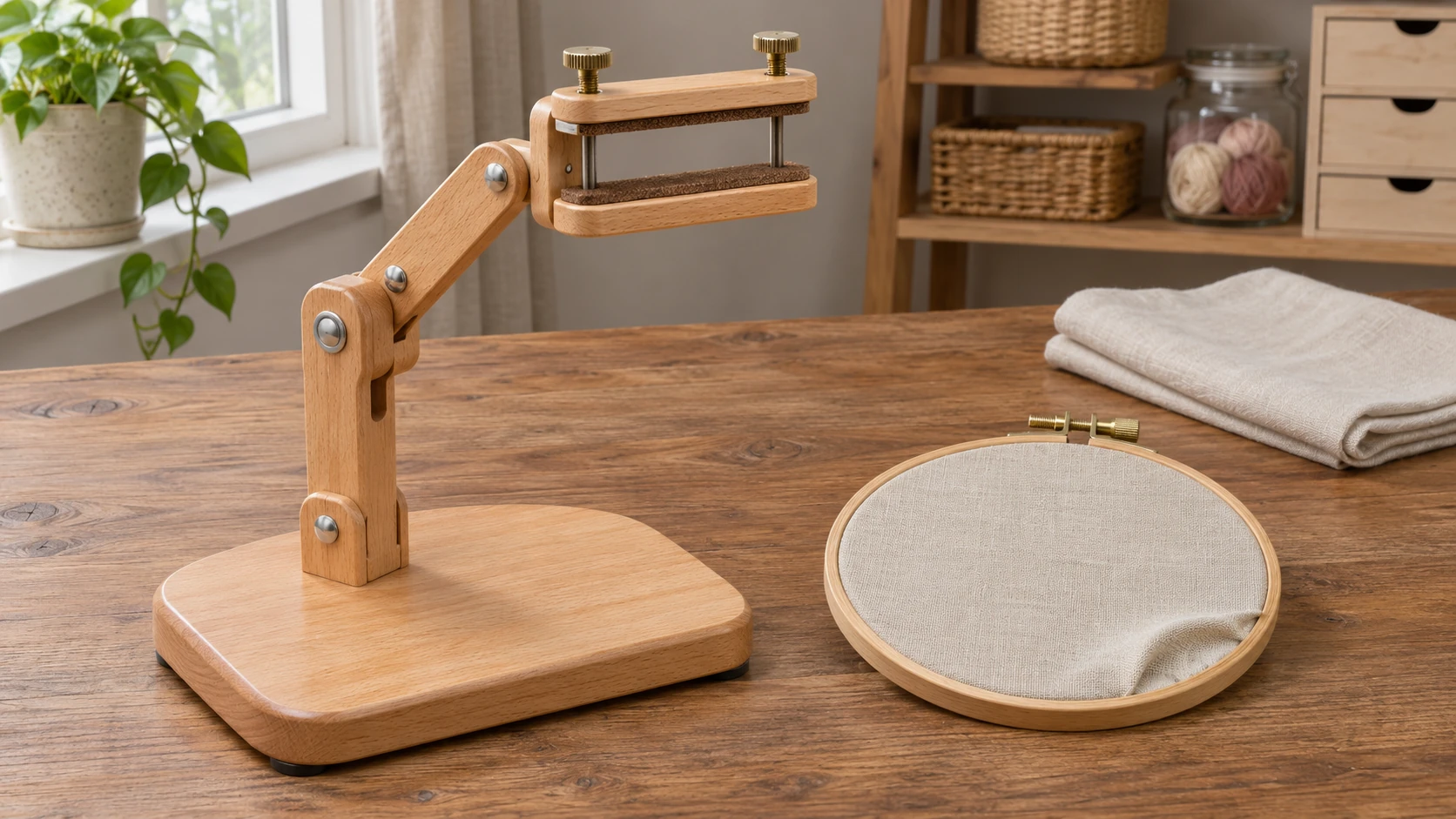
Embroidery support slipping can describe movement in different places. The stand may move with the work, a frame may move in its holder, or cloth may lose tension inside the frame. Identify the contact you mean before looking for a fastening to change. Liz Almond's Working Environment discussion of frames treats the support arrangement and the fabric-holding frame as separate equipment choices, with their own practical limits.
Locate the support that is moving
Almond asks whether a floor support remains stable with the actual frame, work and accessories attached. Her examples include metal and wooden floor arrangements, seat frames and table-mounted supports. The base and available working space matter to that question. Keep her account as an experienced stitcher's discussion of those arrangements. It supplies no load rating or tightening sequence for an unidentified stand. A description of movement at the base should remain a support question while the frame's own fabric-retention question is considered separately. The loaded support arrangement remains the subject of that particular stability enquiry.
Frame grip belongs to the actual clamp
Nurge's interchangeable-head page makes frame grip a specific equipment question. Its Classic 190-A, Robust 190-B and 2026 190-C heads have different stated clamping features. The Robust account describes a wider grip and deeper opening. It also tells readers to consider the combined weight of hoop, fabric and stitching when deciding whether their stand has the stability needed for a larger project.
A stronger grip description therefore leaves another relationship to establish. The supported work and its stand still belong together. The same page limits the replaceable heads to six named Nurge stand models and expressly excludes older named models and other makes. Keep the exact head and stand references in an applicability enquiry.
The 190-C account identifies a head that can be configured for hoops or Nurge Snap Frames. That feature belongs to its specified compatible equipment. A general resemblance between jaws cannot extend the claim to another stand. If the frame moves in the holder, obtain the applicable information for that pairing before deciding which component or adjustment would answer the problem. Keep the head model visible when explaining the intended frame and project.
A hollow frame needs its own compatibility answer
Nurge's FAQ contains a caution against using its embroidery stands to hold a Q-Snap frame. Its stated reason is that the frame can be hollow and tightening the clamp could cause it to crack. That warning identifies a possible consequence of treating more clamping force as the answer to a grip problem. Retain the actual frame type when asking about a support.
The FAQ uses broad stand wording. Read it alongside the actual model information supplied for the particular head under consideration. It does not provide a safe tightening force, a way to reinforce a hollow frame or a universal repair for movement. An unresolved applicability question should remain visible before pressure on the frame is increased.
The same FAQ discusses a stand-head availability question and separately points to replacement screws and wing nuts. Parts availability concerns the named equipment. It does not establish that a fastener from one stand can repair another, or that buying a new fastener diagnoses the movement. Explain which frame and holder are involved so a response can address that relationship. A named frame requirement gives that question a more specific starting point.
Cloth tension is held inside the hoop
DMC's hand-embroidery hoop lesson explains a different contact. The inner and outer rings retain the fabric, while an accompanying stand can support the hoop. Its gradual hoop-tightening guidance concerns the cloth tension between those rings. Turning a stand joint cannot by itself complete the lesson's fabric-holding task.
Helen Bradley's DMC account advises attending to the fabric's tension again during stitching. It also offers binding the inner hoop as a way to reduce slipping and protect the fabric. Keep those points with the two-ring hoop being discussed. They supply neither a lining material nor a modification instruction for a stand clamp.
If the cloth has become slack while the frame remains supported, describe that observed condition when seeking the applicable hoop guidance. DMC also distinguishes loose stitches from stitches pulled tightly enough to pucker the fabric. The cloth held by the hoop and the tension applied to individual stitches deserve their own attention within the method being followed. Keep each tension question attached to its actual subject.
The repair fabric still needs suitable tension
DILLING's repair guide describes the inner ring, outer ring and screw of its hand-embroidery hoop arrangement. Its purpose is to smooth the fabric and help the stitcher control the embroidery. The guide cautions against making the fabric too tight, because that can leave the finished embroidery sitting too loosely on top of the repair. The intended textile result matters alongside retention.
For that reason, a request to hold the cloth more firmly should identify the repair and the applicable method. A smooth working area and an excessively stretched textile are different conditions. DILLING's own guidance uses gentle fabric adjustment before securing its rings. It gives no measured force for an unfamiliar hoop, and no adjustment instruction for either retail support below.
Keep the repair reference available if the tension remains uncertain. Ask what the actual technique expects of the cloth at that stage. An answer about the stand's height or the shape of its base would leave that fabric question open. Resolve the relevant contact before making another change elsewhere.
The stitch method can change the tension question
Inspirations Studios' Scoop on the Hoop is an excerpt from A-Z of Embroidery Stitches 2. It distinguishes ground-fabric tension from the tension of the stitches being formed. Its discussion recommends a hoop for the stab method, where the needle's journey to the back and its return are separate movements. That is a technique context for using a taut surface.
The excerpt contrasts that approach with sewn stitches worked in one scooping movement. It says a hoop is not advisable for that method because the surface tension would be compromised to let the needle pass easily. Keep that distinction within the instruction being followed. The desire for an immovable surface does not establish that every hand-embroidery method calls for the same arrangement.
The same discussion emphasizes an even surface with the weave kept true. Its tightening advice concerns a suitable hoop and its own fastening hardware. It cannot become an instruction to tighten every joint of a separate support. If the method and the observed fabric condition seem to conflict, identify that conflict before substituting a different movement or holder. Return to the specified stitching method when choosing the support arrangement.
Read the floor and tabletop supports separately
The balikha wooden floor-stand listing describes one adjustable support. Its original photo shows an H-shaped base, a single upright, a segmented upper arm and a rectangular jaw assembly. The description's comfort and stability language remains a retail claim. The image provides no loaded-work trial or fastening instructions.
The ATALRPOU tabletop stand listing names a violin-shaped base and butterfly clamps. Its photo shows the curved arm and empty wooden jaws. The description says the clamps secure fabric, but the empty photograph does not demonstrate a direct fabric-mounting method or identify a supplied hoop.
These are visibly different support architectures. Neither short account establishes a supported frame list, clamping force or load limit. Ask for the applicable instructions for the exact stand and intended holder. The catalog labels and photographs do not authenticate maker identity, material species, successful grip or a remedy for an existing slipping problem. A response should identify the exact offered support it concerns, including which holder or frame its information actually covers for the intended work.
Leave inspection and stabilizer choices in their scopes
The embroidery back-check guide concerns identifying one stitched region and examining its reverse using the holder's actual instructions. Its result is a bounded observation about existing work. A thread seen behind a petal is a different question from movement at a stand base or an uncertain clamp-to-frame relationship.
The embroidery stabilizer guide explains backing, topping and removal categories. It keeps material identity and project-specific support requirements together. Changing a stabilizer is a separate material decision. That guide supplies no universal stand-grip repair and no permission to alter layers merely because the working support moves.
Use the back-check account when the next task concerns a particular region of existing embroidery and the view available behind it. Keep the region and its applicable handling instructions together. Use the stabilizer explanation when the open question concerns the support material and what should remain after stitching. Keep its actual material and project requirements together. A useful next reference answers the task you intend to undertake. A limited observation and a material-selection answer can each remain useful without supplying the other guide's instructions or an equipment repair.
If an optional support order offers cryptocurrency
If you later arrange a support purchase through republeq.com and prefer crypto such as USDT, check the payment choices presented for that particular order. Where a suitable option is available, read its instructions before deciding whether to proceed. Keep the buyer and payer roles clear if several people are helping with the purchase. One person may choose the goods while another authorizes payment, and each needs enough information to understand the same order. Agree who will place it and who will retain the confirmation before a payment request is opened. Review the basket, quantities, total and terms together, leaving an unfamiliar instruction open until it is understood. A change to an item or quantity should lead to a fresh reading of the resulting request. Where an asset and network are specified, keep those details together with the current authorized destination. Information saved for an earlier order may concern a different transaction. After any payment action, retain the resulting reference with the order information and the status actually shown. If the state remains unclear, ask about that exact transaction through the official order channel before deciding whether another payment is appropriate. A delayed page update alone leaves that question unresolved. Keep private recovery information and signing credentials outside a shared shopping note. A helper investigating an order usually needs its reference and the specific question, rather than access to the payer's wallet. If a proposed change comes after payment, obtain the applicable merchant instructions for that order before assuming that the earlier payment can be reassigned. You can also decide to wait before purchasing. Record that choice clearly when someone else might otherwise continue an unfinished basket. A useful purchasing record can be brief, containing the selected request, the person responsible and the actual order state. When the people involved understand whether the purchase is pending, completed or postponed, they can decide what follow-up is needed without reconstructing the transaction from scattered messages.