Educational & Explainer Articles
Electric pencil sharpener specifications: battery counts and cutter life
Read electric pencil sharpener specifications by separating battery capacity, use counts, cutter-life claims and actual order contents.
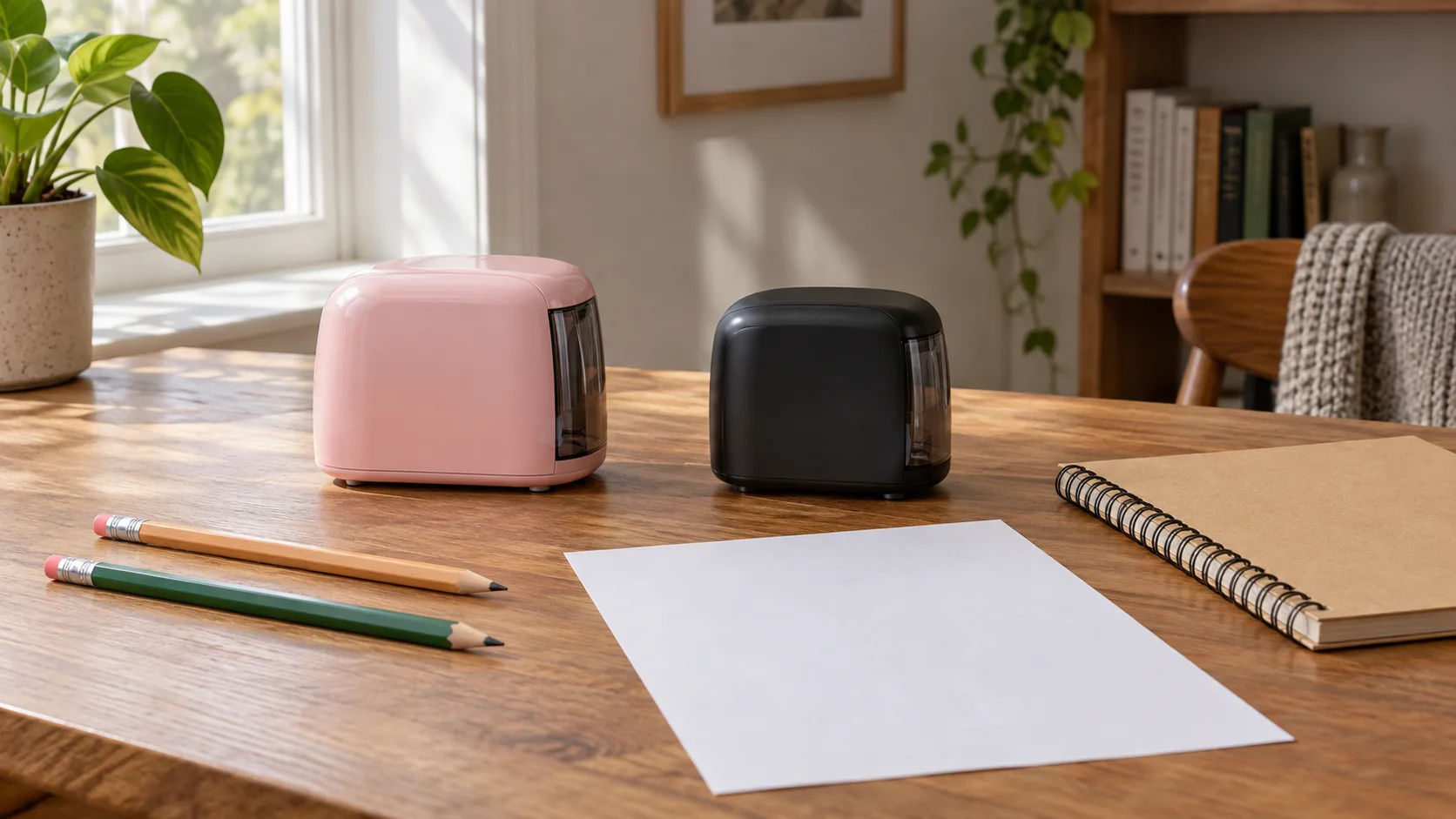
Electric pencil sharpener specifications can describe battery capacity, a number of sharpening sessions, cutter life or the contents of an order. Those figures answer different questions. The Deli rechargeable pink sharpener and BOSTITCH BPS4 provide examples of why the number needs its unit and conditions before it becomes useful for a desk or classroom purchase.
The Deli description states a 2,000 mAh battery, 600 uses on a full charge and an 8,000-use cutter claim. The BPS4 account names battery power and a cutter-life statement of four times, without identifying the comparison behind that multiplier. Read each claim on its own terms. This explainer supplies no sharpening, charging, cleaning or blade-handling instructions and reports no independent performance test.
Begin with the question each number answers
Give each specification a named question. Battery capacity concerns the battery. A use count concerns activity under the conditions behind that claim. Cutter life concerns a component. The quantity delivered concerns the order. Copying a number into the wrong field leaves the original question unanswered.
For a shared desk, you might want to establish how the machine is powered and which instructions apply when power is low. A classroom might need the exact supported pencil sizes and the conditions behind a stated output count. Those needs belong in the inquiry before a larger number becomes a reason to prefer one product.
Keep the actual offer reference with the specification. Deli's selected title identifies a pink rechargeable automatic sharpener for pencils described as 6.9 to 12 mm. The BOSTITCH title identifies a black BPS4 with SKU 1396115115 and UPC 619419798219. A similar-looking product or a familiar brand name does not establish that an answer covers the offered configuration.
Battery capacity versus sharpening sessions
When reading battery capacity versus sharpening sessions, keep the two units on separate lines. The Deli rechargeable electric pencil sharpener states a 2,000 mAh lithium battery. That is a battery-capacity label. It is not a stated number of hours at your desk or a count of pencils you can sharpen in a particular class.
The same description says a full charge takes 1.5 hours and the sharpener can be used 600 times when fully charged. Retain those as two separate attributed claims. The account does not define the pencil material, starting condition, chosen sharpness or other test conditions behind the 600-use figure. It does not identify a charging connector or complete charging procedure here.
Check how the source defines one use before treating it as a fixed amount of work. Do not decide that every use represents one new pencil, one classroom session or an identical amount of material removed. Those interpretations would add a test definition that the actual description has not supplied.
The 1.5-hour charging statement also supplies no guaranteed timetable for every delivered unit and power arrangement. Ask for the applicable charging instructions and conditions rather than substituting a charger from a different device. A capacity number does not establish charger compatibility or whether a particular charging accessory arrives in the package.
Read the BPS4 power account without filling its gaps
The BOSTITCH BPS4 black battery-powered sharpener is described as battery powered. This account does not state a battery count, battery size, rechargeable status or charging duration. Keep those unanswered fields with the actual BPS4 reference when requesting the current power requirements.
Do not copy Deli's lithium battery or recharge claim into the BPS4 record. The shared electric-sharpener category supplies no common battery specification. Likewise, a missing battery-capacity figure does not prove that the BPS4 has a shorter or longer working period. The two descriptions do not provide a matched battery test.
If the power arrangement determines whether the sharpener suits the desk, resolve it before comparing use counts. Identify which power items are included, which are separately required and which instructions apply to the actual unit. The answer can establish a practical power requirement while runtime remains unknown.
Cutter life claims need their own baseline
The Deli account describes alloy steel spiral cutters and says they can be used 8,000 times. That count describes a different claim from the 600 uses on a full charge. One concerns the stated cutter life, while the other concerns a charged battery. Do not divide or combine them to invent a maintenance interval or a number of guaranteed charge cycles.
Cutter life claims need their own baseline when a description uses a multiplier. The BPS4's HHC cutter technology is described as extending cutter life by four times. The account does not identify the comparison cutter, the starting lifespan or the conditions behind that statement. Four times cannot become an absolute count of sharpenings without the missing comparison.
The two cutter statements therefore supply no matched durability ranking. Deli gives a stated count without a complete test definition here. BOSTITCH gives a multiplier without its baseline. Neither establishes the life of the battery, motor, housing or complete sharpener. A statement about a cutter should remain a statement about that component.
Ask whether the manufacturer has a relevant current test account if cutter life will determine the purchase. Keep its actual conditions with the answer. Do not turn a life claim into permission to replace a cutter yourself or assume a replacement is available. Availability, part identity and any service method require their own applicable information.
Keep pencil and finish claims with their stated scope
Deli describes support for pencil diameters from 6.9 to 12 mm and names circular, triangular and hexagonal forms. It also discusses softer colored pencils and five sharpness options. Those are concrete labels to retain when asking about the pencils you actually use. They do not establish that every pencil sold under one broad shape or art category is suitable.
The description's five-second sharpening claim does not define a whole classroom workflow. It provides no shared trial with the BPS4 and no conditions for your actual pencils. Keep it attributed to Deli. The account gives no complete control sequence here, so this article does not tell you how to choose a setting or insert, remove or recover a pencil.
BOSTITCH describes a tip saver intended to help prevent over-sharpening and a motor designed to avoid stalling. These are stated features and intentions. They are not measurements of the number of pencils saved or a guarantee that no stoppage can occur. Keep a question about a particular pencil attached to its own specification and the actual machine.
Separate safety features from a complete procedure
Deli describes an open-lid device that cuts off power and an anti-slip bottom pad. Those descriptions do not authorize opening the lid while the machine operates or testing a protective feature. Use the applicable instructions to establish the correct handling. An advertised feature is not a substitute for the actual operating account.
The same distinction applies to shavings storage. Both descriptions refer to a large-capacity receptacle or tray and less frequent emptying, but neither supplies a measured common capacity or a cleaning schedule here. The phrase large capacity does not tell you how many of your sharpening sessions fit before attention is required.
Keep maintenance questions separate from purchasing arithmetic. The descriptions do not establish an emptying, cleaning or blade-access method for the reader. Obtain the current instructions for the confirmed model when those actions are needed.
Read the offered quantity independently of performance
The BPS4 description preserves both “1 Each” and a bundle of “10 Each” in its title account. That wording leaves the actual selected order quantity to confirm. Do not silently pick one number, describe the purchase as ten machines or treat the ambiguity as a cutter or battery specification.
Ask what the selected order will contain and keep the written answer with its exact offer reference. An answer naming the BPS4 model may establish identity without resolving quantity. An answer about one package's contents may still leave a separately required power item unanswered. Give each field its own answer instead of treating a short confirmation as complete.
A use count also cannot establish the contents of the parcel. Deli's 600-use statement is not an included-pencil count, and its 8,000-use statement is not a quantity of supplied cutters. The numbers describe claims about activity or component life. Package contents need an actual inventory.
Two related examples of keeping a claim with its unit
The Logitech Alto K98M and MageGee LIGHT100 keyboard guide separates MageGee's stated 8,000 mAh battery from an unverified number of working hours. Its actual battery discussion supports the same reading task here: retain a capacity figure without turning it into a guaranteed routine. Keyboard connections, charging instructions and capacity do not transfer to either sharpener.
The Bybiment M220 and Highcool M150 label-printer guide examines a claim of up to 36 continuous rolls without the roll length, density and other stated test conditions needed for a dependable workflow estimate. That concrete output-unit problem helps explain why Deli's sharpening-use count needs its own definition. A printer roll, label size or operating method supplies no sharpener test condition.
Use the claim record for the desk you have
For a hypothetical shared craft table, begin with the actual pencils and the known power arrangement. The record might have a confirmed pencil diameter beside an unanswered question about the offered power accessories. That is a partial specification record. It does not become a complete suitability finding simply because a battery-capacity number is also present.
If several people share that table, describe their real need without treating the source's use count as a timetable. Ask whether the manufacturer has information relevant to those pencils and that routine. Keep an answer about one defined test distinct from a prediction for the entire group's future work. No frequency or number of users is assumed in this example.
When the offer changes, revisit the fields that depend on it. A reply identifying a power accessory for one configuration should not silently accompany another product. Keep the earlier answer with its original model and obtain the information still needed for the replacement candidate. This prevents an apparently complete comparison from being assembled from specifications belonging to different machines.
Keep an answer that resolves the actual question
Give a specification answer the same label as the question it resolves. Battery type belongs beside the power requirement. A test-defined sharpening count belongs beside the use claim. An identified comparison belongs beside the cutter multiplier. A confirmed delivery quantity belongs beside the selected order. Leave the remaining purchasing questions open.
Keep electric pencil sharpener specifications with the actual model, their units and the conditions supplied for them. Deli's recharge, use and cutter statements remain distinct, and the BPS4's power requirements, multiplier baseline and order quantity retain their unanswered fields until an applicable answer resolves them.
Reading electric pencil sharpener specifications starts with the actual unit and the meaning of each battery, use-count or cutter-life claim.