Crypto Commerce
Bybiment M220 thermal label printer vs Highcool M150 Thermal Label Printers
Compare Bybiment M220 thermal label printer by label stock, app and USB setup, battery claims, print workflow, condition, and running cost.
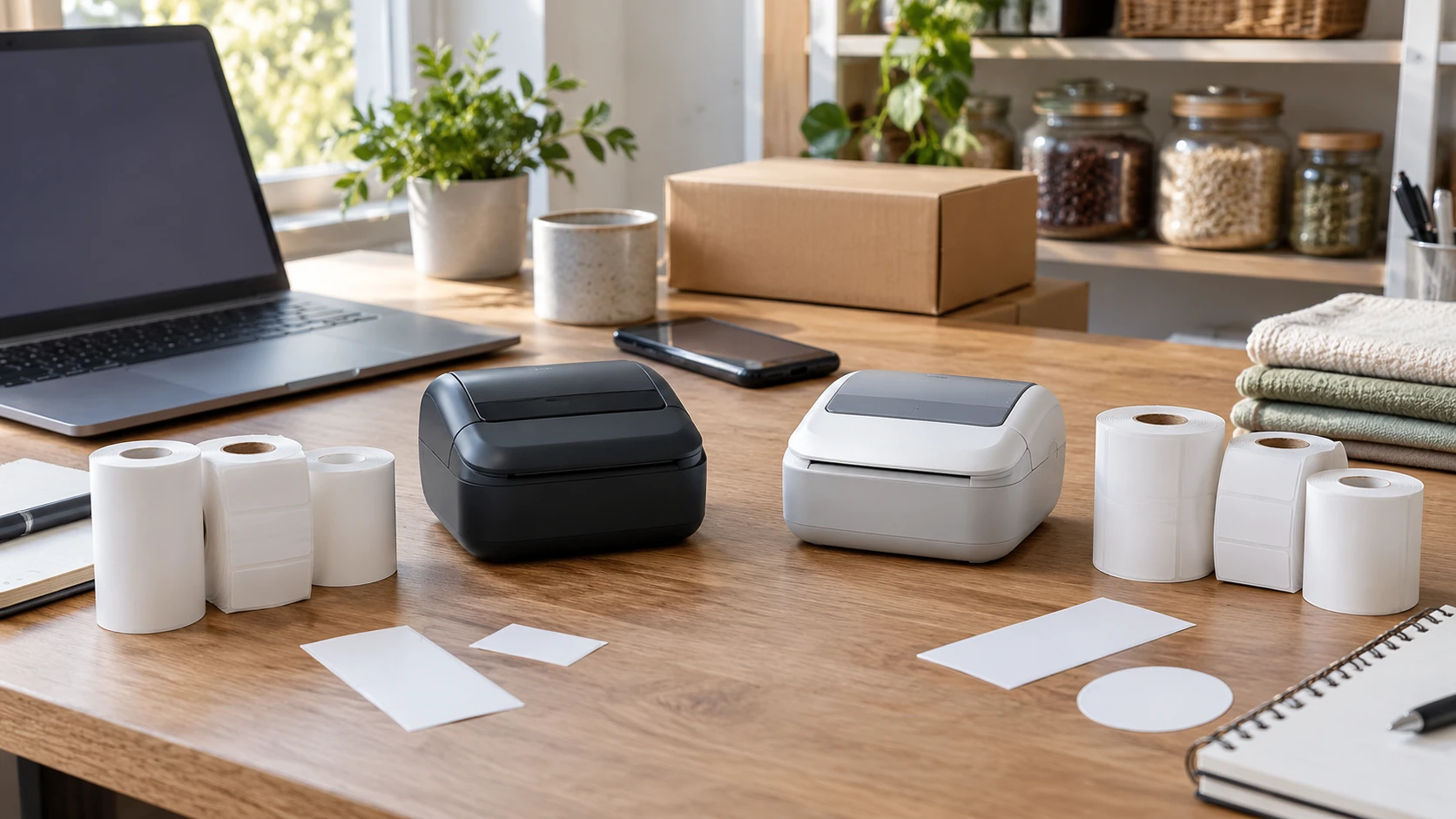
A label printer needs to match the labels a person will print and the device that creates them. The Bybiment M220 thermal label printer is listed with three starter rolls, Bluetooth phone setup, a USB route for named computer systems, and a rechargeable battery. The Highcool M150 listing emphasizes Bluetooth, a one-piece paper-loading path, app templates, and its label material. Both use inkless thermal printing. The saved excerpts do not establish that their labels, apps, chargers, or print settings are interchangeable.
Write down the first hundred labels before choosing either machine. Are they address stickers, price tags, inventory barcodes, jar labels, or short reminders? Measure the actual surface where each will go and the size of any required barcode. A printer that can print a QR code in its app may still be unsuitable if the chosen label is too small to scan reliably or the adhesive fails on the package. Print and scan a sample from the exact phone, computer, and label stock used in the job.
Start with the label rolls — Highcool M150 Bluetooth label printer
Bybiment says its kit includes three rolls sized 1.18 by 1.97 inches, 1.97 by 3.15 inches, and 2.76 by 3.15 inches. Its description also mentions 1.96-by-1.18-inch, or 50-by-30-millimeter, label paper with 230 labels per roll. Those dimensions may describe a particular included roll, but the excerpt does not map 230 labels to all three sizes. Request a current packing list that identifies each roll's dimensions and count. If a workflow needs hundreds of shipping labels, a three-roll starter kit alone does not tell you how many orders it covers.
Highcool's saved excerpt describes labels used for jars, names, addresses, products, reminders, and barcodes, but does not give supported width, length, roll capacity, or included roll count. Ask for a stock compatibility table and the part numbers of labels available locally. Its description claims the label material is free of BPA and BPS and resists fading. Obtain the manufacturer's current material statement if that property matters for a particular setting. A general claim about a label line cannot identify the exact stock inside the package.
The cost of inkless printing comes through label rolls, failed prints, and staff time rather than ink cartridges. Estimate cost per usable label at the sizes used most often. Check whether either printer accepts third-party rolls, how it recognizes gaps or marks, and what happens at the end of a roll. A roll with a low price can become expensive if it feeds poorly or produces labels that peel off during normal handling. Try a sample on the actual surface and inspect it after storage, handling, and any permitted moisture exposure.
Check the software on the devices you own — Highcool M150 Bluetooth label printer
Bybiment's source says Bluetooth pairing works with iOS and Android phones. It also names a USB connection for macOS and ChromeOS, and a Print Master app with text, images, barcodes, QR codes, OCR, forms, icons, and templates. It does not specify operating-system versions or whether all those functions work through both Bluetooth and USB. Ask for the current compatibility chart. If labels are created at a shared office computer, test that exact system rather than assuming a phone demonstration proves the desktop workflow.
Highcool calls itself a Bluetooth printer and names a Print Master app with barcode and QR creation, text, images, voice recognition, PDF printing, more than 100 fonts, 300 templates, and other customization resources. The saved excerpt does not identify a USB printing route or operating-system requirements. The common app name in both descriptions does not prove the same version supports both devices or that templates can be moved between them. Confirm the app publisher, version, account requirements, export options, and access to existing label files before replacing an established printer.
For a shop or school, one labeled workflow can be more valuable than hundreds of templates. Build a sample with the font, barcode type, text size, and logo actually needed. Print it in the normal sequence, then scan the code and read the smallest text. Ask how staff can correct a mistaken address or duplicate a label without rebuilding the layout. If the app requires an account or cloud connection, check what happens during a network outage. Neither saved description answers that question.
Separate battery capacity from output — Highcool M150 Bluetooth label printer
Bybiment gives a 2,200 mAh battery figure and claims up to 36 continuous rolls on one charge. The excerpt does not state roll length, label size, density, idle time, or test conditions behind that number. It also includes an incomplete phrase saying a new auto mode cuts usage by a missing percentage and prolongs time by two to three hours. That line cannot be used for a reliable runtime calculation. Obtain the current manual and test a typical batch before planning a mobile labeling session around the 36-roll claim.
Highcool's saved description does not give a battery capacity, charging connector, or runtime. Confirm whether the exact package is rechargeable or requires another power source. If labels will be printed away from an outlet, record how many of your normal labels can be produced before recharging and how long charging takes. A stationary desk workflow may care more about reliable feeding and stock availability than battery size. The two Republeq's catalog entries' saved claims do not provide a comparable battery test.
Both are described as thermal printers, so no ink or toner is needed for the stated method. That does not mean printed labels last forever. Heat, sunlight, abrasion, chemicals, and the choice of label material can affect legibility. Ask for stock-specific durability data if the labels must remain readable for months, or test a small batch under the actual storage conditions. A shipping tag, freezer container, and retail shelf label have different exposure and adhesive needs. Do not use an ordinary sticker where a particular regulation or food-contact rule requires approved material.
Examine loading and wasted labels — Highcool M150 Bluetooth label printer
Highcool says a one-piece paper-loading design helps prevent misalignment, and that automatic rewind of the first label reduces waste. It also names an NTC temperature sensor intended to maintain clarity under heat. These are Republeq's product descriptions, not a measured misfeed rate. Load a new roll during a demonstration and print ten labels of the chosen design. Check whether the first label is usable, whether the feed remains aligned, and how the printer recovers from a crooked roll or torn label.
Bybiment's saved excerpt does not explain the loading path or label sensing. Its title calls the M220 an upgraded three-inch barcode printer, while the included roll sizes described in the listing are narrower than that maximum phrasing may imply. Ask for supported stock width and printable width separately. A 2.76-inch label may not use its entire width for printing, and a three-inch marketing label does not automatically establish every paper size. Follow the loading instructions and print a full-width test before ordering a large quantity of stock.
Printer upkeep is another practical test. Ask how the print head is cleaned and whether the maker permits a user to remove stuck adhesive or paper. Keep spare rolls protected from heat and moisture as the stock maker directs. If a label jams, a simple recovery that preserves the next printed item can save time during a busy packing run. Neither saved excerpt gives a measured jam rate or a complete service procedure. Examine the current manual and price replacement parts or service before relying on either for daily production.
Resolve Highcool's condition label — refurbished device condition checks
The Highcool product is catalogued under "Restored Tools" while its description talks about the 2024 M150 and its features without saying what restoration was performed. That category label is not enough to establish whether the unit offered is new, used, refurbished, or merely miscategorized. Check Republeq's product page for the condition of the exact stock, photographs of the unit and box, and a written description of any inspection or replacement work. Confirm whether label rolls, charger, cable, and instructions are included and whether a previously used print head has been cleaned or replaced.
The published guide on refurbished device condition checks is relevant to that ambiguity. Verify condition against the delivered model and serial number, then print a sample before the return period ends. Bybiment's saved title does not use a restored label, but its actual box contents and warranty still need checking. Neither product excerpt gives complete written warranty or return terms, so get those from the Republeq's catalog before a large label-stock purchase ties the workflow to the machine.
The Highcool description also makes a certification statement about its labels and BPA/BPS absence. Keep the material statement tied to the exact rolls bought, and seek the original documentation if a purchaser has a compliance requirement. Do not infer that a printer's entire body or every compatible aftermarket label carries the same property. For ordinary office labels, print quality, adhesive behavior, and fit will likely be easier to test directly.
Run one complete labeling task — Highcool M150 Bluetooth label printer
Use the same address, barcode, or inventory label on both printers if samples are available. Begin from the device staff will use, create or import the design, load a roll, print ten copies, and scan each code. Note the time to correct one mistake and the number of labels discarded. Check the label on the intended package or shelf after the handling it normally receives. This exposes software and stock problems that a printer-only demonstration can miss.
Bybiment supplies more explicit information about connection routes, starter-roll sizes, and battery capacity, while leaving loading details and a battery-saving percentage unsettled. The Highcool M150 Bluetooth label printer describes a loading method and broad app features, while its supported stock, power source, and "Restored Tools" condition need confirmation. Choose from the complete label workflow, the cost of replacement stock, and the exact delivered condition rather than the largest template count.