Tools & DIY
Read drawer slide load rating beyond the contents alone
Read drawer slide load rating with drawer construction and contents in view. Establish what the exact offer rates before treating its figure as a storage allowance.
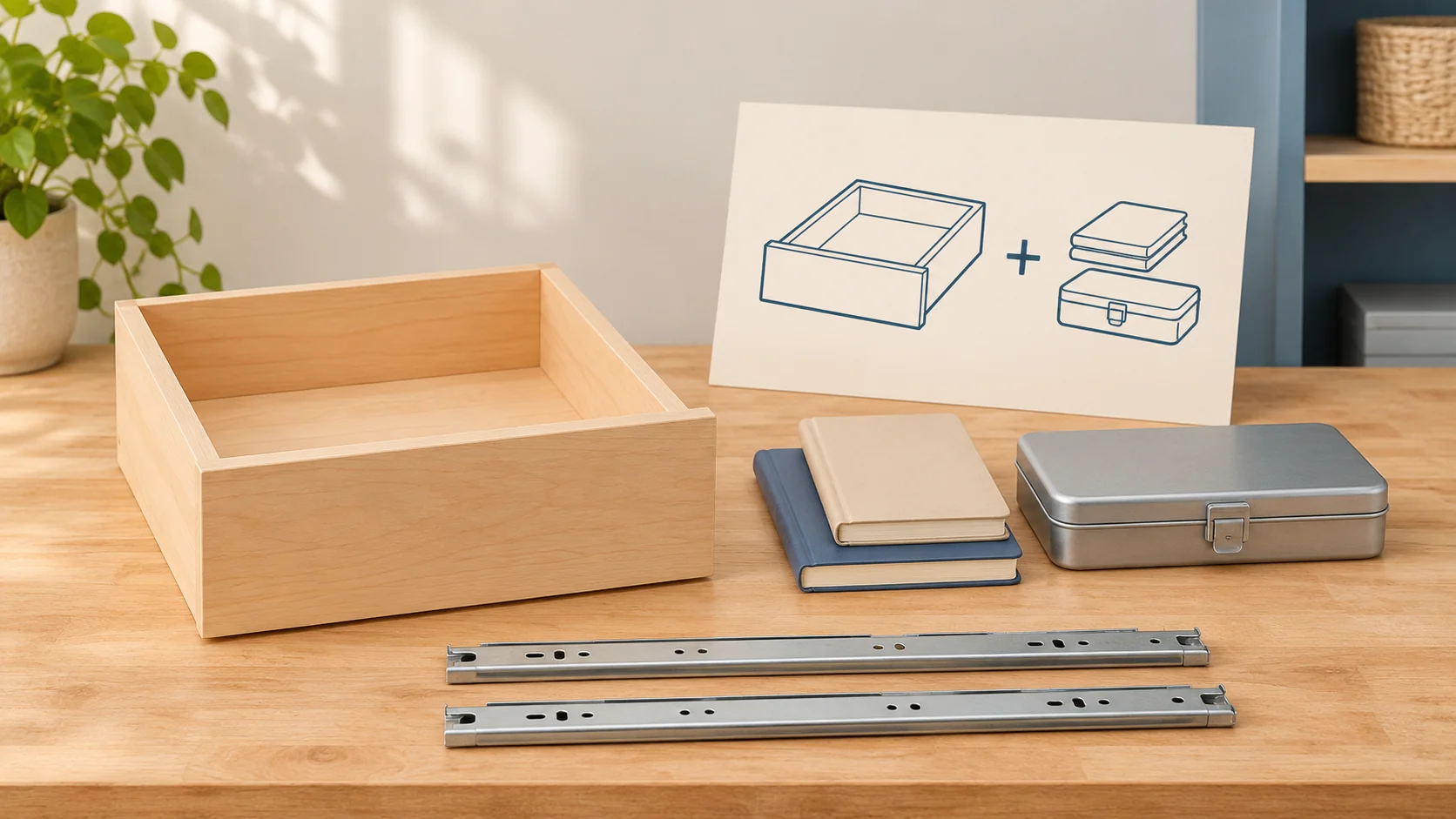
A storage plan often begins with the objects going into a drawer: tools, files, cookware or spare supplies. A drawer slide load rating needs a more careful reading before its figure becomes an allowance for those objects. What does the rated load include? Which hardware arrangement does it describe? An empty drawer still has a box and front, so a comparison that considers only the loose contents can leave part of the intended moving assembly out of the question.
This is a purchasing explanation, not a way to approve an installed drawer. It provides no working-load calculation, installation method or load test. The useful outcome is an understanding of which weights and definitions need to be established for the exact hardware. A rating on an accessory offer cannot certify the cabinet around it or tell you how much an unidentified drawer may safely hold.
Identify drawer construction weight before adding contents
Imagine an uninstalled empty drawer box beside the objects intended for it. Keeping them separate makes a common omission easier to see. The empty box is not weightless simply because the storage space is empty. It remains part of the thing that will move. Treat drawer construction weight as a question to establish, rather than assuming the slide figure is available entirely for the objects you want to store.
Accuride's own load-selection guidance explicitly describes its stated ratings as gross load and tells readers to include drawer construction materials. It also ties its maximum rating to a pair mounted as instructed and to the cycle rating. That is a bounded manufacturer explanation of its own products. It does not authenticate the rating, conditions or suitability of either replacement offer discussed below.
The distinction matters before any arithmetic. A drawer box and its contents are different things to identify. An unknown box weight does not become zero because the seller's page leaves it out. Nor does a remembered storage habit establish a measured load. Keep the missing information visible while deciding what documentation or appropriate assessment the proposed hardware needs.
Keep hardware item weight out of the contents allowance
The StandAlone ST135754 drawer-slide offer lists a 100-pound class rating and a separate 4.05-pound item weight. It claims side mounting, full extension and a pair with screws. The gallery shows one distinguishable nested rail assembly, so delivered pair and screw contents remain unverified. Its several length and dimension statements also remain unresolved. Neither rating nor item weight is a certified allowance for your stored objects.
The WLPZXP drawer-slide offer claims support up to 45 kilograms and describes a pair with mounting screws. Its gallery depicts two nested metal rail assemblies without a separate screw package. The text's extension and size figures are not reconciled here. The pictured construction does not authenticate a maker, validate the stated load or establish conditions for an installed cabinet.
These retail fields have different roles. Item weight identifies a stated property of the purchased item; a load claim concerns support described for the offered hardware. Do not replace the unknown drawer-box weight with the accessory's item weight because both appear in the same product record. If the page does not explain the basis of a figure, ask what it covers before using it in a plan.
For a contents allowance, first establish which complete load the applicable rating concerns. Then establish the actual drawer construction and proposed contents through the appropriate product information and assessment. This article does not supply the numerical result or a safety margin. It also does not suggest subtracting one convenient catalog number from another to create a permission that neither source provides.
Follow a change in the storage plan
Consider a fictional household planning a utility drawer. Sam initially wants it for lightweight stationery. Later the same drawer is proposed for a collection of metal tools. The drawer has not changed its name, location or apparent volume, yet the intended contents are different. Sam should return to the documented load question instead of treating the old plan as approval of the new one.
Sam's first note lists only the objects: notebooks, spare pencils and small packets. That note describes a storage preference. It leaves out the drawer structure and gives no measured weight. Revising the note to include the box and front makes the question more complete without pretending it has been answered. The next step is to establish the applicable hardware information, not to fill the drawer until it feels heavy.
Now suppose another person says that the objects fit easily. Space and supported load remain separate questions. There may be room around a compact object without any evidence that the intended assembly is suitable for it. Equally, a crowded collection need not be the heaviest collection. Keep volume, access and load in view without using one as a proxy for another.
This example is a planning exercise. No drawer was loaded, weighed, installed or operated for this article. It does not identify a suitable rail for Sam or establish how the two retail offers would behave. Its purpose is to catch the contents-only assumption before that assumption becomes a purchase or a claim about safe use.
Ask what the exact rating describes
A useful question names the actual offer and asks whether its stated load is defined for a pair or another specified arrangement, what it includes, and where the applicable conditions are documented. Do not answer that question by multiplying a picture of two rails. The relationship between a product's supplied quantity and its rated arrangement needs the product's own evidence.
Keep the required mounting and application information attached to the rating when it is provided. This article gives no mounting instructions and authorizes no alternative orientation. Accuride's explanation is a reason to read a definition in context; it is not a formula for adjusting the claims of unrelated hardware. An answer concerning one maker's slide cannot quietly become a certification of another offer.
The existing drawer-slide listing terminology guide separates closing features, extension, mounting and adjustment. Those vocabulary questions remain useful, but they are broader than the particular omission here. Understanding full extension does not tell you which weights a load figure includes. Keep the complete moving drawer question separate rather than starting another general feature checklist.
If a seller's response repeats only the same load number, the definition may still be missing. Ask for the relevant explanation tied to the exact item. Do not describe a response as manufacturer approval unless that is what the evidence actually establishes. This article records no real supplier reply, and a detailed-looking catalog entry alone does not settle every condition you need.
Leave an existing fault with its own assessment
A drawer that binds or will not move has a different starting point from a proposed storage load. The guide to a locking drawer slide that stops at an end position concerns identifying the installed hardware and the reported stop. A larger advertised load figure does not identify that mechanism or establish why an existing drawer stopped moving.
Do not use the planning explanation as a reason to add weight to a questionable drawer. Nor should an ordinary-feeling movement be treated as a capacity test. If the installation's condition or permitted use is uncertain, obtain the appropriate assessment. The task here is to understand the purchase requirement, leaving diagnosis, release actions and structural or mounting work with their own applicable instructions.
A change of contents can be worth describing in an enquiry without being proof of a cause. Say what changed and what you actually observed. Avoid converting the sequence into a conclusion that a rating was exceeded or that a rail needs replacement. The proposed load definition and the installed condition may both need answers, but answering one does not automatically answer the other.
Carry the definition into the purchase
Once the appropriate hardware and its documented application are established, retain that reference with the intended storage plan. If the selected item changes, check the replacement's own information rather than carrying a rating across by similarity. A changed drawer box or front also deserves attention in that plan. The point is to preserve what the decision concerned, without claiming an unchanged allowance after its basis changes.
If you consider drawer hardware through republeq.com and prefer crypto such as USDT, keep the exact selected offer and the unresolved load questions beside the order while you establish current purchase instructions. Paying for an item cannot supply a rating definition that the product information has not established. Identify what you intend to buy and obtain the actual order and payment details before authorizing a transaction. This passage confirms no currently available payment method, asset, network or destination for either offer. Follow only the instructions applicable to the current basket and order. If someone helps place the purchase, explain which drawer and documented hardware arrangement the selection concerns. A request for heavy-duty slides may leave that person unaware of the question that determined your choice. If they propose another item, review that item's own information before authorizing a substitution. Keep the order reference and any payment identifier with the purchase correspondence. An instruction from an earlier order does not establish what this selection requires. If the basket or selected variant changes, obtain the current instructions for that order instead of carrying old details forward. When a payment or order attempt has an uncertain result, reconcile that exact attempt before authorizing another one. An unclear confirmation remains an order question until the destination establishes what happened. Once the purchase is confirmed, keep the equipment and load-definition evidence separately from the transaction record. A receipt establishes an order event; it does not certify the delivered hardware's load rating, installation or suitability for your cabinet. Resolve any difference in delivered identity before relying on information obtained for the earlier selection.
Check delivered identity and stated contents against the actual order before treating the purchase as the selected hardware. This comparison does not resolve the StandAlone image's pair-count uncertainty or certify a screw inventory. A parcel count cannot answer the load definition either. Keep a discrepancy tied to the exact order and product information so it can be resolved without inventing a match.
Read the rating with the complete intended moving drawer in view. Establish what the exact figure covers, keep drawer construction weight distinct from the accessory's item weight, and avoid treating the headline as an automatic contents allowance. That leaves a specific purchasing question to answer before the hardware is selected, with no need to turn an unknown weight into an assumed zero.
Conceptual planning scene with a generic uninstalled drawer box and separate objects; no rated load, installation or capacity test is shown.