Furniture & Home Organization
Drawer slide listing terms: read each feature separately
Read each slide feature as a different question, then confirm mounting, dimensions and package contents for the exact model.
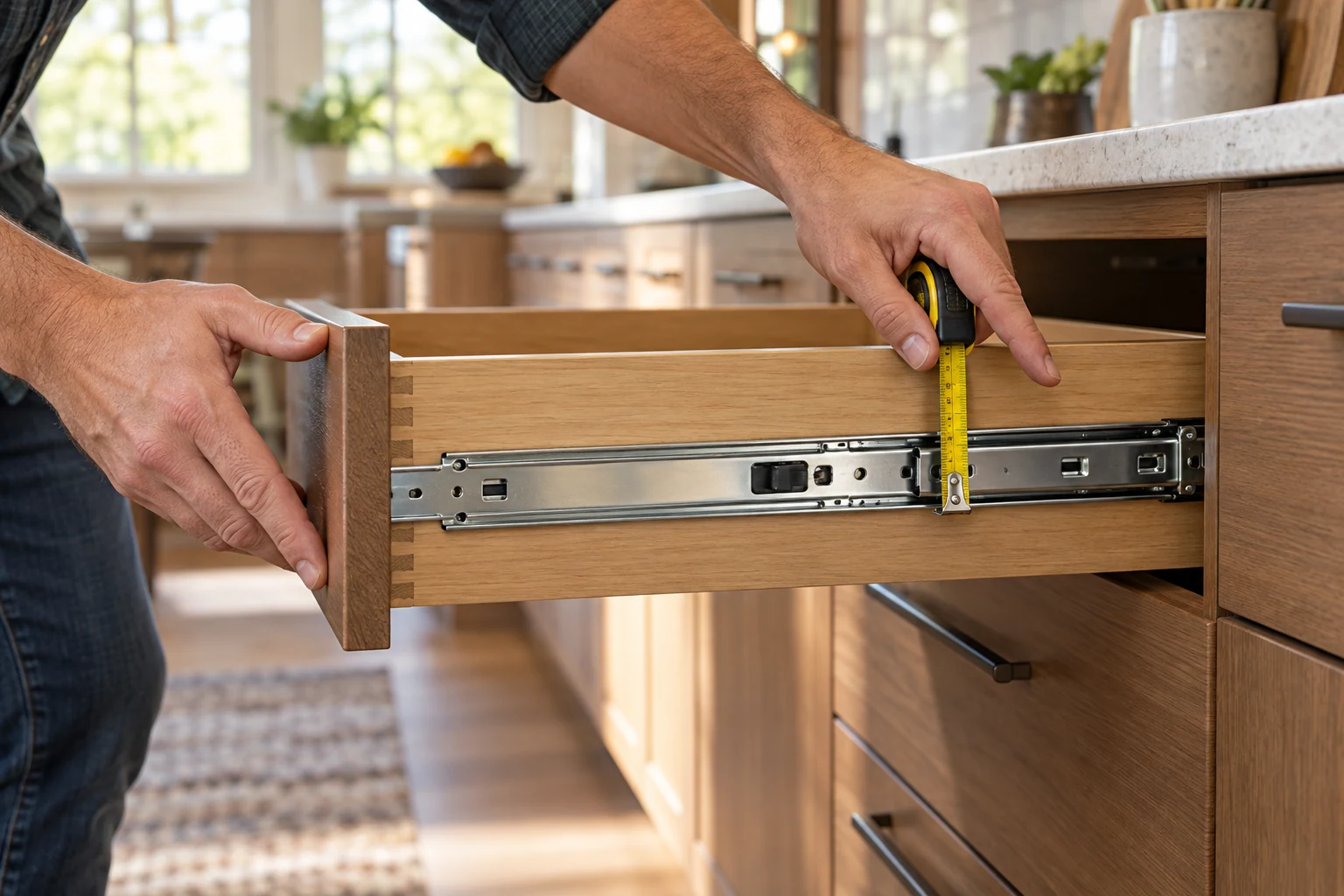
Drawer slide listing terms often arrive in one crowded product title: soft close, full extension, undermount, adjustable and a package count. Those words answer different questions. A reader who treats them as one promise can order a slide that sounds right but does not match the cabinet. This explainer separates what each term describes, what a listing actually says, and what still needs an exact hardware reference. It does not certify a replacement or teach an installation.
Begin with four different questions
Ask how the drawer moves at the end of closing, how far it can open, where the hardware is installed, and what can be adjusted. Soft close concerns the final closing behavior described for the slide. Full extension concerns opening travel. Side, bottom and undermount describe placement or mounting format. Adjustment claims describe a possible setup feature. None of these answers automatically supplies the others.
Write the four questions in separate lines before reading a listing. If an offer says “soft close,” do not fill in “full extension” from habit. If it says “undermount,” do not assume the exact adjustment range or bracket arrangement. If it gives a load rating, do not treat that as a measurement of the space available in your cabinet. Product language is useful when each claim stays attached to its own field.
There is a fifth question: what is actually in the package? A title may count pairs, while the body counts individual pieces or screws. These figures can be easy to misread because one installed drawer normally involves more than one rail component. Do not normalize a conflicting package count by guess. Record the exact seller wording and confirm the received parts or ask the seller before planning an order.
These questions matter even if you are only learning the vocabulary. A drawer that closes gently may still stop short of opening as far as you want. A rail that allows long opening travel may not include a soft final-close action. A package with brackets may still require a specific cabinet geometry. Treating the terms separately helps you ask a precise question of an installer or supplier.
A sample question can reveal the difference. Suppose a household wants a drawer to close quietly but can already reach everything inside. Soft close is relevant; full extension may be optional. Another household may need access to a deep drawer but does not name closing feel as a priority. Its first question is opening travel and cabinet fit. These are examples of requirements, not recommendations for either product. The exact cabinet and installed hardware still decide what is possible.
Some titles stack several attractive terms because people search for all of them. Read the product body and specification table after the title. If a feature appears only in search wording and not in the model's documented details, ask for confirmation. A photo of a drawer extended fully cannot prove a controlled final close, just as a quiet-looking closed drawer cannot prove full extension. Keep visual cues subordinate to exact model documentation.
Soft close is about the end of closing
A soft-close description says something about the final part of a drawer's closing motion. It is not an assurance that the drawer will never rub, that every load will move identically, or that the cabinet will remain aligned. It also does not identify the internal mechanism in an installed drawer. Read the exact product instructions for use, care and adjustment; do not borrow a procedure from another model that shares the phrase.
Look at the claim in its full context. Does the listing name a specific slide model, length and mounting arrangement, or only use a broad title? Does the body describe a closing feature separately from extension and adjustment? Keep a note of what is explicit and what is absent. An absent detail is a question, not permission to infer the most convenient version.
If an existing drawer has lost its gentle close, vocabulary alone will not diagnose it. You would need to observe whether the drawer still reaches the frame and whether something interferes. This explainer is for interpreting offers and descriptions, not for identifying why a household drawer suddenly shuts sharply. Keep the installed-hardware problem separate from the shopping vocabulary.
Full extension is about opening travel
A full-extension claim refers to how the offered slide is intended to let the drawer open. It does not tell you how the final close feels. Nor does it guarantee that every object in the drawer becomes easy to reach in a particular cabinet; the drawer box, face, countertop and installation all affect use. If reach is the important requirement, measure the actual cabinet and ask for the model's drawings.
Do not compare a 15-inch listing and a 20-inch listing as though the longer number alone settles access. Length can refer to a product specification that must match the drawer and cabinet. A longer rail may be wrong for a shallow cabinet; a shorter rail may leave a different amount of usable access. Record the exact dimension and measurement convention from the maker before ordering.
A practical reading exercise is to highlight “full extension” in one color and “soft close” in another. Then write the cabinet question beside each: how far must this drawer open, and how should it close? The exercise may seem simple, but it prevents two attractive features from collapsing into a single vague requirement. If the offer does not answer one question, leave that line open.
Mounting words describe a physical arrangement
Side-mount, bottom-mount and undermount are not interchangeable labels for “fits a drawer.” They refer to how the offered slide system is positioned relative to the drawer and cabinet. Exact clearances, brackets and drawer construction still matter. A seller may use more than one mounting phrase in one page, which makes an exact model reference more important. Do not choose a mounting type from a product photo alone.
The Uxcell drawer hardware page describes 20-inch soft-close slides and mentions side or bottom mounting, while its title and body use different package-count language. The page is a good example of why a reader should preserve the exact wording and confirm the hardware configuration before relying on it. This article does not resolve the apparent count ambiguity or state which arrangement fits a particular cabinet.
The Collinet Industries slide page describes 15-inch undermount soft-close slides, full extension, rear mounting brackets, a locking device and two-way adjustment. Those are several different claims in one offer. Do not transfer its bracket, locking or adjustment details to an unrelated slide. A measured cabinet and exact model drawing are needed before any compatibility decision.
If a page shows a mounting bracket, ask whether it is included in the package and where the maker expects it to be used. If the page shows a locking device, ask what it locks or releases in that specific system. Do not assume a lock means the drawer cannot be removed, or that it serves a child-safety purpose. Names can sound familiar while their actual use is model-specific.
For an installed drawer, photograph the visible hardware only if it can be done safely without removing a heavy drawer or reaching into a moving gap. A partial photo may help a supplier identify the model, but it is not a substitute for dimensions or part numbers. If you cannot see the underside or rear bracket, write “not visible” rather than guessing from the front face.
Adjustment words need direction and range
“Adjustable” is incomplete without knowing what moves and how far. A listing may mean vertical, horizontal, depth or another model-specific adjustment. “Two-way” names a count of directions in an offer, but the page and manual must define the directions and procedure. Do not turn an adjustment screw on an installed drawer merely because a new product page uses similar language.
If alignment is the real purchase requirement, describe the problem in the terms you can observe: the reveal is uneven, the drawer face sits proud, or one side reaches the stop first. Then ask whether the exact offered hardware provides the relevant adjustment and whether the cabinet can use it. The answer belongs to the model instructions and installation measurements, not to a general article title.
Keep adjustment distinct from repair. A drawer that binds, drops or has a detached part needs a condition assessment before someone tries to tune it. A listing feature cannot make a damaged installation safe. If the drawer is unstable or will not stay closed, stop using it and ask for qualified help. The vocabulary can help communicate the problem, but it should not prompt improvised disassembly.
Ratings and package counts are separate claims
A stated load capacity belongs to the offered product under its specified conditions. It does not certify the weight of a loaded drawer you have not measured, the strength of the cabinet, or the quality of an installation. Likewise, a wattage or electrical rating would be irrelevant to ordinary mechanical drawer slides. Keep the decision anchored to the actual rail, drawer and cabinet rather than a large number in a title.
Count the package in the same unit the listing uses. “Four pairs” is not the same phrase as “four pieces,” and screws or brackets may be counted separately. If the package description and title disagree, preserve both and seek clarification. Do not silently choose the larger number because it seems like better value. A missing small bracket can matter more to installation than an extra rail.
Read the specifications in context before comparing offers. One page may give a nominal length in inches and a physical component dimension in millimeters. Those numbers may be close but not identical because they describe different conventions. Do not treat a decimal conversion as proof that two differently described rails are the same model. Record the maker's stated nominal size, part identifier and drawing for an exact comparison.
A useful comparison record quotes the source rather than rewriting it as your own conclusion. Write “listing says 15-inch undermount, full extension, two-way adjustment” and leave a second column for what you still need to verify. That prevents a sales phrase from becoming a cabinet fact. If a later product revision changes the page, keep the date and model identifier with your notes so a supplier knows which offer you examined.
Finally, distinguish a feature from a benefit claim. A locking device is a named component; “secure for every use” would be a much broader outcome. A soft-close mechanism is an offered feature; “never slams” depends on installation, load, condition and actual use. You can ask about those claims without accepting them as universal. This keeps the educational reading exercise useful even when marketing language is more confident than the evidence.
Use related guides for the actual decision
The public guide on a drawer that will not close after slide replacement owns the post-installation failure path. If that is your situation, a list of feature definitions is not enough. Preserve the replacement identity and measurements, then follow the relevant diagnostic. This explainer only helps you keep product terms separate while you identify what was installed.
The guide to drawer organizer clearance owns a different physical interference question. A tray or stored item can block closing without any slide-feature mismatch. If a drawer stops against contents, inspect the actual contact point rather than shopping for a different soft-close rail. Product terminology should not distract from a simple visible obstruction.
When you speak to a supplier or installer, bring four items: cabinet and drawer measurements, the installed part identifier if available, the exact feature you need, and a copy of the offer wording. Ask one question at a time. “Does this exact model fit this drawer and offer the required adjustment?” is better than “Is this a good soft-close slide?” The second question hides several decisions under one adjective.
If an answer remains uncertain, leave the purchase open. It is better to wait for an exact drawing or manual than to infer fit from shared words. Keep a small comparison table for the two candidates: closing action, opening travel, mounting format, adjustment, package contents and evidence source. Mark missing fields as unknown. A blank cell is a useful warning, not a failure to finish the homework.
The terms become manageable when each has its own job. Soft close describes the final close; full extension describes opening travel; mounting names the physical arrangement; adjustment needs direction and range; package counts tell you what should arrive. None proves compatibility alone. Use the exact installed and offered identities to make the next decision, and keep symptoms or obstructions with their own guides.