Tools & DIY
Door closer slamming: separate sweep, latch and opening control
Distinguish closing sweep, final latching and opening backcheck before a surface door closer is adjusted, keeping each model’s evidence and limits separate.
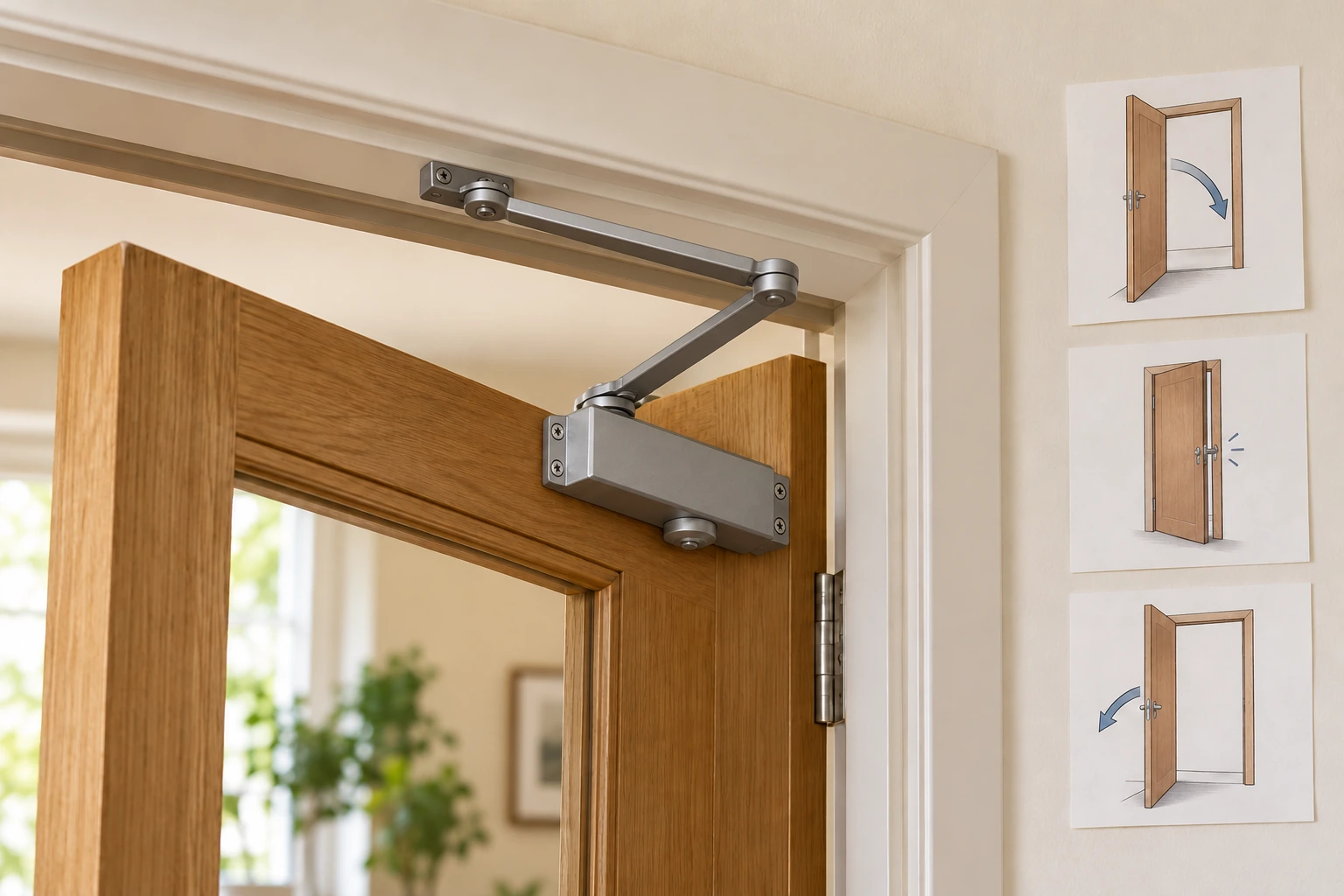
Door closer slamming is a report that needs a little more detail before anyone chooses an adjustment. Was the door opening or closing when the noise occurred? Did it strike the frame, a wall or another object? Describe the event you already noticed. You do not need to reproduce an impact to make a useful repair request, and a loud noise alone cannot identify a failed component.
This guide concerns surface-mounted door closers with an articulated arm. It distinguishes the movement under discussion, identifies the applicable model information and prepares a focused installer or service inquiry. It supplies no universal screw-turn recipe, spring setting or compliance assessment. If the opening cannot be used safely, arrange appropriate assistance rather than conducting another trial while people pass through it.
Identify the closer and the instructions you actually have
The Norton 410XTPNX689 door closer offer describes a standard non-hold-open Series 410 closer. Its gallery shows the covered unit, articulated arm and mounting shoe. Norton's branded catalog separates 410, TPN and 689 as the series, non-hold-open tri-packed arm and finish identifiers. Those details identify the offered arrangement; they do not verify an installation.
The Nuk3y 9000 Series door closer offer shows the body, cover, articulated arm, bracket and installation pieces. Its gallery includes different finishes, so the delivered finish remains a purchase question. The manufacturer's 9000 product page and visibly branded 9000 instruction sheet provide the model-family association used here. No listing or photograph certifies the condition or suitability of your installed closer.
Give the person assessing the door the identity already available to you, such as a retained installation sheet, purchase reference or existing label photograph. A cover that looks similar to a catalog image does not settle the model. If identification would require disturbing hardware, ask how the installer wants to establish it. Keep an uncertain model uncertain instead of attaching another product's directions to it.
Separate opening movement from closing movement
Norton's 410 catalog and Nuk3y's 9000 instructions separately depict opening backcheck, closing sweep and final latching.
In an imagined office, Mara reports a bang while bringing a delivery through a doorway. She initially calls it a closing problem. When describing the occasion, she remembers pushing the door open with the package still in her hands. That recollection changes the question she needs answered: the reported event happened on opening. It does not establish why the noise occurred or which hardware needs attention.
Ask where the door was heading and what it met. A report about contact with a wall is different from contact with the closed frame. If nobody saw the point of contact, retain that gap in the account. Do not turn the loudness of a sound into a measurement of closing force, and do not assume the last person through the doorway caused the problem.
You can use an existing photograph or a normal-use account to explain the route through the opening. Keep the photograph's role modest: it can identify the doorway, nearby objects and visible hardware. It cannot show an unseen impact or establish the condition of a mechanism beneath a cover. Ask for an assessment when the available information leaves those questions open.
Describe the main closing travel and final approach separately
The Nuk3y 9000 sheet labels separate sweep and latching speed controls. It also identifies a spring-power adjustment and an optional delayed-action function. Their presence in the document does not make every function applicable to every supplied variant. Confirm the actual closer and applicable instructions before an adjustment is selected.
A second imagined report concerns a meeting-room door that moves toward the frame and makes its noise at the very end. Mara can explain that sequence without deciding that a latch-speed valve is defective. She should also say whether the door then remained closed, stopped short or moved away again, if she actually saw the outcome. “It was loud” leaves out those separate observations.
If a report instead concerns most of the travel from open toward closed, keep that description in the inquiry. Avoid rewriting it as a final-latch problem merely because the conversation has reached that part of the booklet. An adviser who has the actual model can relate the account to its documented functions. The article provides no setting that can be chosen from a sound recording alone.
Closing and staying latched are also separate outcomes in the report. Someone might be satisfied that a door became quieter while still being unable to confirm that it latched. Record both questions before work begins. A proposed correction should address the problem the building needs resolved, with an appropriate person checking the result, rather than declaring success from the absence of one noise.
Keep a pause or hold-open request separate
Norton's catalog distinguishes standard 410 from the optional delayed-action 410DA, and non-hold-open TPN from hold-open TPH. The selected native title identifies 410XTPNX689. Nuk3y's sheet also marks delayed action optional. A pause or hold-open feature should therefore be confirmed for the actual arrangement, rather than inferred from a familiar cover or an optional diagram.
In another imagined delivery, Mara wants the opening to remain available while several boxes are carried inside. She also wants the door to stop making its reported noise when it closes afterward. These are two requested outcomes. She can explain both to the property manager without deciding which hardware should provide them. A service conversation limited to making the last part quieter might leave the delivery arrangement unanswered.
Describe a remembered pause as accurately as the available account permits. Did someone keep the door in position, or did it remain there after the person moved away? If nobody can answer, leave that detail open. Do not treat a photograph of an open doorway as evidence that a mechanism held it there. The image may show the position clearly while supplying no account of how it reached or maintained it.
Ask the responsible installer to address the intended use of the opening, including any requirement for it to close, before a different holding arrangement is proposed. This article does not recommend a wedge, improvised magnet or substituted arm. Keep a proposed change attached to the particular doorway and its authorized use. The useful distinction is between correcting the reported impact and requesting a different function; a repair estimate should make clear which of those questions it answers.
Keep the safety cautions with the actual model
Nuk3y's 9000 instructions warn that improper installation can cause injury or property damage. They prohibit backing valves out, warn against completely closing the backcheck valve and limit spring-power adjustment. The document says backcheck is not a positive stop. These cautions are reasons to use the applicable installer guidance, not invitations to experiment.
Identify the exact closer and its applicable installation instructions before choosing an adjustment method. The controls, valve positions and permitted adjustments of one model do not establish those of another. If the model or installation arrangement remains uncertain, have the responsible installer resolve that question before settings are changed.
If someone has already changed several settings, tell the installer what is known about that work. An old photograph or written service note may be useful; a guessed reconstruction can mislead the assessment. Do not make more changes merely to recover a remembered position. Ask the responsible person how the installed closer and its current state should be evaluated.
Distinguish the closer from the hardware it works beside
The floor doorstop comes loose guide concerns a floor-mounted base, fastening surface and contact role. It addresses a different component from the overhead closer. A loose floor stop needs its own assessment; this guide does not recommend changing closer settings to compensate for it.
The cabinet door rebounds after hinge replacement guide owns cabinet hinge geometry, replacement fit and contact questions. Its cabinet-specific methods do not become instructions for a surface-mounted door closer. Identify the actual hardware before applying advice from either article.
Suppose Mara's first photograph includes a floor bumper as well as the overhead unit. She should identify which piece appears in each part of the complaint. One person may be reporting an unstable bumper, while another is reporting a closing impact. Both concerns can be real without sharing a cause. Asking for the two issues to be assessed avoids silently treating one replacement as a remedy for the other.
Apply the same discipline to a latch or a nearby obstruction. Report visible contact or an outcome you actually noticed, without assigning blame to the closer. This article does not prescribe bending a strike, moving a mounting point, changing a hinge or altering a door edge. Those choices require an assessment of the actual opening and the hardware concerned.
Decide what the proposed repair is meant to achieve
Before authorizing work, describe the result you need in ordinary terms. You might need an opening that can be used without the reported impact, and confirmation that the door completes its intended closing and latching behavior. Ask the installer which observations it will check and what remains outside the proposed service. A vague promise to make the door lighter or slower may leave the original complaint unanswered.
Consider who normally uses the doorway when discussing that result. A person carrying a package may describe a different difficulty from someone returning through the opening with empty hands. Give those actual accounts to the responsible installer or property manager. This is information about the use of the opening, not a basis for choosing a spring setting or declaring that an accessibility requirement has been met.
Keep any applicable building requirements with the person responsible for the installation. Neither a marketing certification label nor this article establishes that a particular opening complies with them. Ask the qualified provider to identify the relevant requirements and proposed verification. Avoid accepting a change that addresses one complaint while leaving the door's intended safety or access role unexplained.
After authorized work, obtain the provider's account of what it found, what it changed and what result it verified. If a noise remains or the door no longer completes the expected action, report that outcome through the same service reference. Do not repeat the earlier adjustment on the assumption that it merely needs more turns. An unresolved result needs reassessment of the actual work.
Purchasing through Republeq
If the assessment calls for another closer, identify the exact proposed model and supplied arrangement through republeq.com before ordering. Keep the installed unit's problem separate from the new purchase: an attractive offer cannot establish why the existing door behaved as it did. Confirm unresolved variant and supplied-item details with the merchant, and retain the reference used in that exchange. Review the delivery and return conditions applying to your actual order. Choosing a payment method comes after understanding what you intend to buy. If you want to use cryptocurrency, including USDT, check the current checkout for that option rather than treating a general payment label as confirmation that a particular token or network is available. This article supplies no payment address, required amount, exchange rate or promise about processing speed. Follow the merchant's current instructions for the basket you selected and seek clarification when a step is unclear. Do not reuse payment details from an earlier order or somebody else's transaction. If you change the selected product while considering payment, review the displayed order again. Keep the actual order reference and payment response together so an inquiry can identify the transaction concerned. An uncertain outcome needs reconciliation with the merchant before another payment is considered. A transaction confirmation establishes no installation approval or proof that the replacement will remedy the original complaint. Obtain any remaining product and service answers from the relevant current provider before proceeding, and resolve changed payment instructions through the merchant's current support route. If a payment request no longer matches the displayed order, ask the merchant to reconcile that discrepancy before proceeding.
Leave the reported movement clear
Door closer slamming calls for an account of the movement, the actual hardware and the outcome that needs correction. Keep opening, main closing travel and final approach distinct in the service inquiry. Use the instructions for the identified closer, then obtain an appropriate assessment and verified result. Do not substitute a familiar control name or another turn of a screw for an answer about the installed door.