Skills & Planning
Dice set missing a die: check the seven-piece kit first
Two seven-piece dice listings can help identify a set, but neither proves what arrived. Count the pieces you have, check the tray and keep a precise record.
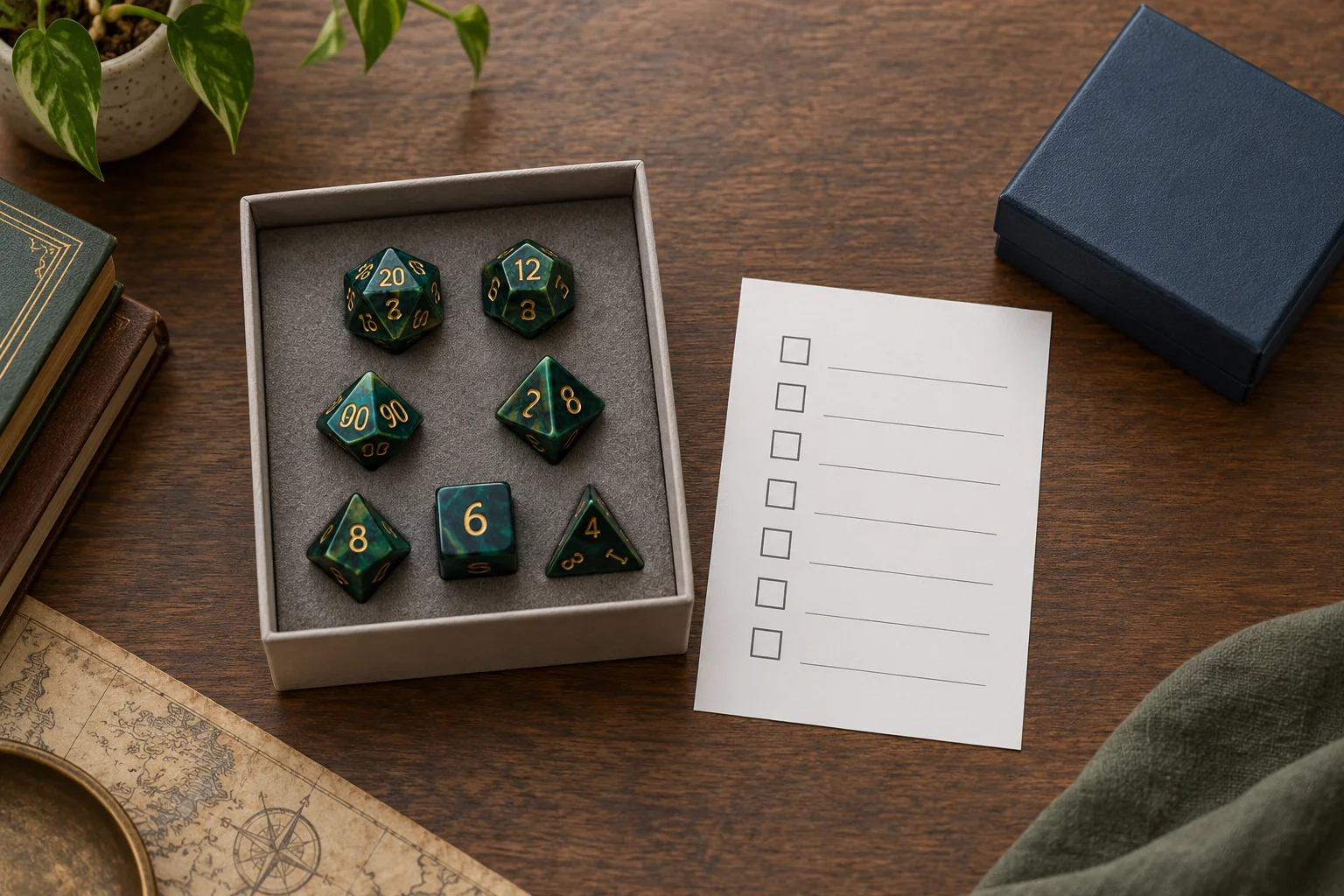
A seven-piece dice set can look incomplete when one shape is hard to recognize or a die has stayed in the package. Before reporting a missing piece, identify the exact set and count what is actually on the table. The Space Voyager seven-piece dice set and the Elvish seven-piece dice set are two separate offers. Each native listing says seven pieces. Their single product photographs show different markings and colors, so a picture of one should not become the inventory guide for the other.
Put the dice you have in one place and leave the retail tray or box nearby. If the set has been used, include the pouch, gaming table and usual storage spot in the search. The first result to write down is a count, not a cause. “Six dice on the table after checking the box” is an observation. It does not say whether the seventh stayed in a pocket, was moved after play, or was absent when the order arrived.
Confirm which seven-piece set you bought
Open the product page from your order or find the SKU on the package. The Space Voyager page describes an AB VINIL Q-Workshop seven-piece set in a multicolor listing. Its retail photograph shows a dark package and seven dark dice with red markings. The Elvish page describes another AB VINIL Q-Workshop seven-piece set. Its photograph shows black dice with pale markings. These details help you keep two similar packages apart. The pictures do not verify the contents of your delivered box.
If a friend sent you a link to the other design, save it as a comparison rather than treating it as the ordered product. A die can look unlike the shape you expected because you remember a photograph from a different set. Write down the URL or SKU that belongs to your purchase, then set the other link aside. This is especially useful when more than one dice set is kept in the same game drawer or carried to a shared table.
Do not infer a material, a durability rating or a performance feature from a themed name. The Elvish listing includes “glow in the dark” in its product phrase, but the saved image alone cannot test how a die looks in darkness or how long any marking lasts. For this inventory check, the relevant claim is the seven-piece count. If you need to evaluate a feature later, use the exact current manufacturer or seller information for that feature.
Count the physical dice once
Clear a small section of table and place each die you find in a row. Move a piece into the row only once. If a die rolls away, mark that movement rather than restarting the count from memory. Count the row aloud or on paper, then count it a second time from the opposite end. A numbered list from one through seven is enough. You do not need to know the name of every polyhedral shape to establish how many separate objects are present.
Keep the tray, box insert and any wrapping on the table until the count is done. Look in each cavity and under loose paper without tearing or damaging the package. The Space Voyager photograph shows dice sitting in a retail window, while the Elvish photograph presents its dice loose against a white background. Those are product images, not records of the packing arrangement in your particular shipment. Check the actual package you received, including parts that the sales picture did not show.
If you find seven pieces, you have settled the basic count. You may still have a different question about a marking or shape. Write that question separately. If you find fewer than seven, list the places checked before naming a missing item. If you find more than seven on a shared table, identify whether any belong to another set before reporting that the seller sent an extra die. A household collection can make a count misleading in either direction.
For a set opened at a game night, ask who put it away and where the dice were last seen. One person may have tucked a die into a bag while another packed the box. Put each answer on the same count sheet with a note about whether it was seen or remembered. A recollection of “all seven were here” is a useful lead, but it cannot substitute for seeing and counting seven today. The point is to make the next search more focused.
Tell a count problem from an identification problem
The selected images show polyhedral dice with different numbers of faces and distinct designs. An unfamiliar shape can be overlooked when you scan for the shape you remember. Instead of calling that shape absent, compare all the physical dice on your table with the exact offer image. Turn each die gently and look at several faces. A number or marking seen on one side may make identification easier, although the photograph may not show every side.
Make two columns: “piece counted” and “piece identified.” A die can be counted even if you do not know its conventional name. If all seven are present but one remains unidentified, your note should say that. If there are six physical dice and a seventh shape is expected from the exact package, your note should say six counted and explain the basis for expecting seven. These records lead to different questions for a seller or another player.
A product photo can be arranged for display. The Space Voyager image shows seven dice in the window and additional large dice in front of the package. Do not count every repeated depiction in the same picture as a separate piece in the offer; the listing text says seven pieces. The Elvish image also shows seven loose dice, some near the image edge. Use the native seven-piece statement and your own delivered count, rather than treating the composition of a photograph as a packing list.
If you already own both designs, keep their dice in separate groups while comparing. The red markings of one set and pale markings of the other may help, but a loose die still needs to be checked against the exact set. Do not assume a die from one design is an approved replacement for the other. The two native pages do not certify matching size, balance, material or marking style. A similar shape is not enough evidence of product compatibility.
Search the places that fit the actual timeline
For a first opening, inspect the retail tray, box corners, wrapping and the surface where you opened it. Photograph the package before discarding any insert. If a delivery box held other purchases, look through that packing material as well. Keep the original order identity in the photograph or in a separate note. An image of six dice on a table is less useful when nobody can tell which product and package it came from.
For a set that has been used, start at the last place you know it was complete. Was it put in a shared game bag, left by a play mat, or moved while clearing a table? Search one location at a time and mark it checked. A note such as “bag side pocket checked; no die found” prevents another searcher from repeating the same step while the tabletop remains unchecked. Stop adding hypothetical places once you have a manageable list of actual locations.
Keep dice away from the edge of the table during the search. A piece that rolls off halfway through can create a second apparent shortage. Put found dice in a shallow dish or lined area, then leave them there until the record is complete. This is a handling method for your own count; the product pages do not promise any particular rolling behavior. If you pause, store the dish and the note together so the next count starts from the same known state.
The holiday dice table guide addresses shared turns and whether another set is needed. It does not establish the contents of your Space Voyager or Elvish package. The two-dice totals guide addresses a counting problem in probability, not an inventory count. If either guide brought you here, return to the exact product page and physical tray for a missing-piece question.
Write a discrepancy another person can verify
If a second physical count still gives fewer than seven, write a short report: exact product name or SKU, order date if known, date the set was opened, number of dice counted, and locations checked. Describe any piece you could not identify without guessing its name. Attach a clear photograph of the dice laid out apart from other sets and one of the package if you have it. Keep the unedited original photographs. They can help explain what you observed at the time.
For a newly delivered set, distinguish “not in the opened box after these checks” from “lost after play.” For a used set, say when you last remember seeing all seven and what has happened since. Neither statement has to assign blame. The two saved native listings do not show the condition of your particular order, and their general seven-piece descriptions cannot tell where a loose die went. Precise uncertainty makes a question easier to answer.
Ask the seller about the exact order and the part you believe may be absent. Include the listing URL rather than only the design name if the title is generic. The native pages used for this guide do not establish a return period, replacement entitlement or warranty outcome. Those depend on your order and the seller's current policy. Do not promise yourself a replacement based on a product photograph or on another buyer's account.
A loose replacement die should wait until the discrepancy is clear. Even within seven-piece polyhedral sets, visible design can differ, and these two pages do not verify cross-set fit or matching performance. If you later decide to buy a substitute, compare the dimensions, markings and intended use from a reliable current source. For now, a careful count and exact product identity give you a sounder starting point than an impulse purchase.
Keep the result with the set
When the search is finished, return each die to its own package or a labeled storage container. Put the count sheet with it. If the seventh die turns up later, add the date and location to the same record rather than erasing the earlier observation. You will know that the original count was accurate for that moment and that the location changed. If no die turns up, the record remains a clear account of what was checked.
The two Q-Workshop listings both make a seven-piece claim, but they are different designs and separate orders. Keep that distinction all the way through the search. Count what you actually hold, use the exact product page to explain what you expected, and leave unknowns as unknowns. The result may be a found die, an identification question, or a specific shortage to raise with the seller. Each outcome is more useful than calling a set incomplete before checking it.