Skills & Planning
Two dice totals: count ordered pairs before probabilities
Two dice totals follow unequal pair counts in an idealized independent uniform model. Count thirty-six ordered outcomes before assigning probabilities.
Count outcomes before counting totals
Two dice totals do not have equal probabilities merely because the totals are different numbers. In the idealized model developed here, the two dice are distinguishable as A and B. Each independently takes a value from one through six, with each value having probability one sixth. Those are declared mathematical assumptions. They are not findings about any physical dice. Under them, thirty-six ordered pairs have equal weight, and those pairs map unevenly onto the possible sums. Seven has six pairs behind it; two has only one.
The useful question is what you are treating as an outcome. A pair preserves both A's value and B's value. A total keeps their sum while discarding which die supplied which part. Several pairs can therefore share a total. Start with the full pair before assigning probabilities to the shorter sum label. This article constructs that account on paper, without rolling products, certifying fairness, predicting a fixed quota in a short trial or supplying rules for a particular commercial game.
Keep the physical examples separate from the model
The green Koplow dice offer identifies KOP01818 as a bulk pack of two hundred green opaque dice with white pips. The description calls them six-sided, square-cornered and twelve millimetres in size. Its sole gallery shows many complete green cube dice. These are source disclosures and appearance observations, without a physical measurement or test here. Neither a familiar pip pattern nor the stated side count establishes the equal probabilities or independence assumed in the mathematical example.
The white Koplow dice offer identifies model 01822 and a bulk pack of two hundred opaque white dice with black pips. Its description also names six sides, square corners and twelve-millimetre size, while the sole gallery shows the complete white dice. This is a separate offered package, not a tested partner for the first one. The article certifies no randomness, balance, readability or actual roll distribution for either offer. The following A and B remain idealized mathematical objects with explicitly assigned values and probabilities.
Give A and B separate positions
Write a pair in the order A, then B. The pair one, six means A has one and B has six. Six, one means A has six and B has one. Both sums are seven, but the ordered pairs differ because the values occupy different named positions. Addition gives the same total when its two parts exchange places; that does not erase the positions from an outcome that was defined to retain them. Keep the definition of the recorded object consistent while doing the count.
You can distinguish A and B with letters on paper, without needing particular product colors. Their order is a feature of this model. If you erase the letters and keep only the total, you have chosen a different description of the same modeled event. That shorter description can be useful, but its probabilities must come from the pairs mapped into it. It cannot inherit equal weight simply because its labels fit neatly into a list. The distinction is the foundation of the calculation, rather than an extra rule added after the answer is known.
Build the six-by-six paper grid
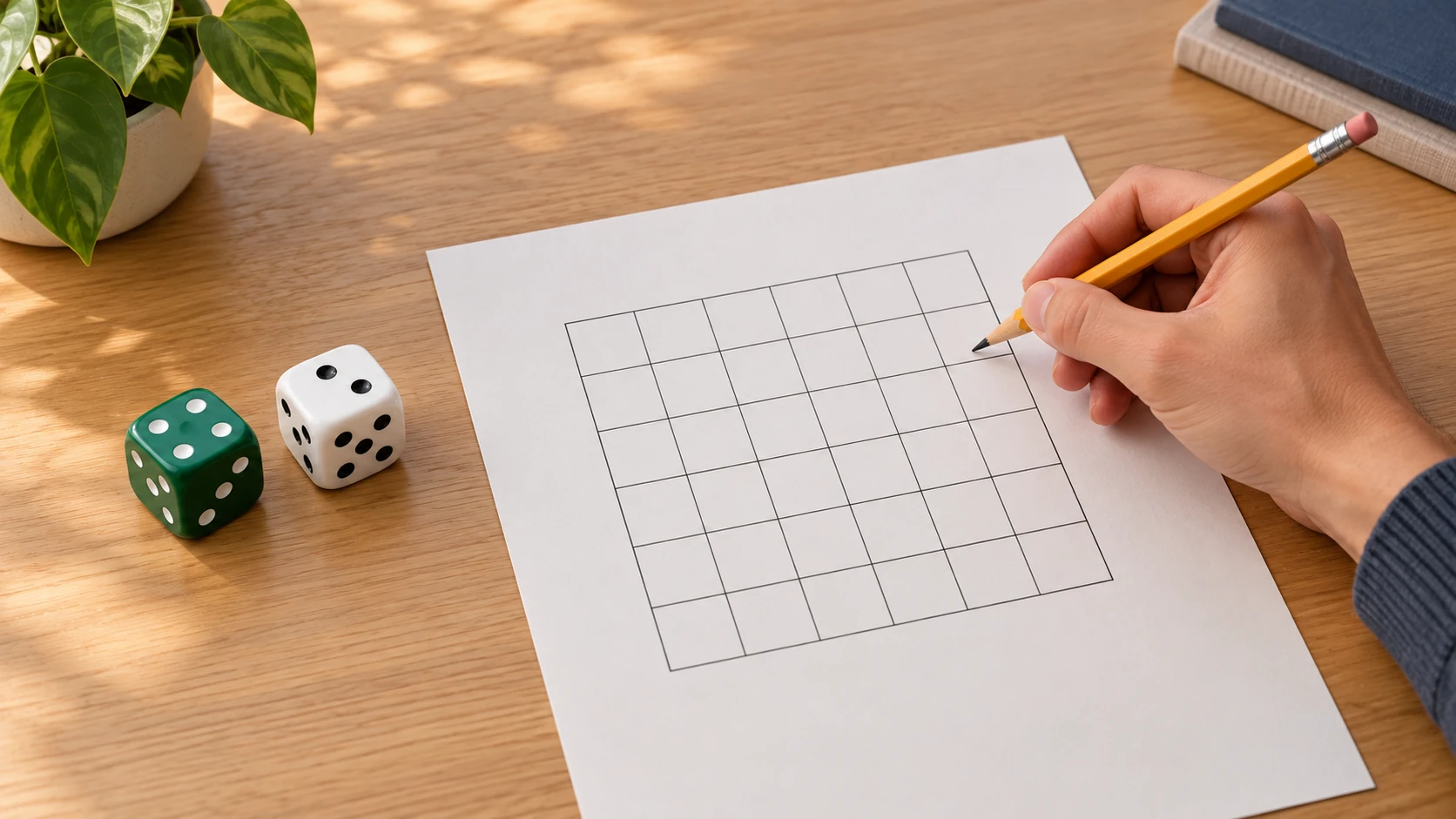
Draw six rows for A's values and six columns for B's values. Label each from one through six. Each cell identifies exactly one ordered pair: its row gives A and its column gives B. With A fixed at one, B still has six possible values. The same is true for each of A's other five rows. Six rows with six cells each give thirty-six cells. No pair has been omitted and no pair has been placed in two different cells under these labels.
The assumption of independent uniform values gives each cell probability one sixth multiplied by one sixth, or one thirty-sixth. Independence matters to that statement. Knowing A's value does not change B's assigned probabilities in this declared model. The equal cell weights are not a consequence of drawing a tidy grid; they follow from the assumptions stated at the beginning. If those assumptions were different, a grid could still list pairs, but counting its cells alone would not necessarily assign their correct probabilities.
Put a sum into each cell
In A's first row, add one to B's values one through six. The row's totals are two, three, four, five, six and seven. In A's second row, the totals are three through eight. Continue the same addition across every row. For example, A equal to four gives totals five, six, seven, eight, nine and ten as B goes from one through six. The total belongs inside the cell without replacing the row and column labels that identify the pair.
Notice what the filled grid now contains: thirty-six cells and only eleven different sum labels, from two through twelve. A list of eleven possible labels is not a list of eleven equally weighted outcomes. Each label may occupy a different number of equal-weight cells. The count you need is how many cells carry the selected sum. This is why dividing one by eleven would answer an assumption the model never made. Equal weight was assigned to the ordered pairs, not directly to the totals.
Find every way to make seven
The pairs for seven are one and six, two and five, three and four, four and three, five and two, and six and one, always preserving A's position first. There are six cells. Under the equal-weight pair model, their combined probability is six thirty-sixths, which simplifies to one sixth. The six entries are separate possibilities, not six turns that must occur or six physical dice that must be purchased. They form the complete set of modeled pairs whose two values add to seven.
For a total of two, only one and one works. Its probability is therefore one thirty-sixth. Twelve likewise has only six and six. Seven has six times the probability of two in this model because six equal-weight pairs map to seven and one maps to two. That is a comparison of defined events, not a promise that the next few observations of physical objects will display a particular ratio. Keep the model result and an actual observation record as different kinds of information.
Check a total containing a double
For six, list one and five, two and four, three and three, four and two, and five and one. There are five ordered pairs, giving probability five thirty-sixths. The double three and three contributes one cell. It should not be counted twice merely because the other pairs come in reversed forms. Reversing three and three leaves the same ordered pair, whereas reversing one and five produces five and one. Checking this distinction helps prevent an accidental extra outcome in the count.
If you decide to write reversed non-double pairs on one line to save space, keep their weight visible. A line reading “one and five, or five and one” represents two cells. A line reading “three and three” represents one. Shortening the notation is allowed, but it does not make every written line equally likely. You can always return to the complete A-row and B-column grid to check which actual modeled cells a shorthand entry represents.
Read the whole distribution as a check
For totals two through twelve in increasing order, the cell counts are one, two, three, four, five, six, five, four, three, two and one. Together they add to thirty-six, accounting for the full grid. Divide each count by thirty-six to obtain its probability under the declared equal weights. The largest count belongs to seven, but its probability is still only one sixth. “Most likely individual total” does not mean certain, required on the next event or more likely than every other total combined.
There is a useful symmetry check in the model. Replace each value with seven minus that value. A pair totaling two becomes a pair totaling twelve; a total of three corresponds to eleven, and four to ten. This one-to-one pairing preserves the number of cells on each side of seven. It explains the matching counts without a physical roll experiment. The check belongs to the numbers one through six and the declared pair construction, not to a claim about manufacturing symmetry in an actual die.
A different event can have the same probability
Consider doubles as a separate event. Its pairs are one and one through six and six, giving six cells and probability one sixth. That equals the probability of total seven, but the events are different. No double in this model totals seven, because adding a value to itself gives an even total. Equal probabilities do not make event descriptions interchangeable. A question asking for doubles cannot be answered by selecting the six cells whose sum is seven.
Similarly, the event “a total of at least ten” contains three cells for ten, two for eleven and one for twelve. Its six cells also give probability one sixth. Here the event groups several total labels. Their probabilities add because these different sums identify separate cells. The example shows why the wording of the question matters: one selected sum, a matching-face condition and a range of sums can each describe different collections within the same complete set of ordered pairs.
Keep existing game and arithmetic guides in their contexts
The Christmas dice gift exchange guide uses one readable die to choose actions in its own proposed four-person round. Its passing and optional swapping rules do not apply to this two-object probability model. A face can have a particular role in that game without defining a sum event here. Keep the agreed activity and its actual components separate from the idealized assumptions used for this paper calculation. This article assigns no gift movement, scoring result or additional turn.
The abacus equal groups guide defines another original arithmetic convention for repeated groups and division. Its physical bead requirements and group labels do not supply evidence that real dice are uniform or independent. Here, the rows are six modeled values of A and the columns are six modeled values of B. The full thirty-six-cell construction is its own declared account. Both exercises benefit from preserving what is being counted, while neither establishes the other's physical equipment requirements or a learner's actual result.
A model probability is not an observed quota
The model allows the same pair to occur again; it does not require every pair to appear once before any can repeat. A run of thirty-six events therefore need not contain each pair exactly once or match every sum count in the grid. The grid enumerates possible equal-weight outcomes, rather than laying out a required schedule. This article conducts no physical trial, estimates no uncertainty from observed data and supplies no procedure for testing actual dice. Do not describe a mathematical enumeration as an experiment that has verified a product.
Keep a possible order separate from the calculation
If a current checkout offers USDT, review the actual product selection and order terms before choosing a payment method. This article makes no promise that either linked package currently provides that option. A payment label cannot establish uniformity, independence or a particular probability distribution for physical dice. The paper grid needs no new purchase, and its thirty-six cells do not describe a required package quantity. If you investigate an offer, confirm the exact model, variant and supplied contents through the actual product information. Retain any order reference with the selected offer and the applicable delivery, cancellation, return and refund conditions. A successful transaction would concern that order; it would not turn the idealized assumptions into measured product facts. This explanation supplies no transfer address, network recommendation, exchange-rate forecast, fee estimate, wallet advice or promise of financial recourse. Never provide wallet secrets or recovery phrases in an equipment enquiry. If an earlier payment result is uncertain, reconcile its actual state through the responsible service before considering another attempt. Changing colors, package sizes or payment methods does not resolve the state of a prior transaction. If another person is helping, distinguish a request for product information from authorization to buy. A correct arithmetic answer is neither instruction. The mathematical model, an actual equipment choice and a real payment each need their own clear basis. Leave an unresolved purchase term visible rather than treating the finished grid as confirmation that an order should proceed. No actual roll, transaction or delivery is reported by this example, and no choice of payment method can provide a missing observation about how a physical die behaves.
Return to the outcome you defined
Two dice totals become understandable when the ordered pairs stay visible behind them. Under the explicit independent uniform one-through-six model, thirty-six equal-weight pairs map unevenly onto eleven sums. Count the cells for the event you actually mean, preserve the distinction between a reversed pair and a double, and keep probability separate from an observed quota. The result is a complete original mathematical explanation, with no claim that a retail package has been tested or that a particular future sequence must occur.