Skills & Planning
Diagonal list argument: no full list of infinite binary sequences
An original four-position binary example introduces the diagonal complement. An arbitrary-list proof supplies the infinite conclusion, with finite words kept in a separate domain.
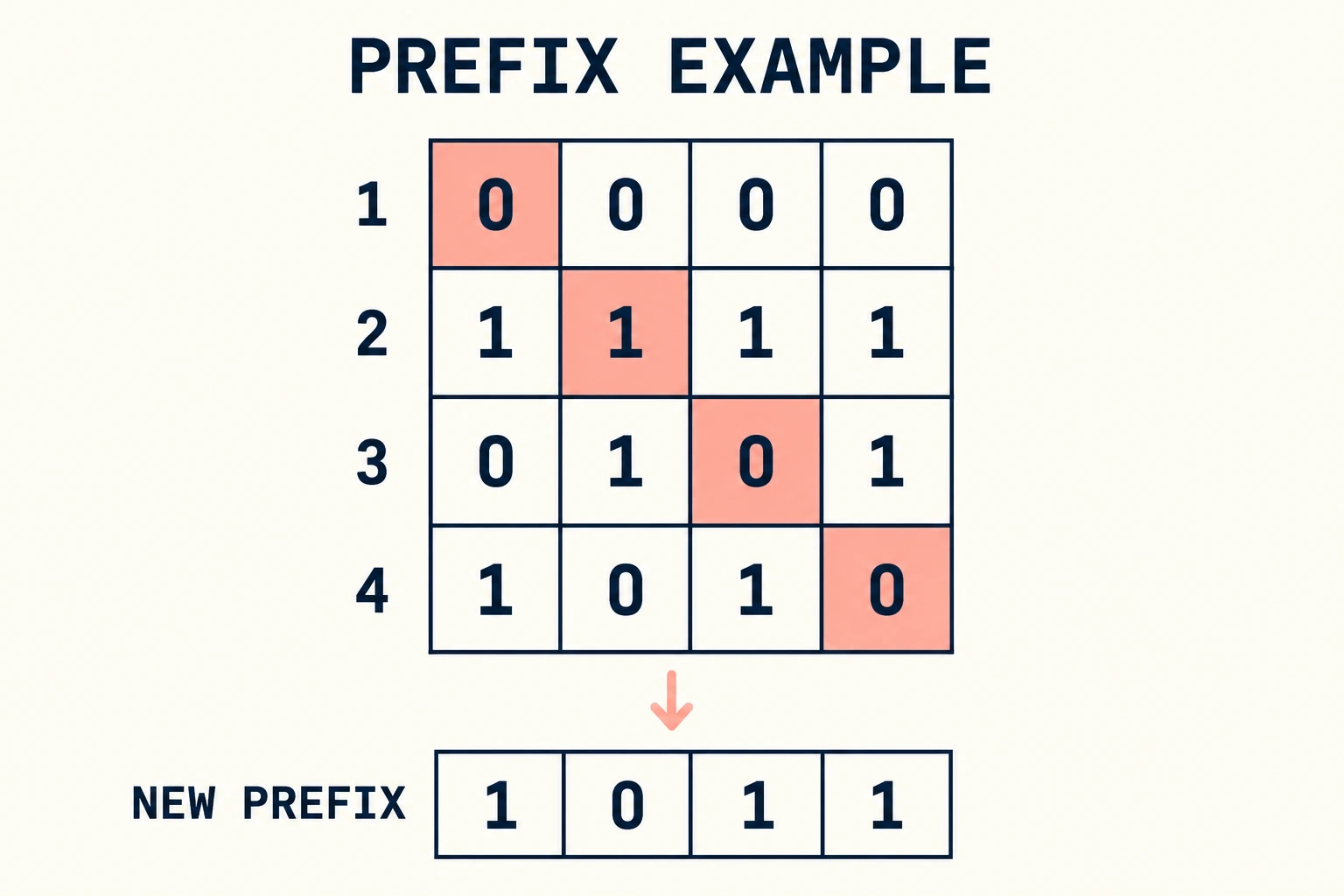
Define the objects before discussing the list
A Diagonal list argument can show why no numbered list covers all infinite binary sequences. Here, a binary sequence has one bit, either zero or one, at every positive integer position. It never stops. The objects are strings of bits, not decimal numbers, random outcomes or readings from a device. A finite group of displayed prefixes will illustrate the construction, while the full conclusion needs a separate arbitrary-list proof.
A numbered list in this explanation has row one, row two, row three and so on, indexed by the positive integers. Every row is an infinite binary sequence. The proposed list may contain duplicate rows. Calling it complete would mean that every infinite binary sequence appears somewhere in it. The argument below finds a sequence that does not appear, whatever proposed list you begin with.
Keep the optional workspace accounts bounded
The optional Mind Reader mesh organizer account names four trays, one drawer, a file section and two pen cups. Its sole image shows a complete black mesh unit with stationery illustrating use. Those pictured objects are not verified supplied stocks, and this article tests no load, material, usable storage capacity or organization-performance claim.
The optional Craig Frames 220030 account describes a gray barnwood appearance on MDF, explicitly not actual barnwood. It names a twelve-by-thirty-six-inch print size and facing, backing and hanging hardware. Its sole image shows a gray frame and Craig Frames card. No actual size, print fit, mounting result or delivered inventory is independently authenticated here.
Neither account supplies the infinite sequences or demonstrates an actual storage-capacity limit. Their optional workspace context supplies no mathematical input. You can complete the proof without buying either offer.
Start with a four-position illustration
Write four sample prefixes in four rows: row one is 0000, row two is 1111, row three is 0101, and row four is 1010. Each prefix specifies only four positions. The bits beyond those positions remain unspecified in this illustration. In particular, four printed zeros do not tell you that every later bit in that row must also be zero.
Read the first position of row one, the second of row two, the third of row three and the fourth of row four. These diagonal bits are zero, one, zero and zero. The row number and position number match at each step. Keep that matching rule visible instead of choosing a convenient bit from some other place in the row.
Flip each selected bit: zero becomes one, and one becomes zero. The four resulting bits form the new prefix 1011. It differs from row one at position one, from row two at position two, from row three at position three and from row four at position four. Each comparison has its own named position where agreement fails.
For example, the new prefix and the fourth shown prefix agree in their first three positions: both begin 101. Their fourth bits differ, with one in the new prefix and zero in row four. Earlier agreement does not erase that difference. Two complete sequences can be unequal because of one differing position even if many other positions agree.
State what the finite example does not establish
The prefix 1011 is missing from the four displayed four-position prefixes. That conclusion is finite. A fifth displayed row could begin 1011, and the four-position check would not exclude it. Nor have you specified the rest of a new infinite sequence merely by writing four bits. Keep both limits beside the illustration before claiming a result about every numbered row.
Adding another row to the drawing is not the full proof either. You could extend the example and check one more diagonal position, but any finished finite drawing would still display only finitely many positions. The general argument must explain how a bit is defined at every positive integer position and why that rule addresses any row number, rather than only those printed on the page.
Let the proposed list be arbitrary
Now suppose someone proposes a numbered list of infinite binary sequences. Do not assume that its rows repeat the four sample prefixes or follow another convenient pattern. Let row n mean whichever infinite sequence the proposal actually puts at position n. Its nth bit exists because each row belongs to the stated infinite-sequence domain.
Define a new sequence D one bit at a time by a rule covering every positive integer n: D’s nth bit is the opposite of the nth bit in row n. If that row bit is zero, use one; if it is one, use zero. Each defined bit is still binary. Because the rule applies to every positive integer position, D is an infinite binary sequence of the required kind.
This definition is mathematical. It does not claim that a person or machine has finished writing infinitely many bits, or that every proposed list comes with a practical method for calculating its entries. The conclusion concerns what sequences a numbered list can contain under the given definitions. Physical memory, writing speed and the space available on a desk do not supply the reason for it.
Compare the new sequence with any chosen row
Choose any positive integer k. At position k, D has the opposite bit from row k by its defining rule. D therefore differs from row k at that position and cannot be the same infinite sequence. There is no need to inspect every other position in the two sequences once that particular difference has been established.
The choice of k was arbitrary. It could name the first row, the millionth row or any other positive integer row number. The same matching-position reason applies in each case. Thus D is absent from every row of this proposed list, even though D belongs to the collection that the list was supposed to cover. The proposal is not complete.
Duplicate rows do not repair that failure. They may put one sequence at several different row numbers, but D still differs from the sequence at row k in position k for every k. A complete list was allowed to repeat entries, so the argument does not depend on first proving that the proposed rows are all different.
Keep the order of the claim clear
The missing sequence is constructed from the proposed list you chose. Changing that list can change D. The conclusion is that each proposed list has a missing sequence of its own, rather than that one fixed sequence is missing from every possible list. Any particular infinite binary sequence could be placed in the first row of some list; that fact does not make the list complete.
Likewise, the claim is not that every infinite collection resists a numbered list. The positive integers themselves already have the familiar list one, two, three and so on. The particular collection at issue contains all infinite binary sequences. Keep that domain attached to the result instead of treating the word infinite alone as the premise that rules out enumeration.
Contrast the finite binary words
Finite binary words belong to a different collection. A word has some finite length, which may be zero. You can list them by increasing length, and within each length place zero before one in ordinary lexicographic order. Begin with the empty word, then 0 and 1, then 00, 01, 10 and 11. Continue with the eight words of length three.
Every fixed length m has finitely many words: each of its m positions has two choices, giving two to the power m possibilities. Before that block come only the finitely many shorter-length blocks. Any particular finite word therefore appears after finitely many earlier entries. This provides a numbered list covering every finite binary word, with no claim about the time needed to print them all.
For a concrete position check, number the empty word as row one. The words of length one occupy rows two and three, and those of length two occupy rows four through seven. Length three begins at row eight with 000. Its next entries are 001, 010, 011, 100 and 101, so the word 101 appears at row thirteen.
The earlier diagonal rule cannot be transferred unchanged to this list. Its first row, the empty word, has no first bit to flip. More generally, a finite word need not have a bit at the position named by its row number. The proof about infinite sequences relied on those matching positions existing. Here that premise is absent, so the successful finite-word enumeration creates no contradiction.
Keep nearby infinite patterns and lists distinct
The related repeating-decimal explanation begins with an explicitly stipulated repeating tail before aligning and subtracting it. The four prefixes here specify no repeating tails, and binary strings are not being treated as decimal numbers. Keep the objects and assumptions separate rather than borrowing an unseen continuation from the earlier arithmetic example.
The related recurring-slot compatibility explanation describes eligible integer positions through a repeating pattern and an explicit family. An infinite family can have a numbered enumeration. The diagonal conclusion here instead concerns the collection of all infinite binary sequences, with one differing coordinate excluding each proposed row.
Keep a separate purchasing enquiry conditional
If you separately consider an organizer or frame order on republeq.com, ask the seller which payment methods apply to that exact order before making any transfer. If cryptocurrency is offered, ask whether USDT is accepted and which network, amount, recipient address and confirmation requirements apply. A familiar token name alone does not answer those questions. Obtain the relevant instructions through a channel you have independently checked, then compare the instructions with the order you intend to place. Ask how any shipping charge, tax, conversion, refund or cancellation would be handled before agreeing to proceed. If a payment provider is involved, ask which party is responsible for confirming receipt and which record you should retain. These are questions to resolve, rather than statements that a particular option exists for either offer. Do not infer a transfer destination from a product photograph or from a prefix in the paper example. Resolve material product and package questions separately from the payment discussion. Information about one package does not automatically describe another quantity or account, and a changed order may require reviewing the resulting terms again. Keep the agreed terms, the order identity and any instructions together so that you can check what you were actually asked to authorize. If the instructions remain unclear or contradictory, stop and obtain clarification rather than filling in the missing details yourself. You can finish the paper proof without placing an order. The argument cannot authenticate payment instructions, establish a checkout method or verify supplied stock. Treat the binary construction as a mathematical definition, with no bearing on whether a proposed purchase or transfer is appropriate for you.
Retain the arbitrary row beside the illustration
Keep the four-position example and the arbitrary-list proof as separate parts of the explanation. The prefix 1011 illustrates four matching-position differences. The full definition of D supplies a bit for every positive integer position and excludes every proposed row at its own index. That is the Diagonal list argument for infinite binary sequences, while finite words and actual workspace objects retain their different questions.