Educational & Explainer Articles
Comparing density and mass using three imagined blocks
Three imaginary blocks show why the greatest assigned mass need not produce the greatest density, with worked ratios and a change of units.
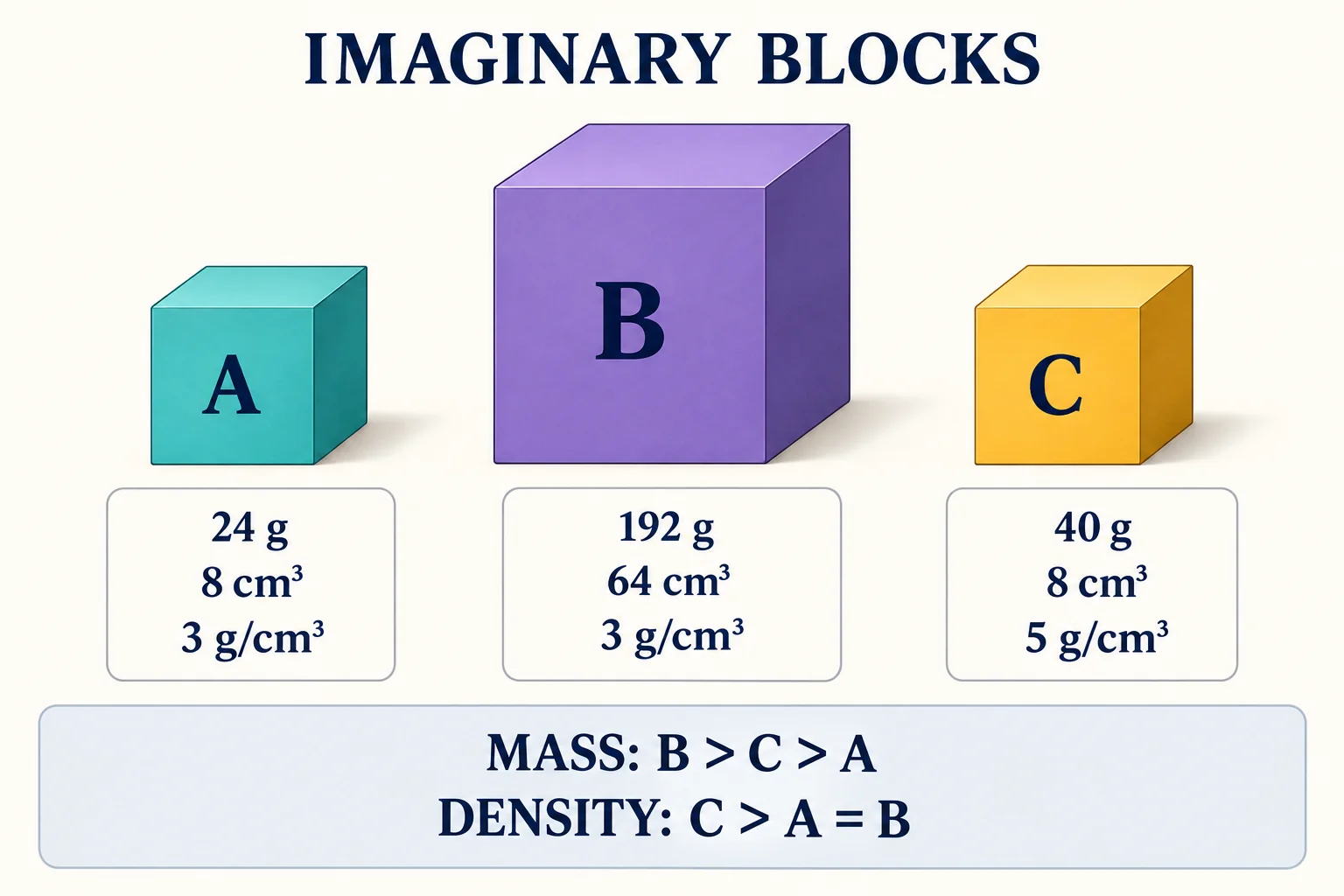
The difference between density and mass becomes clear when the heaviest block loses a density comparison. Consider three imaginary blocks with assigned masses and volumes. One has much more mass than the others, yet another has the greater mass for each cubic centimetre. Following both quantities explains how those statements can be true together.
This is a numerical explanation. Every block value below is invented, and none describes a measurement of the retail specimens discussed later. You can follow the argument from the supplied numbers without obtaining, handling or testing a cube.
Read density as a ratio
OpenStax's Chemistry section on measurements defines density as a sample's mass divided by its volume. It gives kilograms per cubic metre as the SI unit and also discusses grams per cubic centimetre. Its cube example calculates volume by multiplying the edge length by itself three times. These definitions supply the relationship used here; the following numbers belong to our fictional example.
Reading density as a ratio means keeping the denominator with the mass. A statement of 24 grams answers a different question from 24 grams divided by 8 cubic centimetres. The first number can occupy a mass column. The second calculation produces 3 grams per cubic centimetre, with the volume unit still present in the answer.
Begin with two equal volumes
Assign block A a volume of 8 cubic centimetres and a mass of 24 grams. Assign block C the same volume, 8 cubic centimetres, and a mass of 40 grams. The letters identify entries in this example, without naming a material. Write the volume alongside each mass before comparing the entries.
For A, 24 divided by 8 equals 3. For C, 40 divided by 8 equals 5. Their assigned densities are therefore 3 and 5 grams per cubic centimetre. With equal denominators, the larger numerator produces the larger ratio. C has both the greater mass and the greater density in this particular pair.
The equal-volume condition matters to that comparison. If someone copies only the two masses, the reason that the ordering also works for density disappears from the record. Preserve the 8-cubic-centimetre entry on both lines. It lets another reader see exactly which condition makes the short comparison valid.
Add a larger block with its own assigned mass
Give A an ideal geometric shape with an edge length of 2 centimetres. Its calculated volume is 2 times 2 times 2, or 8 cubic centimetres. Now define block B as an ideal cube with a 4-centimetre edge. Its volume is 4 times 4 times 4, or 64 cubic centimetres. These exact dimensions define the drawings in our example; they are not measured tolerances for a supplied specimen.
B's edge is twice A's edge, while its volume is eight times A's volume. The multiplication involves all three edge factors. Doubling just one factor in A's calculation would give 16 cubic centimetres and describe a different set of dimensions. Doubling each factor gives 64.
Assign B a mass of 192 grams. Dividing 192 by 64 gives 3 grams per cubic centimetre. This mass was chosen for the example. No statement about a real material changing size is needed to obtain the answer: both numbers have already been supplied.
A and B consequently have equal calculated densities, although B's assigned mass is eight times A's. Their volumes also differ by a factor of eight. In the division, multiplying both numerator and denominator by eight leaves the ratio unchanged: 192 divided by 64 gives the same result as 24 divided by 8.
Compare the two orderings
The mass ordering is B, then C, then A: 192 grams, 40 grams and 24 grams. The density ordering puts C first at 5 grams per cubic centimetre, with A and B tied at 3. B is the heaviest entry and C is the densest entry. Each answer follows from a different column.
Compare B and C directly. B has 4.8 times C's mass because 192 divided by 40 equals 4.8. B has eight times C's volume because 64 divided by 8 equals eight. Its mass advantage is smaller than its volume advantage, so its mass-per-volume ratio is smaller. The numerical density comparison remains 3 against 5.
A phrase such as “the larger one” would be awkward here. B is larger in the assigned edge length, volume and mass, while C has the larger calculated density. State which quantity you mean. A reader should be able to locate the supporting number without deciding what an unqualified adjective was intended to describe.
Follow a change of units through the whole fraction
OpenStax identifies a centimetre as one hundredth of a metre and a gram as one thousandth of a kilogram. Converting the volume involves cubing the length factor: 0.01 times 0.01 times 0.01 equals 0.000001. One cubic centimetre is therefore one millionth of a cubic metre. That cubic factor differs from the factor used for the mass unit.
Rewrite A's assigned mass as 0.024 kilogram and its volume as 0.000008 cubic metre. Dividing 0.024 by 0.000008 gives 3000 kilograms per cubic metre. The earlier expression was 3 grams per cubic centimetre. Both calculations describe A's original assigned pair, expressed with different units. The change from 3 to 3000 accompanies the change in the unit attached to the density.
Reading “3000” beside “5” without their units would therefore make a poor comparison. Here the 3000 belongs to A in kilograms per cubic metre, while the 5 belongs to C in grams per cubic centimetre. Expressing C in the first unit gives 5000 kilograms per cubic metre. C still has the greater density. Changing the written units has preserved the ordering obtained from the original pairs.
You can also read A's fraction as 3 divided by 1, with grams in the numerator and cubic centimetres in the denominator. Multiplying both numbers by eight returns 24 divided by 8. Multiplying both by sixty-four gives B's 192 divided by 64. These are equivalent numerical ratios. Reducing a written fraction to a denominator of one does not introduce a newly measured one-cubic-centimetre piece of either block. All the physical information assigned to this exercise remains in the original definitions of A, B and C.
Use the same entries to check a missing value
Suppose a second copy of C's line retains its mass of 40 grams and density of 5 grams per cubic centimetre but loses the volume entry. Dividing 40 by 5 recovers 8 cubic centimetres. Multiplying the recovered volume by the density returns 40 grams. Both operations concern the invented line.
Now imagine that C's line retains only “40 grams.” Its volume remains unknown, so the density cannot be calculated from that line alone. Choosing A's volume because both entries appear on the same page would add information the damaged copy no longer supplies. Return to the original definition of C to restore the missing entry.
The units also reveal which division has been written. For A, volume divided by mass would be 8 divided by 24, or one third of a cubic centimetre per gram. That reciprocal quantity has the units in the opposite order. It is not the 3 grams per cubic centimetre obtained from mass divided by volume.
Keep checking density calculations tied to the defined blocks
When checking density calculations, use each complete mass-and-volume pair. Matching 24 grams from A with 64 cubic centimetres from B would give 0.375 grams per cubic centimetre. The arithmetic would be valid for those chosen numbers, but the resulting pair belongs to none of our defined blocks.
The recipe quantity worksheet keeps an original amount beside its calculation. Here, the comparable bookkeeping task is preserving each block's paired entries. The recipe guide supplies no density values or specimen instructions.
A calculated result also depends on the supplied inputs. The caliper reference explanation distinguishes a zero indication from wider accuracy evidence. Our exact fictional dimensions provide numbers for arithmetic; they establish no caliper result or tolerance for a purchased cube.
Read the two specimen offers separately
The GSC International density cube set has a product title identifying its educational purpose. Its description gives general shipping and support language, without a specimen count, dimension list or material inventory. The photograph shows nine cube forms. Appearance alone does not establish the complete supplied contents or identify each material.
The Carolina Biological Supply Company set explicitly lists ten nominal one-inch cubes and instructions. It names aluminum, steel, copper, brass, nylon, acrylic, pine, poplar, oak and PVC. Those are the stated contents of that offer. The description supplies no measured mass or density for an individual cube.
Keep A, B and C in the numerical example. Assigning their values to a photographed specimen would turn a fictional definition into an unsupported product claim. An actual instructional activity needs the applicable specimen information and instructions; this explanation provides no testing or handling sequence.
Consider an order after choosing the teaching material
A lesson plan can help you explain what you want to order. If you are considering the cubes on republeq.com and would prefer to pay with crypto such as USDT, put that preference beside the purchasing question instead of allowing it to settle the choice of teaching material. Identify the offer you intend to buy and the information you still need about its contents. Someone approving the purchase should be able to distinguish that enquiry from the imaginary blocks used in your lesson. When you reach checkout, examine the payment choices presented for that particular order. A reference to USDT in an educational article cannot confirm that the checkout you encounter will offer it. If the method you prefer appears, read the associated instructions and resolve unclear requirements through the actual ordering process before authorizing payment. This discussion provides no destination address, wallet procedure or choice of network. You might also be purchasing for another person who will receive the materials. Agree who will check the order description and retain the confirmation, so the recipient can identify what was requested. Review delivery information against the intended lesson date and read the return conditions that apply to the purchase. Neither a proposed date on your calendar nor a preferred payment method establishes the conditions of a transaction. Leave room to choose another teaching arrangement if an unanswered order question prevents a decision. The numerical explanation remains available while you make that choice. Save any supplier answer with the offer it actually identifies. If the proposed contents change, review that new proposal before carrying an earlier purchasing decision across to it. A payment confirmation would record a transaction; it would add no measured values to the fictional blocks.
For this example, B has the greatest assigned mass and C the greatest assigned density. A and B share the same ratio because their stated masses and volumes increase together by the same factor. Reading density and mass with those paired quantities lets you explain every position in both orderings, while leaving the retail specimens' unmeasured properties open.