Crypto Commerce
Dag WA7-D body camera vs Momo DMT204 for patrol video records
Compare Dag WA7-D body camera by field of view, clip position, recording controls, battery claims, weather ratings, night capture, and file review.
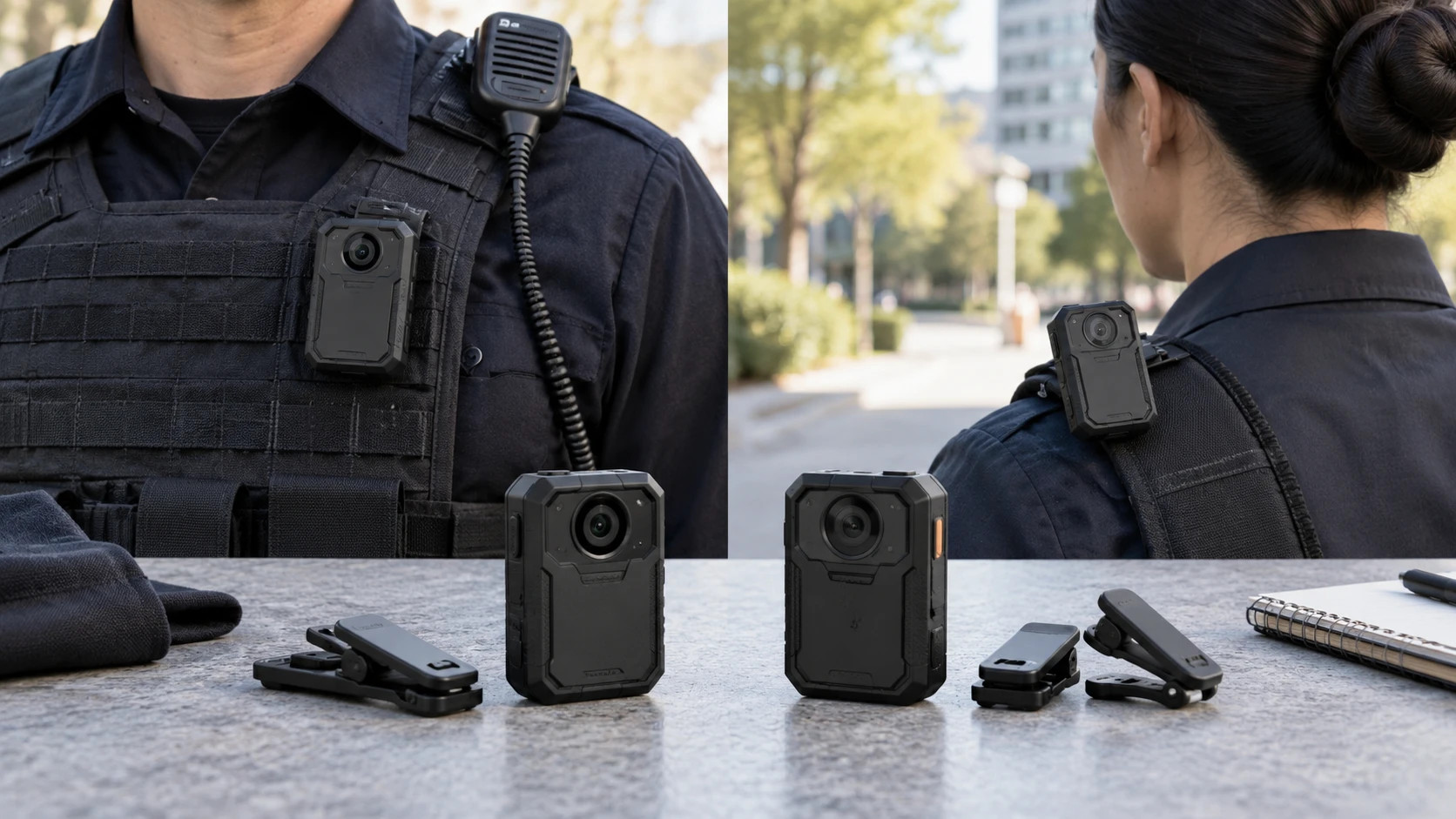
Two cameras can both have 64GB of built-in storage and still record a different view of the same event. The Dag WA7-D body camera listing names 1296p capture, a 170-degree field of view, remote control, and a battery claim above nine hours. Momo's DMT204 listing names a 126-degree lens, one-button operation, two clip styles, and about eight hours at 1080p with the screen off. A buyer should first decide where the camera will be worn and what must be visible in the resulting file.
Body-worn video is affected by clothing, stance, and work routine. A camera on a chest pocket may face a wall when the wearer turns to speak, while a shoulder mount can be blocked by a raised arm. Try the actual uniform or work clothes and walk through representative movements. The saved descriptions give lens angles, but neither provides a standardized example of what remains legible at the edges of a recording. A wider frame can show more surroundings without necessarily making a distant detail clearer.
Test the view from the real mounting point — body camera viewpoint checks
Dag states a 170-degree field of view. That is broad enough to make framing a central question: check whether people near the side of the scene remain recognizable and whether the center preserves the detail needed for the task. The source says 1296p but does not give pixel dimensions, frame rate, or lens-distortion measurements. Request current sample files from the exact model, then make a short test at the planned mounting height. Read a sign or other fixed detail at several distances rather than judging a wide-angle number alone.
Momo gives a 126-degree lens and physical dimensions of 79 by 57 by 26 millimeters. It supplies a 180-degree long clip and a 360-degree rotating clip for a shoulder strap, polo shirt, or belt; the listing also describes in-vehicle use. Try each mount with the clothing and seat belt actually used. A rotating clip can help aim the lens, but it can also be set incorrectly before a shift. Mark a repeatable position and check a sample recording after moving between standing, sitting, and entering a vehicle.
The published guide on body camera viewpoint checks addresses a related recording setup. Use a brief demonstration before relying on either camera: walk toward a doorway, handle a routine task, and talk to someone at the normal distance. Review the saved file rather than the live screen alone. A body camera's display can show a well-framed moment while the actual recording is blocked during the movement that matters. Repeat the test in the light and clothing expected on duty.
Momo's two-inch color LCD lets the wearer see playback and adjust settings. Dag also lists an LCD for playback, without a screen size. Verify that essential controls can be used with gloves or under the local work conditions. A playback screen is useful for checking framing, but review on the camera may be inappropriate when files must be handled under a workplace policy. Agree on who may inspect footage, when a file is copied, and what constitutes the original record before a device is assigned.
Treat battery and storage as task-specific — Momo DMT204 body camera
Dag's source says a 4,000mAh battery supports more than nine hours of continuous recording. It does not name the resolution, display state, night-vision use, temperature, or file settings for that result. Momo lists a 2,300mAh lithium-polymer battery and about eight hours at 1080p with the screen off, with charging in roughly four hours. These are different test descriptions. Run an end-to-end shift simulation at the resolution and controls intended for use, then check the battery remaining and whether recording stopped unexpectedly.
Both sources state 64GB of built-in storage. A capacity number does not show how many hours of video will fit because the listings do not give file bitrate, compression settings, or the space reserved by the system. Record a measured sample hour with each exact device and inspect its file size. Leave headroom for a longer shift, unexpected overtime, and files that cannot yet be deleted. If the device warns before storage fills, test the alert rather than discovering it after a recording is missing.
Momo lists loop recording as a setting. That can be useful in some workflows but can also overwrite older footage if it is left on and storage fills. Determine the current manual's exact behavior and the workplace retention rule before enabling it. Dag's pinned excerpt does not state a loop-recording mode. Do not infer that its files remain forever merely because the source calls them tamper-resistant. Both devices need an established transfer, retention, and backup procedure outside the camera itself.
A battery figure also affects handover. If several people use one device, check whether the camera can be charged and emptied between shifts, whether a spare unit is available, and how the charging port is protected when the camera is worn. The saved Dag description does not give charging time. Momo gives about four hours but does not state whether the device may record while charging. Ask those operational questions before building a schedule around one camera per person.
Understand controls and file identity — Momo DMT204 body camera
Dag lists remote control for hands-free operation. Ask what functions the remote can trigger, its range, how it pairs, and whether the controller is included with the exact package. Test the status signal so the wearer can tell whether a press started a file. Momo emphasizes one-button operation and settings for voice prompts, resolution, time, loop recording, and user ID. Try the start and stop control with the camera in its actual clip location. A button that is easy to find on a table may be difficult to reach on a shoulder strap.
Dag's product text says video files permanently include an officer ID and date/time stamps as tamper-resistant evidence. That is a claim in Republeq's catalog about a feature, not proof of a complete evidence-handling process. Confirm how the clock is set, whether the ID can be changed, and whether original files can be exported without altering them. Momo lists user ID and time settings but gives no equivalent permanence claim. For either camera, test a transfer and inspect the metadata and visible stamp on the saved copy.
Neither pinned listing documents encryption, access permissions, checksum export, or a managed evidence platform. If the footage is used for an organization, ask its records owner to define those requirements before purchase. Keep an incident file identifiable without putting sensitive information in a personal cloud account by default. The choice of camera hardware is only one part of a recording policy. People being recorded, the location, and the work role may bring separate rules that the product page cannot answer.
Check weather and night capture — Momo DMT204 body camera
Dag claims an IP67 waterproof rating and night vision. Momo claims IP65 protection for rain and rough weather, with low-power infrared LEDs that can be switched by a Bulb key. These ratings describe different test conditions, and the saved descriptions do not document connector covers, aging seals, or a complete immersion procedure for the delivered units. Follow each current manual and inspect ports before use in rain. Ask whether recording controls remain usable when the camera or clothing is wet.
Momo also claims shock resistance to 1.8 meters and drops up to two meters. The source does not explain the different figures or the test surfaces. Ask for the maker's actual drop-test terms before treating either number as a guarantee after a fall. Dag's excerpt gives no drop rating. A securely fitted clip can prevent damage more effectively than relying on a claim after the device hits the ground. Check the camera and its recorded file after any impact.
A night-vision label does not establish how much detail survives in a dark corridor or under mixed street lighting. Momo's infrared LEDs have an on/off control; Dag's source does not explain its night-vision control or range. Make short recordings in the actual environment with the intended clothing and reflective surfaces nearby. Review faces, signs, and movement at practical distances. An infrared-lit image can look bright on a small LCD while fine details remain difficult to read on a larger screen.
Verify the delivered workflow — Momo DMT204 body camera
Before deployment, compare the model label, storage amount, clips, remote, charger, and manual with the order. The pinned excerpts do not give complete accessory lists or warranty terms. Charge the camera, set the correct time and user identity, select approved recording settings, and capture a short test file. Then copy it through the method the maker documents and open it on the system that will store the records. A successful playback on the camera does not prove the organization's file workflow will accept it.
Dag supplies a wider stated angle, a larger battery claim, and a file-stamp claim that should be tested against actual transfer needs. Momo supplies two adjustable clip styles, a specified 1080p battery condition, loop-recording settings, and a narrower lens. The Momo DMT204 body camera may fit a mounting routine that needs aiming flexibility, while the Dag may capture more of a scene from a fixed point. Choose from sample files made on the real clothing, the full-shift test, and the record-handling procedure that will be used.