Crypto Commerce
Plan body camera viewpoint checks for a demonstration
A hand can complete a fold while the camera records almost none of it. If you are demonstrating how to wrap a plain card in a paper sleeve, the useful question is whether a viewer can see the edge meet the card and follow what your fingers do next. A short trial recording gives you a better answer than the view you remember having while you worked. Watch the recorded action once without explaining it aloud. If the sleeve seems to change shape behind your hand, the viewer has been asked to infer the step that the demonstration was meant to show.
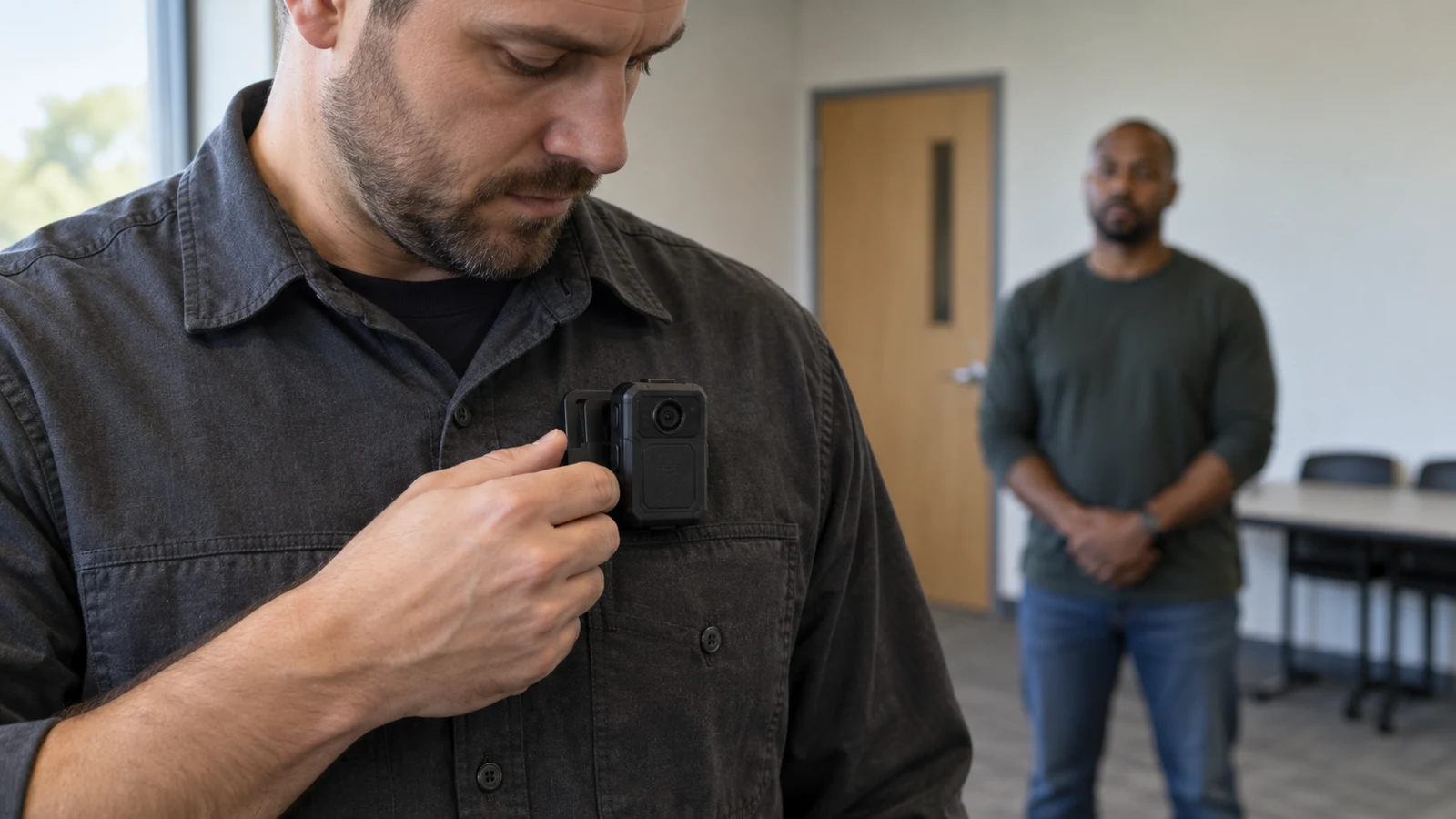
A hand can complete a fold while the camera records almost none of it. If you are demonstrating how to wrap a plain card in a paper sleeve, the useful question is whether a viewer can see the edge meet the card and follow what your fingers do next. A short trial recording gives you a better answer than the view you remember having while you worked. Watch the recorded action once without explaining it aloud. If the sleeve seems to change shape behind your hand, the viewer has been asked to infer the step that the demonstration was meant to show.
Choose one action to test: bring the loose paper edge over the card, press along the fold, then reveal the new edge. This is a fictional, simple example rather than a prescription for making a particular sleeve. It gives the trial a clear question. Can someone tell which edge moved, where it met the card, and what changed when you pressed it? A recording can look steady and still miss that information. Conversely, a viewpoint that moves during the action may be perfectly understandable if the important contact and its result remain visible.
Product Demo Video Planning Starts With What The Viewer Must See
Before recording, name the smallest visual evidence that would let a stranger follow the fold. The card and the unfolded portion of the sleeve should be distinguishable before the movement. During it, the loose edge should remain identifiable as it approaches the card. Afterward, the folded edge should be recognizable as the result of that movement. These are questions about the image, not a full script for a product demonstration. You need enough of the starting arrangement to understand the action, but a long introduction to the materials would make this particular test harder to judge.
Imagine pausing just before the fold. If you can point to the loose edge and the part of the card it will cover, the starting state has done its job. Now imagine pausing during the movement. The crucial moment is when paper meets card, because that contact tells the viewer how the fold was formed. A final view of a neatly wrapped card cannot supply a missing view of that moment. It establishes the outcome while leaving the method open to several interpretations.
You can make the review fairer by asking another person to describe what the trial shows without coaching them. Ask where the paper moved and how they know the new edge was made. Their description is useful when it points to visible evidence. If they guess correctly because folding a sleeve is familiar, ask what in the recording supports the guess. An experienced viewer can often reconstruct an obscured action, but a demonstration should not depend on prior knowledge of this exact fold.
Product Demo Video Planning With A Body-Worn Trial
The Laiye C3/K3 listing describes a compact body-worn camcorder. That makes it a relevant device to consider for body camera viewpoint checks, where the camera moves with the demonstrator. The listing does not establish that any particular way of wearing it will show a close hand movement clearly. Treat the resulting recording as the evidence. A view that feels direct to the wearer may leave the fold hidden behind a wrist, and a view that seems awkward during recording may still explain the action on playback.
For the first trial, record only enough material to show the card before, during, and immediately after the fold. Make the same movement you intend a viewer to understand, rather than posing only the finished sleeve. Then examine the video at normal viewing pace. Body camera viewpoint checks work best when you judge what remains visible throughout the action, not just whether the camera captured the tabletop at the beginning. A fleeting view of the card does not help if the working edge disappears as soon as your fingers touch it.
Look first at the hand nearest the loose edge. Does it cover the spot where the edge meets the card, or can you see paper approaching and settling against the card? Watch the other hand as well: it may steady the sleeve while accidentally blocking the fold. Obstruction is not a fault you can diagnose from the finished frame alone. Find the moment when contact should be visible and decide whether the recording actually shows it. If the hands fill most of the image, a viewer may see motion yet remain unable to tell which layer moved.
Next, follow the working area for the entire movement. A body-worn viewpoint can change as the person leans or turns; whether that matters depends on what the trial captured. If the card slips out of view just as the paper is pressed, the camera has missed the decisive passage even if the card returns afterward. If the edge stays in view but becomes hard to distinguish from the rest of the paper, state that as a separate problem. Knowing whether the loss comes from obstruction or from the working area leaving the image helps you choose a more useful retest.
Finally, compare the moment of folding with the first clear view of the result. Did the recording show the edge becoming a fold, or did the next visible image simply reveal an already folded sleeve? That distinction keeps an assessment honest. You might reasonably say, "I can see the loose edge move across the card and become the new edge." You might instead say, "I can see the loose sleeve and then the finished fold, but my fingers cover the change." Both descriptions refer to a plausible trial; neither claims that either camera has been tested here.
For this action, the second description signals a missing explanation. The viewer can infer that a fold happened, but cannot see where the paper was pressed or which side of the card guided it. A closer look at the same obscured passage will not reveal a contact point that the camera never captured. Body camera viewpoint checks should end with a specific account of what is absent, so the next attempt answers the missing question. "The fold is unclear" is less helpful than "the hand covers the paper-to-card contact until the new edge is already formed."
Sony ZV-1 II Demonstration Framing As A Separate Trial
If the worn viewpoint repeatedly hides the contact point, consider a separate trial from another position. The white Sony ZV-1 II, model ZV1M2/W, is described in its listing as a compact vlog camera. The Sony ZV-1 II demonstration framing question here is narrow: would an independently positioned view show the paper edge arriving at the card while both hands are in motion? The product description does not answer that for your materials or arrangement. A second trial can test it; the name of the camera cannot.
Use the same folding action as the comparison point. If you change the action substantially, an apparently clearer result might come from the different hand movement rather than the different viewpoint. The separately positioned recording need not resemble the body-worn image. It only has to answer the same viewer question: where does the loose edge go, and how does it become the folded edge? Watch for hands that obscure the contact point from this position too. A fixed-looking view can still put a thumb directly between the viewer and the important detail.
When you review the alternative, avoid awarding it a pass just because more of the table is visible. A broad view may keep the whole card in sight while making the moving paper edge difficult to distinguish. Equally, seeing a close view of the paper is of little use if the change takes place outside the visible area. Compare the readable parts of each trial rather than ranking one camera type in general. The useful finding might be that the worn trial shows the beginning clearly and the separate trial shows the contact, while neither alone explains the entire fold.
Sony ZV-1 II Demonstration Framing Against The Same Question
When considering Sony ZV-1 II demonstration framing, describe only what you can observe in your own trial. For example, you might find that the loose edge remains visible as it crosses the card, yet your palm hides the press that makes the fold. That is a partial view, not an automatic solution. You might also find that this viewpoint keeps the contact visible from start to finish. Neither outcome follows from a camera listing. The test is about the recorded image of this task, with these materials and movements, as seen by someone who did not perform it.
A useful comparison can be made in plain sentences. In the worn-view trial, was the card visible before the movement? Could you follow the loose edge while it moved? Was the contact point visible, and could you recognize the new fold without relying on the final pose? Answer the same questions for the separate trial. You do not need scores or specifications to make the choice. If a question has a different answer for each recording, say where the difference appears in the action rather than calling one device better.
It is also reasonable for both trials to fail this particular test. Perhaps each viewpoint shows the starting arrangement and the finished sleeve, while hands cover the decisive press in both. In that case, choosing between them would give the viewer the same gap in understanding. Change the next trial so that the contact remains visible, then watch the new recording before making a claim about its usefulness. Do not assume that purchasing another camera, using a particular support, or combining recordings will solve a visibility problem that has not yet been demonstrated on playback.
Product Demo Video Planning After The Viewpoint Decision
Choose the next attempt based on the smallest missing piece. If the fold is visible from beginning to end in one trial, you can retain that viewpoint for this action. If the loose edge vanishes only while your hand presses it, repeat the action in a new trial and check that exact moment. If the whole card leaves the image, assess whether another viewpoint keeps the working area present throughout the movement. These are decisions about what the viewer can see. They do not require you to claim that an untested arrangement will work.
Keep the conclusion bounded. One successful paper-sleeve trial does not prove that the same viewpoint will explain every hand task, especially one where the important contact happens in a different place. One unsuccessful trial does not rule out a camera either. The recorded movement, the material, and the place where the action occurs all shape what the viewer can learn. If you change any of those, another brief review is more informative than carrying over the earlier verdict as a rule.
Once you know which viewpoint actually reveals the fold, product demo video planning can address the larger question of how to explain a complete process. This page has deliberately stayed with a single hand action. It does not specify an introduction, a sequence of steps, or how to assemble recordings into a finished video. That separation matters: a well-organized demonstration can still have an invisible contact point, and a clear view of one fold does not supply the rest of the explanation.
If you need that broader sequence, continue with the guide to product demo video planning. For this recording, write down one finding in ordinary language before moving on: which edge and contact are visible, where the view fails if it does, and what the next trial must show. That gives you a concrete reason to keep a viewpoint or test another one. The person watching the final demonstration should be able to follow the change in the paper from what the camera shows, without having to take your word for how the fold happened.