Crypto Commerce
CUCKOO CRP-PK1001S rice cooker or a 30-cup commercial cooker for rice service
Compare CUCKOO CRP-PK1001S rice cooker by cooked yield, pressure menus, one-touch service, keep-warm planning, cleaning, and electrical fit.
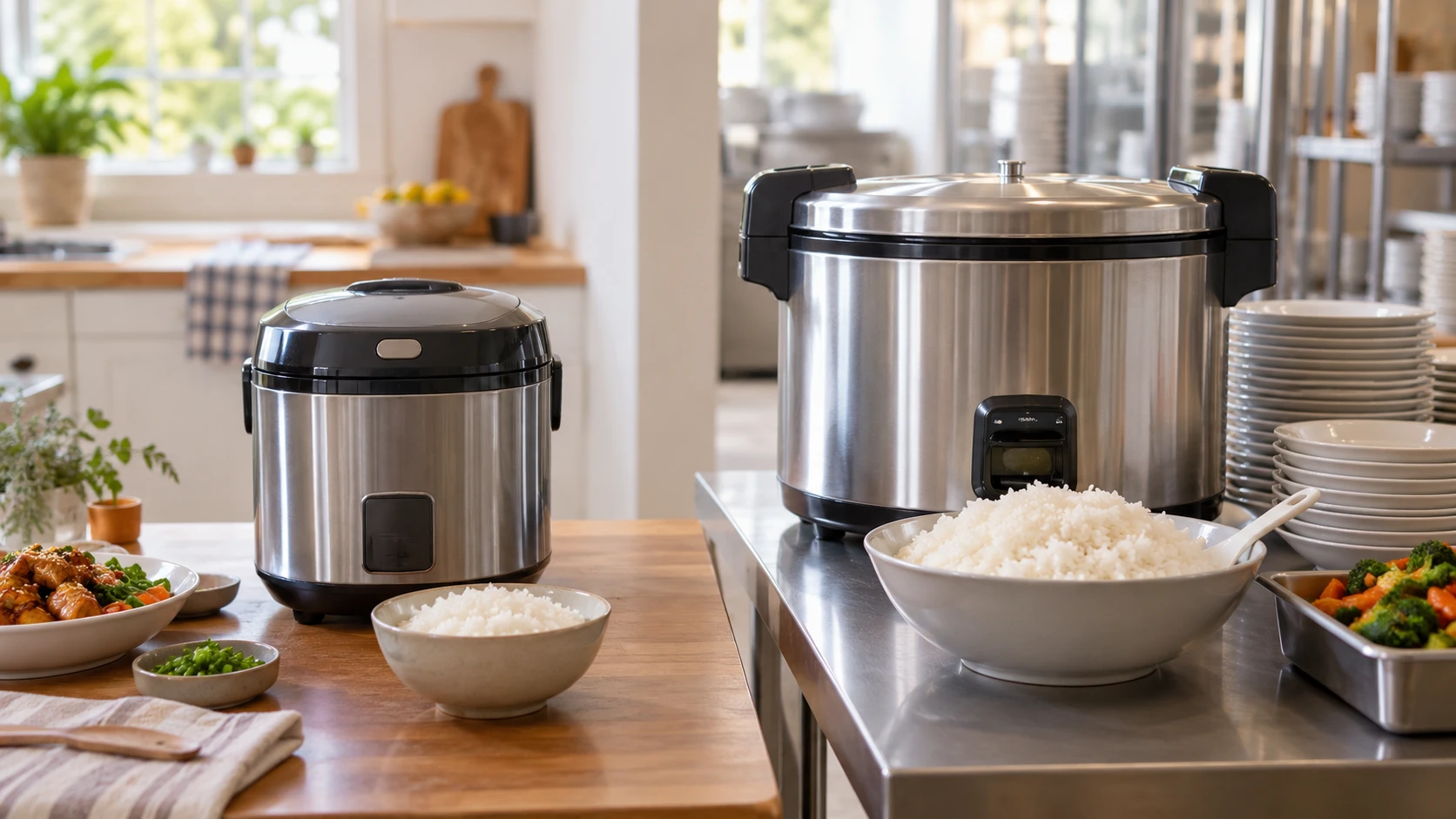
The CUCKOO CRP-PK1001S rice cooker is listed as a heating pressure cooker and warmer for 10 cups of uncooked rice, or 20 cups cooked. It has 13 menu options, a preset timer, reheating, keep-warm, and an automatic steam-clean function. The other model is a one-touch commercial cooker with a much larger stated capacity: 30 cups uncooked or 60 cups cooked. One is aimed at varied home meals and larger family gatherings; the other is described for restaurants, buffets, and hotels that need a large batch ready for service.
Those cup labels need careful reading. The published guide to recipe scaling for batch size helps frame what changes when a recipe grows beyond its usual yield. Here, the product titles use both dry and cooked amounts, with the cooked number twice the dry number. That is a listing convention, not a promise that every rice variety, water ratio, and cooking method produces exactly twice the measured volume. Decide how many portions are needed, then check the model manual's measuring cup and minimum and maximum fill lines for the rice to be cooked.
The 30-cup commercial rice cooker is presented as a 1600-watt one-switch machine. Its package lists a nonstick inner pot, measuring cup, rice scoop, rice sieve, and a detachable stainless-steel lid. The description says it changes to keep-warm after about 38 minutes, but does not define the rice type, batch size, or test conditions behind that time. A large-batch buyer should use a timed trial at the intended fill level before putting a fixed service time on a menu or event plan.
Convert the guest count into a dry-rice batch — recipe scaling for batch size
CUCKOO's 10-cup uncooked rating and the commercial model's 30-cup rating differ by a factor of three on the label. That does not mean the commercial machine is always the better fit for a party three times as large. Some meals use rice as a side, others use it as the base. Children, buffet seconds, and leftovers also change demand. Estimate the dry rice for the actual menu and serving style, then test one batch with the correct cooker cup. A household that regularly uses two or three dry cups may value the smaller machine's menu controls more than unused maximum capacity.
The commercial row calls its 60-cup cooked capacity ideal for catering and constant supply. A large pot can simplify serving a buffet when many portions must be ready together. It can also be cumbersome for a small trial batch if the machine has a minimum fill requirement. The saved row does not state that minimum. Ask for the manual's batch range before assuming a 30-cup cooker can replace a small daily unit. The same question applies to CUCKOO when only one or two servings are needed.
Measuring cups are a common source of planning errors. The commercial package includes a cup, but its saved description does not state the cup's volume. CUCKOO's row gives capacity in cups without saying whether its package includes a measure or what that measure holds. Use each maker's specified cup and fill markings; a standard kitchen cup may not match. When a recipe is scaled, write down the dry amount, water amount, rice variety, and result. That record is more reliable than remembering that a previous batch used "six cups" with an unknown cup.
The cooked-volume number is useful for serving vessels and storage, but it should not replace a real yield test. A different rice variety, rinse method, or water level can change the final texture and volume. Do not fill a cooker beyond its marked limit in pursuit of the headline 20- or 60-cup result. If the event needs more rice than one safe batch provides, plan another cooker or a staggered preparation schedule approved by the kitchen team.
Choose controls for the person cooking — 30-cup commercial rice cooker
CRP-PK1001S lists 13 customizable menu options, reheating, keep-warm, and a preset timer. Its product row also names fuzzy-logic technology and describes placing ingredients in the pot in the morning for rice later. Those features may help a home cook vary recipes or coordinate dinner with a workday. The saved row does not list all 13 menus, the allowed delay for every ingredient, or the exact pressure behavior of each program. Check the current manual before leaving a perishable ingredient in a delayed-start cooker.
The commercial unit favors one-touch operation. A staff member presses a switch, and the listing says it moves to keep-warm automatically. That simpler control can be useful when several workers serve from the same machine, provided the recipe is standardized. It also gives fewer stated choices for different grains. The source does not identify a pressure mode, programmable timer, or rice-type presets for this model. If the operation needs those, obtain the full manual or select a machine whose supported functions are documented.
Pressure changes the CUCKOO safety routine. The listing calls it a pressure rice cooker, so the operator should follow its venting, lid-lock, fill, and cleaning instructions exactly. Do not force the lid during or just after a pressure program. Ask which removable parts need inspection and replacement and how the cooker indicates it is safe to open. The saved source describes menu features but not the release sequence; the manual is essential for training a new user.
For a commercial buffet, the person opening the lid may also be serving quickly under time pressure. The 30-cup listing says the lid is detachable and stainless steel. Confirm how it lifts, where it rests while hot, and how steam is kept away from hands and nearby equipment. One-touch does not remove the need for a safe serving station. A broad counter with room for the pot, scoop, trays, and a person moving behind the server should be planned before the machine arrives.
Use keep-warm as a service plan, not a substitute for one — 30-cup commercial rice cooker
Both listings mention keep-warm. CUCKOO's row describes it among its meal functions; the commercial row says the machine switches to warming after cooking. Neither gives a verified safe holding time or measured rice temperature in the saved excerpt. Follow the manufacturer's instructions and applicable food-service rules for cooked rice. Note when the batch finished and when it must be served or cooled. A warm light is not proof that the center of a large batch is at the required temperature.
The commercial description's 38-minute switch claim should be checked with the actual grain and batch size. If a buffet opens at noon, build in time for washing, filling, cooking, resting if instructed, and moving to the serving position. The CUCKOO preset timer can change when its cycle starts, but it does not make preparation and cleaning disappear. Test the planned schedule on a normal workday before depending on it for a holiday meal or catered service.
Leftovers require a separate plan. Portion and cool cooked rice under the relevant food-safety guidance; do not leave a large pot on keep-warm indefinitely because the listing says it can warm food. The saved pages do not give a cooling procedure or food-holding certification. For a family, that may mean choosing a batch size that is finished at one meal. For a buffet, it may mean a written hold-and-discard rule supervised by the kitchen manager.
Compare cleaning and counter requirements — 30-cup commercial rice cooker
CUCKOO's row lists an inner pot with a black nonstick coating and an Auto-Clean function that steams the cooker interior. That may reduce some residue after a batch, but it does not mean the pot, lid, seals, and removable parts never need hand cleaning. Follow the current cleaning directions and use utensils safe for the coating. Pressure-cooker components deserve careful inspection because a worn seal or blocked vent is a functional issue, not merely a cosmetic one.
The commercial model has a nonstick inner pot, a detachable stainless-steel lid, anti-slip feet, and handles. Its included scoop and sieve also need a place to wash and dry. The listing presents the lid as easy to wipe, but the actual cleaning routine should be checked for the full pot and any hidden food-contact areas. Plan who will empty a large hot batch and where the removable pot can be set down without crowding the sink. A bigger capacity may save cooking cycles while adding weight to each cleaning cycle.
The commercial title says 1600 watts. Confirm the required outlet, circuit, cord length, and installation clearances for the exact unit; the saved row does not provide a full electrical drawing. CUCKOO's excerpt does not state its wattage or dimensions. Measure counter depth and overhead clearance for each, including space to open the lid and remove the inner pot. A cooker can fit on the shelf while being awkward or unsafe to use there.
For either model, check replacement-pot and seal availability before placing it at the center of a daily meal program. The source pages do not give part numbers. A restaurant using one large cooker should know how quickly it can get a replacement pot or lid component. A home cook may care more about whether the smaller pot is easy to rinse and store after dinner. Those service details can matter more over a year than an extra menu button or a higher advertised cup count.
Choose the batch routine you can repeat — recipe scaling for batch size
CUCKOO CRP-PK1001S fits a household that wants its listed pressure-cooking menus, timer, reheating, and 10-cup uncooked maximum for varied meals. Confirm the exact menu table, cup measure, minimum batch, and pressure-release routine. Its 20-cup cooked label is a useful planning figure only after a recipe test with the rice the household buys.
The commercial 30-cup model fits a kitchen that needs a large, repeatable one-touch batch and has room to serve and clean it. Confirm minimum fill, power requirements, lid handling, and what the claimed 38-minute switch means at the intended load. Its 60-cup cooked label is a starting point for staffing and serving vessels, not a substitute for a measured yield and safe holding plan.