Clock & Timekeeping
Draw a countdown timer comparison timeline with labelled starts
Two invented intervals show how different durations can share an end and equal durations can end at different times. The paper model supplies no timer operating instructions.
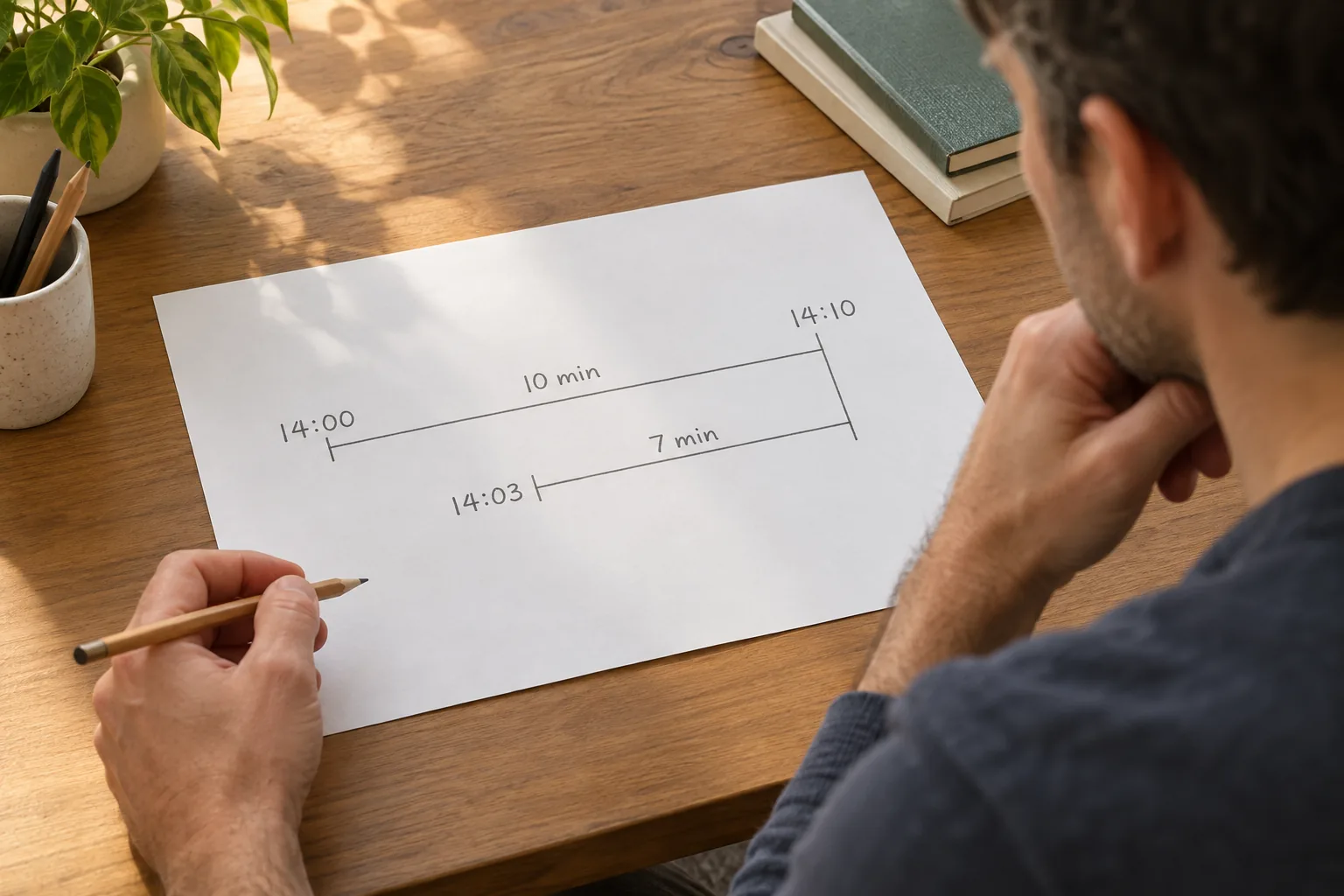
A countdown timer comparison timeline needs more than two duration numbers. Write each proposed start beside its duration and calculate its end using the same declared time reference. Two different durations can then meet at one endpoint, while equal durations can end at different times. The examples below are original paper calculations. They report no synchronized devices, timer test, alert observation or measured elapsed time, and they prescribe no operating procedure for either linked offer.
State the shared reference before comparing intervals
Imagine a fictional planning note written by Lina. Lina declares that all times in the example refer to one assumed clock on one afternoon. There is no clock change, date change or interruption within the short intervals being compared. These are conditions of the paper model. The article does not claim that two actual timers share that reference or that a person can start them at an exact instant without establishing what really happened.
Lina calls the proposed intervals A and B. Those letters identify two entries on the paper, not controls printed on a product and not channels claimed for a selected timer. Each entry has three separate fields: start, duration and calculated end. Keeping the fields apart makes the relationship visible. A duration of ten minutes alone cannot identify an end until the start is supplied within the same declared reference used for the comparison.
Read the two timer offers without inventing operating details
The selected eight-style animal kitchen timer offer is titled as an eight-piece digital countdown timer proposal. Its whole photograph shows animal-shaped units with integrated displays and front buttons. The descriptive field supplies only “1”, so it provides no operating sequence, timing range or accuracy information here. The product title and pictured zeros do not establish a simultaneous start or a successful alert test.
The selected 72-piece digital kitchen timer offer is titled as a bulk magnetic-timer proposal. Its whole photograph shows colored complete timer units with displays, buttons and some stands. Its descriptive field likewise supplies only “1”. No synchronization feature, control sequence, measured alarm level or calibration result is inferred. The number of units in a proposed package does not determine the number of intervals in Lina’s paper example.
For actual equipment, obtain the information and instructions applying to the exact timer before using it. The calculations in this guide need only the declared paper entries. They do not require either offer, establish that an unfamiliar control starts a countdown or supply a battery, reset, mounting or servicing procedure. Keep the equipment question separate from whether the arithmetic of an invented plan is internally consistent. One can be answered while the other remains open.
Label interval start and end in the first example
For interval start and end, Lina gives A a start of 14:00 and a duration of ten minutes. Its calculated end is 14:10. Lina then gives B a start of 14:03 and a duration of seven minutes. Its calculated end is also 14:10. The entries have different starts and different durations, but their ends agree under the declared reference. Neither duration was copied into a time-of-day field to obtain that result.
The three-minute difference between the starts is balanced by a three-minute difference between the durations. B begins three minutes after A and has three fewer minutes to run in the paper model. Adding seven minutes to 14:03 reaches the same endpoint as adding ten minutes to 14:00. This explains the agreement without claiming that Lina has programmed, started or observed two devices. The entries describe a proposal, rather than a record that equipment carried it out.
Equal durations need their own start comparison
Now make a separate example in which both intervals have a ten-minute duration. A still begins at 14:00, so its calculated end remains 14:10. B begins at 14:03, so its calculated end is 14:13. The duration numbers agree, while the endpoints differ by three minutes. A note saying only “both ten minutes” would therefore omit the part of the plan that determines their different ending times.
Lina keeps this second example on a separate line from the first. Otherwise, a reader could retain B’s seven-minute duration from the earlier case while using its later ten-minute end. A calculation assembled from two different cases would not describe either proposal. Label the example being read before checking its arithmetic. The purpose is to preserve one complete relationship at a time, with the start and duration that actually belong together.
A shared start does not erase a duration difference
In a third invented case, both intervals begin at 14:00. A lasts ten minutes and ends at 14:10. B lasts seven minutes and ends at 14:07. The common start makes the duration difference visible in the ending times. It does not make the intervals equal. Lina records the two outcomes as separate calculated endpoints, rather than calling the common start evidence that both proposed reminders would occur together.
These three cases answer different comparisons. Different starts can pair with different durations to give one endpoint. Equal durations with different starts give different endpoints. Equal starts with different durations also give different endpoints. Each statement follows from the specific entries in the paper examples. No general promise is made about actual timers, clock accuracy, human response time or the time at which a real audible signal would be heard.
Keep a revised start with its revised calculated end
Return to the first case, where B was to begin at 14:03 for seven minutes and end at 14:10. Suppose Lina changes its proposed start to 14:04 while keeping seven minutes as its duration. B’s calculated end becomes 14:11. A still ends at 14:10 in the unchanged paper entry. The original common endpoint no longer follows from the revised proposal. Retain the changed start and recalculate the relationship rather than leaving the old end beside it.
If Lina wants the revised B entry to end at 14:10, its proposed duration would instead be six minutes from 14:04. That is another deliberate edit to the paper case, not an instruction to adjust a running timer. Lina records which field she changed. The arithmetic can describe either revised proposal, but the record should not suggest that both seven minutes and six minutes are simultaneously the duration of one unchanged interval.
Attach an observation time to a remaining amount
A separate numerical example concerns remaining duration. Suppose a hypothetical record states “five minutes remain at 14:05”. Under the same uninterrupted paper convention, its calculated end is 14:10. Another record states “five minutes remain at 14:06”, yielding 14:11. The remaining amounts agree, but the reference times differ. Comparing the two fives alone would hide that difference and would not establish one common endpoint.
These are authored records, not readings taken from the linked products. For an actual observation, preserve the time reference and the meaning of the displayed value that were really established. If either part is missing, leave the conclusion open. Do not fill an observation gap with the assumed clock from this example. A consistent paper calculation cannot retrospectively establish what a device was showing or when somebody looked at it.
Keep a planned endpoint distinct from a witnessed event
Lina’s original common 14:10 endpoint is a calculated part of the proposal. It is not evidence that either timer reached an alert condition at that time. A real record would need the actual event being reported and the observation supporting it. This guide gives no alert test, sound measurement or method for proving synchronized operation. It also supplies no recommended timing arrangement for cooking, medication, exercise or another task with its own requirements.
The paper model can still be useful before any device is chosen. It identifies whether the proposed starts and durations describe the intended relationship. If the arithmetic does not support a shared endpoint, Lina can revise the plan while it remains on paper. If it does support one, the equipment and execution questions remain separate. A mathematically coherent proposal should be described as a proposal until there is evidence of what actually occurred.
Leave alert diagnosis and MAX setup with their own information
The countdown timer alert troubleshooting guide distinguishes an expected event from an actual display or sound observation. Its Taylor and BTB SIGN information belongs to those selected products. Lina’s comparison instead checks relationships among proposed interval entries. A shared calculated endpoint does not diagnose a silent timer or prove that a particular device was running the intended mode.
The Time Timer MAX setup guide follows the matching MAX instructions for face, duration, alert choice and starting a chosen amount. It also keeps the reminder separate from whether a desk task is complete. This timeline supplies none of those control steps. It can compare invented intervals without approving a particular setup, choosing a productivity target or claiming that an actual task finished at a calculated time.
Keep the Republeq crypto choice with the actual purchase
If the planning question leads to a possible timer purchase through republeq.com, retain the exact offer and the product information still needed for the decision. Lina’s fictional timeline establishes no accuracy, synchronization capability, alert audibility or suitability for a real task. Confirm the actual item, package and applicable instructions before deciding whether to order. If the current checkout offers cryptocurrency, including USDT, consider the methods and conditions presented for that particular basket. This article establishes no current token availability, payment network, address or amount and supplies no transfer procedure. A preferred payment method cannot supply missing operating information or turn a paper endpoint into an observed event. Read the delivery and return terms applying to the real purchase, and preserve necessary unanswered questions while deciding whether to proceed. If a transaction is made, retain its actual order identity and payment response. An uncertain result needs reconciliation through the merchant before another payment is considered. Changing a proposed interval or selecting another timer package does not establish that a previous transaction was cancelled, refunded or transferred. Those questions belong to the actual purchasing record. A successful payment would likewise not demonstrate a simultaneous start, verify a clock reference or prove that a planned reminder was heard. Keep the proposed interval relationship, chosen equipment and real transaction result distinct, with the information that answers each question. No order, payment or device performance is represented as completed by the fictional calculations in this guide.
Finish with one complete set of interval entries
Lina’s first example ends with ten minutes from 14:00 and seven minutes from 14:03, each reaching a calculated 14:10 under the same stated assumptions. A countdown timer comparison timeline is readable when the start, duration and end remain attached to each other. Preserve revisions and observation references where they matter. The arithmetic can clarify a proposal while actual device setup, timing and observations still require their own evidence.
Two paper intervals illustrate a shared endpoint under an explicitly assumed time reference.